The Most Grown Native Plants in the United States, by State
A data page, not an essay: the American native plants held by the most wholesale growers, counted grower by grower and state by state from growers' current lists on HortOS, with the median trade price at the size most growers price. Two paragraphs on what the tables show and what they do not, then the tables, refreshed each edition.
Updated September 25, 2026. Counts and medians from the live us.hortosapp.com plant and price pages on 24 September 2026; refreshed with each United States edition of the HortOS Plant Price Index.

On this page
Ask which native plants American growers actually produce and the answer on most pages is a list of what someone thinks they should. This page is the other thing: what the wholesale trade holds on its current lists, counted grower by grower and state by state, with the trade price at the size most growers sell. The one idea to hold on to is that a plant's rank here measures how many growers list it, not how many containers exist or how well it suits any particular site, and that the list is dominated by the plants landscapers order by the truckload: bald cypress and live oak, southern magnolia, pink muhly grass, wax myrtle, and the South Florida shrubs that line every new subdivision.
The counts come from growers' current lists on HortOS, a free directory of American wholesale plant growers with their published availability and trade prices, as the live plant pages printed them on 24 September 2026, and the prices from the live price pages the same day: one price per grower, trade lists only, a median only where three or more growers price a size. A plant counts as native when its species occurs naturally in the United States in the USDA PLANTS sense; cultivars and selections follow their species, and a hybrid counts only where every parent is native. The tables will be refreshed with each United States edition of the HortOS Plant Price Index. They summarize what growers list and are not a planting guide.
Quick facts
| Most listed native | Bald cypress (Taxodium distichum), 348 growers on 24 September 2026, with a #30 median of $120 ex tax across 89 pricing growers. |
|---|---|
| Native share | 37 of the 100 most listed plants on American growers' lists are native by species (compiled September 2026); the rest are exotics such as podocarpus, crape myrtle, ligustrum and the palms of the tropics. |
| What a rank means | Growers with the plant on their current list, in any size. It says nothing about volume, quality or suitability for a site. |
| Prices | Median trade price ex tax at the size most growers price, one price per grower, resellers and website prices excluded, freight not included; a state median needs three growers in that state. |
| Where the growers are | Florida holds most growers with a current list, then Texas, North Carolina, Georgia and South Carolina; the Northeast, Midwest and West have a handful each, so their tables are short and their counts small. |
| Native is not local | A species native to the United States may be from another region or climate. Provenance is a separate question, answered by the grower, not by this table. |
What the tables show, and what they do not
They show demand as growers see it. A grower lists a plant because customers order it, so the plants at the top are the ones landscapers, municipalities and developers buy most: the street and shade trees of the Southeast, the screening hollies and magnolias, the grasses planted by the acre, and the coastal shrubs of South Florida. Ornamental natives sold in small numbers, and the local ecotypes a restoration nursery grows for one watershed, sit far down the list or off it, because few production growers carry them. On the HortOS plant pages most native species are held by a handful of growers; the ones in these tables are the exceptions.
They do not show what is native to a place. The USDA PLANTS database records a plant as native to the lower 48 states if it is native to any part of them, so a species on this list may be native to Florida and an introduction in Oregon; the table cannot tell a buyer whether a particular grower's stock is a local ecotype or even a straight species. They do not show quantity: a grower with ten thousand liners and a grower with a tray count the same. And they do not show a price for a size fewer than three growers price, which is why some cells read fewer than three growers.
They do show where a buyer can go. Every plant name links to its price page, which prints the median, low and high at every size with enough growers, and the plant page behind it lists every grower holding the plant, by state and size, with the date each list was updated. The state hubs for Florida, Texas, North Carolina, Georgia, South Carolina, Louisiana, Tennessee, Pennsylvania, New Jersey and California list the growers by city.
The most listed native plants, United States
The 25 native plants listed by the most growers on 24 September 2026, with the container size most growers price and the national median trade price ex tax at that size, and in brackets the number of growers pricing it. Field grown means the grower prices the line as a field grown tree rather than by container.
Florida
Florida's list is the South Florida palette: buttonwood, Simpson's stopper, live oak, sea grape, bald cypress, muhly grass and cocoplum. Florida holds more growers with current lists than every other state together, which is why its counts run into the hundreds.
| Plant | Growers in FL | Size most growers price | National median | FL median |
|---|---|---|---|---|
| Conocarpus erectus | 210 | 25G | $110 (78) | $110 |
| Myrcianthes fragrans | 209 | 7G | $18 (95) | $18 |
| Quercus virginiana | 198 | 45G | $265 (108) | $275 |
| Conocarpus erectus 'Sericeus' | 195 | 7G | $16 (71) | $16 |
| Coccoloba uvifera | 179 | 7G | $18 (81) | $18 |
| Taxodium distichum | 164 | 30G | $120 (89) | $115 |
| Muhlenbergia capillaris | 160 | 3G | $6 (163) | $5 |
| Chrysobalanus icaco 'Red Tip' | 147 | 7G | $16 (75) | $16 |
| Ilex vomitoria 'Schillings' | 130 | 3G | $7 (87) | $6.50 |
| Magnolia grandiflora 'Little Gem' | 129 | 30G | $125 (89) | $125 |
Texas
Texas is a tree state on these lists: live oak, Shumard oak, bald cypress, cedar elm, bur oak and chinquapin oak, priced mostly as field grown or in the #30 and #45 classes.
| Plant | Growers in TX | Size most growers price | National median | TX median |
|---|---|---|---|---|
| Quercus virginiana | 56 | 45G | $265 (108) | $232.50 |
| Quercus shumardii | 45 | Field grown | $149 (45) | $360 |
| Taxodium distichum | 41 | 30G | $120 (89) | $120 |
| Ulmus crassifolia | 40 | 45G | $227.50 (12) | $227.50 |
| Magnolia grandiflora 'Little Gem' | 33 | 30G | $125 (89) | $150 |
| Quercus macrocarpa | 30 | Field grown | $150 (24) | $275 |
| Pinus taeda | 29 | 15G | $58.13 (36) | $62.50 |
| Ilex x attenuata 'Eagleston' | 27 | 30G | $125 (74) | $150 |
| Quercus muehlenbergii | 27 | Field grown | $160 (13) | $155 |
| Myrica cerifera | 25 | 3G | $8 (86) | $10 |
North Carolina
| Plant | Growers in NC | Size most growers price | National median | NC median |
|---|---|---|---|---|
| Thuja occidentalis 'Smaragd' | 37 | Field grown | $75 (53) | $85 |
| Quercus phellos | 31 | Field grown | $140 (57) | $135 |
| Magnolia grandiflora 'Little Gem' | 30 | 30G | $125 (89) | $162.50 |
| Acer rubrum 'October Glory' | 27 | Field grown | $135 (48) | $125 |
| Magnolia grandiflora 'Bracken's Brown Beauty' | 27 | 30G | $125 (62) | Fewer than three growers |
| Muhlenbergia capillaris | 26 | 3G | $6 (163) | $11.50 |
| Betula nigra 'BNMTF' | 23 | Field grown | $132.50 (34) | $105 |
| Cercis canadensis | 21 | Field grown | $117.50 (38) | $122.50 |
| Myrica cerifera | 21 | 3G | $8 (86) | $11.75 |
| Taxodium distichum | 21 | 30G | $120 (89) | Fewer than three growers |
Georgia
| Plant | Growers in GA | Size most growers price | National median | GA median |
|---|---|---|---|---|
| Magnolia grandiflora 'Little Gem' | 29 | 30G | $125 (89) | $130 |
| Quercus texana | 24 | Field grown | $135 (51) | $140 |
| Taxodium distichum | 24 | 30G | $120 (89) | $125 |
| Magnolia grandiflora 'Bracken's Brown Beauty' | 22 | 30G | $125 (62) | $125 |
| Quercus phellos | 22 | Field grown | $140 (57) | $232.50 |
| Cupressus arizonica glabra 'Carolina Sapphire' | 21 | 15G | $65 (55) | $65 |
| Quercus shumardii | 20 | Field grown | $149 (45) | $198 |
| Acer rubrum 'October Glory' | 19 | Field grown | $135 (48) | $145 |
| Quercus lyrata | 19 | Field grown | $130 (37) | $155 |
| Magnolia grandiflora 'Claudia Wannamaker' | 15 | Field grown | $247.50 (28) | $300 |
South Carolina
| Plant | Growers in SC | Size most growers price | National median | SC median |
|---|---|---|---|---|
| Magnolia grandiflora 'Little Gem' | 18 | 30G | $125 (89) | $125 |
| Quercus phellos | 17 | Field grown | $140 (57) | $135 |
| Taxodium distichum | 15 | 30G | $120 (89) | $127.50 |
| Quercus virginiana | 14 | 45G | $265 (108) | Fewer than three growers |
| Magnolia grandiflora 'Bracken's Brown Beauty' | 13 | 30G | $125 (62) | Fewer than three growers |
| Quercus texana | 13 | Field grown | $135 (51) | $135 |
| Myrica cerifera | 12 | 3G | $8 (86) | $8 |
| Quercus lyrata | 12 | Field grown | $130 (37) | $130 |
| Acer rubrum 'October Glory' | 10 | Field grown | $135 (48) | $147.50 |
| Magnolia virginiana | 10 | Field grown | $125 (34) | $125 |
Louisiana and Tennessee
Louisiana first, then Tennessee, where the list turns to the deciduous trees of the upper South: red maple, redbud, tulip poplar and willow oak, priced as field grown.
| Plant | Growers in LA | Size most growers price | National median | LA median |
|---|---|---|---|---|
| Ilex vomitoria 'Nana' | 13 | 3G | $8.50 (45) | $6.50 |
| Magnolia grandiflora 'Little Gem' | 13 | 30G | $125 (89) | $110 |
| Muhlenbergia capillaris | 13 | 3G | $6 (163) | $6.88 |
| Hesperaloe parviflora | 12 | 3G | $9 (23) | $7.50 |
| Ilex x attenuata 'Eagleston' | 10 | 30G | $125 (74) | $120 |
| Taxodium distichum | 10 | 30G | $120 (89) | $95 |
| Quercus texana | 8 | Field grown | $135 (51) | Fewer than three growers |
| Quercus virginiana | 8 | 45G | $265 (108) | Fewer than three growers |
| Yucca filamentosa 'Color Guard' | 8 | 3G | $12.75 (48) | $9 |
| Bouteloua gracilis 'Hachita' | 7 | 1G | $3.75 (7) | $3.75 |
| Plant | Growers in TN | Size most growers price | National median | TN median |
|---|---|---|---|---|
| Acer rubrum 'October Glory' | 18 | Field grown | $135 (48) | $80 |
| Acer x freemanii 'Jeffersred' | 17 | Field grown | $135 (45) | $60 |
| Cercis canadensis | 17 | Field grown | $117.50 (38) | $37 |
| Liriodendron tulipifera | 16 | Field grown | $125 (35) | $70 |
| Quercus phellos | 15 | Field grown | $140 (57) | $77.50 |
| Thuja occidentalis 'Smaragd' | 15 | Field grown | $75 (53) | $70 |
| Cercis canadensis 'Forest Pansy' | 14 | Field grown | $115 (30) | $55 |
| Taxodium distichum | 14 | 30G | $120 (89) | Fewer than three growers |
| Acer rubrum 'Brandywine' | 13 | Field grown | $140 (26) | $72.50 |
| Liquidambar styraciflua 'Slender Silhouette' | 13 | Field grown | $145 (29) | $95 |
Pennsylvania, New Jersey and California
Few growers in these states publish a list yet, so the counts are small and most state medians are unavailable; the plants are listed so a buyer can see who holds them. Pennsylvania first, then New Jersey, whose list is the Mid-Atlantic native shrub palette of inkberry, sweetspire, bayberry, summersweet and switchgrass, then California, where the list is western species such as deer grass, sotol and toyon, with no prices yet.
| Plant | Growers in PA | Size most growers price | National median | PA median |
|---|---|---|---|---|
| Cercis canadensis | 10 | Field grown | $117.50 (38) | $170 |
| Pinus strobus | 9 | Field grown | $82.50 (28) | $71.65 |
| Quercus rubra | 9 | Field grown | $149.50 (24) | $269.50 |
| Quercus bicolor | 8 | Field grown | $125 (41) | $230 |
| Thuja occidentalis 'Smaragd' | 8 | Field grown | $75 (53) | $75 |
| Carex pensylvanica | 7 | 1G | $5.97 (14) | Fewer than three growers |
| Carpinus caroliniana | 7 | Field grown | $135 (34) | Fewer than three growers |
| Cladrastis kentukea | 7 | Field grown | $185 (16) | $250 |
| Hamamelis virginiana | 7 | 3G | $22 (11) | Fewer than three growers |
| Hydrangea arborescens 'Annabelle' | 7 | 3G | $17 (24) | $32 |
| Plant | Growers in NJ | Size most growers price | National median | NJ median |
|---|---|---|---|---|
| Thuja occidentalis 'Smaragd' | 15 | Field grown | $75 (53) | $47.50 |
| Ilex glabra 'Shamrock' | 12 | 3G | $13.88 (36) | $19.38 |
| Itea virginica 'Henry's Garnet' | 12 | 3G | $11.50 (57) | $21.98 |
| Myrica pensylvanica | 12 | 3G | $19.98 (16) | $24 |
| Panicum virgatum 'Heavy Metal' | 12 | 3G | $10.50 (29) | $18 |
| Clethra alnifolia 'Hummingbird' | 11 | 3G | $18 (25) | $23.20 |
| Panicum virgatum 'Shenandoah' | 10 | 3G | $11 (29) | $18.45 |
| Quercus palustris | 10 | Field grown | $120 (35) | $120 |
| Itea virginica 'Sprich' | 9 | 3G | $18.75 (30) | $19.95 |
| Juniperus horizontalis 'Wiltonii' | 9 | 3G | $11.50 (42) | $15 |
| Plant | Growers in CA | Size most growers price | National median | CA median |
|---|---|---|---|---|
| Hesperaloe parviflora | 14 | 3G | $9 (23) | Fewer than three growers |
| Muhlenbergia capillaris | 12 | 3G | $6 (163) | Fewer than three growers |
| Muhlenbergia rigens | 12 | Not enough growers | Fewer than three growers | |
| Dasylirion wheeleri | 10 | Not enough growers | Fewer than three growers | |
| Heteromeles arbutifolia | 10 | Not enough growers | Fewer than three growers |
What to watch for
- Reading the rank as a recommendation. It is a count of growers. The plant at the top is the easiest to buy, not the best for the site.
- Reading native as local. The species is American; the seed may be from another region, and the plant may be a cultivar. Ask the grower for the source and whether it is the straight species.
- Comparing medians across sizes. A #3 median and a field grown median are different products; compare a plant with itself at one size.
- Treating a small count as a trend. A Pennsylvania count of seven growers moves when one list arrives or lapses.
- Quoting a number without its date. The live pages change as lists arrive; a figure from this page carries the date it was read.
Getting it right
- Start from a regional native plant database and your state's native plant society list for the species that suit the site, then use these tables to see which of them the trade holds in quantity.
- Open the plant page for each species to see the growers in your state, their sizes and how current each list is.
- Check the median on the price page before asking for quotes, and ask each grower for the seed source and whether the line is the straight species.
- For species low on the list or absent from it, ask a native specialist or a grower that grows to order, and order a season ahead.
A word of caution
The counts and medians on this page are what the HortOS pages printed on one date; the live pages change as lists arrive, so a figure there may differ from the ones quoted here. The native classification is by species and is a working list, not a botanical authority; the USDA PLANTS database is the reference for whether a species is native, and the grower is the authority on where its seed came from. For which species suit a site, ask a regional native plant database, an extension office or a horticulturist.
Sources
- USDA PLANTS database help document: native status by jurisdiction.
- USDA Forest Service, an introduction to using native plants in restoration projects: ecotypes and sourcing.
- Lady Bird Johnson Wildflower Center, native plants of North America: species by region.
- Audubon native plants database: natives by zip code.
More guides
Deer Resistant Plants for the Northeast by Rating and Trade Price
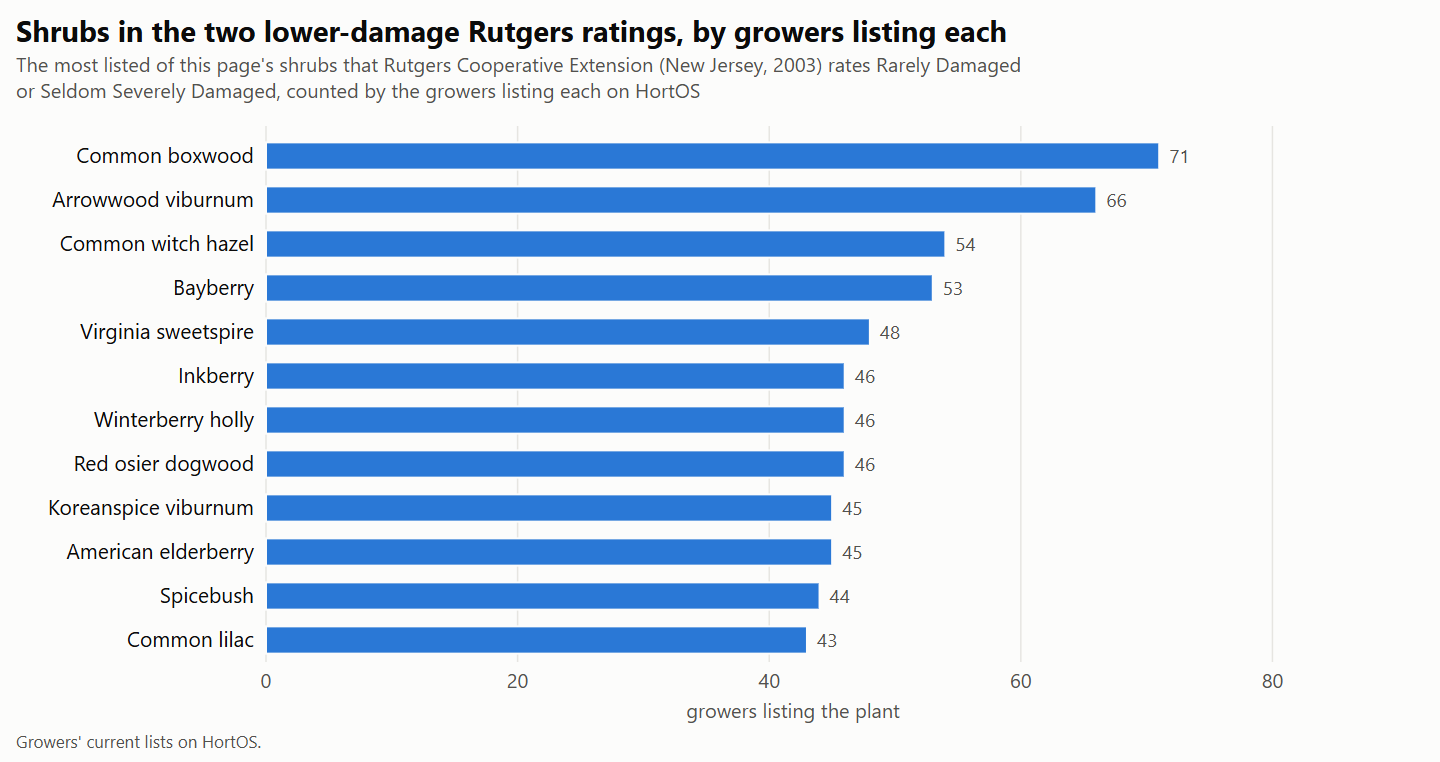
Rutgers Cooperative Extension (New Jersey, 2003) rates landscape plants in four classes by how often deer damage them. This page sets those ratings beside how many growers list each plant and, where enough growers price a size, its median trade price. It shows where a Maryland list and a New York county list differ, and what a rating leaves out.
Planting near power lines: utility rules and the plants they name
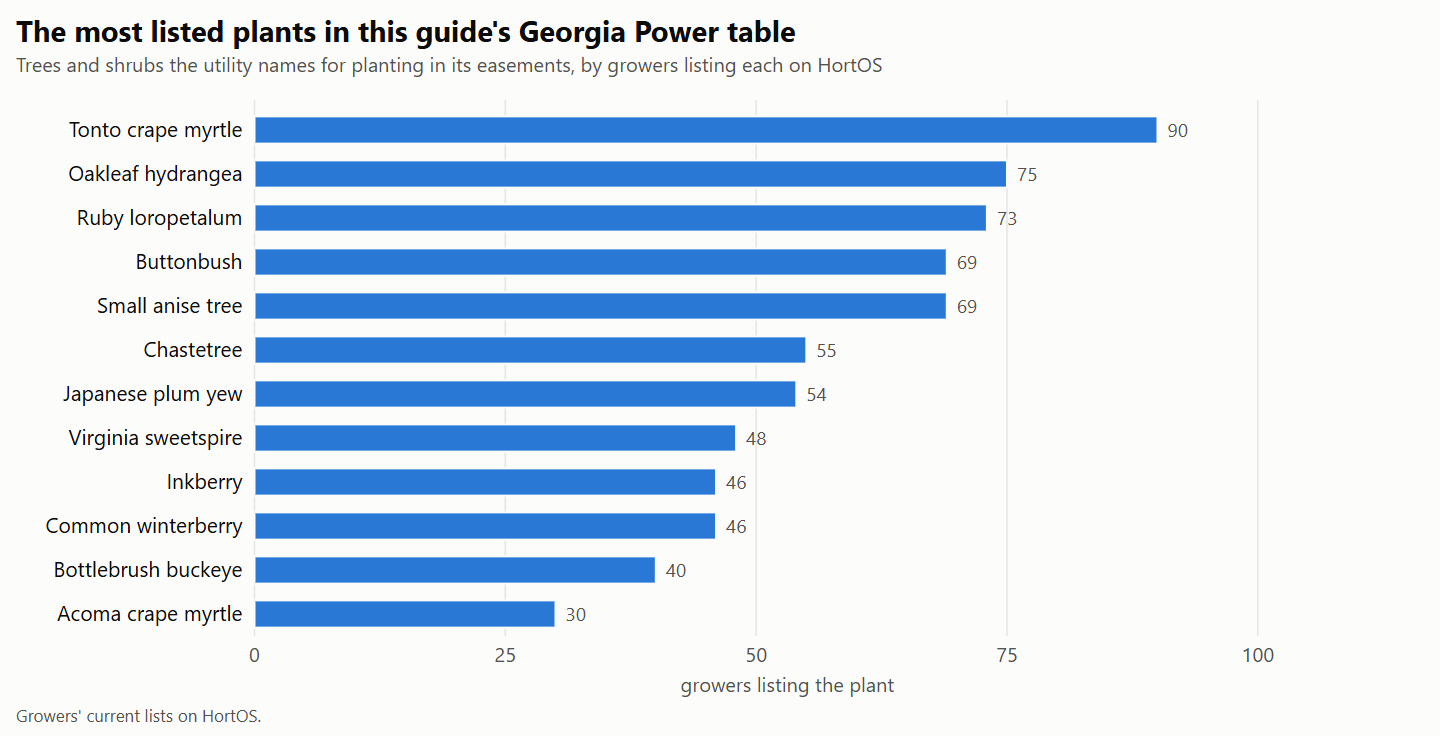
What Georgia Power, Florida Power & Light, Dominion Energy, Santee Cooper and Eversource publish about planting near distribution and transmission lines, beside a Florida statute, a New Jersey rule as published in 2010, a California general order and a national reliability standard. Tables set the plants Georgia Power and Santee Cooper name beside grower counts and median trade prices.
Hurricane wind resistance of trees and what they cost at trade
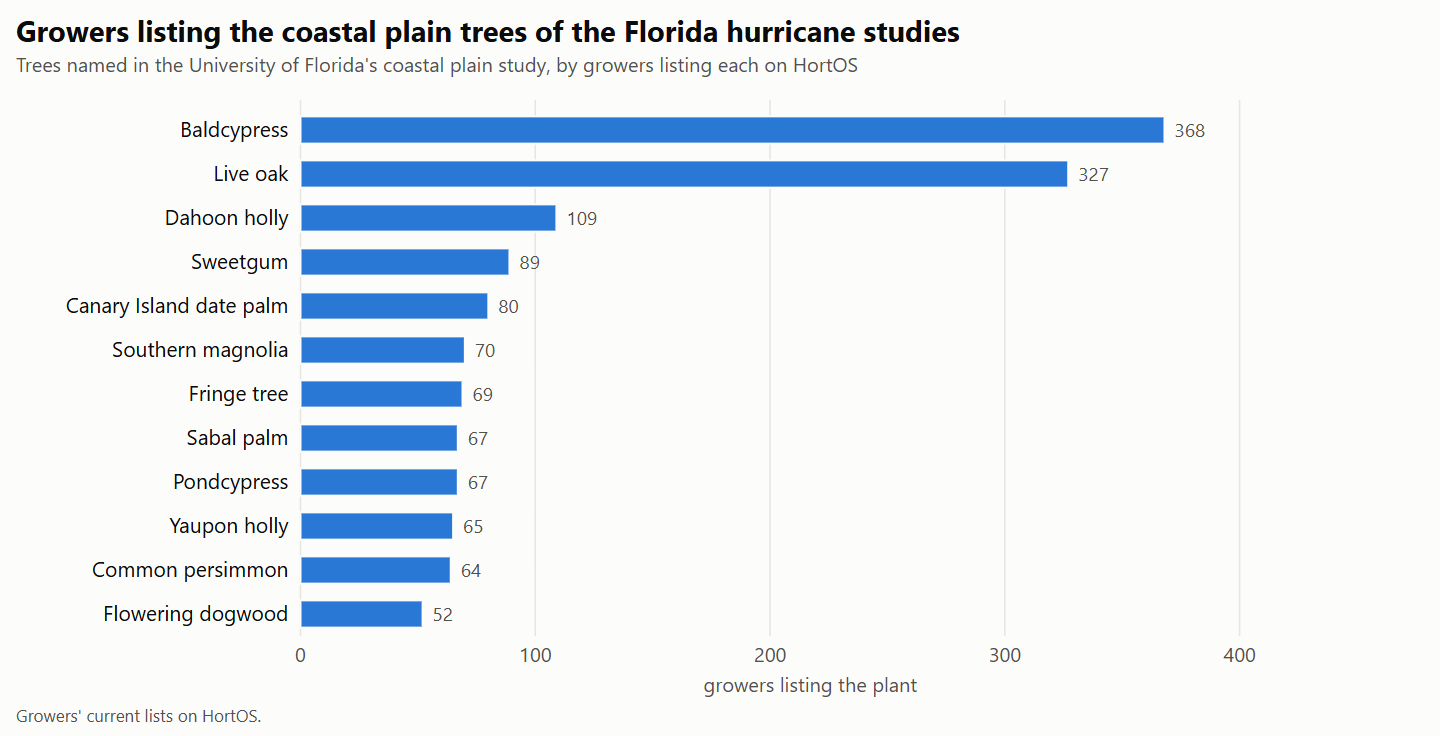
What the University of Florida's hurricane studies found for trees on the coastal plain and in south Florida, set beside the growers listing each tree on HortOS and the median trade price of a #15 container. The page describes the UF/IFAS wind resistance classes, links the full lists and says what neither the studies nor the figures show.