Hurricane wind resistance of trees and what they cost at trade
What the University of Florida's hurricane studies found for trees on the coastal plain and in south Florida, set beside the growers listing each tree on HortOS and the median trade price of a #15 container. The page describes the UF/IFAS wind resistance classes, links the full lists and says what neither the studies nor the figures show.
Updated October 19, 2026. Figures are what the live us.hortosapp.com price and plant pages printed.
On this page
- Quick facts
- How the University of Florida measured wind resistance
- Coastal plain trees beside what growers list
- South Florida trees beside what growers list
- How far the findings travel along the Gulf and the Carolinas
- What survival figures and grower counts leave out
- What to watch for
- Getting it right
- A word of caution
- Sources
An urban forester on the Gulf Coast, replanting a street after a storm, asks which trees stood last time and what the sturdier ones cost. University of Florida scientists studied 10 hurricanes to answer the first question. UF/IFAS Extension's finding for Florida, published in 2007, is that wind resistance is relative: some species stay standing far more often than others, and no tree is completely windproof. In those studies live oak, sand live oak, southern magnolia and sabal palm were among the best survivors of Hurricanes Ivan, Erin and Opal.
This page draws on UF/IFAS Extension's wind resistance publications and the two 2007 papers in Arboriculture & Urban Forestry behind them. Beyond Florida it draws on Mississippi State University Extension, North Carolina Cooperative Extension, the North Carolina Forest Service and, for one line, the Texas Department of Insurance. It adds what HortOS, a free directory of American wholesale plant growers with their published availability and trade prices, shows for each tree. It is not a planting plan, an arborist's assessment or a reprint of the UF/IFAS lists.
Quick facts
| The studies | UF/IFAS scientists studied 10 hurricanes to see their effect on urban trees, and report an overall sample of 18,200 trees in 100 neighborhoods (UF/IFAS Extension, Florida, EDIS FOR119, 2007, revised 2026). |
|---|---|
| The survey | In June 2005 UF/IFAS sent 240 surveys to Florida arborists, urban foresters and forest scientists, and 85 came back, a return of 35% (UF/IFAS Extension, Florida, EDIS FOR119, 2007, revised 2026). |
| The classes | UF/IFAS sorts broad-leaved, conifer, palm and fruit trees into four classes of wind resistance, from highest to lowest, in one list for USDA hardiness zones 8 and 9 and another for zones 10 and 11 (UF/IFAS Extension, Florida, EDIS FOR118, 2007, revised 2026). |
| The warning | UF/IFAS says its lists are to be used with caution, because no species, and no single tree, is fully windproof (UF/IFAS Extension, Florida, EDIS FOR119, 2007, revised 2026). |
| Wind speed | Live oak survival fell to 78% in Hurricanes Charley and Andrew in south Florida, where winds reached 145 and 165 mph (UF/IFAS Extension, Florida, EDIS FOR119, 2007, revised 2026). |
| Live oak at trade | 327 growers list live oak on HortOS. The size most of them price is #45, at a median of $265 across 107 growers, one price per grower, ex tax. |
How the University of Florida measured wind resistance
UF/IFAS set up its Urban Forest Hurricane Recovery Program in Florida after the 2004 and 2005 hurricane seasons, with funding from the Florida Forest Service and the USDA Forest Service (UF/IFAS, 2026). The measure in its studies is survival. UF/IFAS (Florida, 2007, revised 2026) defines wind resistance as a tree's capacity to stay standing and alive in hurricane-force winds. It calculated survival as the share of each species' trees still standing after the storm. A second count treated a broad-leaved tree or conifer that had lost half or more of its branches as dead. On that count UF/IFAS reports survival after Hurricane Ivan of 98% for sand live oak, 81% for live oak, 66% for laurel oak and 65% for water oak (Florida, 2007, revised 2026).
The second input is opinion. The 2005 survey asked Florida arborists, urban foresters and forest scientists to rank the trees they had seen after hurricanes as high, medium or low (UF/IFAS, Florida, 2007, revised 2026). From survival, branch loss, the survey and the scientific literature, UF/IFAS then drew up lists of relative wind resistance for Florida and the coastal plain in 2007. Taken together, the lists sort broad-leaved trees, conifers, palms and fruit trees into four classes: highest, medium-high, medium-low and lowest. This page does not reprint the lists: they are UF/IFAS's own, and the current versions are linked under Sources.
A class is a judgment drawn from all of those inputs, so it can differ from one storm's survival figure. Wax myrtle was among the trees with the highest survival in the 130 mph winds of Hurricane Ivan in 2004, yet UF/IFAS places it in the medium-low class of its coastal plain list (Florida, 2007, revised 2026). Slash pine and longleaf pine stood up to the winds but were prone to insects and disease afterwards, the reason UF/IFAS's 1997 Florida Panhandle study gives for their lower rating. When UF/IFAS returned three months after Hurricane Charley, 48% of the longleaf pines and 27% of the south Florida slash pines left standing had died (Florida, 2007, revised 2026).
Coastal plain trees beside what growers list
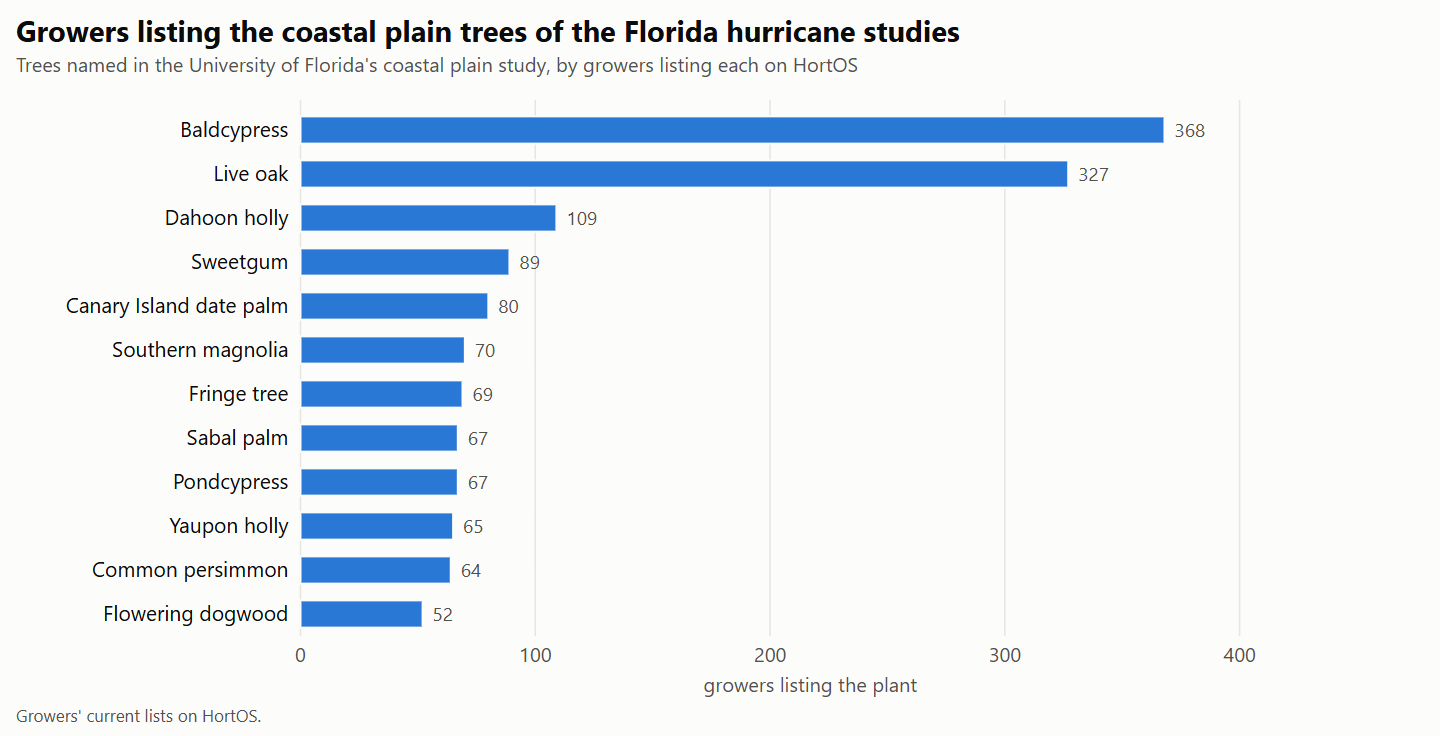
The first table sets 18 trees from the coastal plain list beside HortOS figures. A tree is shown on three conditions. One of the 2007 papers names it in its text for a finding of its own or, for yaupon holly, of its group. It sits in the highest or medium-high class of the coastal plain table in UF/IFAS's EDIS FOR118 (Florida, revised 2026). It has a page on this site. That table rates 58 more trees that are not shown. EDIS FOR119 (revised 2026) prints no palm in its highest class, so the palms here follow the FOR118 table.
The column headed UF/IFAS study finding (2007) is not a tree's class. It is what the paper in Arboriculture & Urban Forestry reports for that tree in Florida: survival after a named hurricane, or a rating in the survey. Prices are medians across growers' current trade lists on HortOS: one price per grower, ex tax, freight not included, with the number of growers pricing each size in brackets. Grower counts are the growers listing each plant on HortOS, in any size. Anyone can see the prices on HortOS, and only the trade can order.
| Plant | UF/IFAS study finding (2007) | Growers listing it | #15 median (growers pricing) |
|---|---|---|---|
| Live oak (Quercus virginiana) | Best survivors in Ivan, Erin and Opal | 327 | $65 (71) |
| Sand live oak (Quercus geminata) | Best survivors in Ivan, Erin and Opal | 30 | $65 (4) |
| Southern magnolia (Magnolia grandiflora) | Best survivors in Ivan, Erin and Opal | 70 | $80 (13) |
| Flowering dogwood (Cornus florida) | Best survivors in Ivan, Erin and Opal | 52 | $100 (3) |
| Sabal palm (Sabal palmetto) | Best survivors in Ivan, Erin and Opal | 67 | $75 (3) |
| American holly (Ilex opaca) | Among the highest survival in Ivan | 34 | $100 (3) |
| Crape myrtle (Lagerstroemia indica) | Among the highest survival in Ivan | 36 | $58 (3) |
| Sweetgum (Liquidambar styraciflua) | Among the highest survival in Ivan | 89 | $50 (10) |
| Baldcypress (Taxodium distichum) | Rated high by 91% in the survey | 368 | $59.25 (68) |
| Pondcypress (Taxodium ascendens) | Rated high by 91% in the survey | 67 | $55 (12) |
| Dahoon holly (Ilex cassine) | Rated high in the expert survey | 109 | $62.50 (20) |
| Yaupon holly (Ilex vomitoria) | Hollies rated high in the survey | 65 | $55 (16) |
| Myrtle oak (Quercus myrtifolia) | Rated high in the expert survey | 5 | $75 (3) |
| Sparkleberry (Vaccinium arboreum) | Rated high in the expert survey | 8 | Fewer than three growers |
| Fringe tree (Chionanthus virginicus) | Rated high in the expert survey | 69 | $70 (10) |
| Common persimmon (Diospyros virginiana) | Rated high in the expert survey | 64 | $66.38 (4) |
| Swamp chestnut oak (Quercus michauxii) | Rated medium in the expert survey | 45 | $60 (5) |
| Canary Island date palm (Phoenix canariensis) | Rated high by 89% in the survey | 80 | $85 (7) |
Most of the growers listing the plants in this table are in Florida and Texas.
Every median in both plant tables is for a #15 container, not always the size most growers price. Field grown lines are left out, because one field grown figure pools every caliper. No row is the cost of planting a tree. The guide to what a tree costs by container size and caliper gives medians up the American container ladder, and the guide to nursery pot sizes explains what a container class does and does not say.
Some medians rest on few growers. Sand live oak (4 growers pricing a #15), flowering dogwood (3), sabal palm (3), crape myrtle (3), myrtle oak (3), common persimmon (4) and American holly (3) each have fewer than five. A median on so few moves when one grower changes a price. A median needs three growers pricing the size, so sparkleberry and, in the next table, pond apple have none. Palms above a #15 are sold by height, and this page gives no figure for them.
The cells hold two kinds of evidence. The rows from live oak to sweetgum are measurements of survival after Hurricanes Ivan, Erin and Opal (Arboriculture & Urban Forestry, Florida, 2007). The rows below them are survey ratings, and a rating is the view of those of the survey's 85 respondents who rated that tree. The same 2007 Florida paper reports the high rating of the hollies as a group, so yaupon holly's cell is the group's rating and not its own. Dahoon holly's rating is reported in the tropical paper of the same year.
The oaks show how place changes a finding. UF/IFAS (Florida, 2007, revised 2017) reports that across four coastal plain hurricanes laurel oak had lower survival than either live oak or sand live oak. In that 2007 study's two south Florida hurricanes, laurel oak and live oak fared alike in survival and branch loss. UF/IFAS also reports that street laurel oaks in Bagdad, Florida, are being replaced by other species, live oak among them (Florida, 2007, revised 2026). The guide to street trees and canopy shows where growers list trees in #15 and larger sizes.
South Florida trees beside what growers list
The second table does the same for the tropical and subtropical table of EDIS FOR118, which covers zones 10 and 11. Its 10 trees meet the same three conditions against the 2007 tropical paper and that table, and none of them is already in the first table. Its finding column takes in Puerto Rico as well as south Florida. The FOR118 table rates 84 trees that are not shown here. Some of those are in the first table because both FOR118 tables rate them, among them live oak, sand live oak, southern magnolia, crape myrtle, dahoon holly, both cypresses and sabal palm. The figures have the same basis as above.
| Plant | UF/IFAS study finding (2007) | Growers listing it | #15 median (growers pricing) |
|---|---|---|---|
| Gumbo limbo (Bursera simaruba) | Among the best survivors in Florida | 105 | $67.50 (10) |
| Sea grape (Coccoloba uvifera) | Among the best survivors in Florida | 184 | $45 (60) |
| West Indian mahogany (Swietenia mahagoni) | Best survivor after Hurricane Georges | 59 | $57.50 (8) |
| Cocoplum (Chrysobalanus icaco) | Rated high in the expert survey | 77 | $35 (9) |
| Lignum vitae (Guaiacum sanctum) | Rated high in the expert survey | 28 | $150 (10) |
| Pond apple (Annona glabra) | Rated high in the expert survey | 14 | Fewer than three growers |
| Areca palm (Dypsis lutescens) | Survival of 89% or more | 235 | $45 (100) |
| Manila palm (Veitchia merrillii) | Survival of 89% or more | 278 | $50 (111) |
| Pygmy date palm (Phoenix roebelenii) | Survival of 89% or more | 258 | $55.10 (79) |
| Coconut palm (Cocos nucifera) | Intermediate survival, 77% | 60 | $52.50 (16) |
Most of the growers listing the plants in this table are in Florida.
These cells also mix measurement and opinion. Gumbo limbo and sea grape were among the species that survived Florida's hurricanes best, and areca, Manila and pygmy date palms had survival of 89% or more (Arboriculture & Urban Forestry, South Florida and Puerto Rico, 2007). Cocoplum, lignum vitae and pond apple were ranked high by the survey's experts, and the 2007 South Florida paper says its own studies held little information on them. The same 2007 paper gives coconut palm intermediate survival, 77%, in Hurricanes Charley and Georges, and adds that the palm survived poorly in Hurricane Andrew in south Florida.
West Indian mahogany is the tree the 2007 paper finds hard to place. Its cell rests on another study, made in Puerto Rico after Hurricane Georges, that the paper cites, in which the tree had 100% survival. The survey's respondents still ranked it medium to low (Arboriculture & Urban Forestry, South Florida and Puerto Rico, 2007).
Palms had 88% survival in Hurricane Charley, against 77% for the rest of the tree species (UF/IFAS, South Florida, 2007, revised 2017). Strangler fig was among the best survivors in Florida's hurricanes (Arboriculture & Urban Forestry, South Florida, 2007). UF/IFAS notes that live oak, laurel oak and strangler fig may stay standing in the 145 mph winds of Charley and still lose large branches (South Florida, 2007, revised 2017).
How far the findings travel along the Gulf and the Carolinas
The measurements behind both lists were made after hurricanes in Florida, on the Gulf Coast and in Puerto Rico (UF/IFAS, 2007, revised 2026). Extension services in other states have taken them up. The third table names each authority read for this page that reports on wind and trees for a state or region.
| State or region | Authority, publication and year |
|---|---|
| Florida and the coastal plain, zones 8 and 9 | UF/IFAS Extension, EDIS FOR119, 2007, revised 2026 |
| South Florida and Puerto Rico, zones 10 and 11 | UF/IFAS Extension, EDIS FOR120, 2007, revised 2017 |
| Florida Panhandle | UF/IFAS Extension, Circular 1183, 1997 |
| Gulf Coast | Arboriculture & Urban Forestry 33(2), 2007, citing a 1979 report |
| Mississippi | Mississippi State University Extension, Publication 3111, 2024 |
| South Carolina coastal plain | Arboriculture & Urban Forestry 33(2), 2007, citing a 1991 study |
| North Carolina coast | N.C. Cooperative Extension, Pender County Center, 2024 |
| North Carolina coastal plain | N.C. Forest Service, SRN-006, 2017 |
The last row needs a careful reading. The North Carolina Forest Service (North Carolina, 2017) reports a planted forestry trial in southeast Mississippi, measured after Hurricane Katrina, in which mortality was 7% for longleaf pine and 26% for loblolly pine.
Not every row is separate evidence. Mississippi State University Extension (Mississippi, 2024) rests its wind ratings on the UF/IFAS assessments of Florida and Puerto Rico hurricanes from 1992 to 2004. It describes live oak as highly resistant to wind and tolerant of saline soil and salt spray. North Carolina Cooperative Extension (North Carolina, 2024) reports that, among large trees, the Florida and Gulf Coast studies found southern magnolia, live oak and bald cypress the most resistant to wind, and adds that they thrive along the Carolina coast. Both pages restate the Florida studies, and neither reports a measurement of its own.
The Gulf Coast and South Carolina rows come from the 2007 coastal plain paper. It cites a 1979 report that both cypresses, live oak and sabal palm had the best wind resistance after Hurricanes Camille and Frederick on the Gulf Coast. It also cites a 1991 study after Hurricane Hugo in the forests of South Carolina's coastal plain, where laurel oak and water oak took more damage than live oak.
No Louisiana, Texas, Georgia or South Carolina authority's own wind list was read for this page. For those states the page carries only what the Florida studies and the work they cite report. The medians in both plant tables are national, and the sentence under each table says where the growers behind them are. The page shows no price for any one Gulf state or for the Carolinas. Each state's growers are on its hub: Florida, Mississippi, Louisiana, Texas, Georgia, South Carolina and North Carolina.
What survival figures and grower counts leave out
The lists are not complete. UF/IFAS (Florida, 2007, revised 2026) says they hold only the species met in the studies in numbers large enough for statistics, so a tree's absence is not a rating. It adds, in the same Florida publication of 2007, that one species may behave differently in another place because of soil, climate and local disease.
Species is one factor among several. Trees in groups had higher survival than single trees in Hurricane Ivan, 80% against 70%, and in Hurricane Jeanne, 88% against 78% (UF/IFAS, Florida, 2007, revised 2026). In an analysis of broad-leaved species after Hurricane Andrew, 73% of properly pruned trees survived against 47% of unpruned trees, by the same 2007 Florida publication.
After Hurricanes Erin and Opal struck in 1995, UF/IFAS reported that 1 to 2% of the surveyed trees had damaged property (Florida Panhandle, 1997).
A count here is growers listing the plant, not how many plants exist or how well it suits a site. The directory does not show the structure of a grower's trees, their roots, where they were grown or whether a size suits a planting space. UF/IFAS (Florida, 2007, revised 2026) recommends planting trees of high quality, each with a central leader and good form, and those are questions for the grower.
What to watch for
- Reading the highest class as windproof. UF/IFAS (Florida, 2007, revised 2026) says that no species and no single tree is fully windproof, and it reports live oak survival of 78% at 145 and 165 mph.
- Reading survival as an undamaged tree. UF/IFAS (Florida, 2007, revised 2026) reports that sweetgum has good survival yet tends to break some branches.
- Counting a standing pine as a survivor too early. Three months after Hurricane Ivan, UF/IFAS found that 56% of the standing sand pines had died (Florida, 2007, revised 2026).
- Taking a survey rating for a measurement. For West Indian mahogany the survey's ratings and the measured survival disagreed (UF/IFAS, South Florida, 2007, revised 2017).
- Taking a median for a local price. Each median is for a #15 container, and the figures are national, not those of any one Gulf state or of the Carolinas.
Getting it right
- Find the USDA hardiness zone of the site. UF/IFAS (Florida, 2007, revised 2026) keeps one list for zones 8 and 9 and another for zones 10 and 11.
- Open EDIS FOR118 under Sources and find the table for that zone. Read the class of each tree under consideration and any note printed beside it.
- Measure the planting space against the tree's mature size. UF/IFAS (Florida, 2007, revised 2026) gives rooting space of at least 10 by 10 feet for small trees, 20 by 20 for medium trees and 30 by 30 for large trees.
- Open each tree's price page from the tables to see the sizes growers price and the states they are in. The price check sets a quote beside the current medians, and each grower in the directory has its own page.
- Ask the grower about the trees themselves: the container size and trunk caliper, whether each has a single central leader and where it was grown. The grower decides price, minimum order and terms.
A word of caution
Most of the wind findings here are UF/IFAS's, measured after hurricanes in Florida, on the Gulf Coast and in Puerto Rico and published from 1997 to 2026, and UF/IFAS says no tree is completely windproof. The Texas Department of Insurance's home insurance guide, last updated June 1, 2026, puts wind or hail damage to trees and shrubs among the damages most Texas home policies do not cover, and refers readers to their policy or agent. The grower counts and medians are what HortOS showed, and each grower sets its own prices and terms.
Sources
- UF/IFAS Extension, Selecting Coastal Plain Species for Wind Resistance (EDIS FOR119): the coastal plain study and list.
- UF/IFAS Extension, Selecting Tropical and Subtropical Tree Species for Wind Resistance (EDIS FOR120): the tropical and subtropical list.
- UF/IFAS Extension, Wind and Trees: Lessons Learned from Hurricanes (EDIS FOR118): both class tables and the lessons.
- UF/IFAS Extension, Wind and Trees: Surveys of Tree Damage in the Florida Panhandle after Hurricanes Erin and Opal (Circular 1183): the 1997 Panhandle surveys.
- Duryea, Kampf and Littell, Hurricanes and the Urban Forest: I. Effects on Southeastern United States Coastal Plain Tree Species, Arboriculture & Urban Forestry 33(2), 2007: the coastal plain study.
- Duryea, Kampf, Littell and Rodriguez-Pedraza, Hurricanes and the Urban Forest: II. Effects on Tropical and Subtropical Tree Species, Arboriculture & Urban Forestry 33(2), 2007: the tropical and subtropical study.
- UF/IFAS, Trees and Hurricanes: Urban Forest Hurricane Recovery Program: the program behind the lists.
- Mississippi State University Extension, Storm-Resistant Trees for Mississippi Landscapes (Publication 3111): Mississippi's storm resistant trees.
- N.C. Cooperative Extension, Pender County Center, Planting Trees With Hurricanes in Mind: a Carolina coast reading.
- North Carolina Forest Service, Longleaf Pine is Resilient in the Face of Hurricane Winds (SRN-006): longleaf pine and hurricane wind.
- Texas Department of Insurance, Home insurance guide: what home policies cover.
More guides

What a Tree Costs at the Nursery, by Container Size and Caliper
A tree has a knowable wholesale price before freight, planting and margin are added, and the container size sets it far more than the species does. This page gives the trade prices for seven widely grown American trees at every size three or more growers publish, with the sizing rules behind them.

Nursery Pot Sizes Explained: Millimetres, Litres and Gallons
Australian growers name a pot by its rim diameter up to 400 mm and by its volume in litres above that, while American growers use gallon classes. This guide explains each step of the ladder, the approximate height and age behind it, how to convert between systems, and what the trade pays at every size.

Street Trees and Canopy: What Advanced Stock Costs and Who Holds It
A standing reference for urban forestry programs and tree nonprofits: the trees the American trade grows for streets and parks, the nursery-gate median at #15, #30, #45 and #65 and as field grown stock, how many growers in each state hold advanced stock, why lead times run to years, and what a street tree costs against a giveaway.