Street Trees and Canopy: What Advanced Stock Costs and Who Holds It
A standing reference for urban forestry programs and tree nonprofits: the trees the American trade grows for streets and parks, the nursery-gate median at #15, #30, #45 and #65 and as field grown stock, how many growers in each state hold advanced stock, why lead times run to years, and what a street tree costs against a giveaway.
Updated September 25, 2026. Figures from the live us.hortosapp.com price and plant pages on 24 September 2026 and growers' current lists compiled the same month; refreshed with the first United States edition of the HortOS Plant Price Index.

On this page
Every city with a canopy goal meets it one tree at a time, from a grower who potted a liner on years earlier. The idea that matters most is that the trees a city plants on a street, a #30 or #45 container or a field grown tree of two to three inches caliper, come from a small number of growers concentrated in one state, that the same handful of species dominates what they grow at that size, and that the price of a tree at the nursery gate is the smallest part of what it costs to plant it and keep it alive. A canopy plan that does not start with the nursery is a plan for seedlings.
This page sets out what American growers hold at advanced sizes as a standing reference: which trees the trade grows for streets and parks, what a #15, #30, #45 and #65 tree costs at the nursery gate, how many growers in each state hold advanced stock, why the lead times are what they are, and what a city pays for a street tree against what a giveaway costs. It draws on the Arbor Day Foundation's Tree City USA standards, the USDA Forest Service's Urban and Community Forestry program, American Forests' Tree Equity Score, the American nursery stock standard published by AmericanHort, and Clemson Cooperative Extension on planting balled and burlapped trees. It summarizes what they say and is not a substitute for a specification.
Quick facts
| Who holds the big trees | Growers with a #15 or larger container, a boxed tree or field grown stock on their current list, compiled from growers' lists on HortOS in September 2026: Florida 774, Texas 67, North Carolina 61, Georgia 45, South Carolina 25, Louisiana 23, Tennessee 23, New Jersey 20. |
|---|---|
| What they cost | Live oak on the live price pages, 24 September 2026, median ex tax: #15 $65.00, #30 $132.50, #45 $265, #65 $350. The same tree in a #3, the giveaway size, has a median of $10.25. |
| What they grow | Live oak, bald cypress, the Natchez and Muskogee crape myrtles and the Little Gem magnolia lead; the rest of the list is hollies, magnolias, arborvitae and the screening shrubs of Florida. |
| The standard | Tree City USA asks a community for a tree board or department, a tree ordinance, at least $2 per capita a year on community tree care, and an Arbor Day observance (Arbor Day Foundation). |
| The money | The Forest Service's Urban and Community Forestry program, traditionally funded at $36 to $40 million a year, received $1.5 billion under the Inflation Reduction Act and announced more than $1 billion in grants in 2023. |
| Lead time | A #15 tree is three to four years from a liner, a #30 or #45 four to six, a three-inch caliper field grown tree longer; the ANSI Z60 standard sets how it is measured when it arrives. |
The programs, and the bottleneck behind them
The Arbor Day Foundation's Tree City USA program recognizes a community that meets four standards: a tree board, department or position with legal authority for public tree care, a community tree ordinance, a documented minimum of $2 per capita a year on community tree care activities, and an Arbor Day observation and proclamation. The USDA Forest Service's Urban and Community Forestry program, the only federal program dedicated to urban trees, says 84 percent of Americans live in urban communities and describes its traditional funding as $36 to $40 million a year; under the Inflation Reduction Act it received $1.5 billion, announced more than $1 billion in grants to communities in all 50 states in 2023, and allocated $250 million to state forestry agencies. American Forests' Tree Equity Score gives every neighborhood a score from 0 to 100 built on canopy, surface temperature, income, employment, race, age, language and health, so that a city can see where trees are needed most.
The supply side is narrower than the programs suggest. Compiled from growers' current lists on HortOS, a free directory of American wholesale plant growers with their published availability and trade prices, in September 2026, the growers holding a #15 or larger container, a boxed tree or field grown stock number 774 in Florida, 67 in Texas, 61 in North Carolina, 45 in Georgia, 25 in South Carolina, 23 each in Louisiana and Tennessee and 20 in New Jersey; every other state has fewer than 15. Those are the growers a city, a developer or a tree program can buy an advanced tree from this season, and the same handful of species dominates what they grow at that size. A tree equity program in a northern city is buying from a trade whose advanced stock sits mostly in the Southeast.
What the trade grows for streets and parks
The table lists the trees held at advanced sizes by the most growers, with the number of growers holding each at a #15 or larger on their current list and the median trade price ex tax at #15, #30, #45 and #65 and as a field grown tree, as printed on the live price pages on 24 September 2026, one price per grower, resellers and website prices excluded, with the number of growers pricing that size in brackets. Palms and other trees priced by height are left out. A field grown line is a dug tree, usually priced by caliper, and its median pools every caliper a grower lists, so it is a wider figure than a container class.
| Tree | Growers holding advanced stock | #15 | #30 | #45 | #65 | Field grown |
|---|---|---|---|---|---|---|
| Quercus virginiana | 289 | $65 (69) | $132.50 (92) | $265 (108) | $350 (50) | $292.50 (74) |
| Taxodium distichum | 268 | $58.50 (67) | $120 (89) | $225 (65) | $315 (21) | $150 (74) |
| Lagerstroemia fauriei 'Natchez' | 263 | $60 (99) | $115 (102) | $225 (47) | $270 (7) | $125 (73) |
| Magnolia grandiflora 'Little Gem' | 257 | $65 (81) | $125 (89) | $250 (49) | $325 (10) | $155 (49) |
| Lagerstroemia fauriei 'Muskogee' | 239 | $60 (88) | $115 (82) | $222.50 (38) | $325 (7) | $150 (64) |
| Clusia guttifera | 223 | $40 (140) | $180 (3) | $225 (37) | $325 (5) | $185 (6) |
| Podocarpus macrophyllus 'Maki' | 217 | $45 (130) | $112.50 (26) | $225 (44) | $325 (7) | $125 (12) |
| Magnolia grandiflora 'Bracken's Brown Beauty' | 207 | $73.50 (44) | $125 (62) | $252.50 (56) | $350 (20) | $190 (57) |
| Ilex 'Nellie R. Stevens' | 186 | $60 (59) | $120 (49) | $245 (32) | $299 (9) | $150 (58) |
| Thuja plicata 'Green Giant' | 186 | $65 (77) | $125 (31) | $230 (8) | Fewer than three | $102.50 (80) |
| Lagerstroemia 'Tuscarora' | 178 | $60 (73) | $115 (66) | $232.50 (18) | $275 (5) | $107.50 (38) |
| Magnolia grandiflora 'D.D.Blanchard' | 169 | $65 (31) | $125 (54) | $252.50 (44) | $325 (17) | $225 (37) |
| Ligustrum japonicum | 163 | $50 (57) | $110 (43) | $220 (23) | $275 (13) | $212.50 (44) |
| Elaeocarpus decipiens | 162 | $55 (53) | $125 (38) | $250 (67) | $375 (13) | $375 (7) |
| Ilex x attenuata 'Eagleston' | 159 | $60 (50) | $125 (74) | $270 (54) | $362.50 (16) | $252.50 (24) |
| Conocarpus erectus | 155 | $42.50 (56) | Fewer than three | $275 (44) | $450 (8) | $20 (15) |
Two things stand out. The list is Florida's: live oak, bald cypress, the southern magnolias, buttonwood and the Eagleston holly are native, and the crape myrtles, podocarpus, clusia, ligustrum, Japanese blueberry, Nellie R. Stevens holly and Green Giant arborvitae are the exotic screening and street trees of the Southeast; a northern shade tree list of red maple, oaks and elms sits further down, held by fewer growers. And the price ladder is steep and consistent: a #15 tree sits near $50 to $75, a #30 near $110 to $135, a #45 near $220 to $275 and a #65 near $270 to $450, so each step up buys roughly the cost of the steps below it again. The pot sizes guide explains the ladder, and what a tree costs by container size and caliper follows seven trees up every rung.
What a city pays for, and what a giveaway costs
A street tree and a giveaway tree are different products from the same grower. On the live price pages on 24 September 2026, live oak (Quercus virginiana) had a median of $10.25 in a #3 across 32 pricing growers, $65.00 in a #15 across 69, $132.50 in a #30 across 92, $265 in a #45 across 108 and $350 in a #65 across 50; bald cypress (Taxodium distichum) ran $10.00, $58.50, $120, $225 and $315 at the same sizes. A thousand giveaway trees in a #3 are a plant bill near $10,000; a thousand street trees in a #45 are near $265,000 ex tax before a hole is dug.
And the plant is the cheap part. Tree City USA's $2 per capita standard counts planting and initial care, maintenance, removal, management, utility line clearance and volunteer hours, because the tree's lifetime cost is in the watering, the pruning and the pit, not the purchase. The difference between a #30 and a #45 is small against the planting; the difference between a tree that is watered for two summers and one that is not is the whole budget. That is the case for buying the larger tree where it will be watered and for planting the smaller one, in quantity, where a volunteer will.
Why the lead times are long
A #15 tree is three to four years from a liner and a #45 five to six; the years are the reason the price doubles at each rung and the reason a grower cannot answer a bid for five hundred trees of a species it did not pot on years before. The American nursery stock standard, published by AmericanHort and approved by the American National Standards Institute, establishes common techniques for measuring plants, for specifying and stating their size, for the proper relationship between height and caliper or height and width, and for whether a root ball or container is large enough for a plant of a given size; AmericanHort says a revision between January 2024 and April 2025 produced the 2025 edition, approved on April 12, 2025. Clemson Cooperative Extension adds the calendar: most balled and burlapped trees are dug and planted in the cooler months after leaf drop, while container grown trees can be planted through the year and are best planted in fall for the dormant season root growth.
Growing a tree to that standard cannot be hurried, which is why the trade sells advanced stock two ways: from the list, where the plant page shows what a grower holds today, and by contract, where a city or contractor books trees a season or more ahead and the grower grows them on. A canopy program that wants species diversity, or a northern palette the Florida growers do not carry, has to order before the trees exist.
Where the growers are
The state hubs for Florida, Texas, North Carolina, Georgia, South Carolina, Tennessee and New Jersey list the growers by city, and each plant page shows who holds a tree at each size with the date the list was updated. The Florida hub alone lists 814 growers in Miami and 585 in Homestead, which is where most advanced stock sits; a buyer in the Northeast, the Midwest or the West is usually buying from a distance, with the freight and the state entry rules that brings.
What to watch for
- Specifying a size that is not grown. The #65 medians on this page rest on a handful of growers per species; a species outside the table may be held by one grower or none at that size.
- Pricing the tree and not the planting. The tree is a fraction of the lifetime cost; the budget line that fails a canopy goal is watering, not purchase.
- Buying a container, not a tree. A #45 label is a container class; caliper, height and root ball under the ANSI standard are what a specification should call up.
- Ordering in the planting season. Advanced trees for a fall program were potted on years before. A bid in September buys what is on the list.
- Reading a field grown median as a container price. It pools every caliper a grower lists; ask for the price at the caliper you need.
Getting it right
- Settle the species list against the canopy plan and the site, then check each species' plant page for who holds it at the size you need.
- Check the median at #15, #30, #45 and #65 on the price pages before the estimate, and test a quote with the price check.
- Specify caliper, height and root ball under the ANSI standard, not a container class alone, and inspect the stock at the nursery before it ships.
- Contract grow the species the trade does not hold in volume, a season or more ahead.
- Budget the planting and the first summers of watering with the tree, and choose the size by where it will be watered, not by what looks best on planting day.
A word of caution
The medians on this page are aggregates of growers' published lists on one date; the live price pages change as lists arrive, so a figure there may differ from the ones quoted here. The grower counts by state are compiled from growers' current lists and will move as lists arrive. The ANSI nursery stock standard is a paid document, described here and not reproduced; a tree contract needs the specifier and an inspector. On stock, sizes and ship dates, the grower's word is the one that counts.
Sources
- Arbor Day Foundation, Tree City USA standards: the four standards and $2 per capita.
- USDA Forest Service, Urban and Community Forestry Program: the program and its funding.
- USDA Forest Service, urban forests: the Inflation Reduction Act grants.
- American Forests, Tree Equity Score: how the score is built.
- AmericanHort, American nursery stock standards: the ANSI Z60 standard and its 2025 edition.
- Clemson Cooperative Extension, planting trees correctly: when balled and burlapped trees are dug.
- i-Tree, USDA Forest Service: tools that quantify what trees provide.
More guides

Nursery Pot Sizes Explained: Millimetres, Litres and Gallons
Australian growers name a pot by its rim diameter up to 400 mm and by its volume in litres above that, while American growers use gallon classes. This guide explains each step of the ladder, the approximate height and age behind it, how to convert between systems, and what the trade pays at every size.

What a Tree Costs at the Nursery, by Container Size and Caliper
A tree has a knowable wholesale price before freight, planting and margin are added, and the container size sets it far more than the species does. This page gives the trade prices for seven widely grown American trees at every size three or more growers publish, with the sizing rules behind them.
Parking lot shade tree rules and what the trees cost at trade
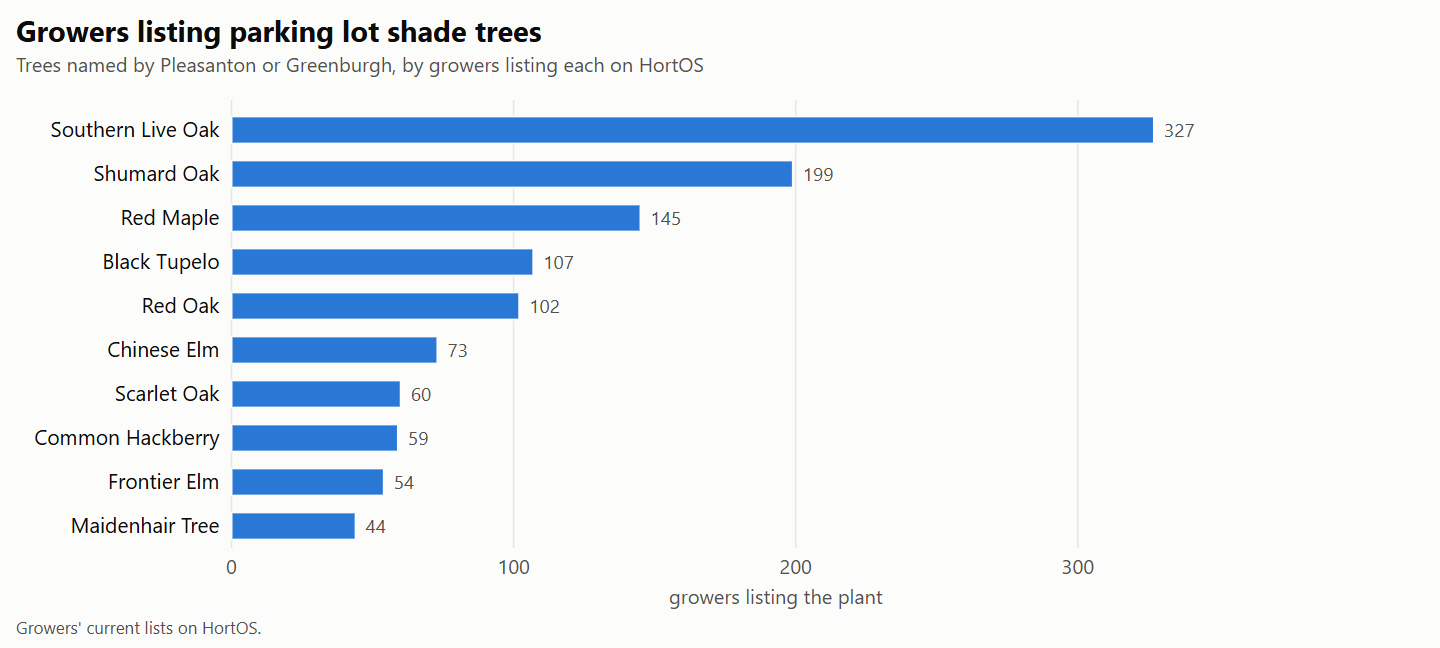
The parking lot rules read here are either a shade target or a spacing rule. This guide sets out rules from California, Pleasanton, Greenburgh, Houston, Palm Beach County and St. Johns County as their own documents state them, then shows how many growers list each shade tree named by Pleasanton or Greenburgh and its trade median in a #15 container.