Parking lot shade tree rules and what the trees cost at trade
The parking lot rules read here are either a shade target or a spacing rule. This guide sets out rules from California, Pleasanton, Greenburgh, Houston, Palm Beach County and St. Johns County as their own documents state them, then shows how many growers list each shade tree named by Pleasanton or Greenburgh and its trade median in a #15 container.
Updated September 19, 2026. Figures are what the live us.hortosapp.com price and plant pages printed.
On this page
A site designer laying out a new parking lot wants to know how many trees the local rule asks for and what those trees cost at trade. The parking lot tree rules read for this page are of two kinds: a shade target that fixes no number of trees per space, and a spacing rule that puts a tree in each landscape island. The city, county or state agency whose code covers the site decides which kind applies.
This page reads the rules from California's code papers, Pleasanton, Greenburgh, Houston, Palm Beach County and St. Johns County, with surveys by the USDA Forest Service. HortOS, a free directory of American wholesale plant growers with their published availability and trade prices, adds how many growers list each of 16 shade trees and each tree's trade median in a #15 container. It is not a cost per parking space or a reading of a code for a project.
Quick facts
| California schools | CALGreen Section 5.106.12.1, as the California Building Standards Commission reprinted it in 2022, asks for shade trees of at least No. 10 container size, or equal, to shade 50 percent of a surface parking area within 15 years. |
|---|---|
| Who that section binds | The California Division of the State Architect's checklist DSA 403-C, effective September 12, 2026, names Section 5.106.12.1 among the measures for projects at K-12 schools and community colleges. |
| Other California buildings | The California Building Standards Commission's guide to the supplement effective July 1, 2024 carries a voluntary measure, Section A5.106.11.3, that points to Section 5.106.12 where there is no local shade tree ordinance. |
| Houston's ratio | The City of Houston, Texas brochure on its Tree and Shrub Ordinance, revised March 2009, says one parking lot tree is required for every 10 spaces and each space must sit no more than 120 feet from a tree. |
| Palm Beach County's islands | The Unified Land Development Code of Palm Beach County, Florida (Article 7, Supplement No. 32, printed October 2025) asks for a landscape island for every ten parking spaces in its U/S Tier, with one tree in each island. |
| What a survey measured | The USDA Forest Service reported in 2002 that parking lots it surveyed in Sacramento, California, against a target of 50 percent shade, had effective shade of 8.1 percent. |
Shade targets and spacing rules, code by code
The 6 rows below are parking lot tree rules, each as the jurisdiction's own dated document states it.
| Jurisdiction and scope | Shade or spacing test | Trees asked for | Source and year |
|---|---|---|---|
| California: K-12 schools and community colleges | Half of the surface parking area shaded by trees within 15 years, counted at midday on the summer solstice | Set by the shade calculation | CALGreen s. 5.106.12.1 (DSA-SS), as the California Building Standards Commission reprinted it in 2022 |
| Pleasanton, California: commercial developments | More than half of the surface parking area shaded within 15 years | Set by the shade calculation, each tree counted at the canopy width on the city's list | City of Pleasanton shade tree guidelines, 2020 |
| Greenburgh, New York: new and rebuilt parking lots | Half of the lot's surface shaded within 15 years of planting | Set by the shade calculation | Zoning Ordinance s. 285-38D, as the town's guidelines of July 2020 describe it |
| Greenburgh, New York: the guidelines | No more than 10 spaces in a row without a landscaped island or peninsula | At least one tree in each such island or peninsula | Town of Greenburgh guidelines posted as a draft, July 2020 |
| Palm Beach County, Florida: on-site parking | A landscape island for each 10 spaces, at most 100 feet apart, in the U/S Tier; for each 8 or 6 spaces in the other tiers | One tree in each island | Unified Land Development Code, Article 7, Supplement No. 32, printed October 2025 |
| St. Johns County, Florida: larger off-street vehicular use areas | Rows of parking broken by landscape islands so that none runs more than 100 feet | One tree in each island | Land Development Code s. 6.06.03, edition of January 12, 2026 |
California's rule is narrower than it is often described. Section 5.106.12 carries the banner "[DSA-SS]" in the California Building Standards Commission's 2022 reprint, and its percentages are taken at midday on the summer solstice.
For other nonresidential buildings in California the measure is voluntary. Section A5.106.11.3, in the commission's guide to the supplement effective July 1, 2024, says only that a project with no local shade tree ordinance follows Section 5.106.12. Pleasanton is one that applies the shade tests itself: the City of Pleasanton, California says in its guidelines updated in October 2020 that they cover commercial developments only.
In New York, the guidelines the Town of Greenburgh posted as a draft, dated July 2020, describe the town's zoning ordinance, at Section 285-38D, as requiring shade over 50 percent of the lot surface within 15 years of planting.
The other kind of rule counts spaces or feet. Houston's 2009 brochure says the ordinance's planting requirements apply in Houston, Texas to new commercial and multi-family developments that need a building permit and to property expansions over 1,000 square feet. The same 2009 Houston brochure says at least half of the parking lot trees are to be large trees from the city's list. Palm Beach County, Florida's code of October 2025 asks for an island for every eight spaces in its AGR and Glades Tiers and every six in its Rural and Exurban Tiers. St. Johns County, Florida's Land Development Code, edition of January 12, 2026, places its limit on unbroken rows of parking in a paragraph of Sec. 6.06.03 on larger vehicular use areas, so the code sets the lot size at which it starts.
The tree sizes the rules name
The rules name sizes in three different ways. California's section, in the 2022 reprint, names a No. 10 container, and the City of Pleasanton, California's checklist revised in January 2023 lists the same section with a #10 container. A No. 10 container sits between the #7 and #15 classes in ANSI Z60.2-2025, the American nursery standard, so #15 is the first class above it in the table further down.
Greenburgh, New York's guidelines of July 2020 set the smallest parking lot shade tree at a 2-inch caliper for deciduous trees and 8 feet in height for evergreens. Palm Beach County, Florida's code of October 2025 sets a canopy tree at 12 feet tall with a 2.5-inch caliper at installation, in a section that sets out its own exceptions. St. Johns County, Florida's code of January 12, 2026 says in Sec. 6.06.02 that a tree at planting is 8 to 10 feet tall with a 2-inch caliper.
The 2-inch caliper those rules name sits above #15. For Type 1 shade trees, the American standard ANSI Z60.2-2025 pairs a 2-inch caliper with the #20, #25 and #45 container classes. The guide to street trees and canopy covers the trees growers list in larger container classes, which this page does not repeat.
What growers list and the #15 trade median
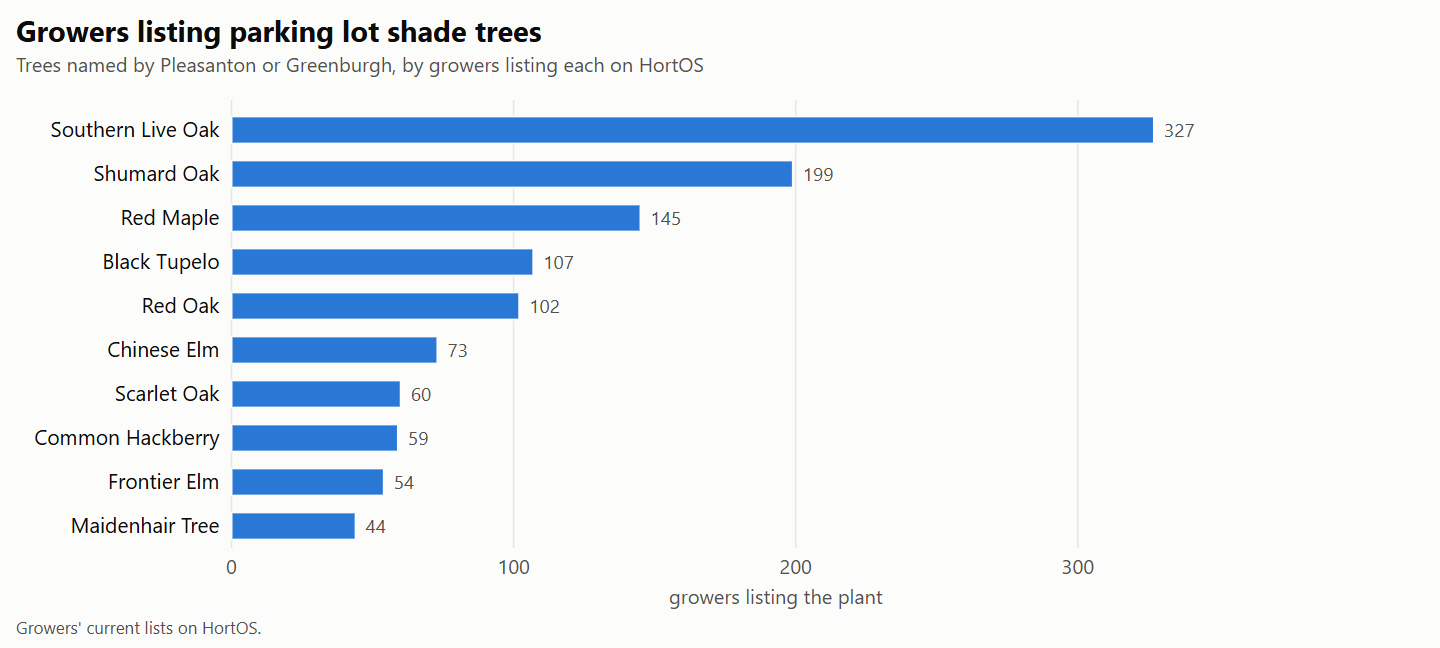
The rows below are drawn from the oaks, elms, maples, hackberries, lindens, planes, zelkovas, ginkgos and tupelos named on Pleasanton's 2020 shade tree list or in the sample table of Greenburgh's July 2020 guidelines. A tree is shown where growers on HortOS price the same species or the same named cultivar, and the rows are in order of growers listing each tree. 18 more trees of those kinds named by the city or the town are not shown. Prices are medians across growers' current trade lists on HortOS: one price per grower, ex tax, freight not included, with the number of growers pricing each size in brackets.
| Plant | Growers listing it | #15 median (growers pricing) |
|---|---|---|
| Southern Live Oak (Quercus virginiana) | 327 | $65 (71) |
| Shumard Oak (Quercus shumardii) | 199 | $60 (30) |
| Red Maple (Acer rubrum 'October Glory') | 145 | $75 (23) |
| Black Tupelo (Nyssa sylvatica) | 107 | $70 (11) |
| Red Oak (Quercus rubra) | 102 | $96 (7) |
| Chinese Elm (Ulmus parvifolia) | 73 | $80 (8) |
| Scarlet Oak (Quercus coccinea) | 60 | Fewer than three growers |
| Common Hackberry (Celtis occidentalis) | 59 | $125 (3) |
| Frontier Elm (Ulmus 'Frontier') | 54 | $56.48 (4) |
| Maidenhair Tree (Ginkgo biloba 'Autumn Gold') | 44 | $122.95 (6) |
| Red Maple (Acer rubrum 'Armstrong') | 44 | Fewer than three growers |
| Saw Leaf Zelkova (Zelkova serrata 'Village Green') | 40 | $75 (5) |
| Maidenhair Tree (Ginkgo biloba 'Princeton Sentry') | 33 | $140 (8) |
| London Plane (Platanus x acerifolia 'Bloodgood') | 29 | Fewer than three growers |
| English Oak (Quercus robur) | 17 | Fewer than three growers |
| Red Maple (Acer rubrum 'Bowhall') | 14 | Fewer than three growers |
The growers listing the plants in this table are spread across many states; the most are in Florida, Texas and North Carolina.
A count here is growers listing the plant, not how many plants exist or how well it suits a site. Southern live oak heads the table with 327 growers listing it. 11 of the 16 rows carry a #15 median. A median needs three growers pricing a size. Two of the medians rest on few growers: common hackberry on 3 and Frontier elm on 4. Medians at #25 and #45 are not printed, because most of these trees lacked three growers pricing those classes. Anyone can see the prices on HortOS, and only the trade can order.
The city and the town behind the rows are in California and New York, and the table cannot say that a tree is listed by a grower near any site. The guide to what plants cost in 2026 sets these medians in the wider run of trade prices by container class.
What the surveys found and what this page does not show
The USDA Forest Service has measured how shade targets turn out. Its paper on Davis, California (journal year 2000) reports field surveys of five lots where canopy cover ran from 8 to 45 percent and averaged 25 percent. That 2000 Forest Service paper on Davis, California gives the reasons: unsuited species, soil that could not carry healthy growth, crowns pruned back or dead trees left unreplaced, and trees set too far apart. The agency's 2002 summary of its Sacramento, California survey says the trees there, grown by computer to their projected 15-year size, shaded 21 percent, and that lots with large-statured trees would probably do better than lots with small ones.
The Forest Service's 2002 summary says trees in Davis, California parking lots lowered asphalt surface temperatures by as much as 36 degrees Fahrenheit. It also says, of United States ordinances in 2002, that a rule of one tree per number of spaces lets trees be clustered at islands or the lot edge, often leaving large areas of pavement unshaded. The U.S. Environmental Protection Agency's 2008 guide for the United States says a planted strip along the whole of a parking bay can shade more of a lot than islands at the row ends. UF/IFAS Extension in Florida (revised May 2026) says a typical design can call for 200 cubic feet of soil for a tree, where the ideal would be 2,000 to 3,000.
The page leaves several things unshown. A row in the price table is not acceptance by any city or county: each keeps its own list, and Greenburgh, New York's July 2020 guidelines say their listed species do not suit every situation. HortOS gives no canopy width and no shade credit for any tree; those belong to each city. Each count is for the exact species or named cultivar. A median is the trade price of the tree alone in one container class, with nothing for planting, soil, islands, irrigation or upkeep. The table prices no tree at the caliper the Florida and New York rules name. The shade rules fix no number of trees per space, so the page gives no cost per space.
What to watch for
- Reading California's Section 5.106.12.1 as a rule for every parking lot. The State Architect's 2026 checklist ties it to California's K-12 schools and community colleges. The commission's guide to the 2024 supplement carries it for other California projects as a voluntary measure.
- Treating a shade target as a tree count. Each city sets the calculation, with its own canopy widths.
- Pricing a #15 tree against a rule that names a 2-inch caliper, which ANSI Z60.2-2025 pairs with larger container classes.
- Carrying a tree from one city's list to another's project. Each jurisdiction keeps its own.
- Reading an older summary as the present rule. The code in force is the city's, the town's or the county's to state.
Getting it right
- Find which body's code covers the site, and ask its planning office which edition is in force.
- Ask that office whether its rule is a shade target, a spacing rule or both, and which document sets out the calculation.
- Ask for the jurisdiction's own tree list. The city landscape architect, the town forestry officer or the county decides what counts.
- Read the size the rule names, as a container class, a caliper or a height, and ask growers for trees at that size and grade.
- Ask the project's landscape architect how much soil each island gives a tree.
A word of caution
Each rule here is as its dated document read on the day this page was written, and codes change. California's code bodies speak for CALGreen, and Pleasanton, Greenburgh, Houston, Palm Beach County and St. Johns County each speak for their own codes. The planning office of the jurisdiction decides what applies to a project.
Sources
- California Building Standards Commission, Heat Island Effect Shade Tree, Draft Initial Express Terms (2022): the text of Section 5.106.12.
- California Building Standards Commission, Supplement Update Guide to the 2022 CALGreen Code, Nonresidential: the voluntary shade tree measure.
- California Division of the State Architect, DSA 403-C CALGreen Code Submittal Checklist: which projects the section binds.
- City of Pleasanton, Shade Tree Guidelines for Commercial Properties: the city's shade calculation method.
- City of Pleasanton, Green Building Prescriptive Checklist, Non-Residential Buildings: the city's permit checklist.
- Town of Greenburgh, Parking Lot Tree Shading Design and Maintenance Guidelines: the town's shade and island guidelines.
- USDA Forest Service, Actualizing Microclimate and Air Quality Benefits with Parking Lot Shade Ordinances: the Davis parking lot survey.
- USDA Forest Service, Where Are All the Cool Parking Lots?: the Sacramento shade survey summary.
- U.S. Environmental Protection Agency, Reducing Urban Heat Islands: Trees and Vegetation: shading paved surfaces with trees.
- City of Houston, Landscape Regulations for Development: Tree and Shrub Ordinance brochure: the city's parking lot ratio.
- Palm Beach County, Unified Land Development Code, Article 7, Landscaping: the county's island and tree rules.
- St. Johns County, Land Development Code, Article VI: the county's parking area tree rules.
- UF/IFAS Extension, Urban Design for a Wind-Resistant Urban Forest: soil space for paved sites.
- AmericanHort, American Standard for Nursery Stock (ANSI Z60.2-2025): container classes and tree sizes.
More guides

Street Trees and Canopy: What Advanced Stock Costs and Who Holds It
A standing reference for urban forestry programs and tree nonprofits: the trees the American trade grows for streets and parks, the nursery-gate median at #15, #30, #45 and #65 and as field grown stock, how many growers in each state hold advanced stock, why lead times run to years, and what a street tree costs against a giveaway.

What Plants Cost at the Nursery in 2026
The general reference behind every article on what a landscape costs: the median trade price ex tax of the line most growers price at each container class from #1 to #100, the spread across growers, the difference between states, what a nursery-gate price leaves out, and worked figures for a planting, a street tree order and a giveaway.
Converting golf, campus and HOA common area turf to grasses
For association managers, campus facility managers and golf superintendents. It reports what two Florida Statutes sections and UF/IFAS and Penn State Extension say about turf, associations and establishing grasses, and adds the growers listing clump grasses with the container median where three growers price a size.