Converting golf, campus and HOA common area turf to grasses
For association managers, campus facility managers and golf superintendents. It reports what two Florida Statutes sections and UF/IFAS and Penn State Extension say about turf, associations and establishing grasses, and adds the growers listing clump grasses with the container median where three growers price a size.
Updated September 11, 2026. Figures are what the live us.hortosapp.com price and plant pages printed.
On this page
A manager who looks after an association's common areas wants to know what it costs to plant clump grasses where mowed turf now grows. A golf course superintendent with a rough nobody plays asks the same thing. Buying the grasses is only one cost of a turf conversion: Penn State Extension (2024) puts most of the time and money of a meadow planting in its first three years.
This page draws on two sections of the Florida Statutes (2026) on associations, irrigated turf and Florida-friendly landscaping. It adds the UF/IFAS Extension fact sheet on muhly grass (2024) and two Penn State Extension pages (2024 and 2025) on lawn conversion and golf stands. For the grasses themselves it turns to HortOS, a free directory of American wholesale plant growers with their published availability and trade prices. It is not a planting design, a seed price list or legal advice.
Quick facts
| Florida associations | Florida Statutes s. 720.3075(4)(b) (2026): association documents may not bar an owner from putting Florida-friendly landscaping on the owner's own land. |
|---|---|
| Irrigated turf | Florida Statutes s. 373.185 (2026): a local ordinance in a water management district's incentive program must set a ceiling on the share of a Florida-friendly landscaped area given to irrigated turf and impervious surface. |
| Muhly grass | UF/IFAS Extension (2024): a clumping grass 3 to 4 feet tall, planted 24 to 36 inches apart, for USDA hardiness zones 7 through 11. |
| Establishment | Penn State Extension (2024): a perennial meadow usually needs two or three years to establish. |
| Golf stands | Penn State Extension, writing on Pennsylvania courses (2025): naturalized golf stands lower spending on water, fertilizer, fungicides and mowing, and still need mowing at least once a year. |
| Lawn area | Penn State Extension (2024): more than 24 million acres of lawn surround homes in the United States. |
Florida law on turf, associations and common ground
In Florida Statutes s. 720.3075 (2026), the Florida Legislature finds a compelling public interest in Florida-friendly landscaping. It also finds that water conservation in the state depends on the part played by homeowners' associations and local governments. Subsection (4)(b) bars association documents from prohibiting an owner from putting in such landscaping. The protection is written for the owner's own land, and the subsection does not speak of common areas. How the section applies to a given community is a question for the association's attorney.
Florida Statutes s. 373.185 (2026) defines Florida-friendly landscaping as quality landscapes that save water, protect the environment, suit local conditions and tolerate drought. Its principles start with matching each plant to its spot, then careful watering and fertilizing. It adds keeping irrigation to a minimum and proper upkeep. Under the same section each water management district must design and run an incentive program to bring local governments to adopt such ordinances. A qualifying ordinance puts a ceiling on how much of a Florida-friendly landscaped area may be irrigated turf and impervious surface. A campus or association in Florida may find its turf area shaped by a county or city ordinance as well as its own plans. The local planning office says which ordinance applies.
Establishing grasses where turf grew
Penn State Extension's page on meadows and prairies as lawn alternatives (2024) starts with taking out the lawn. It says a planting does best on smooth soil cleared of competing growth, and that a meadow can be planted from seed or from plants. In the first year the young plants need several mowings to keep competing growth down. From the second year the stand is cut once a year, in late winter or early spring. Penn State Extension also says the dense roots of grasses crowd out unwanted plants and keep upkeep low. The same page notes that county or local rules may limit the height or kind of plants grown. The county or local government that sets such a rule decides whether it reaches a given stand.
For the Southeast, the UF/IFAS Extension fact sheet on muhly grass (2024) gives size, spacing and site detail. It names Florida pine flatwoods, coastal uplands, beach dunes and sandhills as the grass's native range. It rates its drought tolerance as high. It says the grass makes a fine-textured mass planting on sites from roadsides to home landscapes, with little care beyond an optional spring cut of brown leaves.
Golf roughs and out-of-play areas
The golf advice read for this page is Pennsylvania's, and the climate there changes the answer. Penn State Extension's page on naturalized grass stands for golf courses (2025) says such stands lower spending on water, fertilizer, fungicides and mowing. It gives no figure. It puts them in areas that are neither watered nor fed, away from where they would hold up play. It also reports the other side. On the fertile soils of much of Pennsylvania the stands grow very dense and may need occasional mowing and thinning, work that often calls for special equipment and adds capital cost for some courses.
Penn State Extension (2025) names fine fescues and tall fescue as the most persistent grasses for naturalized golf areas in the Northeast and Mid-Atlantic. It calls little bluestem a North American native. In Penn State trials it did well sown with fine fescue at 10 to 20 pounds of seed an acre. That advice is written for Pennsylvania, and a course in Florida or the Carolinas has its own state's extension service.
Trade prices for grasses in containers
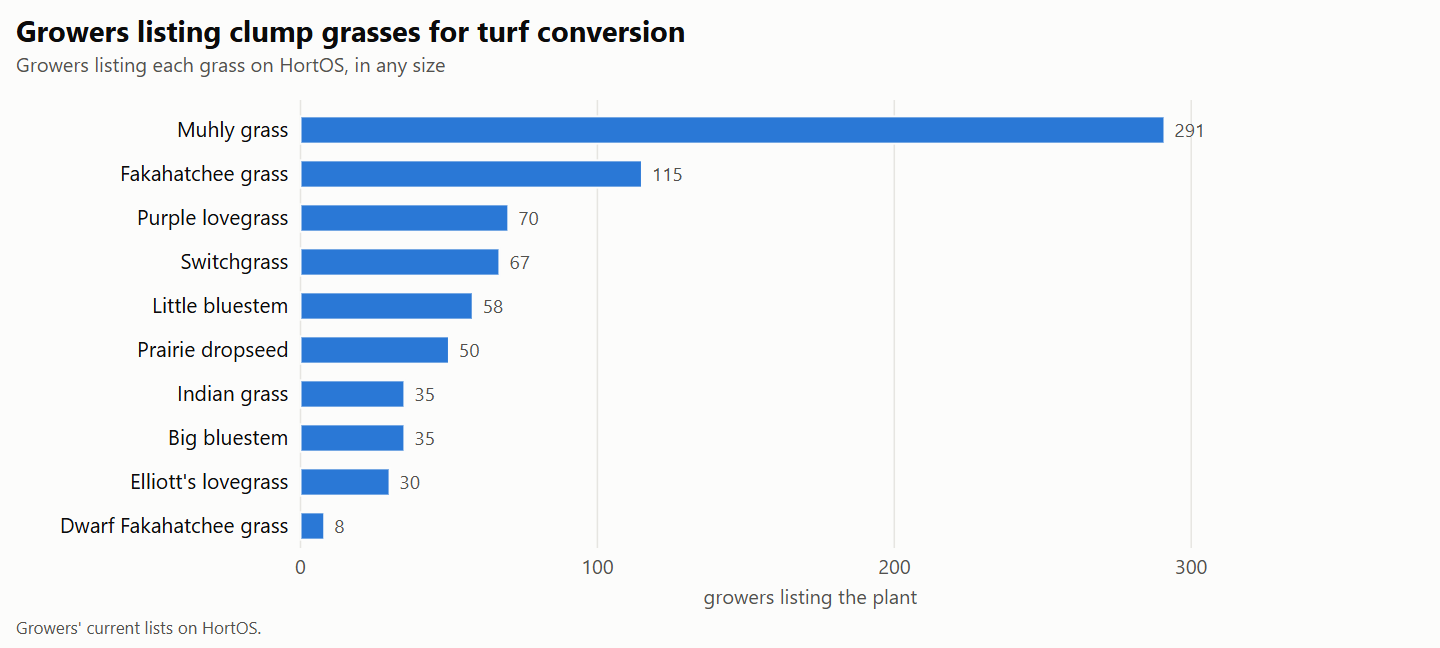
The table sets out 10 clump grasses chosen for this guide, each in the straight species and each with a price page on HortOS. For every grass, the row shows how many growers list it, the container size priced most often, and the median for that size. Prices are medians across growers' current trade lists on HortOS: one price per grower, ex tax, freight not included, with the number of growers pricing each size in brackets. Anyone can see the prices on HortOS, and only the trade can order.
| Plant | Growers listing it | Size most growers price | Median (growers pricing) |
|---|---|---|---|
| Muhly grass (Muhlenbergia capillaris) | 291 | #3 | $6.00 (165) |
| Fakahatchee grass (Tripsacum dactyloides) | 115 | #3 | $4.75 (70) |
| Dwarf Fakahatchee grass (Tripsacum floridanum) | 8 | #3 | $5.75 (4) |
| Switchgrass (Panicum virgatum) | 67 | #1 | $4.00 (15) |
| Purple lovegrass (Eragrostis spectabilis) | 70 | #1 | $3.00 (34) |
| Elliott's lovegrass (Eragrostis elliottii) | 30 | #1 | $2.90 (23) |
| Little bluestem (Schizachyrium scoparium) | 58 | #1 | $3.98 (20) |
| Prairie dropseed (Sporobolus heterolepis) | 50 | #1 | $5.00 (15) |
| Indian grass (Sorghastrum nutans) | 35 | #1 | $4.00 (11) |
| Big bluestem (Andropogon gerardii) | 35 | #1 | $3.83 (6) |
Most of the growers listing the plants in this table are in Florida and North Carolina. The size shown for each plant is the container size most growers price; field grown lines are not counted.
Muhly grass is the most widely listed of these grasses, with 291 growers listing it. Its median is $6.00 at #3 across 165 growers. Fakahatchee grass has a median of $4.75 at #3 from 70 growers. Dwarf Fakahatchee grass is priced at #3 by only 4 growers, so its median of $5.75 rests on a handful of lists. A median on so few moves when one grower changes a price.
The other grasses in the table are priced most often at the smaller container. Little bluestem has a median of $3.98 at #1 across 20 growers. Prairie dropseed has $5.00 across 15, and purple lovegrass $3.00 across 34. Switchgrass is listed by 67 growers in the straight species shown here. Few of these grasses are priced as liners or plugs on growers' lists. That is why the table shows the container size most growers price rather than a liner price.
Each state's growers are on its hub: Florida for the statutes above and Pennsylvania for the Penn State advice. A board planning beds as well as grass areas can use the guide to the native plants most widely grown in the trade, which sets grasses beside shrubs and trees.
What the figures do not show
The table prices containers, not seed, and gives no liner or plug price for most of these grasses. It shows no planting labor and none of the mowing that Penn State Extension says the first years demand. A grower count says nothing about where a grower's seed was collected. It does not show whether a line is the straight species or a selection, or how the plants were grown. A course or district that wants a local ecotype asks the grower for the seed origin, the label name and the growing medium. It gets those in writing before it orders. The guide to reading an availability list shows how growers set out sizes and names, which helps when those questions go to a sales desk.
A count here is growers listing the plant, not how many plants exist or how well it suits a site. Nativity is stated on this page only where an authority states it. That is muhly grass for Florida, from UF/IFAS Extension, and little bluestem for North America, from Penn State Extension.
What to watch for
- Reading s. 720.3075(4)(b) of the Florida Statutes (2026) as a rule about common areas, when it is written for an owner's own land.
- Planning a golf rough from fescue advice written for Pennsylvania without asking the extension service in the course's own state.
- Budgeting for the plants and not for the first-year mowing and the yearly cut that Penn State Extension describes.
- Putting a tall stand where a county or city height rule applies, a limit Penn State Extension (2024) flags.
- Setting a container median beside a seed quote as if the two bought the same result.
Getting it right
- The board or the course owner decides the area to convert. Ask the manager or superintendent to map the turf that is unwatered and out of play.
- The county or city planning office says which turf, height and landscaping rules apply. Ask it before choosing grasses.
- The state's extension service says which grasses suit the region. Ask its county agent for a list and a spacing.
- The grower says what it can grow to order and from what seed. Ask for the size, the count and the seed origin in writing.
- The contractor prices planting and the first years of mowing. Ask for those as separate lines.
A word of caution
This page reports the Florida Statutes as published in 2026 and extension advice from UF/IFAS (2024) and Penn State (2024 and 2025). None of it is a ruling on a given site. An association's attorney reads its documents, and the county planning office reads its ordinances. The state's extension service judges which grasses suit a course or campus.
Sources
- Florida Statutes s. 720.3075, Prohibited clauses in association documents: associations and Florida-friendly landscaping.
- Florida Statutes s. 373.185, Local Florida-friendly landscaping ordinances: definition, ordinances and irrigated turf.
- UF/IFAS Extension, Muhlenbergia capillaris Muhly Grass: muhly grass size and spacing.
- Penn State Extension, Meadows and Prairies: Wildlife-Friendly Alternatives to Lawn: removing lawn and establishing meadows.
- Penn State Extension, Naturalized Grass Stands for Golf Courses: golf stands, costs and mowing.
More guides

The Most Grown Native Plants in the United States, by State
A data page, not an essay: the American native plants held by the most wholesale growers, counted grower by grower and state by state from growers' current lists on HortOS, with the median trade price at the size most growers price. Two paragraphs on what the tables show and what they do not, then the tables, refreshed each edition.

Reading a Wholesale Availability List, and Pricing the Plants in a Bid
For landscape contractors, designers, estimators and students: what each column of a wholesale availability list means, how much the same plant at the same size varies between growers and states, how the low, median and high on the price pages are built, and how to carry the plant line of a bid from the list to the client.

Street Trees and Canopy: What Advanced Stock Costs and Who Holds It
A standing reference for urban forestry programs and tree nonprofits: the trees the American trade grows for streets and parks, the nursery-gate median at #15, #30, #45 and #65 and as field grown stock, how many growers in each state hold advanced stock, why lead times run to years, and what a street tree costs against a giveaway.