Planting near power lines: utility rules and the plants they name
What Georgia Power, Florida Power & Light, Dominion Energy, Santee Cooper and Eversource publish about planting near distribution and transmission lines, beside a Florida statute, a New Jersey rule as published in 2010, a California general order and a national reliability standard. Tables set the plants Georgia Power and Santee Cooper name beside grower counts and median trade prices.
Updated October 4, 2026. Figures are what the live us.hortosapp.com price and plant pages printed.
On this page
- Quick facts
- Whose line it is, and which kind
- What statute and regulation fix, and whom they bind
- Georgia Power's list beside grower counts and trade medians
- Santee Cooper's transmission list beside the same figures
- What an operator's list and a grower count leave unsaid
- What to watch for
- Getting it right
- A word of caution
- Sources
A shade tree committee is asked what residents may plant where a power line runs. The utilities, statute and rules read for this page give no single height: each sets its own limit, and the limit changes with the kind of line. Santee Cooper (South Carolina, read October 2026) permits nothing that may pass 12 feet at maturity in its transmission right of way. Eversource (Massachusetts, Connecticut and New Hampshire, 2026) describes plants of 25 feet or under as safe to grow anywhere on a property near its roadside distribution lines.
This page reports what Georgia Power, Florida Power & Light, Dominion Energy, Santee Cooper and Eversource publish. Beside them stand a Florida statute, a New Jersey rule published in 2010, a California general order, a national reliability standard and a Virginia extension publication. HortOS, a free directory of American wholesale plant growers with their published availability and trade prices, adds how many growers list most of the plants two of those operators name, with a median trade price. It is no utility's consent and no guide to work near lines.
Quick facts
| Georgia Power, border zone | Georgia Power (Georgia, undated guide, read October 2026) allows compatible plants up to 15 feet tall in the border zone of a transmission right of way, and says taller plants will be removed. |
|---|---|
| Santee Cooper, transmission | Santee Cooper (South Carolina, undated list, read October 2026) requires its written consent before anything is planted in its transmission right of way, and permits nothing there that may pass 12 feet at maturity. |
| Distribution lines | Dominion Energy (South Carolina, 2026) describes trees that grow past about 15 feet as unsuited to distribution rights of way. Eversource (Massachusetts, Connecticut and New Hampshire, 2026) asks that trees reaching 45 feet or more stand at least 30 feet from its roadside distribution lines. |
| Florida statute | Under section 163.3209, Florida Statutes (2026), no local government may adopt an ordinance or a land development regulation requiring trees or other plants that will grow past 14 feet inside the established right-of-way of an electric utility. The same section says it does not supersede local ordinances or regulations on specimen trees or historical trees (Florida Statutes, section 163.3209, 2026). |
| New Jersey, published January 2010 | As published in the New Jersey Register in January 2010, N.J.A.C. 14:5-9.6(c) says an electric distribution company "shall not allow woody plants that mature above three feet tall to grow in the wire zone" of a transmission line. The paragraph has exceptions of its own (New Jersey Board of Public Utilities, 2010). |
| Oakleaf hydrangea at trade | 75 growers list oakleaf hydrangea on HortOS. The size more of them price than any other is #3, at a median of $11.32 across 26 growers, one price per grower, ex tax. |
Whose line it is, and which kind
Georgia Power (Georgia, guide read October 2026) states the problem in a line: tall trees planted under or near power lines end up needing pruning to stay clear of the wires. Each figure below belongs to one operator, and most to one kind of line, distribution or transmission.
Georgia Power (Georgia, read October 2026) describes the wire zone of a transmission right of way, under the wires and beside the structures, as suited to low grasses and perennials. In the border zone, the rest of that right of way, it allows compatible plants up to 15 feet and says anything taller will be removed (Georgia Power, Georgia, read October 2026).
South Carolina shows the split inside one state. Dominion Energy (South Carolina, 2026) describes trees that grow past about 15 feet as unsuited to distribution rights of way and to ground near overhead lines. Santee Cooper (South Carolina, read October 2026) permits nothing in its transmission right of way that may pass 12 feet at maturity.
Eversource (Massachusetts, Connecticut and New Hampshire, 2026) ties height to distance from its roadside distribution lines: it describes plants that stay at 25 feet or under as safe to grow anywhere on a property. Trees maturing at 30 to 45 feet go 15 to 30 feet from the lines, and trees of 45 feet or more at least 30 feet away (Eversource, Massachusetts, Connecticut and New Hampshire, 2026). On a one-zone transmission right of way, the plants Eversource manages are those able to grow past 15 feet at maturity (Massachusetts, Connecticut and New Hampshire, 2026).
Ground-level transformers carry clearances of their own, given in the table for Georgia Power and Florida Power & Light. The recommended practices of Florida Power & Light (Florida, 2026) include low-growing, compact or shallow-rooted plants that cannot grow into its clear zone.
The table sets 14 such statements side by side, each in this page's own words. Every row comes from the operator's own document, or from the statute, rule or standard itself, and applies only to the lines or the place it names.
| Authority and state | Where it applies | What it says | Dated |
|---|---|---|---|
| Georgia Power, Georgia | Under the wires of a transmission right of way (wire zone) | Low grasses and perennials are the stated fit | Undated guide, read October 2026 |
| Georgia Power, Georgia | Rest of the right of way (border zone) | Plants to 15 ft; anything taller is removed | Undated guide, read October 2026 |
| Georgia Power, Georgia | Land beside a utility right-of-way (low zone) | Species that stay at 25 ft or under | Undated guide, read October 2026 |
| Georgia Power, Georgia | Transformer for underground lines | Shrubs 10 ft clear of the front and 3 ft clear of each other side | Undated guide, read October 2026 |
| Florida Power & Light, Florida | Pad-mounted transformer | A clear zone of 8 ft in front, 3 ft behind and 3 ft at each side | Page read October 2026 |
| Florida Statutes, section 163.3209 | Established electric utility right-of-way | No local rule may require planting anything that will grow past 14 ft; local rules on specimen and historical trees are not superseded | 2026 statutes |
| Dominion Energy, South Carolina | Distribution rights of way and near overhead lines | Trees taller than about 15 ft are described as unsuitable | Page read October 2026 |
| Santee Cooper, South Carolina | Transmission right of way | Nothing that may grow past 12 ft at maturity is permitted | Undated list, read October 2026 |
| Santee Cooper, South Carolina | Wire zone of transmission lines of 200 kV or more | No plantings are permitted | Undated list, read October 2026 |
| Eversource (Massachusetts, Connecticut, New Hampshire) | Property near roadside distribution lines | Plants that stay at 25 ft or under are described as safe to grow anywhere | Page read October 2026 |
| Eversource (Massachusetts, Connecticut, New Hampshire) | Roadside distribution lines | Trees of 45 ft or more stand 30 ft or further from the lines | Page read October 2026 |
| New Jersey Board of Public Utilities, N.J.A.C. 14:5-9.6 | Wire zone of a transmission line | No woody plants that mature above 3 ft, other than as the paragraph itself provides | As published in the New Jersey Register, January 2010 |
| NERC reliability standard FAC-003-5 | Transmission lines operated at 200 kV or higher | Line owners manage vegetation so that none comes inside the flash-over clearance | Version 5, read October 2026 |
| California Public Utilities Commission, General Order 95, Rule 35 | Overhead lines that cross trees and vegetation | Minimum conductor to vegetation clearances are to be kept | Revisions noted on the rule's page to January 2012 |
What statute and regulation fix, and whom they bind
Four rows of that table are not an operator's guidance. Section 163.3209 of the Florida Statutes (2026) limits what local governments may require. They may not adopt an ordinance or a land development regulation that requires planting "a tree or other vegetation that will achieve a height greater than 14 feet" in the established right-of-way of an electric utility (Florida, 2026). The section adds that it does not supersede local ordinances or regulations governing specimen trees or historical trees (Florida Statutes, section 163.3209, 2026).
As published in the New Jersey Register in January 2010, N.J.A.C. 14:5-9.6(c) says an electric distribution company "shall not allow woody plants that mature above three feet tall to grow in the wire zone" of a transmission line. The paragraph has exceptions of its own (N.J.A.C. 14:5-9.6(c), New Jersey, 2010). In the same notice the Board of Public Utilities (New Jersey, published January 19, 2010) said the three foot limit had not been amended and applies to woody plants only. The Board said too (New Jersey, 2010) that a company can let a tree that grows taller than 15 feet stay in the border zone, where it finds the tree meets the standards of integrated vegetation management.
NERC reliability standard FAC-003-5 (United States, version 5, read October 2026) applies to every overhead transmission line run at 200 kV or higher and to certain lines below that voltage. It requires vegetation to be managed so that none comes inside the flash-over clearance (NERC, FAC-003-5, read October 2026). Where overhead conductors pass through trees and vegetation in California, Rule 35 of General Order 95 (California Public Utilities Commission, revisions noted to January 2012) says minimum clearances between line conductors and vegetation shall be maintained.
Georgia Power's list beside grower counts and trade medians
Georgia Power's guide (Georgia, undated, read October 2026) carries a list of 38 recommended trees and shrubs, with a line telling readers not to plant directly under overhead lines. A listed tree is considered for the easement only where it stands in a landscaped area, and one that right-of-way crews could take for brush is likely to be cut down (Georgia Power, Georgia, read October 2026). Georgia Power (Georgia, read October 2026) also tells readers to keep to the exact cultivar listed, because others may not be compatible, and says its permission for plantings can be changed or withdrawn at any time.
The table shows 28 of the 38 entries, and 10 are not shown. Each row is matched to this site's page for the same species or the same named cultivar, and rows run from most growers to fewest. Georgia Power's guide gives a mature height for every entry; the guide is linked under Sources. Prices are medians across growers' current trade lists on HortOS: one price per grower, ex tax, freight not included, with the number of growers pricing each size in brackets. Grower counts are the growers listing each plant on HortOS, in any size.
The growers listing the plants in this table are spread across many states; the most are in Florida, North Carolina and Georgia. The size shown for each plant is the container size most growers price; field grown lines are not counted.
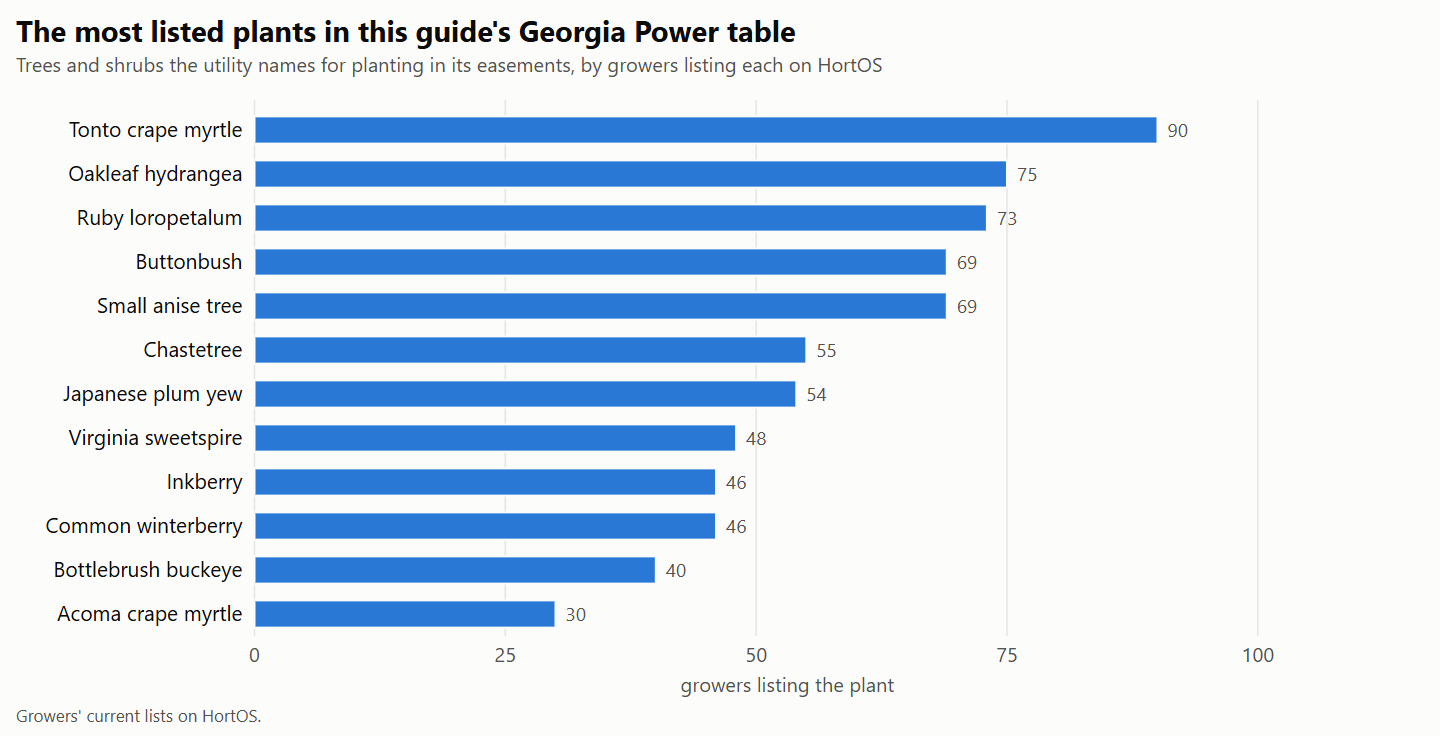
Tonto crape myrtle has the most growers in the table: 90 list it, and the size more of them price than any other is #15, at a median of $65 across 22 growers. A median needs three growers pricing one size, so the 6 rows marked Fewer than three growers carry a count and no price. A median on fewer than five growers is thin: forsythia rests on 4 growers, gardenia on 3 and doublefile viburnum on 3. Anyone can see the prices on HortOS, and only the trade can order.
Georgia Power (Georgia, read October 2026) gives oakleaf hydrangea a mature height of 12 feet, and the crape myrtles Acoma and Tonto 10 feet each. The # numbers in the size column are container classes; the guide to nursery pot sizes explains them and writes #3 as 3G. Sizes differ from row to row, so two rows' medians are not like for like. The medians are national figures, not Georgia prices.
Santee Cooper's transmission list beside the same figures
Santee Cooper's list (South Carolina, undated, read October 2026) is for its transmission right of way, and its conditions come before its plants. Santee Cooper (South Carolina, read October 2026) requires its written consent before any vegetation goes into that right of way. It permits no planting in the wire zone of lines of 200 kV or more, and nothing in the right of way that may pass 12 feet at maturity (Santee Cooper, South Carolina, read October 2026). It says its list is not complete, and that a plant which grows past 12 feet may be removed whether or not the list names it (Santee Cooper, South Carolina, read October 2026).
The table shows 25 of the 28 entries on that list, each matched at species level to a page on this site, and 3 are not shown. The height column is Santee Cooper's own mature height for each plant (South Carolina, read October 2026). The other columns are HortOS figures on the same basis as the table above.
| Plant | Mature height on Santee Cooper's transmission list (South Carolina, read 2026) | Growers listing it | Size most growers price | Median (growers pricing) |
|---|---|---|---|---|
| Pink muhly (Muhlenbergia capillaris) | 4 ft | 291 | #3 | $6.00 (165) |
| American beautyberry (Callicarpa americana) | 8 to 10 ft | 132 | #3 | $9.00 (63) |
| Dwarf palmetto (Sabal minor) | 5 ft | 81 | #7 | $35 (44) |
| Oakleaf hydrangea (Hydrangea quercifolia) | 6 ft | 75 | #3 | $11.32 (26) |
| Little bluestem (Schizachyrium scoparium) | 2 to 4 ft | 58 | #1 | $3.98 (20) |
| Virginia sweetspire (Itea virginica) | 8 ft | 48 | #3 | $12.13 (14) |
| Inkberry (Ilex glabra) | 10 ft | 46 | #3 | $12 (13) |
| Elderberry (Sambucus canadensis) | 5 to 12 ft | 45 | #3 | $15 (11) |
| Coastal sweet-pepperbush (Clethra alnifolia) | 10 ft | 44 | #3 | $22 (9) |
| Bottlebrush buckeye (Aesculus parviflora) | 6 to 12 ft | 40 | #3 | $22.48 (8) |
| Needle palm (Rhapidophyllum hystrix) | 5 to 10 ft | 40 | #15 | $91 (20) |
| Dwarf fothergilla (Fothergilla gardenii) | 6 to 10 ft | 36 | #3 | $18 (9) |
| Sweetshrub (Calycanthus floridus) | 3 to 9 ft | 32 | #3 | $13.75 (8) |
| Chokeberry (Aronia arbutifolia) | 6 to 10 ft | 27 | #3 | $14 (9) |
| Smooth hydrangea (Hydrangea arborescens) | 5 ft | 23 | Fewer than three growers | |
| Anise tree (Illicium floridanum) | 6 to 10 ft | 23 | #3 | $9.50 (13) |
| Sasanqua camellia (Camellia sasanqua) | 2 to 12 ft | 22 | #3 | $15.75 (6) |
| Scarlet rose mallow (Hibiscus coccineus) | 2 to 8 ft | 20 | #1 | $3.25 (7) |
| Fetterbush (Lyonia lucida) | 3 to 6 ft | 14 | #3 | $10 (5) |
| Possumhaw (Ilex decidua) | 6 to 10 ft | 13 | Fewer than three growers | |
| American snowbell (Styrax americanus) | 10 ft | 12 | Fewer than three growers | |
| Mapleleaf viburnum (Viburnum acerifolium) | 2 to 6 ft | 10 | #3 | $17.50 (3) |
| Florida doghobble (Agarista populifolia) | 12 ft | 9 | #3 | $10 (3) |
| Drooping leucothoe (Leucothoe fontanesiana) | 3 to 6 ft | 7 | Fewer than three growers | |
| Bush honeysuckle (Diervilla sessilifolia) | 3 to 4 ft | 5 | Fewer than three growers |
Most of the growers listing the plants in this table are in Florida, North Carolina and Maryland. The size shown for each plant is the container size most growers price; field grown lines are not counted, and palms and other plants sold by height are not priced above #15.
Pink muhly has the most growers in this table, with 291 listing it. The median for mapleleaf viburnum rests on 3 growers and the one for Florida doghobble on 3, so one grower's change of price moves either. In 5 rows there is a count and no median.
The list applies in South Carolina, and the medians beside it are national. No count in either plant table shows a grower inside the territory of Santee Cooper or of any other utility. The hubs for South Carolina, Georgia and Florida show each state's growers.
What an operator's list and a grower count leave unsaid
HortOS gives no mature height. Every mature height given for a plant on this page is an operator's, and operators differ on the same plant. Oakleaf hydrangea is 12 feet on Georgia Power's list (Georgia, read October 2026) and 6 feet on Santee Cooper's (South Carolina, read October 2026). A median is the price of one container size and says nothing about the size a plant reaches.
A row in either plant table is not consent to plant at any address. Georgia Power and Santee Cooper each keep that decision for their own easement or right of way, on the conditions set beside their lists (Georgia and South Carolina, read October 2026).
Each count belongs to one page, for a species or for a named cultivar. Growers who list other cultivars of gardenia, forsythia, camellia, azalea, crape myrtle or loropetalum are not counted in those rows. The cultivar is what Georgia Power (Georgia, read October 2026) tells readers to match. A count here is growers listing the plant, not how many plants exist or how well it suits a site.
Authorities also differ in what they leave out. Virginia Cooperative Extension (Virginia, 2024) leaves Japanese maple and crape myrtle out of its recommendations for planting near utility lines. It adds (Virginia Cooperative Extension, Virginia, 2024) that omission does not necessarily mean a species is incompatible with those lines. Georgia Power's list (Georgia, read October 2026) names the crape myrtles Acoma and Tonto and a laceleaf Japanese maple.
Such recommendations are regional. Virginia Cooperative Extension (Virginia, 2024) chose its species for the Mid-Atlantic region, and consulted the nursery lists of the Virginia and North Carolina nursery and landscape associations to judge whether each could be bought. The operators read for this page are in Georgia, Florida, South Carolina and the states Eversource serves, and each utility sets its own figures.
Virginia has five utility arboretums, holding more than 300 specimens across 190 species and cultivars (Virginia Cooperative Extension, Virginia, 2024). Eversource said in a Massachusetts news release of 2022 that it keeps four public utility arboreta, one of them on the UMass Amherst campus. The guide to street trees and canopy covers the taller trees the trade grows for streets and parks.
What to watch for
- Carrying one utility's height to another's line. Georgia Power (Georgia, read October 2026) allows 15 feet in its border zone, and Santee Cooper (South Carolina, read October 2026) permits nothing that may pass 12 feet in its transmission right of way.
- Reading a distribution figure as a transmission figure. The figures for the two kinds of line differ, and the first table says where each one applies.
- Taking a listed plant for consent. Santee Cooper (South Carolina, read October 2026) says a plant that grows past 12 feet may be removed whether its list names it or not.
- Swapping one cultivar for another. Georgia Power (Georgia, read October 2026) says cultivars other than the one it lists may not be compatible.
- Reading Florida's 14 feet as a planting limit on owners. The sentence in section 163.3209, Florida Statutes (2026), is about what a local government may require to be planted.
Getting it right
- Ask the utility that owns the line whether it is a distribution or a transmission line, and where its right of way or easement runs.
- Read that utility's own planting document for its height limit, its distances and its clear zone around a transformer.
- Ask whether written consent is needed before planting, as Santee Cooper (South Carolina, read October 2026) requires in its right of way.
- Take the mature height from the operator's own list, and the exact cultivar where the list names one.
- Open a plant's price page from the tables to see the sizes growers price, and set a quote beside the current medians with the price check.
- Ask the grower, through its page in the directory, for the cultivar name as labeled and the container size. The grower decides price, minimum order and terms, which the guide to buying from a wholesale grower covers.
A word of caution
Every height, distance and rule on this page belongs to the operator or the instrument named with it, and applies only to the lines or the place named there. Georgia Power (Georgia, read October 2026) says its permission for plantings in its easements can be changed or withdrawn, and Santee Cooper (South Carolina, read October 2026) requires its written consent in its right of way. For any other line, the utility that owns it is the one to ask; New Jersey's rule is reported as published in January 2010, and the Board of Public Utilities is the authority on how it reads now. The counts and medians beside Georgia Power's and Santee Cooper's lists are national figures as HortOS showed them, and they fix no grower's price or terms.
Sources
- Georgia Power, Plant the Right Tree in the Right Place: right-of-way zones and plant list.
- Florida Power & Light, Right Tree, Right Place: transformer clear zone and plants.
- Florida Legislature, Florida Statutes, section 163.3209: local planting rules in rights-of-way.
- Dominion Energy, South Carolina Tree Trimming: distribution right-of-way height limit.
- Santee Cooper, Planting Near Transmission Lines: transmission right-of-way planting list.
- Eversource, Planting Guidance for Property Owners: distances from roadside distribution lines.
- Eversource, Transmission System Vegetation Management: transmission right-of-way maintenance zones.
- Eversource, Massachusetts news release of April 27, 2022: utility arboreta in Massachusetts.
- New Jersey Board of Public Utilities, adopted amendments to N.J.A.C. 14:5-9.2 and 14:5-9.6 (courtesy copy of the adoption, New Jersey Register of January 19, 2010): transmission wire zone and border zone.
- North American Electric Reliability Corporation, Reliability Standard FAC-003-5, Transmission Vegetation Management: vegetation near high-voltage transmission lines.
- California Public Utilities Commission, General Order 95, Rule 35, Vegetation Management: conductor to vegetation clearances.
- Virginia Cooperative Extension (Virginia Tech and Virginia State University), Selecting and Managing Trees to Avoid Conflicts with Overhead Utility Lines (publication 430-029): omitted species and utility arboretums.
More guides

Nursery Pot Sizes Explained: Millimetres, Litres and Gallons
Australian growers name a pot by its rim diameter up to 400 mm and by its volume in litres above that, while American growers use gallon classes. This guide explains each step of the ladder, the approximate height and age behind it, how to convert between systems, and what the trade pays at every size.

Street Trees and Canopy: What Advanced Stock Costs and Who Holds It
A standing reference for urban forestry programs and tree nonprofits: the trees the American trade grows for streets and parks, the nursery-gate median at #15, #30, #45 and #65 and as field grown stock, how many growers in each state hold advanced stock, why lead times run to years, and what a street tree costs against a giveaway.

Buying From a Wholesale Grower When You Are Not in the Trade
Native plant societies, watershed districts, land trusts, schools and church committees can buy from wholesale growers when they order like the trade: in quantity, ahead of the season, on the grower's terms. This page explains who sells to whom, resale certificates and exemptions, minimums and pooling, the sizes to buy, straight species and ecotype, lead times and shipping.