Deer Resistant Plants for the Northeast by Rating and Trade Price
Rutgers Cooperative Extension (New Jersey, 2003) rates landscape plants in four classes by how often deer damage them. This page sets those ratings beside how many growers list each plant and, where enough growers price a size, its median trade price. It shows where a Maryland list and a New York county list differ, and what a rating leaves out.
Updated October 10, 2026. Figures are what the live us.hortosapp.com price and plant pages printed.
On this page
A Master Gardener staffing a county help desk in New Jersey is asked which shrubs the deer will leave alone, and what growers charge for them. Rutgers Cooperative Extension answers the first half with a rating, not a promise. Its list sorts landscape plants into four classes by how often and how badly deer damage them. A damage rating ranks how often deer damage a plant; it does not promise that deer will leave it alone.
This page reports the ratings Rutgers Cooperative Extension published as bulletin E271 in 2003 and keeps online. It sets them beside what Maryland Cooperative Extension, University of Maryland Extension, the Maryland Department of Natural Resources, Cornell Cooperative Extension Warren County and UConn Extension have published on deer and plants. HortOS, a free directory of American wholesale plant growers with their published availability and trade prices, adds how many growers list each plant shown and, where enough price a size, its median trade price. It is not planting advice, and it reprints no list in full.
Quick facts
| The scale | Rutgers Cooperative Extension rates landscape plants in four classes, lettered A to D: Rarely Damaged, Seldom Severely Damaged, Occasionally Severely Damaged and Frequently Severely Damaged (New Jersey, bulletin E271, 2003). |
|---|---|
| The size of the list | The Rutgers list held 527 entries when read on October 4, 2026: 168 rated Rarely Damaged, 228 Seldom Severely Damaged, 115 Occasionally Severely Damaged and 16 Frequently Severely Damaged. |
| The limit of a rating | Rutgers says "no plant is deer proof" and ties results to local deer populations and the weather (New Jersey, 2003). University of Maryland Extension (2026) says no plant is deer-proof, and UConn Extension (Connecticut, 2016) says none is completely deer proof. |
| Who compiled it | Rutgers drew up the list with nursery and landscape professionals, extension personnel and Master Gardeners in northern New Jersey. Its publication record dates the six-page bulletin, E271, to April 25, 2003. |
| Lists differ by place | Eastern white pine is Seldom Severely Damaged on the Rutgers list (New Jersey, 2003), Frequently Damaged in Maryland Cooperative Extension's Fact Sheet 655 (2003) and Occasionally Damaged on the Cornell Cooperative Extension Warren County list (New York, 2025). |
| On growers' lists | Arrowwood viburnum, rated Rarely Damaged by Rutgers (New Jersey, 2003), was listed by 66 growers across the United States on HortOS. Its national median trade price at #3 was $16 across 17 growers, ex tax, freight not included. |
How Rutgers arrives at a rating
Rutgers Cooperative Extension describes its list as landscape plants rated by how well they resist deer damage. The Rutgers publication record dates it to April 25, 2003, as bulletin E271. The live list carries no date of its own, and this page read it on October 4, 2026. The tables below print each rating under a header that carries the bulletin's year.
Each entry carries a name, a plant type and one of the four ratings. On that date the list sorted its entries into ten plant types, among them 134 shrubs, 91 trees and 158 perennials. Some entries are species, some are whole genera and some are named cultivars, and a rating belongs to the entry as Rutgers names it. Rutgers (New Jersey, 2003) rates fothergilla and sweet pepperbush as genera, both Seldom Severely Damaged.
Rutgers (New Jersey, 2003) says no plant is deer proof, and that plants in the first two classes are the better choice for a landscape where deer damage is likely. Rutgers (New Jersey, 2003) says plants in the last two classes are often the ones deer prefer and call for added protection, such as a fence or a repellent.
Lower-damage ratings beside growers and trade prices
Shrubs
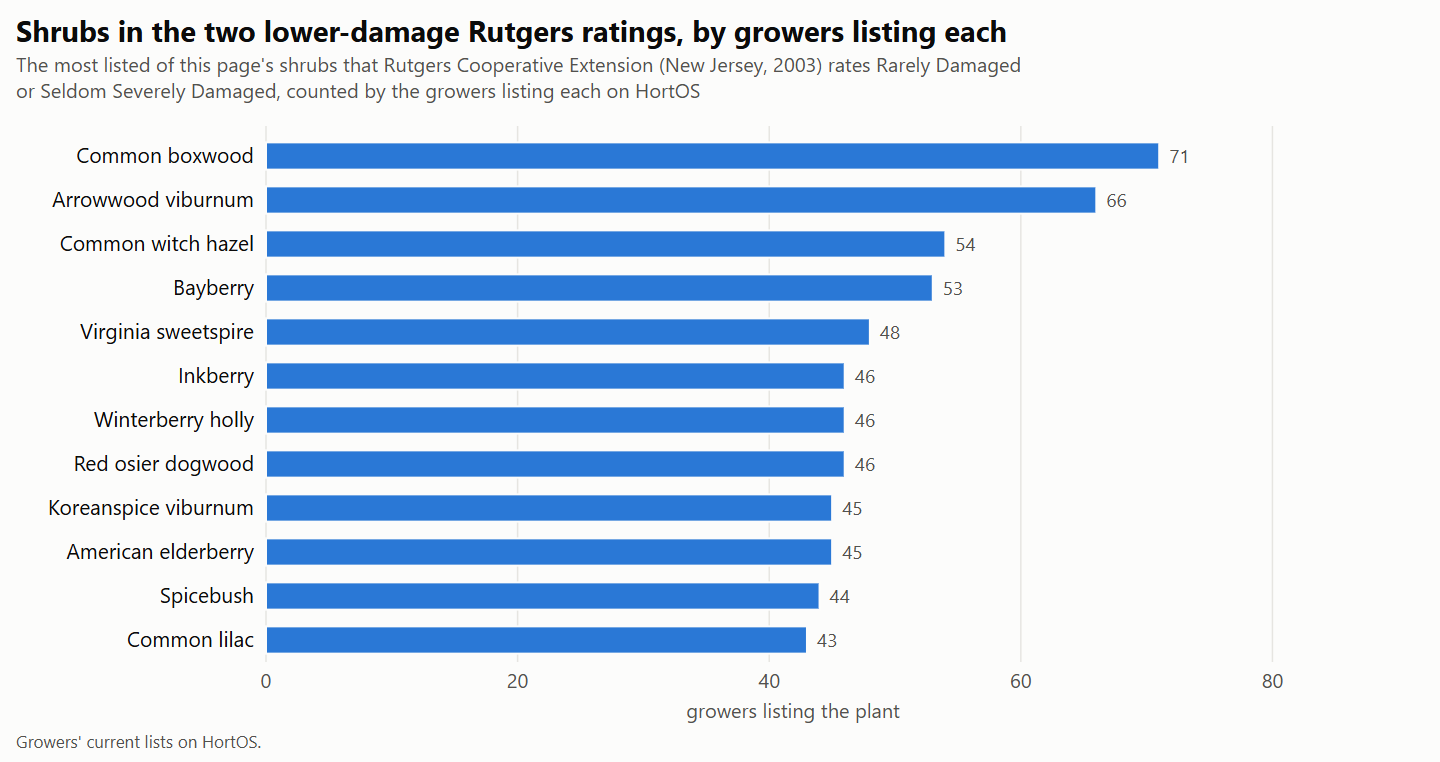
The first table holds 26 shrubs that Rutgers rates Rarely Damaged or Seldom Severely Damaged and that have a plant page on HortOS. Shrubs in wide use and the natives of the region were taken first. The 10 Rarely Damaged rows come first, then the 16 rated Seldom Severely Damaged. Rutgers has another 77 shrub entries in those two classes that are not shown, and its full list is linked under Sources. Prices are medians across growers' current trade lists on HortOS: one price per grower, ex tax, freight not included, with the number of growers pricing each size in brackets. Anyone can see the prices on HortOS, and only the trade can order.
| Plant | Rutgers rating (2003) | Growers listing it | Size most growers price | Median (growers pricing) |
|---|---|---|---|---|
| Arrowwood viburnum (Viburnum dentatum) | Rarely Damaged | 66 | #3 | $16 (17) |
| Bayberry (Myrica pensylvanica) | Rarely Damaged | 53 | #3 | $19.98 (16) |
| Common boxwood (Buxus sempervirens) | Rarely Damaged | 71 | #1 | $4.38 (6) |
| Fragrant sumac (Rhus aromatica) | Rarely Damaged | 25 | #3 | $17.48 (4) |
| Japanese pieris (Pieris japonica) | Rarely Damaged | 20 | #5 | $25 (3) |
| Russian cypress (Microbiota decussata) | Rarely Damaged | 17 | #3 | $18.90 (4) |
| Japanese plum yew (Cephalotaxus harringtonia) | Rarely Damaged | 6 | Fewer than three growers | |
| Drooping leucothoe (Leucothoe fontanesiana) | Rarely Damaged | 7 | Fewer than three growers | |
| Blue mist shrub (Caryopteris x clandonensis) | Rarely Damaged | 9 | Fewer than three growers | |
| Moonglow juniper (Juniperus scopulorum 'Moonglow') | Rarely Damaged | 28 | #3 | $13.50 (6) |
| Inkberry (Ilex glabra) | Seldom Severely Damaged | 46 | #3 | $12 (13) |
| Winterberry holly (Ilex verticillata) | Seldom Severely Damaged | 46 | #3 | $18.98 (8) |
| Virginia sweetspire (Itea virginica) | Seldom Severely Damaged | 48 | #3 | $12.13 (14) |
| Common witch hazel (Hamamelis virginiana) | Seldom Severely Damaged | 54 | #3 | $22 (11) |
| Koreanspice viburnum (Viburnum carlesii) | Seldom Severely Damaged | 45 | #3 | $16 (14) |
| Coast leucothoe (Leucothoe axillaris) | Seldom Severely Damaged | 30 | #3 | $24.70 (11) |
| Red chokeberry (Aronia arbutifolia) | Seldom Severely Damaged | 27 | #3 | $14 (9) |
| Spicebush (Lindera benzoin) | Seldom Severely Damaged | 44 | #3 | $18 (16) |
| Red osier dogwood (Cornus sericea) | Seldom Severely Damaged | 46 | #3 | $18 (9) |
| Common sweetshrub (Calycanthus floridus) | Seldom Severely Damaged | 32 | #3 | $13.75 (8) |
| American elderberry (Sambucus canadensis) | Seldom Severely Damaged | 45 | #3 | $15 (11) |
| Blackhaw viburnum (Viburnum prunifolium) | Seldom Severely Damaged | 30 | #3 | $16 (7) |
| Snowberry (Symphoricarpos albus) | Seldom Severely Damaged | 19 | #5 | $16 (3) |
| Shrubby St. John's wort (Hypericum prolificum) | Seldom Severely Damaged | 14 | #1 | $6.00 (3) |
| Common lilac (Syringa vulgaris) | Seldom Severely Damaged | 43 | #5 | $25 (7) |
| Mugo pine (Pinus mugo) | Seldom Severely Damaged | 42 | #3 | $19.33 (6) |
The growers listing the plants in this table are spread across many states; the most are in New Jersey, North Carolina and Oregon. The size shown for each plant is the container size most growers price; field grown lines are not counted.
A median needs three growers pricing a size. A row that reads Fewer than three growers has too few growers pricing any one size, and shows no price. Where the bracket shows fewer than five growers the median is thin, and it moves when a single grower changes a price. Japanese pieris, Russian cypress, fragrant sumac, snowberry and shrubby St. John's wort are such rows. The guide to nursery pot sizes describes the container classes in which these shrubs are priced. Where container sizes are priced by the same number of growers the smallest is shown: common boxwood here, and later Allegheny serviceberry, sugar maple, blue oat grass, northern red oak and sweetgum.
University of Maryland Extension (2026) places red chokeberry, spicebush, elderberry and blackhaw, all in this table, among native woody plants that usually escape significant browsing. The guide to the most grown native plants by state shows which natives the most growers list nationally and by state, New Jersey and Pennsylvania among them.
Trees
The second table holds 24 trees in the same two ratings, with natives and the spruces taken first. Rutgers has 28 more tree entries in those ratings that are not shown. Rutgers (New Jersey, 2003) files bottlebrush buckeye under trees and rates dwarf Alberta spruce by its cultivar name.
| Plant | Rutgers rating (2003) | Growers listing it | Size most growers price | Median (growers pricing) |
|---|---|---|---|---|
| American holly (Ilex opaca) | Rarely Damaged | 34 | #3 | $29.75 (6) |
| Bottlebrush buckeye (Aesculus parviflora) | Rarely Damaged | 40 | #3 | $22.48 (8) |
| Dwarf Alberta spruce (Picea glauca 'Conica') | Rarely Damaged | 62 | #3 | $22.45 (16) |
| Katsura tree (Cercidiphyllum japonicum) | Rarely Damaged | 21 | Field grown only | |
| Pawpaw (Asimina triloba) | Rarely Damaged | 49 | #3 | $16 (15) |
| Red pine (Pinus resinosa) | Rarely Damaged | 8 | Field grown only | |
| River birch (Betula nigra) | Rarely Damaged | 114 | #30 | $125 (20) |
| Paper birch (Betula papyrifera) | Rarely Damaged | 19 | Fewer than three growers | |
| Pitch pine (Pinus rigida) | Rarely Damaged | 8 | Fewer than three growers | |
| Norway spruce (Picea abies) | Seldom Severely Damaged | 95 | #3 | $25 (9) |
| Colorado blue spruce (Picea pungens) | Seldom Severely Damaged | 52 | #1 | $6.88 (4) |
| White spruce (Picea glauca) | Seldom Severely Damaged | 42 | Field grown only | |
| Serbian spruce (Picea omorika) | Seldom Severely Damaged | 35 | Field grown only | |
| Allegheny serviceberry (Amelanchier laevis) | Seldom Severely Damaged | 36 | #1 | $10.50 (3) |
| Shadbush (Amelanchier canadensis) | Seldom Severely Damaged | 35 | #3 | $21.98 (4) |
| Eastern red cedar (Juniperus virginiana) | Seldom Severely Damaged | 151 | #15 | $65 (27) |
| Eastern white pine (Pinus strobus) | Seldom Severely Damaged | 80 | #3 | $18 (7) |
| Red maple (Acer rubrum) | Seldom Severely Damaged | 152 | #15 | $60 (20) |
| Sugar maple (Acer saccharum) | Seldom Severely Damaged | 63 | #5 | $35 (4) |
| Tulip tree (Liriodendron tulipifera) | Seldom Severely Damaged | 134 | #15 | $60 (22) |
| Sourwood (Oxydendrum arboreum) | Seldom Severely Damaged | 39 | #7 | $39 (7) |
| Sassafras (Sassafras albidum) | Seldom Severely Damaged | 24 | #5 | $35 (6) |
| Dawn redwood (Metasequoia glyptostroboides) | Seldom Severely Damaged | 66 | #15 | $75 (9) |
| Douglas fir (Pseudotsuga menziesii) | Seldom Severely Damaged | 25 | Field grown only |
The growers listing the plants in this table are spread across many states; the most are in Florida, North Carolina and Oregon. The size shown for each plant is the container size most growers price; field grown lines are not counted. Where a row says Field grown only, its growers price that plant as field grown stock and no container median is shown.
A median is printed for 17 of the 24 trees. In 5 rows the cell reads Field grown only: the only priced sizes for those trees are field grown, a class that pools every caliper, so no median is printed. For many trees on this page, more growers price field grown than the container size shown. The container size most growers price differs by tree, #3 for Norway spruce and #30 for river birch, so the medians are not for like sizes. Those for Colorado blue spruce, Allegheny serviceberry, shadbush and sugar maple rest on fewer than five growers.
Perennials, ferns and grasses
The third table holds 33 perennials, groundcovers, ferns and ornamental grasses in the same two ratings, Rarely Damaged first. Rutgers has 147 more entries of those types and ratings that are not shown. Rutgers (New Jersey, 2003) rates catmint as a genus, and its row is the genus page. The Rutgers list (New Jersey, 2003) holds 10 ferns, each rated Rarely Damaged, and UConn Extension (Connecticut, 2016) says nearly all ornamental grasses and ferns resist deer damage well.
| Plant | Rutgers rating (2003) | Growers listing it | Size most growers price | Median (growers pricing) |
|---|---|---|---|---|
| False indigo (Baptisia australis) | Rarely Damaged | 41 | #1 | $6.00 (9) |
| Bleeding heart (Dicentra spectabilis) | Rarely Damaged | 16 | #1 | $8.61 (4) |
| Russian sage (Perovskia atriplicifolia) | Rarely Damaged | 57 | #1 | $6.00 (9) |
| Wild ginger (Asarum canadense) | Rarely Damaged | 14 | #1 | $6.50 (3) |
| Adam's needle yucca (Yucca filamentosa) | Rarely Damaged | 35 | #3 | $11 (15) |
| Catmint (Nepeta) | Rarely Damaged (rated as a genus) | 50 | Fewer than three growers | |
| Threadleaf coreopsis (Coreopsis verticillata) | Rarely Damaged | 13 | Fewer than three growers | |
| Lamb's ear (Stachys byzantina) | Rarely Damaged | 14 | Fewer than three growers | |
| Bearberry (Arctostaphylos uva-ursi) | Rarely Damaged | 19 | #1 | $3.65 (4) |
| Christmas fern (Polystichum acrostichoides) | Rarely Damaged | 44 | #1 | $6.94 (12) |
| Cinnamon fern (Osmunda cinnamomea) | Rarely Damaged | 34 | #1 | $6.49 (10) |
| Ostrich fern (Matteuccia struthiopteris) | Rarely Damaged | 35 | #2 | $13.82 (6) |
| Sensitive fern (Onoclea sensibilis) | Rarely Damaged | 29 | #1 | $8.00 (7) |
| Royal fern (Osmunda regalis) | Rarely Damaged | 30 | #1 | $6.99 (7) |
| Marginal wood fern (Dryopteris marginalis) | Rarely Damaged | 20 | Liner | $1.19 (4) |
| Little bluestem (Schizachyrium scoparium) | Rarely Damaged | 58 | #1 | $3.98 (20) |
| Switchgrass (Panicum virgatum) | Rarely Damaged | 67 | #1 | $4.00 (15) |
| Indian grass (Sorghastrum nutans) | Rarely Damaged | 35 | #1 | $4.00 (11) |
| Northern sea oats (Chasmanthium latifolium) | Rarely Damaged | 71 | #1 | $4.63 (22) |
| Hakone grass (Hakonechloa macra) | Rarely Damaged | 25 | #1 | $10.95 (3) |
| Blue fescue (Festuca glauca) | Rarely Damaged | 35 | #1 | $4.80 (3) |
| Blue oat grass (Helictotrichon sempervirens) | Rarely Damaged | 36 | #1 | $5.83 (4) |
| Purple coneflower (Echinacea purpurea) | Seldom Severely Damaged | 55 | #1 | $4.80 (13) |
| Butterfly weed (Asclepias tuberosa) | Seldom Severely Damaged | 71 | #1 | $4.50 (21) |
| Swamp milkweed (Asclepias incarnata) | Seldom Severely Damaged | 58 | #1 | $4.75 (18) |
| Common yarrow (Achillea millefolium) | Seldom Severely Damaged | 42 | #1 | $4.25 (3) |
| Foamflower (Tiarella cordifolia) | Seldom Severely Damaged | 15 | #1 | $8.00 (3) |
| Virginia bluebells (Mertensia virginica) | Seldom Severely Damaged | 12 | Liner | $2.36 (3) |
| Stokes' aster (Stokesia laevis) | Seldom Severely Damaged | 22 | #1 | $4.74 (8) |
| Lance coreopsis (Coreopsis lanceolata) | Seldom Severely Damaged | 32 | #1 | $3.88 (12) |
| Sneezeweed (Helenium autumnale) | Seldom Severely Damaged | 17 | #1 | $4.13 (4) |
| Plumbago (Ceratostigma plumbaginoides) | Seldom Severely Damaged | 40 | #1 | $6.07 (7) |
| Bee balm (Monarda didyma) | Seldom Severely Damaged | 20 | Fewer than three growers |
The growers listing the plants in this table are spread across many states; the most are in Florida, Pennsylvania and New Jersey. The size shown for each plant is the container size most growers price; field grown lines are not counted, and palms and other plants sold by height are not priced above #15.
The medians for bleeding heart, wild ginger, bearberry, Hakone grass, blue fescue, blue oat grass, common yarrow, foamflower and sneezeweed rest on fewer than five growers each. So do those for marginal wood fern and Virginia bluebells, which are medians for liners, not for #1 containers.
Plants in the two higher-damage ratings
The fourth table reports the other end of the scale: 19 shrubs, trees and perennials that Rutgers rates Frequently Severely Damaged or Occasionally Severely Damaged, the Frequently Severely Damaged rows first. Rutgers has 87 more entries of those types in the two ratings that are not shown. Rutgers (New Jersey, 2003) rates yews and hosta as genera, and each of those rows is the genus page. One row, Nellie R. Stevens holly, is a cultivar that Rutgers rates by name.
| Plant | Rutgers rating (2003) | Growers listing it | Size most growers price | Median (growers pricing) |
|---|---|---|---|---|
| American arborvitae (Thuja occidentalis) | Frequently Severely Damaged | 32 | Fewer than three growers | |
| Yews (Taxus) | Frequently Severely Damaged (rated as a genus) | 26 | Fewer than three growers | |
| Hosta | Frequently Severely Damaged (rated as a genus) | 61 | #1 | $6.00 (5) |
| Pinxterbloom azalea (Rhododendron periclymenoides) | Frequently Severely Damaged | 11 | Fewer than three growers | |
| Bigleaf hydrangea (Hydrangea macrophylla) | Occasionally Severely Damaged | 30 | #3 | $14 (3) |
| Panicle hydrangea (Hydrangea paniculata) | Occasionally Severely Damaged | 26 | Fewer than three growers | |
| Oakleaf hydrangea (Hydrangea quercifolia) | Occasionally Severely Damaged | 75 | #3 | $11.32 (26) |
| Mountain laurel (Kalmia latifolia) | Occasionally Severely Damaged | 19 | #2 | $21.50 (4) |
| Rosebay rhododendron (Rhododendron maximum) | Occasionally Severely Damaged | 18 | #3 | $17.63 (6) |
| Highbush blueberry (Vaccinium corymbosum) | Occasionally Severely Damaged | 25 | #3 | $18 (7) |
| Nellie R. Stevens holly (Ilex 'Nellie R. Stevens') | Occasionally Severely Damaged | 249 | #15 | $65 (62) |
| Eastern hemlock (Tsuga canadensis) | Occasionally Severely Damaged | 39 | #3 | $13.50 (5) |
| Western arborvitae (Thuja plicata) | Occasionally Severely Damaged | 28 | Field grown only | |
| Eastern redbud (Cercis canadensis) | Occasionally Severely Damaged | 194 | #15 | $77.50 (28) |
| Flowering dogwood (Cornus florida) | Occasionally Severely Damaged | 52 | #5 | $40 (4) |
| White fringe tree (Chionanthus virginicus) | Occasionally Severely Damaged | 69 | #3 | $20 (12) |
| Northern red oak (Quercus rubra) | Occasionally Severely Damaged | 102 | #3 | $12.50 (7) |
| White oak (Quercus alba) | Occasionally Severely Damaged | 113 | #15 | $60 (14) |
| Sweetgum (Liquidambar styraciflua) | Occasionally Severely Damaged | 89 | #3 | $11 (10) |
The growers listing the plants in this table are spread across many states; the most are in North Carolina, Florida and Tennessee. The size shown for each plant is the container size most growers price; field grown lines are not counted. Where a row says Field grown only, its growers price that plant as field grown stock and no container median is shown.
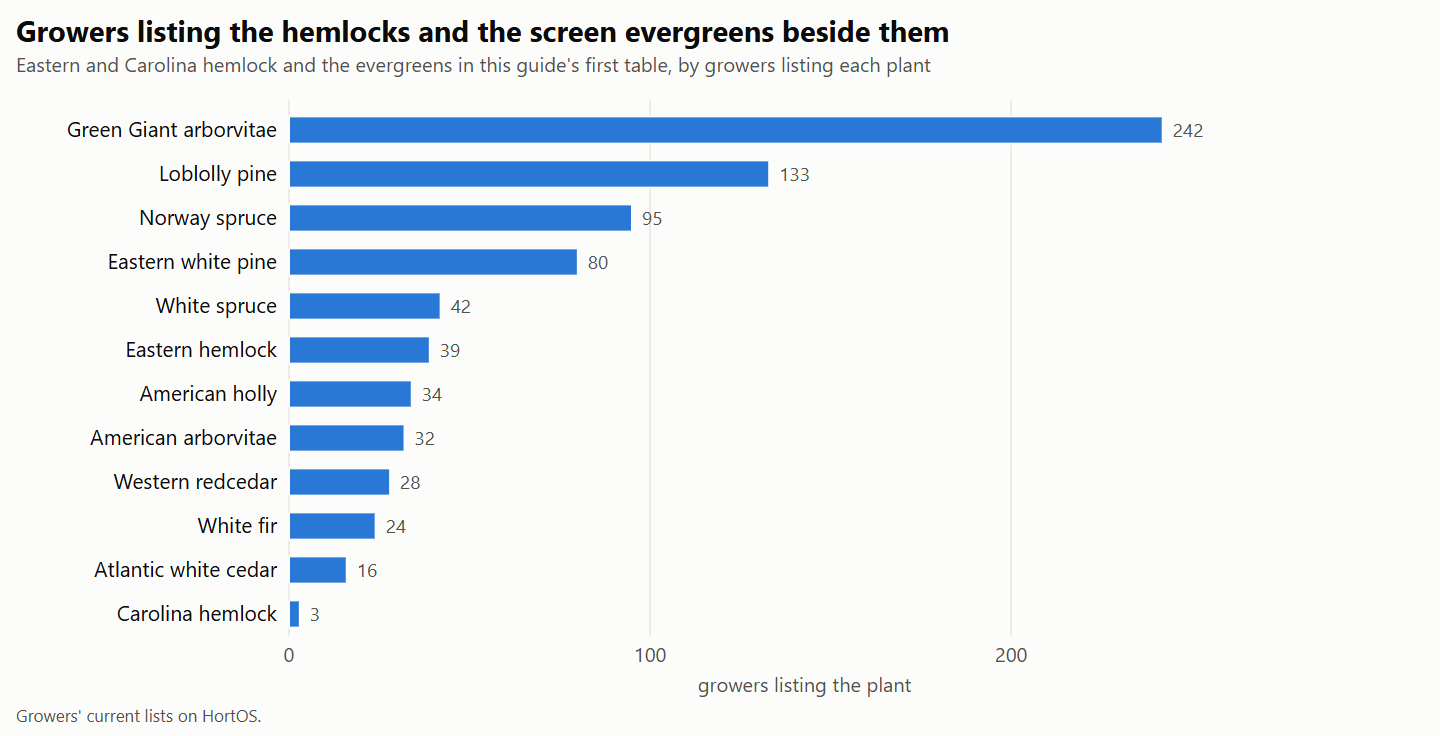
The table reports those ratings as Rutgers gives them and takes no view of any plant. University of Maryland Extension (2026) names pinxterbloom azalea among native species that are favorite foods of white-tailed deer. The medians for bigleaf hydrangea, mountain laurel and flowering dogwood rest on fewer than five growers. Rutgers (New Jersey, 2003) rates eastern hemlock Occasionally Severely Damaged, and a separate guide covers hemlock woolly adelgid and the evergreens planted as screens.
On protection, UConn Extension (Connecticut, 2016) says a deer fence has to stand at least 8 feet high, reach the ground and leave no gap larger than 6 inches by 6 inches. Fact Sheet 655 from Maryland Cooperative Extension (2003) suggests keeping susceptible plants near the house or behind a fence, or ringing preferred species with less-preferred ones.
The same plant on the lists of other states
The Rutgers list was compiled with input from professionals and Master Gardeners in northern New Jersey, and other extension services place some of the same plants differently. The next table sets 14 plants side by side. Its columns are the Rutgers list (New Jersey, 2003), Maryland Cooperative Extension's Fact Sheet 655 (2003) and the Cornell Cooperative Extension Warren County list (New York, page updated September 11, 2025). Each cell uses that list's own words. The rows are not a sample of the lists: most were picked because the lists place the plant differently, and a few because they agree.
| Plant | Rutgers, New Jersey, 2003 | Maryland Cooperative Extension, 2003 | Cornell Cooperative Extension Warren County, New York, 2025 |
|---|---|---|---|
| Eastern white pine (Pinus strobus) | Seldom Severely Damaged | Frequently Damaged | Occasionally Damaged |
| Red maple (Acer rubrum) | Seldom Severely Damaged | Occasionally Damaged | Occasionally Damaged |
| Sugar maple (Acer saccharum) | Seldom Severely Damaged | Occasionally Damaged | Occasionally Damaged |
| Eastern red cedar (Juniperus virginiana) | Seldom Severely Damaged | Occasionally Damaged | Occasionally Damaged |
| Allegheny serviceberry (Amelanchier laevis) | Seldom Severely Damaged | Rarely Damaged | Occasionally Damaged |
| Koreanspice viburnum (Viburnum carlesii) | Seldom Severely Damaged | Seldom Damaged | Occasionally Damaged |
| Red osier dogwood (Cornus sericea) | Seldom Severely Damaged | Rarely Damaged | Seldom Severely Damaged |
| Pitch pine (Pinus rigida) | Rarely Damaged | Seldom Damaged | Seldom Severely Damaged |
| Eastern hemlock (Tsuga canadensis) | Occasionally Severely Damaged | Frequently Damaged (hemlocks as a genus) | Occasionally Damaged |
| Atlantic white cedar (Chamaecyparis thyoides) | Occasionally Severely Damaged | Occasionally Damaged | Frequently Severely Damaged |
| Balsam fir (Abies balsamea) | Occasionally Severely Damaged | Frequently Damaged | Frequently Severely Damaged |
| Inkberry (Ilex glabra) | Seldom Severely Damaged | Seldom Damaged | Seldom Severely Damaged |
| Common boxwood (Buxus sempervirens) | Rarely Damaged | Rarely Damaged (boxwoods as a genus) | Rarely Damaged |
| American arborvitae (Thuja occidentalis) | Frequently Severely Damaged | Frequently Damaged | Frequently Severely Damaged |
The category names are close but not the same. Fact Sheet 655 (Maryland, 2003) uses Rarely Damaged, Seldom Damaged, Occasionally Damaged and Frequently Damaged, and defines Seldom Damaged plants as ones whose browsing is usually minor. Cornell Cooperative Extension Warren County (New York, 2025) groups woody plants as rarely damaged, seldom severely damaged, occasionally damaged and frequently severely damaged, by common name only. A Seldom Damaged in one column is therefore not the same class as a Seldom Severely Damaged in another. Fact Sheet 655 (Maryland, 2003) rates hemlocks and boxwoods as genera, and those cells say so. Rutgers (New Jersey, 2003) lists balsam fir twice: the cell is its tree entry, and a dwarf form under shrubs is rated Seldom Severely Damaged.
None of these sources presents its classes as the result of trials. Fact Sheet 655 (Maryland, 2003) rests its placements on what nursery operators, landscape contractors, designers, extension and research staff and professional horticulturists had seen, and credits a Cornell Cooperative Extension publication as its framework. Cornell Cooperative Extension Warren County (New York, 2025) calls its list a guide developed from a range of sources that may not be equally reliable.
Lists differ inside one state as well. The Maryland Department of Natural Resources publishes a list it calls incomplete, of plants deer do not normally prefer (undated, read in 2026). That list includes winterberry holly and mountain laurel, and Fact Sheet 655 (Maryland, 2003) places both among shrubs Frequently Damaged. University of Maryland Extension (2026) places sweetgum among native woody plants that usually escape significant browsing, and Rutgers (New Jersey, 2003) rates it Occasionally Severely Damaged.
University of Maryland Extension (2026) says no plant is deer-proof and that such lists can contradict one another outright, because what deer choose depends on what else there is to eat at that time and place. Fact Sheet 655 (Maryland, 2003) adds that a species rarely damaged in one part of the country may be highly preferred in another, and names holly, white pine and deciduous magnolias as examples.
What a rating and a grower count leave out
A Rutgers entry carries one rating, and the list's introduction speaks of plants deer prefer; it does not mention antler rubbing. University of Maryland Extension (2026) says a buck rubbing its antlers on a trunk in autumn can seriously injure a young tree or kill it. University of Maryland Extension (2023) says repellents are not effective against antler rubbing.
A rating is not a rating of every cultivar of a species, and the Rutgers list records nothing about the size or age of a plant. UConn Extension (Connecticut, 2016) says deer especially like young flower buds and plants that are well watered or well fertilized.
Place and season change the outcome. Rutgers (New Jersey, 2003) ties results to local deer populations and weather, and Fact Sheet 655 (Maryland, 2003) says no plant is safe in every condition. UConn Extension (Connecticut, 2016) says deer come into suburban yards most in winter, when the woods offer little, and again in spring as soft new growth appears. University of Maryland Extension (2026) gives eastern redcedar as its example: classed as deer-resistant, yet stripped of its lower twigs where deer numbers are too high.
The grower counts and medians have limits of their own. A count here is growers listing the plant, not how many plants exist or how well it suits a site. A grower listing a plant says nothing about how that plant fares with deer. For a native planting, a grower's seed source, whether a line is the straight species and how it was grown are not on the directory. Those are questions to put to the grower, in writing, before an order. The figures are national, and no median on this page is a Northeast price. Few of the growers listing these plants are in New England. The state hubs for New Jersey, New York, Pennsylvania, Maryland and Connecticut show the growers in each state.
This page's ratings come from New Jersey, Maryland and one county extension office in New York: none is from Connecticut, Pennsylvania, Massachusetts, Rhode Island, northern New England or a statewide New York source.
What to watch for
- Reading Rarely Damaged as deer proof. Rutgers (New Jersey, 2003) says no plant is deer proof, and Fact Sheet 655 (Maryland, 2003) says that when food is short deer browse even the plants they like least.
- Carrying a rating to a relative. Rutgers (New Jersey, 2003) rates yews, hosta and catmint as genera and a few cultivars by name, and a rating for one entry is not a rating for another species or cultivar.
- Borrowing a list from another region. Fact Sheet 655 (Maryland, 2003) urges care with preference lists drawn up outside the reader's own area.
- Reading a national median as a local price. Each median pools growers in several states and leaves out freight, and one on fewer than five growers can move with a single price change.
Getting it right
- Find the plant on the Rutgers list itself and note the exact entry, whether a species, a genus or a named cultivar, with its rating.
- Look the same plant up on a list from the planting's own state where one exists, such as Fact Sheet 655 for Maryland, and note any difference.
- Ask the county extension office how heavy deer browsing is locally, since Rutgers (New Jersey, 2003) says results depend on the local deer population.
- For a plant in the two higher-damage classes, read what the list's publisher says about fences and repellents. The owner of the site, or the body that manages public land, decides what is planted and how it is protected.
- Open the directory or the plant's page on HortOS to see which growers list it and in which states, then ask the grower for the size, the price and the freight in writing.
A word of caution
The ratings on this page belong to Rutgers Cooperative Extension, Maryland Cooperative Extension and Cornell Cooperative Extension Warren County, as read in October 2026, and any of them can change. None of them calls a plant deer proof. Deer damage on a particular site is a question for the county extension office, and deer management is one for the state wildlife agency. HortOS showed these grower counts and medians; a grower's own list and quote settle what it lists and at what price.
Sources
- Rutgers Cooperative Extension, Landscape Plants Rated by Deer Resistance: the four ratings and the full list.
- Rutgers NJAES, publication E271, Landscape Plants Rated by Deer Resistance: the bulletin's number and date.
- Maryland Cooperative Extension, Fact Sheet 655, Resistance of Ornamentals to Deer Damage: Maryland's four categories and placements.
- University of Maryland Extension, Deer Resistant Native Plants: why lists differ, native species.
- University of Maryland Extension, Deer Damage: browsing signs, antler rubbing, seasons.
- Cornell Cooperative Extension Warren County, Deer Resistant Plants: a New York county list.
- UConn Extension, Preventing Deer Damage in the Home Landscape: fence height, repellents, seasons.
- Maryland Department of Natural Resources, Deer-Resistant Plants: the state wildlife agency's list.
More guides

Nursery Pot Sizes Explained: Millimetres, Litres and Gallons
Australian growers name a pot by its rim diameter up to 400 mm and by its volume in litres above that, while American growers use gallon classes. This guide explains each step of the ladder, the approximate height and age behind it, how to convert between systems, and what the trade pays at every size.

The Most Grown Native Plants in the United States, by State
A data page, not an essay: the American native plants held by the most wholesale growers, counted grower by grower and state by state from growers' current lists on HortOS, with the median trade price at the size most growers price. Two paragraphs on what the tables show and what they do not, then the tables, refreshed each edition.
Hemlock woolly adelgid and evergreens that replace a hemlock screen
For homeowners, watershed groups and arborists facing a hemlock screen with woolly adelgid. It reports what the USDA Forest Service, Penn State Extension and Pennsylvania's conservation department say on treating or replanting, and what Maine and Wisconsin say on moving hemlock. It adds NC State Extension's light classes, growers listing each evergreen by state, and container medians for named selections.