Hemlock woolly adelgid and evergreens that replace a hemlock screen
For homeowners, watershed groups and arborists facing a hemlock screen with woolly adelgid. It reports what the USDA Forest Service, Penn State Extension and Pennsylvania's conservation department say on treating or replanting, and what Maine and Wisconsin say on moving hemlock. It adds NC State Extension's light classes, growers listing each evergreen by state, and container medians for named selections.
Updated October 7, 2026. Figures are what the live us.hortosapp.com price and plant pages printed.
On this page
- Quick facts
- Treat, replant or wait: what the forest agencies report
- State lines and hemlock nursery plants
- The hemlocks and the screen evergreens, by growers and state
- Container medians for the named selections
- What a listing and a median leave unsaid
- What to watch for
- Getting it right
- A word of caution
- Sources
A homeowner looks at a hemlock screen infested with hemlock woolly adelgid and asks what evergreen should replace it, and what growers list that evergreen for at trade. Replanting is not a like-for-like swap: NC State Extension (read 2026) lists eastern hemlock for deep shade, and lists none of the ten evergreens this page sets beside it for deep shade.
This page reports what the USDA Forest Service, Penn State Extension and Pennsylvania's Department of Conservation and Natural Resources say about treating or replanting, and what the agriculture departments of Maine and Wisconsin say about moving hemlock plants. It sets NC State Extension's light classes beside who lists each evergreen on HortOS, a free directory of American wholesale plant growers with their published availability and trade prices. It is not treatment advice, it rates no plant, and it does not stand in for the state agency that decides.
Quick facts
| The pest | The USDA Forest Service (2016) describes hemlock woolly adelgid as a pest, not native, of hemlocks in forests and in ornamental plantings of eastern North America, and placed it across about half of eastern hemlock's natural range. |
|---|---|
| How long a tree lasts | The USDA Forest Service (2016) reports that the adelgid can kill hemlocks of any age in 4 to 15 years, and that in the North trees can live on, weakened, for more than 15 years. |
| The owner's options | Pennsylvania's Department of Conservation and Natural Resources (read 2026) gives forest landowners with many infested hemlocks three options: treat, harvest and replant, or wait and see. |
| Moving hemlock plants | Maine's Department of Agriculture, Conservation and Forestry (page read October 2026) says hemlocks grown in infested areas may not enter the non-quarantined parts of Maine. Wisconsin's Department of Agriculture, Trade and Consumer Protection (page read October 2026) reports an exterior quarantine on hemlock nursery plants from 25 named states, other named areas and any state or area declared infested. |
| Shade | NC State Extension's Plant Toolbox (North Carolina, read 2026) lists eastern hemlock at 40 to 70 feet, for dappled sun, partial shade or deep shade. It lists none of the replacement evergreens in this page's first table for deep shade. |
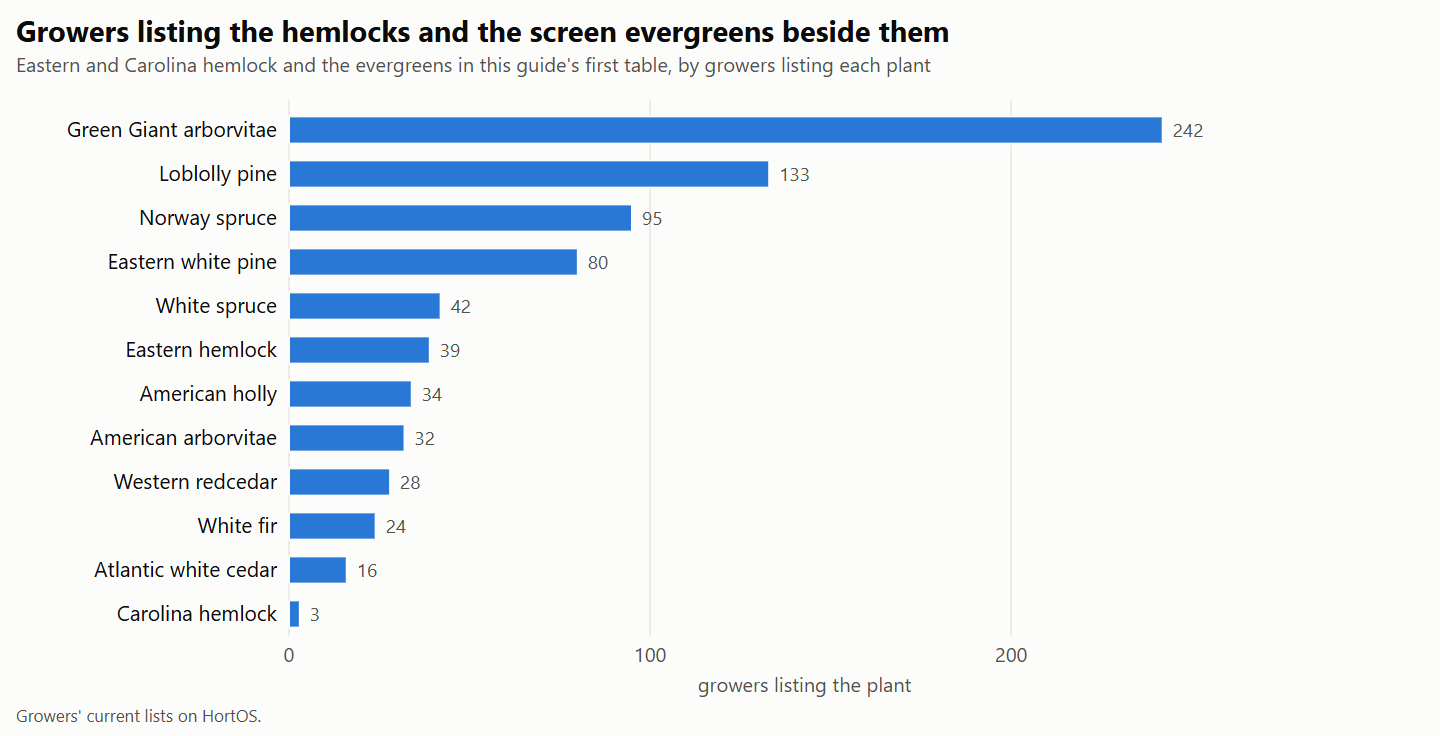
| Who lists them, and a price | 242 growers listed Green Giant arborvitae on HortOS, 80 eastern white pine and 39 eastern hemlock, in any size. The national median trade price of Green Giant arborvitae at #15 was $65 across 78 growers pricing it, one price per grower, ex tax, freight not included. |
Treat, replant or wait: what the forest agencies report
The USDA Forest Service (2016) reports that eastern and Carolina hemlock have shown very limited resistance, and that many trees in natural and ornamental settings have died. The Forest Service (2016) says the adelgid can kill hemlocks of any age in 4 to 15 years, and reports more than 15 years of weakened survival in the North, where winter cold limits the insect. A 2019 sheet from Tennessee State University and the University of Georgia reports faster death in the southern United States. UMass Extension (Massachusetts, 2022) reports that trees already under stress may die in 3 to 5 years.
Pennsylvania's Department of Conservation and Natural Resources reports the adelgid in all 67 Pennsylvania counties by the end of 2023. NHBugs, a University of New Hampshire site (read 2026), reports it in more than half of New Hampshire's towns.
Treatment is reported here only as options. The USDA Forest Service (2016) says systemic insecticides are applied as a soil drench, by soil injection or by trunk injection, and that treatment should go on before a tree is severely damaged. Penn State Extension (Pennsylvania, read 2026) describes commercial applicators injecting a systemic insecticide labeled for the adelgid into the soil around large trees. The Forest Service's 2015 guide for forest owners in northern New England says insecticides can be effective where the area is small and the trees are valuable. The same 2015 guide calls insecticides costly and mostly used on specimen trees, says treatment is for trees whose decline is moderate or less, and says no pesticide treatment gives permanent protection. This page names no product, rate or month, and read no rule on who may apply a treatment. Whether to treat one screen is a question for a certified applicator or the county extension office.
Pennsylvania's Department of Conservation and Natural Resources (read 2026) gives owners of forest land with many infested hemlocks three options: treat, harvest and replant, or wait and see. The Pennsylvania department (read 2026) reports that its own restoration work sometimes replants with native species such as eastern white pine, which it says the adelgid does not affect. The Forest Service's 2015 northern New England guide says a forest owner whose hemlocks are declining can consider planting softwoods to carry on what the hemlock did. The same 2015 Forest Service guide says many infested trees will survive with reduced canopies, and that hemlocks in hardiness zone 4b and colder may not be greatly affected.
State lines and hemlock nursery plants
Replanting with hemlock raises a second question: where the plants were grown. The paragraphs below report what two agencies' own pages say, as read in October 2026. The rule texts themselves were not read for this page.
Maine's Department of Agriculture, Conservation and Forestry says, on its Horticulture Program's hemlock quarantine page (read October 2026), that Maine has a hemlock woolly adelgid quarantine, which the page calls Chapter 266. The same page says hemlocks grown in areas infested with the adelgid are not allowed into the non-quarantined parts of the state. It says a certificate of origin or a state phytosanitary certificate must accompany a shipment into those parts. It also says that hemlocks grown in or brought into Maine's quarantined areas may not be moved to the rest of the state. The Maine department's list of quarantined towns, updated November 2023, takes in every town of Androscoggin, Cumberland, Kennebec, Knox, Lincoln, Sagadahoc, Waldo and York counties, and names other counties town by town.
Wisconsin's Department of Agriculture, Trade and Consumer Protection says, on its quarantine requirements page (read October 2026), that it runs an exterior quarantine covering items able to carry the adelgid, hemlock nursery plants and seedlings among them. The Wisconsin page applies the quarantine to 25 whole states, the District of Columbia, British Columbia and Nova Scotia, and to any state or area that responsible agencies declare infested. The states the Wisconsin page names take in all of New England, New York, Pennsylvania and the southern Appalachian states from West Virginia to Georgia. The Wisconsin page lists exceptions. One lets regulated items enter with a phytosanitary certificate signed by an official of the state or province of origin, after that official has inspected them.
These are only the states for which a page was read. This page does not show any other state's rule on moving hemlock. On the Maine and Wisconsin pages (read October 2026) the department of the state the hemlock is going to sets what may enter, and an official of the state of origin issues or signs the certificate. For any other state, its plant regulator is the body to ask.
The hemlocks and the screen evergreens, by growers and state
The first table sets eastern and Carolina hemlock beside evergreens that NC State Extension's Plant Toolbox lists or describes for screen, hedge or privacy use and that have a page on HortOS. Eastern white pine and loblolly pine are there because the Toolbox (read 2026) names them as filling a similar niche to eastern hemlock. The Toolbox is a database of North Carolina plant pages, not a rated list, so the 12 rows are this page's own selection. Grower counts are the growers listing each plant on HortOS, in any size. A count here is growers listing the plant, not how many plants exist or how well it suits a site.
| Plant | Growers listing it | States with most growers |
|---|---|---|
| Eastern hemlock (Tsuga canadensis) | 39 | North Carolina 10, Pennsylvania 6, Tennessee 4 |
| Carolina hemlock (Tsuga caroliniana) | 3 | North Carolina 2, Tennessee 1 |
| Green Giant arborvitae (Thuja 'Green Giant') | 242 | North Carolina 49, Georgia 35, Florida 30 |
| American arborvitae (Thuja occidentalis) | 32 | Oregon 8, Pennsylvania 4, Minnesota 4 |
| Western redcedar (Thuja plicata) | 28 | Oregon 11, New York 3 |
| American holly (Ilex opaca) | 34 | New Jersey 5, North Carolina 5, Florida 5 |
| Eastern white pine (Pinus strobus) | 80 | Pennsylvania 11, North Carolina 9, Oregon 9 |
| Loblolly pine (Pinus taeda) | 133 | Florida 31, Texas 31, North Carolina 12 |
| Norway spruce (Picea abies) | 95 | Oregon 18, North Carolina 14, New York 9 |
| White spruce (Picea glauca) | 42 | Oregon 6, Pennsylvania 6, New York 6 |
| White fir (Abies concolor) | 24 | Oregon 6, Pennsylvania 4, New Jersey 3 |
| Atlantic white cedar (Chamaecyparis thyoides) | 16 | Maryland 4 |
The last column names the states with the most growers listing each plant, three at most, and stops where states tie for the next place.
The table gives counts only: a median needs three growers pricing one size, and five of its plants have no container median. Container medians for most of the others are in the next section. Carolina hemlock and American arborvitae have no price page, and western redcedar, white spruce and white fir are priced only as field grown.
Light sets the hemlock apart. NC State Extension's pages (North Carolina, read 2026) list dappled sun, partial shade or deep shade for eastern hemlock in the light field, and deep shade for none of the ten evergreens set beside the hemlocks. The same pages list full sun only for Norway spruce and loblolly pine, and full sun with partial shade or dappled sun for the other eight evergreens and for Carolina hemlock, in that field. NC State (read 2026) says American arborvitae thins badly in full shade, and that too much shade costs American holly its density. NC State's mature heights (read 2026) run from 30 to 70 feet for white fir and Carolina hemlock to 60 to 90 feet for loblolly pine. The one other conifer read for this page that NC State (read 2026) lists for deep shade is red spruce (Picea rubens), at 60 to 70 feet. On the same count basis, 7 growers listed red spruce on HortOS.
NC State's pages (North Carolina, read 2026) mark both hemlocks, American arborvitae, American holly, eastern white pine, loblolly pine and Atlantic white cedar as native plants, and do not so mark the other five.
Climate changes the answer. NC State Extension (North Carolina, read 2026) says western redcedar suffers where summers are hot and humid, that white spruce cannot take such summers, and that white fir does not suit the Southeast. NC State (read 2026) says Norway spruce can serve as a screen in colder climates.
The last column shows where the growers are. No New England state appears in that column in any row. The hubs for New York, New Jersey and Tennessee show who lists what there.
Container medians for the named selections
Growers list many screen evergreens under a cultivar name, and a cultivar's figures are its own, never the species' figures. The second table holds named selections of American arborvitae, American holly, Japanese cedar and eastern white pine, ranked by growers listing each. NC State Extension (read 2026) describes Emerald Green only as narrow and columnar, and Japanese cedar (Cryptomeria japonica) as an alternative to Leyland cypress for screening. Prices are medians across growers' current trade lists on HortOS: one price per grower, ex tax, freight not included, with the number of growers pricing each size in brackets. Anyone can see the prices on HortOS, and only the trade can order.
| Plant | Growers listing it | Size most growers price | Median (growers pricing) |
|---|---|---|---|
| Emerald Green arborvitae (Thuja occidentalis 'Smaragd') | 161 | #3 | $13 (37) |
| Yoshino Japanese cedar (Cryptomeria japonica 'Yoshino') | 68 | #15 | $81.25 (17) |
| Radicans Japanese cedar (Cryptomeria japonica 'Radicans') | 50 | #15 | $83.13 (10) |
| Satyr Hill American holly (Ilex opaca 'Satyr Hill') | 41 | #15 | $93.50 (10) |
| Nigra arborvitae (Thuja occidentalis 'Nigra') | 40 | #3 | $14 (6) |
| Techny arborvitae (Thuja occidentalis 'Techny') | 23 | #1 | $9.00 (3) |
| Columnar white pine (Pinus strobus 'Fastigiata') | 20 | Field grown only | |
| Dan Fenton American holly (Ilex opaca 'Dan Fenton') | 10 | Field grown only |
The growers listing the plants in this table are spread across many states; the most are in North Carolina, New Jersey and Georgia. The size shown for each plant is the container size most growers price; field grown lines are not counted. Where a row says Field grown only, its growers price that plant as field grown stock and no container median is shown.
The cells that read Field grown only are selections whose only priced sizes are field grown. Each median is a national figure across every grower pricing that size, not a price for any one state or region.
The plants in the first table have container medians where three growers price one size. On the same basis, at #3 the median for Green Giant arborvitae was $11.50 across 53 growers pricing it, and for loblolly pine $10.50 across 20. Eastern white pine stood at $18 across 7 growers pricing it, Norway spruce at $25 across 9 and American holly at $29.75 across 6. Eastern hemlock itself stood at $13.50 at #3, across 5 growers pricing it. These too are national medians.
The guide to reading a wholesale availability list explains container classes and how a median is built. Medians by container class across the whole trade are in the guide to what plants cost at the nursery.
What a listing and a median leave unsaid
A listing on HortOS shows that a grower lists a plant. It does not show that the plant is free of the adelgid, that it has been inspected, or that it holds the certificate a state asks for. The grower and the state plant regulator answer those.
The directory also does not show where a grower's seed or cuttings came from, whether a plant is the straight species or a selection, or how it was raised. The way to find out is to write to the grower. Ask for the seed source by county or state, whether the line is the species or a named cultivar, and whether it was raised from seed or cuttings.
This page carries no pest or disease rating for any replacement evergreen. Pennsylvania's Department of Conservation and Natural Resources (read 2026) says eastern white pine is not affected by the adelgid. The light classes are NC State's for North Carolina, not for Maine or Tennessee. The medians are national and leave out freight.
What to watch for
- Putting a sun tree where the hemlock stood in shade. NC State Extension (North Carolina, read 2026) lists Norway spruce and loblolly pine for full sun only.
- Carrying a plant out of its climate. NC State Extension (North Carolina, read 2026) says white fir does not suit the Southeast.
- Reading a cultivar's figure as the species' figure. Green Giant arborvitae and western redcedar are separate rows with separate counts, although the HortOS page for Green Giant is titled Thuja plicata 'Green Giant'. NC State Extension's page (read 2026) names it Thuja 'Green Giant'.
- Bringing hemlock plants across a state line unasked. The agriculture departments of Maine and Wisconsin (pages read October 2026) each describe a certificate that travels with hemlock nursery plants.
Getting it right
- Have the hemlocks' condition judged first. A certified arborist or the county extension office can say whether the trees are in moderate decline or better, the threshold the Forest Service's 2015 guide for northern New England forests gives for treating.
- If the choice is to treat, ask the state's pesticide regulator who may apply a systemic insecticide to hemlocks there. The Forest Service's 2015 guide for northern New England says only those who know the state and federal rules should apply one.
- If hemlock is to be planted or moved, ask the plant regulator of the destination state whether a certificate must travel with the plants, and which one. Ask the grower which county they were grown in.
- Note the hours of direct sun where the screen stands, and ask the local extension office whether the plant suits that light and the hardiness zone.
- Open a plant's page from the table to see its growers by state, then put the seed source and straight species questions to each grower in writing.
- Check the median at the size wanted on the price pages, and ask each grower for a written quote that includes freight. The guide to buying from a wholesale grower explains how a society or watershed group outside the trade places such an order.
A word of caution
Who may apply an insecticide to a hemlock in a given state is a question for that state's pesticide regulator; no rule on it was read for this page. This page reports the treatment only as Penn State Extension and the USDA Forest Service describe it, and the owner's three options as Pennsylvania's Department of Conservation and Natural Resources lists them. What hemlock may enter a state is a question for that state's plant regulator, and whether a replacement suits a site is one for the local extension office or a certified arborist. The counts and medians are what HortOS pages printed on one date, and a figure on the live pages may differ.
Sources
- USDA Forest Service, Biology and Control of Hemlock Woolly Adelgid (revised 2016): range, impact, control options.
- USDA Forest Service Northeastern Area, Managing Hemlock in Northern New England Forests (2015): options for forest owners.
- Penn State Extension, Hemlock Woolly Adelgid: biology and management options.
- Pennsylvania Department of Conservation and Natural Resources, Hemlock Woolly Adelgid: Pennsylvania spread, options, replanting.
- UMass Extension, Hemlock Woolly Adelgid fact sheet (2022): decline of stressed trees.
- Tennessee State University and University of Georgia, Hemlock Woolly Adelgid (2019): decline in the South.
- NHBugs, University of New Hampshire, Hemlock Woolly Adelgid: spread in New Hampshire.
- Wisconsin Department of Agriculture, Trade and Consumer Protection, Hemlock Woolly Adelgid Quarantine Requirements: the exterior quarantine.
- Maine Department of Agriculture, Conservation and Forestry, Hemlock Quarantine Information: moving hemlock in Maine.
- Maine Department of Agriculture, Conservation and Forestry, Maine Towns and Counties Quarantined (updated November 2023): the quarantined towns.
- NC State Extension, Tsuga canadensis: eastern hemlock traits.
- NC State Extension, Tsuga caroliniana: Carolina hemlock traits.
- NC State Extension, Thuja 'Green Giant': Green Giant arborvitae traits.
- NC State Extension, Thuja occidentalis: American arborvitae traits.
- NC State Extension, Thuja plicata: western redcedar traits.
- NC State Extension, Ilex opaca: light and shade.
- NC State Extension, Pinus strobus: eastern white pine traits.
- NC State Extension, Pinus taeda: loblolly pine traits.
- NC State Extension, Picea abies: Norway spruce traits.
- NC State Extension, Picea laxa (white spruce): light and climate.
- NC State Extension, Abies concolor: white fir traits.
- NC State Extension, Chamaecyparis thyoides: Atlantic white cedar traits.
- NC State Extension, Picea rubens: red spruce traits.
- NC State Extension, Cryptomeria japonica: Japanese cedar for screening.
More guides

Reading a Wholesale Availability List, and Pricing the Plants in a Bid
For landscape contractors, designers, estimators and students: what each column of a wholesale availability list means, how much the same plant at the same size varies between growers and states, how the low, median and high on the price pages are built, and how to carry the plant line of a bid from the list to the client.

What Plants Cost at the Nursery in 2026
The general reference behind every article on what a landscape costs: the median trade price ex tax of the line most growers price at each container class from #1 to #100, the spread across growers, the difference between states, what a nursery-gate price leaves out, and worked figures for a planting, a street tree order and a giveaway.

Buying From a Wholesale Grower When You Are Not in the Trade
Native plant societies, watershed districts, land trusts, schools and church committees can buy from wholesale growers when they order like the trade: in quantity, ahead of the season, on the grower's terms. This page explains who sells to whom, resale certificates and exemptions, minimums and pooling, the sizes to buy, straight species and ecotype, lead times and shipping.