Removing and replacing storm damaged trees in Florida under state law
A Florida statute stops a local government requiring a permit, a fee or replanting where a single-family homeowner holds signed documentation that a tree poses an unacceptable risk. This guide sets out the section, how several local governments describe it, what the state says about fallen trees and insurance, and the trees Florida growers list.
Updated October 10, 2026. Figures are what the live us.hortosapp.com price and plant pages printed.
On this page
A Florida homeowner with a split live oak leaning toward the roof after a hurricane asks one thing first: can the city make the household wait for a permit. Section 163.045 of the 2026 Florida Statutes stops a local government asking for one where the owner of a single-family home possesses signed documentation that the tree poses an "unacceptable risk". The test is the documented risk of the tree, not the storm.
This page draws on the Florida Statutes, the Florida Department of Financial Services and UF/IFAS Extension. It also draws on the pages of Tampa, Orlando, Tarpon Springs and Palm Beach County. Beside the law it sets the replacement trees and palms that Florida growers list on HortOS, a free directory of American wholesale plant growers with their published availability and trade prices. It reports what those authorities say and who decides. It is not legal advice, and it is not advice on an insurance policy.
Quick facts
| The rule | Section 163.045(2) of the 2026 Florida Statutes bars a local government from requiring notice, an application, approval, a permit, a fee or mitigation before a documented tree on residential property is pruned, trimmed or removed. |
|---|---|
| Who documents the risk | Section 163.045(1)(a) of the 2026 Florida Statutes names an International Society of Arboriculture (ISA) certified arborist or a Florida licensed landscape architect, who assesses the tree on site and signs. |
| Property covered | Section 163.045(1)(b) of the 2026 Florida Statutes covers a detached single-family building on a lot in active single-family residential use, as a conforming or legally recognized nonconforming use under local land development regulations. |
| Replanting | Section 163.045(3) of the 2026 Florida Statutes says no local government may make the owner replant after work done under the section. |
| Mangroves | Section 163.045(4) of the 2026 Florida Statutes leaves specifically delegated mangrove protection, under sections 403.9321 to 403.9333, outside the section. |
| Dates | The history line of section 163.045 in the 2026 Florida Statutes shows chapter 2019-155 created it and chapter 2022-121, Laws of Florida, amended it; the amending act took effect on 1 July 2022. |
What section 163.045 says and how local governments apply it
The section is short, and each working subsection is addressed to what a local government may not require. Its text in the 2026 Florida Statutes does not mention storms or hurricanes. It reaches any tree that carries the documentation, whatever caused the risk, and it reaches pruning and trimming as well as removal.
Under section 163.045(2) of the 2026 Florida Statutes, a tree poses an unacceptable risk when removal is the only practical way to bring its risk "below moderate". The section names the yardstick by title: "Best Management Practices - Tree Risk Assessment, Second Edition (2017)". The finding belongs to the arborist or landscape architect who assesses the tree on site and signs.
The text of section 163.045 in the 2026 Florida Statutes names no homeowners' association and no private covenant. Section 720.305(1) of the 2026 Florida Statutes says each association member, and the association, is governed by chapter 720, the community's governing documents and the association's rules. The guide to Florida-Friendly landscaping law and associations takes up associations and their documents.
Mangroves stand apart: sections 403.9321 to 403.9333 of the 2026 Florida Statutes are the Mangrove Trimming and Preservation Act.
The table below has 15 rows, each one matter with its authority and year. The first rows give what the section says. The next give how the local governments read for this guide describe or apply it, each in its own account and not as law. The last give the state insurance office and the extension service.
| Matter | What the source says | Authority and year |
|---|---|---|
| Permit, notice or fee to prune, trim or remove a documented high-risk tree at a single-family home | A local government is barred from asking for notice, an application, approval, a permit, a fee or mitigation | Florida Statutes s. 163.045(2), 2026 |
| Who documents the risk | A landscape architect licensed in Florida, or an arborist holding ISA certification, who assesses the tree on site and signs the assessment | Florida Statutes s. 163.045(1)(a), 2026 |
| The risk test | Removal has to be the only practical way to bring the risk below moderate, under the tree risk assessment publication the section names (second edition, 2017) | Florida Statutes s. 163.045(2), 2026 |
| Property covered | A detached single-family building on a lot in active single-family residential use, where that use conforms to the local land development regulations or is a legally recognized nonconforming use under them | Florida Statutes s. 163.045(1)(b), 2026 |
| Replanting after the work | A local government cannot make the owner replant a tree worked on under the section | Florida Statutes s. 163.045(3), 2026 |
| Mangroves (Mangrove Trimming and Preservation Act) | The section does not reach delegated mangrove protection under ss. 403.9321 to 403.9333 | Florida Statutes s. 163.045(4), 2026 |
| How one city checks a removal | Tampa's memorandum says an owner who wants to avoid a notice of violation should give the city the signed assessment, and the city then decides whether the removal qualifies | City of Tampa, city attorney memorandum, 2022 |
| Land one city says falls outside it | Tampa lists commercial land, a residential lot with no house on it, and a lot with a duplex, townhomes or another multi-family building | City of Tampa, city attorney memorandum, 2022 |
| A second city's wording | Orlando's permit page says a residential owner needs no permit once an ISA arborist with the tree risk qualification, or a landscape architect licensed in Florida, reports the tree as a danger | City of Orlando permit page, read October 2026 |
| A city arborist for residents | Tarpon Springs keeps an ISA certified arborist on its staff to inspect residents' trees and files a report of each inspection | City of Tarpon Springs, read October 2026 |
| Replacement after a natural disaster | Where the county applies its temporary suspension provision after a natural disaster, Palm Beach County's code sets one similar tree, palm or pine for each one damaged as the replacement standard, unless the state section exempts the property | Palm Beach County Unified Land Development Code, Article 7, Supplement 32, 2025 |
| Insurance and hauling away a fallen tree | The department says most policies pay for removal where the fallen tree damaged insured property, usually within limits, and usually not where it fell on the ground and damaged nothing covered | Florida Department of Financial Services, read October 2026 |
| A tree that lands on a neighbor's house in a hurricane | The department says the damage falls to the neighbor's own home policy unless the tree's owner is legally liable, which normally takes negligence | Florida Department of Financial Services, read October 2026 |
| Remove or restore | The state university's extension service says a storm damaged tree does not always have to come down and that treatment saves many | UF/IFAS Extension, publication FOR-117, revised 2026 |
| What to plant where a tree failed | The same service recommends replanting with species shown to resist wind better, in groups rather than singly | UF/IFAS Extension, publication FOR118, revised 2026 |
The local governments in their own words
The City of Tampa's tree page, updated in 2026, says trees are protected under section 27-284 of its city code. A Tampa city attorney memorandum of 2022 says the city can tell a qualifying removal from an unlawful one only by seeing the documentation. An owner who wants to avoid a notice of violation should provide it, the memorandum says, and the city then decides whether the removal qualifies. That is Tampa's practice. The statute says only that the owner possesses the documentation.
The City of Orlando's permit page, read in October 2026, words the test its own way. It says no permit is required where the owner obtains a report that the tree poses a danger, from an arborist holding the ISA Tree Risk Assessment Qualification or from a Florida licensed landscape architect. The City of Tarpon Springs, on its page read in October 2026, says an ISA Certified Arborist on its staff inspects hazardous trees and a report of each inspection is kept.
Palm Beach County's code, in the 2025 supplement of Article 7, lets the county's Executive Director of PZB suspend the article's landscape standards for a time after a hurricane. For vegetation the Executive Director determines to be damaged by a natural disaster under that provision, the 2025 county code sets a replacement standard. It is one similar tree, palm or pine for each one damaged, unless the state section exempts the property.
Fallen trees and insurance
The Florida Department of Financial Services, as read in October 2026, says most policies cover debris and tree removal where the fallen tree damaged insured property, usually within limits. The same Florida page of 2026 says there is usually no such cover where a tree fell on the ground and damaged nothing covered. Policies vary between insurers, it says, so the owner's own contract decides. Whether a policy pays anything toward the tree itself, or toward a new one, is likewise for the policy to say.
Remove, restore or replant, according to the extension service
UF/IFAS Extension, in its Florida fact sheet on assessing hurricane damaged trees (revised 2026), puts one question first: whether a tree's risk to people, animals or property is unacceptable. It says a leaning tree likely to fall on a person, a building, a power line or a roadway should come down at once. It also says a tree stripped of its leaves is usually not dead. The Florida Chapter of the ISA, on its 2026 page for tree owners, calls removal of a living tree a last resort.
On replanting, the UF/IFAS fact sheet on wind and trees (Florida, revised 2026) recommends a new tree where one fails. It sorts trees into four wind classes, from highest to lowest, for two regions: USDA zones 8 and 9, and zones 10 and 11. The same 2026 fact sheet warns that every tree can fail in wind, and that soil, wind strength, past care, health and age all bear on the result. The guide to hurricane wind resistant trees sets out the study findings behind those classes tree by tree.
Laurel oak shows why the findings are read with their region. UF/IFAS (Florida, revised 2026) reports that in four Panhandle hurricanes laurel oak survived less well than live oak and sand live oak. It also reports that in two south Florida hurricanes survival and branch loss were similar for the three oaks.
What Florida growers list as replacement trees
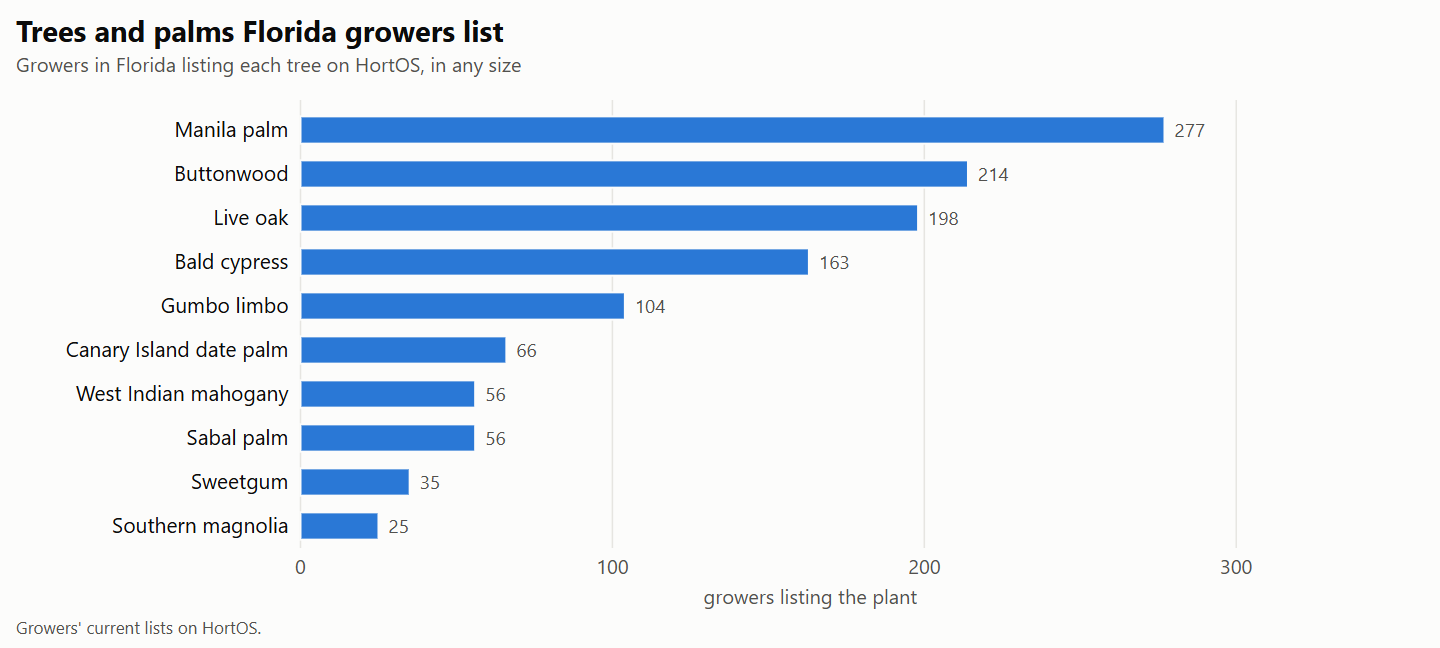
The second table shows 15 trees and palms as growers list them to the trade. The rule of selection has three parts. A tree is named in the text of one of two UF/IFAS hurricane fact sheets (Florida, both revised 2026) as standing up to wind, as an example to plant, as resisting decay after damage or as long lived. The same service places it in the highest or the medium-high wind class for at least one region. And the tree has a plant page of its own on HortOS. Rated plants not shown: 0. Wax myrtle, which UF/IFAS (Florida, revised 2026) names as a small tree for planting under power lines, sits in the medium-low class for both regions and so is not a row.
The first column counts growers in Florida. Prices are medians across growers' current trade lists on HortOS: one price per grower, ex tax, freight not included, with the number of growers pricing each size in brackets. The fourth column is the national median, and the last column is the median across Florida growers at the same size. Anyone can see the prices on HortOS, and only the trade can order.
| Plant | Growers listing it in Florida | Size most growers price | Median (growers pricing) | Florida median |
|---|---|---|---|---|
| Live oak (Quercus virginiana) | 198 | #45 | $265 (107) | $275 |
| Sand live oak (Quercus geminata) | 22 | #3 | $9.75 (6) | $9.75 |
| Southern magnolia (Magnolia grandiflora) | 25 | #15 | $80 (13) | $72.50 |
| Sweetgum (Liquidambar styraciflua) | 35 | #3 | $11 (10) | $8.75 |
| Bald cypress (Taxodium distichum) | 163 | #30 | $120 (89) | $115 |
| Dogwood (Cornus florida) | 3 | #5 | $40 (4) | Fewer than three growers |
| Crape myrtle (Lagerstroemia indica) | 18 | #30 | $150 (7) | $155 |
| Winged elm (Ulmus alata) | 13 | #15 | $61.25 (4) | $65 |
| Gumbo limbo (Bursera simaruba) | 104 | #25 | $150 (41) | $150 |
| Buttonwood (Conocarpus erectus) | 214 | #25 | $110 (85) | $110 |
| West Indian mahogany (Swietenia mahagoni) | 56 | #25 | $145 (25) | $145 |
| Wild tamarind (Lysiloma latisiliquum) | 25 | #25 | $150 (7) | $150 |
| Sabal palm (Sabal palmetto) | 56 | #7 | $40 (4) | $40 |
| Canary Island date palm (Phoenix canariensis) | 66 | #15 | $85 (7) | $80 |
| Manila palm (Veitchia merrillii) | 277 | #15 | $50 (111) | $50 |
Each median is for the container size named in its row and for no other. The sizes run from #3 for sand live oak to #45 for live oak, so one row is not to be compared with another. A small container holds a young plant. The national figure for dogwood rests on 4 growers, and its Florida cell has no median. A median needs three growers pricing a size. The medians for winged elm (4 growers pricing) and sabal palm (4) rest on few growers too, and a median on so few can move when one grower reprices.
What the tables and the directory do not show
The first table covers the local governments read for this guide. It is not a survey of Florida, and another city or county may describe or apply the section differently.
The second table records what growers list. It does not show a tree's grade, its branch structure or its roots. It does not show whether a species suits a site or will stand in a given storm, which is the extension service's own caveat. A trade median is what growers list to the trade for a container of that size. It is not a homeowner's price, and it puts no value on a mature tree or on replacing one like for like. Nothing on a grower's list says what an insurance policy pays.
What to watch for
- Reading the section as a storm rule. Section 163.045 of the 2026 Florida Statutes turns on documentation of an unacceptable risk, with or without a hurricane.
- Treating any letter as documentation. Section 163.045(1)(a) of the 2026 Florida Statutes defines it as an onsite assessment under the named procedures, signed by the assessor. Tampa's memorandum of 2022 says paperwork lacking either may lead to a notice of violation.
- Assuming every home is covered. Tampa's memorandum of 2022 gives commercial land, a residential lot with no residential structure, and a lot with a duplex, townhomes or another multi-family building as examples outside the definition.
- Reading the section as a rule about associations. It is addressed to local governments. Section 720.305(1) of the 2026 Florida Statutes says what governs an association's members.
- Reading a trade median as the cost of replacing a tree. The table shows young container trees as listed to the trade.
Getting it right
- Ask the tree or permitting office of the city or county how it applies section 163.045 and what it wishes to see. The local government decides how it handles a removal in its jurisdiction.
- Under section 163.045(1)(a) of the 2026 Florida Statutes, the onsite, signed assessment comes from an ISA certified arborist or a Florida licensed landscape architect. That person decides the risk finding. UF/IFAS (Florida, revised 2026) suggests asking a tree worker for proof of insurance, certification, the standards used, the cost and the timeframe.
- In a community with an association, read the governing documents and ask the association. Its documents and rules decide what applies to its members.
- What a policy pays toward a fallen tree or debris is for the insurer and the policy to decide. The Florida Department of Financial Services, as read in October 2026, points owners to their own contract.
- For a new tree, read the UF/IFAS wind classes for the region, then ask each grower for the size, the grade and the lead time of the trees it lists.
A word of caution
The Florida Legislature amended section 163.045 in 2022 and can do so again, so the current text of the Florida Statutes is the reference and not this page. Each local government decides how it handles a removal, the arborist or landscape architect the statute names decides the risk finding, and the insurer decides what a policy pays. A question about one property belongs with the local permitting office, a Florida attorney or the insurer.
Sources
- Florida Legislature, The 2026 Florida Statutes, section 163.045: the tree removal exemption itself.
- Laws of Florida, Chapter 2022-121: the 2022 amendment and its date.
- Florida Legislature, The 2026 Florida Statutes, section 403.9321: the name of the mangrove act.
- Florida Legislature, The 2026 Florida Statutes, section 720.305: what governs association members.
- City of Tampa, Construction Services Division, Tree Information: Tampa tree permits and the exemption.
- City of Tampa, city attorney memorandum on the tree removal statutory exemption: how Tampa applies the exemption.
- City of Orlando, Apply for a Tree Removal or Encroachment Permit: Orlando tree permit steps.
- City of Tarpon Springs, Building Department, Tree and Site Information: the city's account of the statute.
- Palm Beach County, Unified Land Development Code, Article 7, Landscaping: county vegetation removal and replacement rules.
- Florida Department of Financial Services, Homeowners Insurance Overview: home policies and tree removal.
- Florida Department of Financial Services, General Insurance Coverage FAQs: storm questions and answers.
- UF/IFAS Extension, Wind and Trees: Lessons Learned from Hurricanes: hurricane lessons and wind lists.
- UF/IFAS Extension, Assessing Hurricane-Damaged Trees and Deciding What to Do: removing or restoring a damaged tree.
- UF/IFAS Extension, Cleaning Up After a Hurricane: Get the Right Tree Care Professional: hiring an arborist after storms.
- Florida Chapter, International Society of Arboriculture, How to Find Certified and Qualified Arborists: choosing a certified arborist.
More guides
Florida's HOA landscaping law and the plants the state program lists
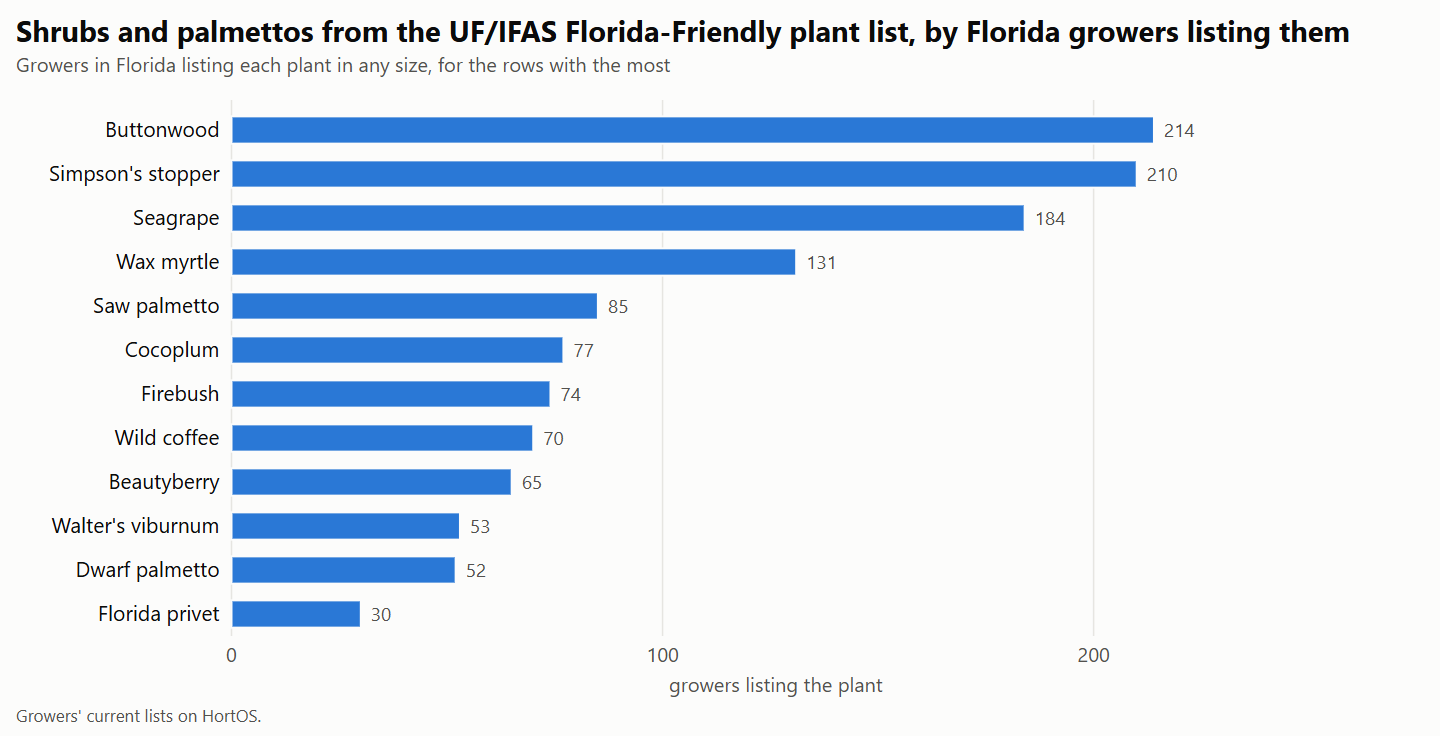
What two sections of the Florida Statutes say about homeowners' association covenants and Florida-friendly landscaping, what they leave with the association, and who decides a dispute. Two tables follow: groundcovers, grasses and shrubs from the UF/IFAS program's plant list, the Florida growers listing each, and a trade median for each at the container size most growers price.
Hurricane wind resistance of trees and what they cost at trade
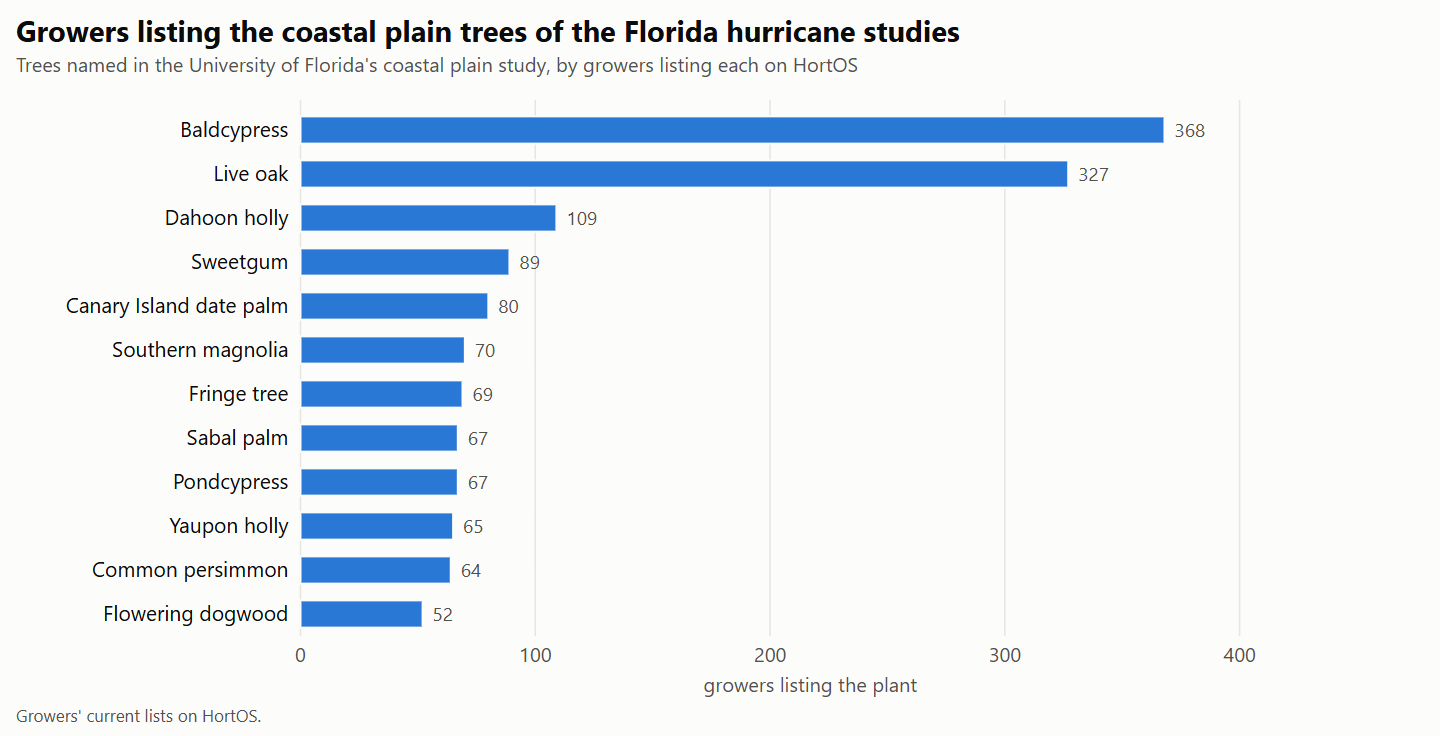
What the University of Florida's hurricane studies found for trees on the coastal plain and in south Florida, set beside the growers listing each tree on HortOS and the median trade price of a #15 container. The page describes the UF/IFAS wind resistance classes, links the full lists and says what neither the studies nor the figures show.

The Most Grown Native Plants in the United States, by State
A data page, not an essay: the American native plants held by the most wholesale growers, counted grower by grower and state by state from growers' current lists on HortOS, with the median trade price at the size most growers price. Two paragraphs on what the tables show and what they do not, then the tables, refreshed each edition.