Florida's HOA landscaping law and the plants the state program lists
What two sections of the Florida Statutes say about homeowners' association covenants and Florida-friendly landscaping, what they leave with the association, and who decides a dispute. Two tables follow: groundcovers, grasses and shrubs from the UF/IFAS program's plant list, the Florida growers listing each, and a trade median for each at the container size most growers price.
Updated October 13, 2026. Figures are what the live us.hortosapp.com price and plant pages printed.
On this page
A homeowner in a deed-restricted Florida community wants to replace part of a lawn with groundcovers, grasses and shrubs, and asks whether the association can refuse. Under s. 373.185(3)(b) and s. 720.3075(4)(b), Florida Statutes (2026), a covenant or an association document may not prohibit an owner from implementing Florida-friendly landscaping, and the definition both sections use names principles and practices and no plant. The University of Florida's Florida-Friendly Landscaping Program says (2026) that owners still need approval where deed restrictions or covenants require it.
This page quotes six sections of the 2026 Florida Statutes from the Legislature's own site. It reports how the University of Florida's Institute of Food and Agricultural Sciences (UF/IFAS), the Florida Department of Environmental Protection and an article in The Florida Bar Journal read them. HortOS, a free directory of American wholesale plant growers with their published availability and trade prices, adds the Florida growers listing plants from the program's 2022 list, with a trade median for each at the size most growers price. It is not legal advice and does not cover condominiums.
Quick facts
| The rule | A deed restriction, a covenant or a homeowners' association document "may not prohibit or be enforced so as to prohibit any property owner from implementing Florida-friendly landscaping" (ss. 373.185(3)(b) and 720.3075(4)(b), Florida Statutes, 2026). |
|---|---|
| The definition | Florida-friendly landscaping means "quality landscapes that conserve water, protect the environment, are adaptable to local conditions, and are drought tolerant"; nine principles follow and no plant is named (s. 373.185(1)(b), Florida Statutes, 2026). |
| Review by the association | An association may review plans for "any structure or other improvement" only as far as that authority is "specifically stated or reasonably inferred" in the declaration of covenants or published guidelines the declaration authorizes (s. 720.3035(1)(a), Florida Statutes, 2026). The UF/IFAS program says approval is still needed where covenants require it (2026). |
| Fines | A fine "may not exceed $100 per violation", or $1,000 in the aggregate for a continuing violation, unless the governing documents provide otherwise (s. 720.305(2), Florida Statutes, 2026). A fine also needs "at least 14 days' written notice of the parcel owner's right to a hearing" (s. 720.305(2)(b), Florida Statutes, 2026). |
| Before a court | A dispute between an association and an owner over changes to a parcel needs a demand for presuit mediation before it goes to court (s. 720.311(2)(a), Florida Statutes, 2026). That paragraph sets exceptions, the collection of a fine or an assessment among them (s. 720.311(2)(a), Florida Statutes, 2026). |
| The plant list | The UF/IFAS Florida-Friendly Landscaping guide (2022) gives each plant its Florida regions, its native status and a drought tolerance, and says its plants are not the only ones that can be used in Florida. |
The two sections in their own words
Section 373.185(3)(b), Florida Statutes (2026), says a deed restriction or covenant "may not prohibit or be enforced so as to prohibit any property owner from implementing Florida-friendly landscaping on his or her land". Section 373.185(3)(c), Florida Statutes (2026), applies the same rule to a local government ordinance.
Section 720.3075(4)(b), Florida Statutes (2026), repeats the rule for homeowners' association documents, "including declarations of covenants, articles of incorporation, or bylaws," and uses the term "as defined in s. 373.185". Chapter 720 of the Florida Statutes (2026) is headed Homeowners' Associations. UF/IFAS (2020) notes that condominiums are governed differently, and this page does not cover them.
Both rules turn on one definition. Section 373.185(1)(b), Florida Statutes (2026), says Florida-friendly landscaping means "quality landscapes that conserve water, protect the environment, are adaptable to local conditions, and are drought tolerant." The same paragraph of s. 373.185, Florida Statutes (2026), names nine principles, from "planting the right plant in the right place" and efficient watering to mulching and waterfront protection. It adds practices such as soil analysis and proper maintenance, and it names no plant (s. 373.185(1)(b), Florida Statutes, 2026).
In s. 373.185(3)(a), Florida Statutes (2026), the Legislature finds that Florida-friendly landscaping "serves a compelling public interest" and that homeowners' associations and local governments have an essential part in the state's water conservation and water quality efforts. The history line printed with s. 373.185, Florida Statutes (2026), ends at chapter 2009-243, Laws of Florida.
What stays with the association
Section 720.3035(1)(a), Florida Statutes (2026), covers an association's authority to review and approve plans "for the location, size, type, or appearance of any structure or other improvement on a parcel". Under s. 720.3035(1)(a), Florida Statutes (2026), that authority is permitted only to the extent it is "specifically stated or reasonably inferred" in the declaration of covenants or in published guidelines the declaration authorizes. The same paragraph of s. 720.3035, Florida Statutes (2026), requires the association to apply and enforce those standards "reasonably and equitably" on all parcel owners. The words of s. 720.3035(1)(a), Florida Statutes (2026), are "structure or other improvement", and this page does not say whether a planting plan is one.
Section 373.185(3), Florida Statutes (2026), tells each water management district to use materials developed by "the department", UF/IFAS and the Florida-Friendly Landscaping Program. The readings below are their authors' own, and none is a ruling.
- The UF/IFAS Florida-Friendly Landscaping Program (2026) says architectural review survives the law, and that owners still need approval where deed restrictions or covenants require it.
- The same UF/IFAS page (2026) says a review board may set out plant, turfgrass and mulch options if its covenants permit and the options suit the site, and may require the upkeep its deed restrictions set.
- UF/IFAS (2026) says an association can require St. Augustinegrass where the grass suits the site and the deed restrictions specify it, and that neither the program nor the 2009 legislation fixes a bed-to-turf ratio.
- UF/IFAS (2020) says an association may restrict a yard that is all rock, gravel or mulch, and that the 2009 bill does not address common property the association owns.
- In their model covenants (2010), the Florida Department of Environmental Protection and UF/IFAS say the law does not remove an association's ability to create and enforce aesthetic standards for landscaping that keep within the law's practices and materials.
- An article in The Florida Bar Journal (2020) says the statute protects no plant, and that it is unsettled whether an owner is free to choose any native plant.
Who decides at each step
The steps below stand in separate sections of the Florida Statutes (2026) and are not put in sequence here. This page reports who decides at each and predicts no result.
- The committee. Under s. 720.3035(4)(a), Florida Statutes (2026), an association or committee denying an application for "a structure or other improvement" must give written notice stating "with specificity" the rule or covenant relied on and the part that does not conform.
- A fine. Section 720.305(2), Florida Statutes (2026), says a fine "may not exceed $100 per violation", or $1,000 in the aggregate for a continuing violation, unless the governing documents provide otherwise. Section 720.305(2)(b), Florida Statutes (2026), requires "at least 14 days' written notice of the parcel owner's right to a hearing" before a fine is imposed. That hearing is held within 90 days, before a committee of three or more members, none of them an officer, director or employee of the association or a close relative of one (s. 720.305(2)(b), Florida Statutes, 2026).
- Mediation. Section 720.311(2)(a), Florida Statutes (2026), says a dispute "between an association and a parcel owner regarding use of or changes to the parcel" needs a demand for presuit mediation before it goes to court. The same paragraph of s. 720.311, Florida Statutes (2026), says presuit mediation does not cover the collection of an assessment, a fine or other money claimed to be due. The demand form in s. 720.311, Florida Statutes (2026), says the mediator has no authority "to determine who is right or wrong".
- A court or an arbitrator. Under s. 720.311(2)(c), Florida Statutes (2026), if mediation does not resolve every issue the parties may take what is unresolved to court or elect arbitration. Section 720.305(1), Florida Statutes (2026), says the prevailing party in litigation between an association and a member "is entitled to recover reasonable attorney fees and costs."
An article in The Florida Bar Journal (2020) says an owner whose application is denied, or who faces enforcement after planting, has to assert rights under s. 373.185 in court, and that case law on the subject is relatively undeveloped. UF/IFAS (2020) says it and the Florida Department of Environmental Protection give technical help and teaching, not legal advice, and settle no dispute between an association and an owner. No court decision was read for this page.
The program's plant list and the Florida growers listing its plants
"Florida-Friendly Landscaping" with capitals is the name of a UF/IFAS program. HortOS is not part of it, and the program did not supply or review this page. Its guide to plant selection and landscape design (UF/IFAS, 2022) holds a plant list. The 2022 guide says UF/IFAS horticulture specialists consider the listed plants well adapted to Florida landscapes, and that other plants can also be grown in Florida. It calls it a common misconception that only Florida natives qualify (UF/IFAS, 2022).
For each entry the list's key gives the regions of Florida where the plant will grow (North, Central, South), whether it is a Florida native, and a drought tolerance of High, Medium, Low or None (UF/IFAS, 2022). The tables below do not reprint those values, and the list is linked under Sources. The program's app page (UF/IFAS, 2026) describes 500 plants, and its values may differ from the 2022 guide.
The first table takes its rows from the Groundcovers and Grasses groups of the 2022 list. The rows are entries that name one species, or one species and its cultivars, that the list marks as a Florida native, that have a trade price page on HortOS and that a grower in Florida lists. Not every entry that meets those tests is shown. Perennial peanut, mondo grass and Asiatic jasmine are added: the list does not mark them as native, and their entries mention foot traffic (UF/IFAS, 2022). The table has 16 rows. The other entries of the two groups are not shown.
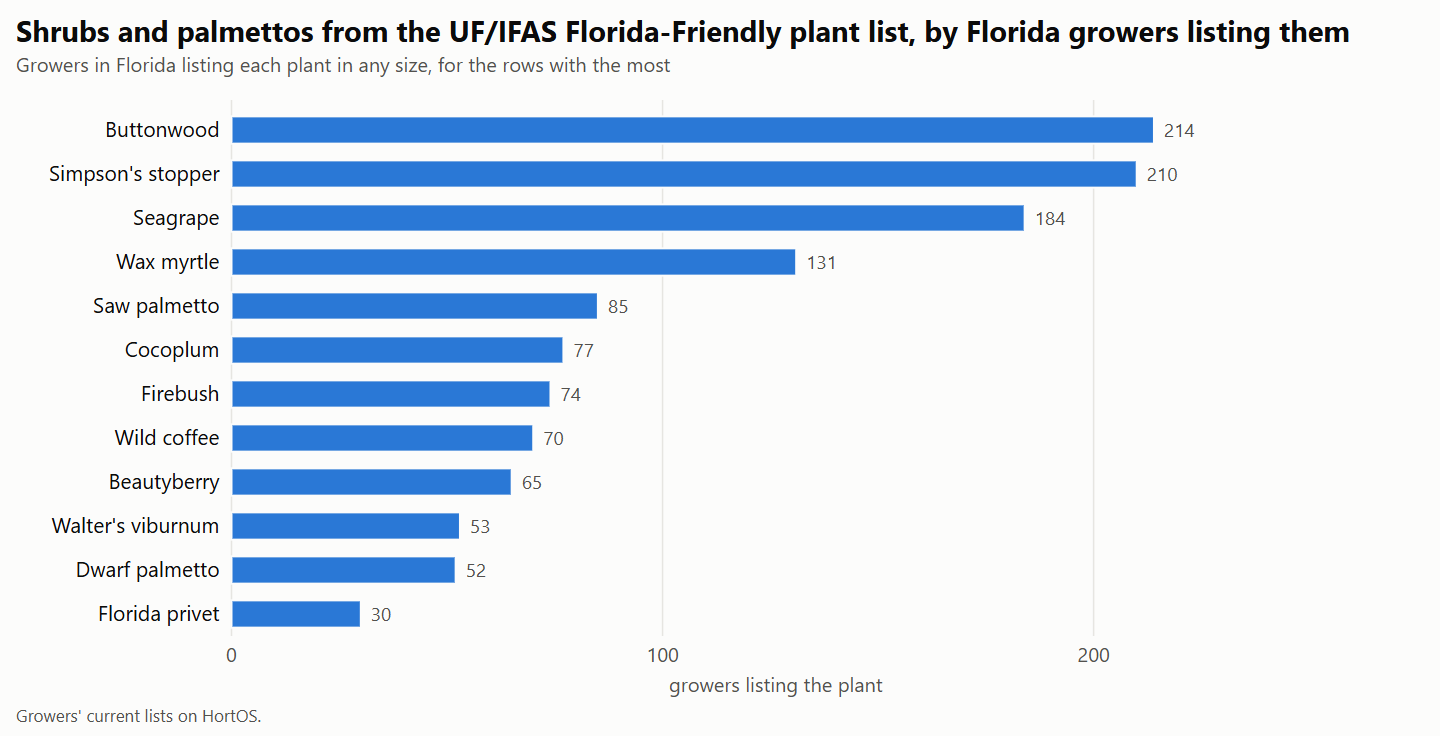
The count is the growers in Florida listing the plant, in any size. Prices are medians across growers' current trade lists on HortOS: one price per grower, ex tax, freight not included, with the number of growers pricing each size in brackets. That median is national, for the one container size most growers price. The Florida median is the median across Florida growers pricing the same size, and it prints only where at least three do.
The size differs by row, so medians are not compared from row to row, and on many rows the two medians are the same figure. Saltgrass has two sizes tied on growers pricing them, and the table prints the liner, across 3 growers, with no Florida median. Switchgrass has 4 growers in Florida listing it, so its median, across 15 growers, is national only.
The second table takes its rows from the Large Shrubs and Small Shrubs groups of the 2022 list. Each row is one species, marked as a Florida native in the list, with a trade price page on HortOS and a grower in Florida listing it. Not every entry that meets those tests is shown. Saw palmetto is added from the list's palm group. Another 103 entries of the two shrub groups are not shown. The columns are those of the first table.
Some medians rest on few growers pricing the size: pipestem's #3 median on 3, rusty lyonia's #1 median on 3 and sparkleberry's #3 median on 4. Pipestem, Carolina allspice and sweet pepperbush have a national median and no Florida median. For sea myrtle the two medians differ widely: $16.50 nationally at #3, across 7 growers, and $6.00 in Florida. The national figure takes in growers outside Florida. Buttonwood's median is for a #25 container and yaupon holly's for a #15 container, where most rows of this table are #3 or #7. Dwarf palmetto and saw palmetto are priced here only in containers up to #15, because larger palms are sold by height.
What the tables cannot tell an owner or a board
The medians are trade prices by container size, not what a homeowner pays or what a finished planting costs. Anyone can see the prices on HortOS, and only the trade can order. A listing is what a grower lists, not plants on hand. A count here is growers listing the plant, not how many plants exist or how well it suits a site.
The tables do not show which part of Florida a plant suits. The list gives each entry its regions, and not every entry is given all three (UF/IFAS, 2022). A Florida count takes in growers anywhere in the state.
The directory does not show, for any grower, where seed or cuttings came from, whether the plants are the straight species or a named selection, or how they were grown. The 2022 list rates several of these entries as a species and its cultivars together, and its Walter's viburnum entry says the dwarf cultivars are 2 to 4 feet tall (UF/IFAS, 2022). A row here is the species' own page on HortOS, and the pages for named selections or for another botanical name are not counted in it. A buyer who needs to know asks the grower three things: the origin of the seed or cuttings, the exact selection, and the growing practice. The directory leads to each grower's own page.
The selection rests on the 2022 list, and a plant's absence from a table says nothing against it. The definition in s. 373.185(1)(b), Florida Statutes (2026), names no plant, and nothing in a table here says an association must accept one. The guide to the most grown native plants ranks natives by growers across the country and state by state. Container classes such as #1, #3 and #7 are set out in the guide to nursery pot sizes, and buying from a wholesale grower covers who a grower sells to.
What to watch for
- Treating the plant list as the law. The definition in s. 373.185(1)(b), Florida Statutes (2026), names no plant, and an article in The Florida Bar Journal (2020) says no plants are protected by the statute.
- Planting first. An article in The Florida Bar Journal (2020) says approval must be sought where deed restrictions require it, even where the practice is protected.
- Borrowing words from another subsection. The words "null and void as against the public policy of this state" close subsection (1) of s. 720.3075, Florida Statutes (2026), on developer clauses, not subsection (4)(b) on landscaping.
- Leaning on s. 720.3045. Section 720.3045, Florida Statutes (2026), is about items "not visible from the parcel's frontage or an adjacent parcel", artificial turf and vegetable gardens among them, and does not mention Florida-friendly landscaping.
- Taking a national median for a Florida price. The median with growers in brackets is national, and only the last column is Florida's.
Getting it right
- Read the community's declaration of covenants and any published guidelines the declaration authorizes. Section 720.3035(1)(a), Florida Statutes (2026), permits the review authority only so far as it is "specifically stated or reasonably inferred" there.
- Ask the association's manager or review committee what an application must show, and whether its guidelines name plants, turfgrass or mulch. Under s. 720.3035, Florida Statutes (2026), the association or its committee decides the application.
- Check each plant against the UF/IFAS list (2022) or the program's app (2026) for the region of Florida and the site.
- Look up who lists a plant on its HortOS page, then ask the grower about size, selection, origin and growing practice. An owner outside the trade asks a landscape contractor to place the order.
- Take a question about rights under either section to a Florida attorney. UF/IFAS (2020) says that it and the Florida Department of Environmental Protection cannot advise on legal rights.
A word of caution
The statute text here is the 2026 edition of the Florida Statutes as the Legislature's site printed it in October 2026, and it can change. The readings reported from UF/IFAS, the Florida Department of Environmental Protection and an article in The Florida Bar Journal are their authors' own, not rulings. The association or its committee decides an application (s. 720.3035, Florida Statutes, 2026), a court or an arbitrator the parties elect decides a dispute (s. 720.311(2)(c), Florida Statutes, 2026), and a Florida attorney is the one to ask. The grower counts and medians are what HortOS printed, and they move as growers update their lists.
Sources
- Florida Statutes, section 373.185 (the Florida Legislature): the definition and the covenant rule.
- Florida Statutes, section 720.3075 (the Florida Legislature): the association documents rule.
- Florida Statutes, section 720.3035 (the Florida Legislature): review authority and its limits.
- Florida Statutes, section 720.305 (the Florida Legislature): fines, notice, hearing, attorney fees.
- Florida Statutes, section 720.3045 (the Florida Legislature): items not visible from outside.
- Florida Statutes, section 720.311 (the Florida Legislature): presuit mediation before court.
- The Florida Bar Journal, Application of the Florida-Friendly Landscaping Statute to Homeowner Disputes Regarding Violation of Restrictive Covenants: a journal article's reading, 2020.
- UF/IFAS Florida-Friendly Landscaping Program, Guide to Plant Selection and Landscape Design: the program's full plant list.
- UF/IFAS Florida-Friendly Landscaping Program, Frequently Asked Questions: the program's answers on associations.
- UF/IFAS Extension, ENH1179, Questions and Answers on the 2009 Florida-Friendly Landscaping Legislation: UF/IFAS answers on the law.
- UF/IFAS and Florida Department of Environmental Protection, Model Covenants, Conditions and Restrictions: the agencies' position, 2010.
- UF/IFAS Florida-Friendly Landscaping Program, FFL Plants app page: the program's current plant app.
More guides

The Most Grown Native Plants in the United States, by State
A data page, not an essay: the American native plants held by the most wholesale growers, counted grower by grower and state by state from growers' current lists on HortOS, with the median trade price at the size most growers price. Two paragraphs on what the tables show and what they do not, then the tables, refreshed each edition.

Nursery Pot Sizes Explained: Millimetres, Litres and Gallons
Australian growers name a pot by its rim diameter up to 400 mm and by its volume in litres above that, while American growers use gallon classes. This guide explains each step of the ladder, the approximate height and age behind it, how to convert between systems, and what the trade pays at every size.

Buying From a Wholesale Grower When You Are Not in the Trade
Native plant societies, watershed districts, land trusts, schools and church committees can buy from wholesale growers when they order like the trade: in quantity, ahead of the season, on the grower's terms. This page explains who sells to whom, resale certificates and exemptions, minimums and pooling, the sizes to buy, straight species and ecotype, lead times and shipping.