Trees extension lists name in place of ash, and who lists them
Sets Iowa State University Extension's list of trees to plant where ash has been lost beside the diversity limits Iowa, Wisconsin and others publish and the dated quarantine position. One table gives the growers listing each tree on HortOS and, for most rows, a national trade median for one container size.
Updated October 11, 2026. Figures are what the live us.hortosapp.com price and plant pages printed.
On this page
A tree board member in a town where the ash are coming down has one question: which trees do the extension lists name in place of ash, and do growers list them. The lists from Iowa and Wisconsin both come with a limit on how many trees of one kind are planted, so the answer they give is a mix of trees and never a single tree. This page sets those lists and limits beside what growers list today.
It draws on Iowa State University Extension, the Wisconsin Department of Natural Resources and the University of Wisconsin-Madison Division of Extension. It also draws on the Federal Register, the agriculture departments of Minnesota and Wisconsin, the Morton Arboretum and the Nebraska Statewide Arboretum. It adds counts and trade medians from HortOS, a free directory of American wholesale plant growers with their published availability and trade prices. It is a summary of what those bodies publish, and it is not a planting plan for any site.
Quick facts
| Federal quarantine | The USDA Animal and Plant Health Inspection Service removed its domestic quarantine regulations for emerald ash borer by a final rule in the Federal Register of December 15, 2020, effective January 14, 2021. |
|---|---|
| Spread at that date | That Federal Register rule of December 2020 dates the first find to southeast Michigan in 2002 and counts 35 states, with the District of Columbia, where the borer had been found by then. |
| Iowa's guideline | Iowa State University Extension (2025) gives 10-20-30: no more than 10 percent of trees of one species, 20 percent of one genus and 30 percent of one family. |
| Wisconsin's rule | The Wisconsin Department of Natural Resources (undated page, read in 2026) gives 20-10-5: no more than 20 percent from one family, 10 percent from one genus and 5 percent from one species. |
| Minnesota counties | The Minnesota Department of Agriculture's quarantine page, read on October 5, 2026, says 62 Minnesota counties have known infestations of the borer. |
| On HortOS | The table below held 19 trees from Iowa State University Extension's 2025 list, 14 of them with a national trade median for one container size. |
The trees the lists name in place of ash
Iowa State University Extension (Iowa, 2025) says the borer kills all native ash and that the loss changes the urban tree canopy. Its page then lists trees to consider where an ash has been removed, each with its botanical name, hardiness zones and plant family. The Wisconsin Department of Natural Resources hosts a list from the University of Wisconsin-Madison Division of Extension (undated, read in 2026), and the Nebraska Statewide Arboretum publishes one for Nebraska (undated, read in 2026).
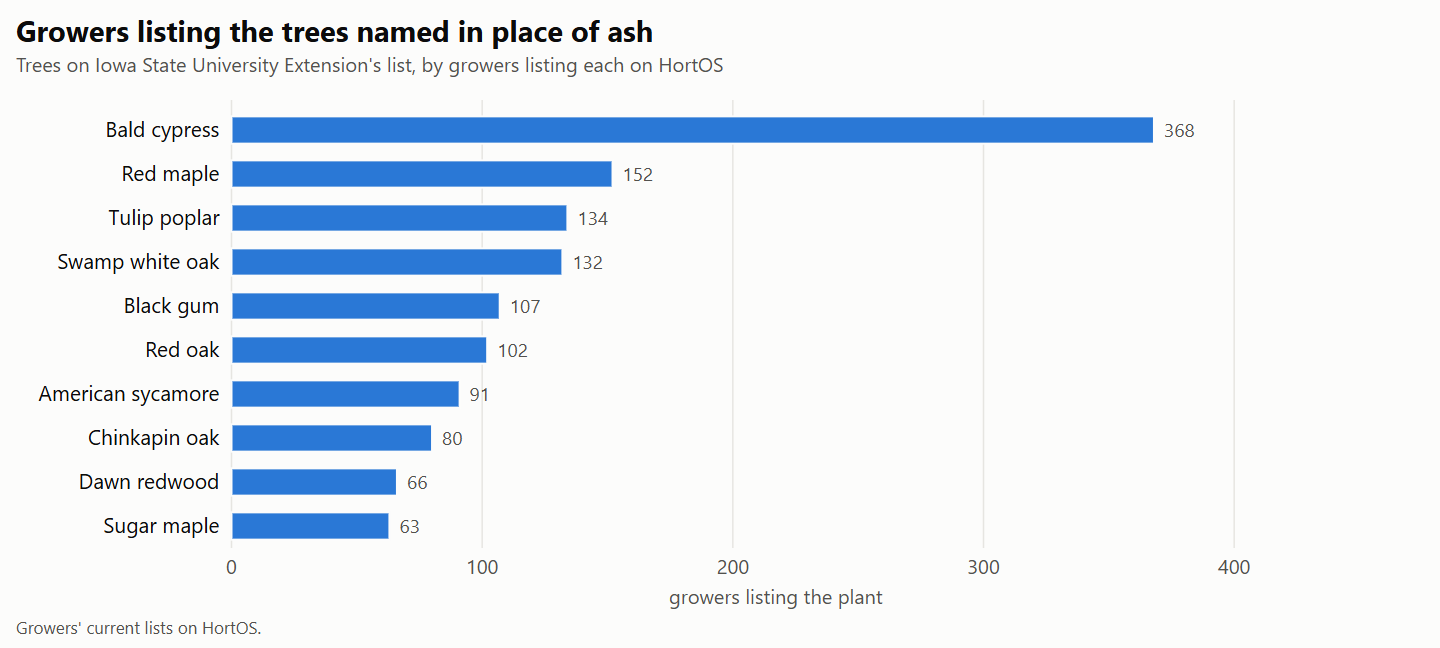
The table shows 19 of the trees on Iowa State's list, each a single species or form with a page on this site, from bald cypress to Miyabe maple. The count beside each tree is the growers listing it in any size, and the median rests on the smaller number in brackets, the growers pricing the one size shown. Prices are medians across growers' current trade lists on HortOS: one price per grower, ex tax, freight not included, with the number of growers pricing each size in brackets. Anyone can see the prices on HortOS, and only the trade can order.
| Plant | Family and hardiness zones, Iowa State University Extension (2025) | Growers listing it | Size most growers price | Median (growers pricing) |
|---|---|---|---|---|
| Bald cypress (Taxodium distichum) | Cupressaceae; zones 4 to 9 | 368 | #30 | $120 (89) |
| Red maple (Acer rubrum) | Sapindaceae; zones 3 to 9 | 152 | #15 | $60 (20) |
| Tulip poplar (Liriodendron tulipifera) | Magnoliaceae; zones 4 to 9 | 134 | #15 | $60 (22) |
| Swamp white oak (Quercus bicolor) | Fagaceae; zones 3 to 8 | 132 | #7 | $37.75 (10) |
| Black gum (Nyssa sylvatica) | Cornaceae; zones 4 to 9 | 107 | #3 | $14.50 (17) |
| Red oak (Quercus rubra) | Fagaceae; zones 3 to 7 | 102 | #3 | $12.50 (7) |
| American sycamore (Platanus occidentalis) | Platanaceae; zones 4 to 9 | 91 | #15 | $60 (16) |
| Chinkapin oak (Quercus muehlenbergii) | Fagaceae; zones 5 to 7 | 80 | #30 | $135 (9) |
| Dawn redwood (Metasequoia glyptostroboides) | Cupressaceae; zones 5 to 8 | 66 | #15 | $75 (9) |
| Sugar maple (Acer saccharum) | Sapindaceae; zones 4 to 8 | 63 | #5 | $35 (4) |
| Hackberry (Celtis occidentalis) | Cannabaceae; zones 2 to 9 | 59 | #5 | $36 (3) |
| Ginkgo (Ginkgo biloba) | Ginkgoaceae; zones 3 to 8 | 58 | #15 | $65 (5) |
| Kentucky coffee tree (Gymnocladus dioicus) | Fabaceae; zones 3 to 8 | 37 | Field grown only | |
| Basswood (Tilia americana) | Malvaceae; zones 2 to 8 | 34 | #3 | $15 (3) |
| Northern catalpa (Catalpa speciosa) | Bignoniaceae; zones 4 to 8 | 30 | Field grown only | |
| Shingle oak (Quercus imbricaria) | Fagaceae; zones 4 to 8 | 30 | #3 | $14.50 (3) |
| London planetree (Platanus x acerifolia) | Platanaceae; zones 5 to 8, with 4 and 9 in brackets | 14 | Field grown only | |
| Thornless honeylocust (Gleditsia triacanthos inermis) | Fabaceae; zones 3 to 8 | 8 | Fewer than three growers | |
| Miyabe maple (Acer miyabei) | Sapindaceae; zones 4 to 8 | 5 | Fewer than three growers |
The growers listing the plants in this table are spread across many states; the most are in Florida, Tennessee and North Carolina. The size shown for each plant is the container size most growers price; field grown lines are not counted. Where a row says Field grown only, its growers price that plant as field grown stock and no container median is shown.
A count here is growers listing the plant, not how many plants exist or how well it suits a site. The size differs from row to row, so the medians cannot be set against each other, and the table does not rank the trees by price. A #3 or a #5 is a young tree in a small container, and its median is not the price of a tree at street planting size.
The hardiness zones in the table are the ones Iowa State University Extension (Iowa, 2025) prints beside each tree on its list. It rates chinkapin oak and dawn redwood from zone 5, and London planetree from zone 5 with zone 4 in brackets, where it rates hackberry and basswood from zone 2. What is named for a colder state is for that state's extension service or forestry agency to say in its own list.
3 rows read Field grown only and 2 read Fewer than three growers, and the page gives no median for those. A median needs three growers pricing a size. Some medians that are shown are thin. Sugar maple has 63 growers listing it, and its median rests on the 4 who price a #5. The medians for hackberry and basswood rest on 3 and 3 growers, and the one for ginkgo on 5. The thornless honeylocust row is the thornless form's own page, so its count is not the count for honeylocust as a whole.
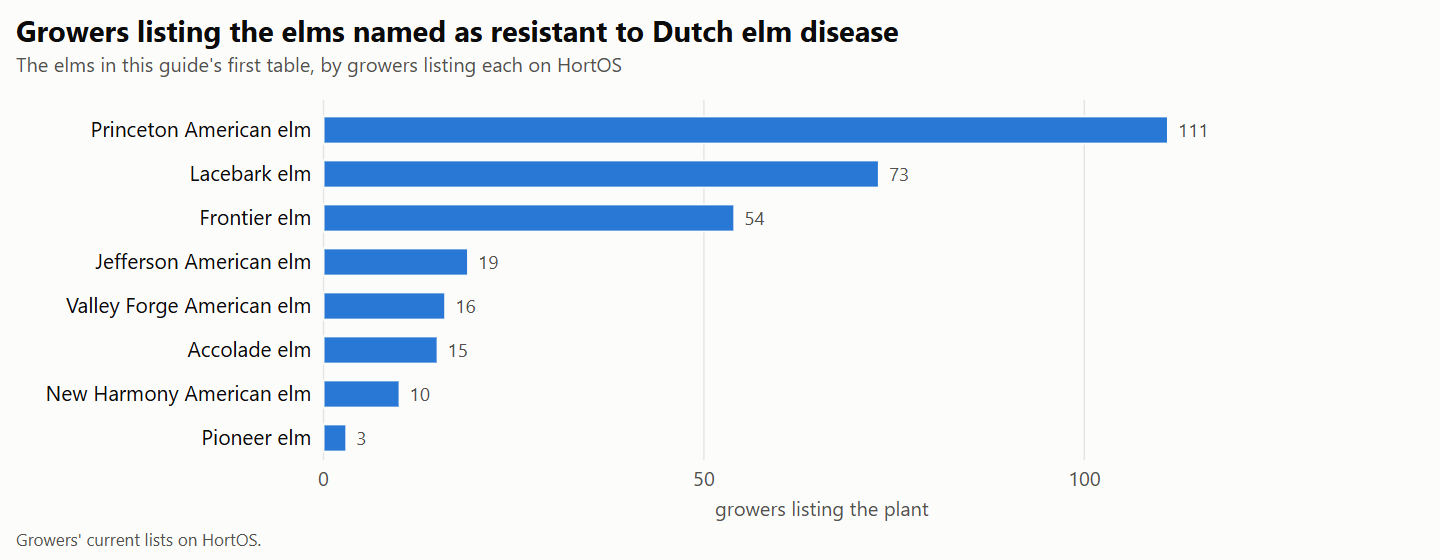
Iowa State University Extension (Iowa, 2025) puts an asterisk on the maples and oaks in its list. Its reason is that residential neighborhoods often hold too many maples and oaks already, so these trees may not add the diversity a planting needs. In the table those rows are red maple, sugar maple and Miyabe maple, and swamp white oak, red oak, chinkapin oak and shingle oak. The same list names American elm only as cultivars resistant to Dutch elm disease, which is a group of selections and so has no row here. The guide to elms named as resistant to Dutch elm disease takes that entry up, because each cultivar has its own record and its own growers.
The diversity limits that come with the lists
Each list sits beside a limit on how much of one kind is planted. Iowa State University Extension (Iowa, 2025) applies its 10-20-30 guideline to a yard and its neighborhood. A 1999 paper in the Journal of Arboriculture on a Maryland street tree inventory states the same 10, 20 and 30 percent formula for the urban forest as a whole. That 1999 Maryland paper credits the formula to a paper of 1990. The Morton Arboretum's community guide of 2012, written in Illinois, gives the same 10, 20 and 30 percent limits.
Wisconsin's figures differ. The Wisconsin Department of Natural Resources (undated page, read in 2026) calls the 30-20-10 planting rule out of date and says it was not adequate for the borer. Its own rule runs family first: 20 percent, then 10 percent for a genus and 5 percent for a species, with cultivars counted in the species. The Morton Arboretum's northern Illinois tree list of 2019 gives 5 percent for a species, 10 percent for a genus and 15 percent for a family.
Wisconsin DNR Forestry News said in 2021 that the four most common genera in Wisconsin's urban forests were maples, ashes, honeylocusts and lindens. Among the table's rows, the three maples, thornless honeylocust and basswood, which is a linden, belong to those genera. The Wisconsin Department of Natural Resources (undated page, read in 2026) also reports a view that 5 percent for a genus would be more reasonable. It adds that such a limit has to be weighed against whether a species suits the site and whether nurseries grow it. The guide to street trees and canopy covers the wider question of what cities plant along a street.
Treatment and the quarantine position
Replacement is one of two courses the sources describe. Iowa State University Extension (Iowa, 2025) says treatment exists, that some trees are too far gone for it, and that treatment is usually expensive. The Morton Arboretum's 2012 community guide for Illinois recommends that treatment be considered only for ash that have lost 30 percent or less of their canopy.
The federal quarantine regulations were removed by the Federal Register rule of December 2020, and the count of states in the Quick facts is that rule's figure and no later. Wisconsin's Department of Agriculture, Trade and Consumer Protection says on its page, read in October 2026, that the borer was first confirmed in Wisconsin in 2008 and has since been detected in all 72 counties. The same page says the borer was deregulated nationally in 2021 and that Wisconsin's own quarantine rule was rescinded in 2023.
The Minnesota Department of Agriculture says on its page, read on October 5, 2026, that it issues quarantines for counties where the borer is confirmed. The page says the quarantine restricts moving firewood and ash material inside Minnesota and out of counties with infestations. It also says regulated articles may not leave a quarantined area, treated or untreated, without one of the department's certificates. County counts change, and the department's own page is the place to check them.
What the table does not show
A listing is a name, a container size and often a price. It does not show a tree's caliper, its branching or the condition of its roots. Nor does it show how the tree was grown beyond the size label. The University of Wisconsin-Madison Division of Extension list (Wisconsin, undated, read in 2026) says trees are normally planted balled and burlapped or from containers, or are sold bare root. It also estimates that in the Upper Midwest a tree takes about one year for each inch of caliper to establish, so a 2 inch tree takes two or more years in Wisconsin.
The table is silent on seed source, on which selection of a species a grower lists, and on whether a grower delivers to the reader's state. A buyer can put each of those questions to the grower, along with caliper and root condition. The growers in each state are on the directory's state pages, among them Iowa, Wisconsin, Minnesota, Illinois and Michigan. The medians are national figures and are not the price in any one state.
The page carries no delivered or planted price, no field grown price and no figure for what treating an ash costs. It does not say which tree suits a given site, which is the forester's or the arborist's judgment.
What to watch for
- Reading a median for a #3 or a #5 as the price of a tree at planting size. It is the price of a young tree in that container.
- Taking a tree's place on a list as leave to plant it everywhere. Iowa State University Extension (Iowa, 2025) marks its own maples and oaks as often over-represented.
- Mixing up the diversity rules. Wisconsin's 20-10-5 from the Department of Natural Resources (undated, read in 2026) runs family, genus, species, where Iowa's 10-20-30 runs species, genus, family.
- Treating the December 2020 Federal Register count of states, or the Minnesota Department of Agriculture's county count of October 2026, as current on a later date.
Getting it right
- Start with the list for the state concerned. The state extension service or forestry agency decides what it recommends, and its own page carries its list.
- Ask the city forester or tree board which diversity limit the community uses and how the present trees count against it. They hold the inventory.
- Ask a certified arborist whether a standing ash is a candidate for treatment. The owner decides, on the arborist's reading of the canopy.
- Ask the state agriculture department what its rules say about moving ash wood or firewood. The department decides, and its own page states its position.
- Ask each grower for caliper, root form, seed source, the selection listed and whether it delivers to the site's state. The grower sets the terms of sale.
A word of caution
The lists and limits on this page belong to Iowa State University Extension, the Wisconsin Department of Natural Resources, the University of Wisconsin-Madison Division of Extension and the other bodies named, and each can revise its page. The Minnesota and Wisconsin quarantine positions here are what each state's agriculture department said on its page in October 2026. The choice of tree for a site rests with the city forester, the tree board or a certified arborist. HortOS shows what growers list and nothing about how a tree will perform.
Sources
- Iowa State University Extension and Outreach, Yard and Garden: What can I plant to replace an ash tree killed by emerald ash borer?: Iowa's replacement list and guideline.
- Wisconsin Department of Natural Resources, Replanting with Diversity: Wisconsin's 20-10-5 planting rule.
- University of Wisconsin-Madison Division of Extension, Alternatives to Ash Trees for the Urban Landscape: Wisconsin's list and planting forms.
- Wisconsin DNR Forestry News, Species Diversity In The Urban Forest: the most common genera in Wisconsin's urban forests, 2021.
- Federal Register, Removal of Emerald Ash Borer Domestic Quarantine Regulations: the federal final rule.
- Minnesota Department of Agriculture, Emerald Ash Borer Quarantine: Minnesota's quarantine and county count.
- Wisconsin Department of Agriculture, Trade and Consumer Protection, Emerald Ash Borer: Wisconsin's status since deregulation.
- The Morton Arboretum, community guide to emerald ash borer (the copy hosted by the Iowa Department of Natural Resources): the 2012 guide for communities.
- The Morton Arboretum, Northern Illinois Tree Species List: the 5-10-15 guideline.
- Nebraska Statewide Arboretum, Best Trees to Replace Ash: Nebraska's replacement list.
- Journal of Arboriculture, A Methodology for Assessing and Managing Biodiversity in Street Tree Populations: the 10-20-30 formula, 1999.
More guides
Dutch elm disease resistant elms and the growers that list them
For city foresters, shade tree committees and arborists choosing elms. It sets the American elm selections, hybrids and lacebark elm that universities and federal agencies name as resistant beside the growers listing each, with national trade medians. It reports how each fared in the National Elm Trial, one caution on record for each, and why resistance is not immunity.

Street Trees and Canopy: What Advanced Stock Costs and Who Holds It
A standing reference for urban forestry programs and tree nonprofits: the trees the American trade grows for streets and parks, the nursery-gate median at #15, #30, #45 and #65 and as field grown stock, how many growers in each state hold advanced stock, why lead times run to years, and what a street tree costs against a giveaway.

The Most Grown Native Plants in the United States, by State
A data page, not an essay: the American native plants held by the most wholesale growers, counted grower by grower and state by state from growers' current lists on HortOS, with the median trade price at the size most growers price. Two paragraphs on what the tables show and what they do not, then the tables, refreshed each edition.