Dutch elm disease resistant elms and the growers that list them
For city foresters, shade tree committees and arborists choosing elms. It sets the American elm selections, hybrids and lacebark elm that universities and federal agencies name as resistant beside the growers listing each, with national trade medians. It reports how each fared in the National Elm Trial, one caution on record for each, and why resistance is not immunity.
Updated September 17, 2026. Figures are what the live us.hortosapp.com price and plant pages printed.
On this page
A city forester or a shade tree committee drafting a street tree list asks which elms the authorities name as resistant to Dutch elm disease, and which growers list each one. UW-Madison Extension (Wisconsin, 2024) gives the idea that matters most: resistance is not immunity, and a resistant elm can still become infected. In resistant varieties, it says, the disease usually develops more slowly, which leaves time to manage it.
This page reports what UW-Madison Extension, Ohio State University Extension, the University of Minnesota, North Dakota State University Extension, the Morton Arboretum, the Minnesota Department of Agriculture and the USDA Agricultural Research Service say about elms. It adds the National Elm Trial's 2017 report and papers in the U.S. Forest Service's 2017 proceedings. Beside them it sets who lists each elm on HortOS, a free directory of American wholesale plant growers with their published availability and trade prices. It rates no elm and gives no treatment advice.
Quick facts
| Resistant, not immune | UW-Madison Extension (Wisconsin, 2024) says resistant elm varieties can still become infected. North Dakota State University Extension (2023) says immunity is found in no species or cultivar of elm. |
|---|---|
| Elms UW-Madison names | UW-Madison Extension (Wisconsin, 2024) names five American elm varieties as resistant, among them Princeton, Valley Forge and New Harmony. It names four hybrids, among them Accolade and Frontier. |
| The national trial | The National Elm Trial's report (United States, 2017) covers plantings at 16 locations, followed for 7 to 10 years. Only one cultivar, the elm sold as Accolade, averaged over 90 percent survival. |
| Why trial trees died | The National Elm Trial's authors (United States, 2017) say freeze damage, drought and wind breakage likely caused most deaths, and that the cause of death went undetermined at most locations. |
| Regulation in Minnesota | The Minnesota Department of Agriculture's page (read 2026) says no state or federal regulations cover Dutch elm disease in Minnesota, and that some municipalities require control of infected elms. |
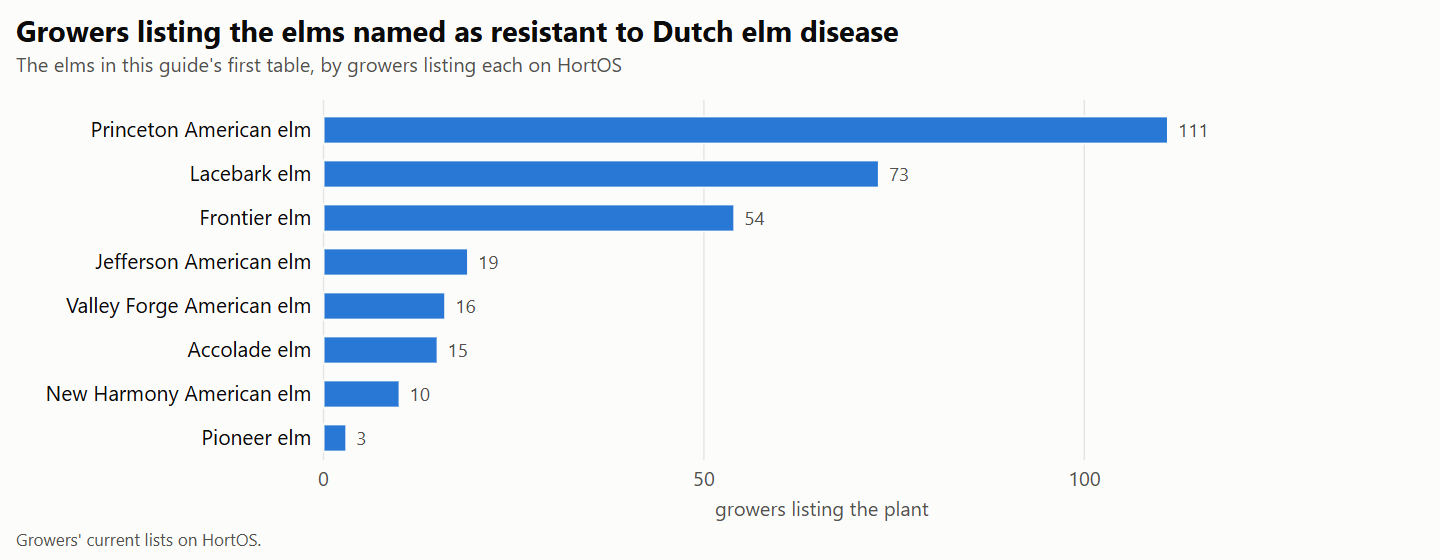
| Who lists them, and a median | 111 growers listed Princeton American elm on HortOS, 54 Frontier elm and 16 Valley Forge American elm, in any size. The national median trade price of Princeton at #15 was $70 across 11 growers pricing it, one price per grower, ex tax, freight not included. |
Resistant, tolerant and immune in the authorities' own terms
UW-Madison Extension (Wisconsin, 2024) describes Dutch elm disease as a fungal disease that kills North America's native elms. It says the disease is now found across the United States.
Other authorities draw the same line between resistance and immunity. North Dakota State University Extension (2023) says elms differ in how susceptible they are and that none is immune. A paper in the U.S. Forest Service's 2017 proceedings says no American elm has yet shown immunity, and that the tolerance a clone shows varies with growing conditions and with the way it is tested. The National Elm Trial's report (United States, 2017) says Princeton, Valley Forge and New Harmony have held up very well against the disease for years without being completely resistant.
The lists of names differ. UW-Madison Extension (Wisconsin, 2024) names five American elm varieties as resistant: Princeton, Valley Forge, New Harmony, American Liberty and Independence. It names four hybrids that are not native: Accolade, Frontier, New Horizon and Regal. Its page names neither Jefferson nor Triumph. Ohio State University Extension (Ohio, 2021) lists Princeton, Valley Forge, New Harmony, Jefferson and Colonial Spirit among American elm cultivars it describes as resistant. The same Ohio article calls Frontier a disease-resistant introduction of the U.S. National Arboretum.
Jefferson's source is federal. The USDA Agricultural Research Service said in 2006 that it had released Jefferson jointly with the National Park Service, after screening tests found the elm's tolerance of the disease outstanding. A paper in the U.S. Forest Service's 2017 proceedings records that Jefferson was tested by inoculation and found tolerant.
Lacebark elm is named as a species. Ohio State University Extension's 2016 fact sheet (Ohio) places it among the Asian elms, which it calls "much less susceptible". The Morton Arboretum (Illinois, page read 2026) says lacebark elm resists the disease strongly. The Arboretum's pages (read 2026) also name Triumph elm and Emerald Sunshine elm as resistant.
The sources differ on American Liberty. UW-Madison Extension (Wisconsin, 2024) names American Liberty and Independence as resistant, and Ohio State University Extension's 2016 fact sheet (Ohio) names American Liberty among resistant elms to plant. The National Elm Trial's report (United States, 2017) says inoculation studies later found crown dieback in American Liberty like that of American elm seedlings. A paper in the U.S. Forest Service's 2017 proceedings describes American Liberty as a group of clones sold under one name. It says the group did not show high tolerance in stringent Agricultural Research Service trials, though the identity of the trees sent was not disclosed, and that it is not sold through nurseries.
On regulation, the Minnesota Department of Agriculture's page on the disease (read 2026) says "there are no state or federal regulations related to Dutch elm disease in Minnesota". The same page says some municipalities require control of infected elms, and that communities now mostly plant cultivars regarded as resistant.
The named elms, the growers listing each and a median
The first table sets 8 elms beside the authority that names each as resistant or tolerant. A row is an elm for which a university, a federal agency or the National Elm Trial's report is that authority, and for which HortOS prints a price page for the same cultivar or species. The authorities read for this page name 18 more elms than the table shows, and 7 of those are in the second table. Prices are medians across growers' current trade lists on HortOS: one price per grower, ex tax, freight not included, with the number of growers pricing each size in brackets. Anyone can see the prices on HortOS, and only the trade can order.
| Plant | Named resistant or tolerant by | Growers listing it | Size most growers price | Median (growers pricing) |
|---|---|---|---|---|
| Princeton American elm (Ulmus americana 'Princeton') | UW-Madison Extension, 2024 | 111 | field grown | $135 (47) |
| Valley Forge American elm (Ulmus americana 'Valley Forge') | UW-Madison Extension, 2024 | 16 | field grown | $127.50 (8) |
| New Harmony American elm (Ulmus americana 'New Harmony') | UW-Madison Extension, 2024 | 10 | field grown | $160 (5) |
| Jefferson American elm (Ulmus americana 'Jefferson') | USDA Agricultural Research Service, 2006 | 19 | field grown | $152.50 (8) |
| Accolade elm (Ulmus 'Morton') | UW-Madison Extension, 2024 | 15 | field grown | $142.50 (8) |
| Frontier elm (Ulmus 'Frontier') | UW-Madison Extension, 2024 | 54 | field grown | $125 (19) |
| Pioneer elm (Ulmus 'Pioneer') | National Elm Trial report, 2017 | 3 | field grown | $185 (3) |
| Lacebark elm (Ulmus parvifolia) | Ohio State University Extension, 2016, as much less susceptible | 73 | field grown | $152.50 (16) |
The growers listing the plants in this table are spread across many states; the most are in Texas, North Carolina and Tennessee. The size shown for each plant is the line most growers price. Where that is the field grown line, the median pools trees of every trunk size on the growers' lists, so it is not the price of one size.
The second column gives one authority for each elm, not every authority that names it. For Pioneer it is the National Elm Trial's report (United States, 2017), which lists Pioneer among the releases bred from European and Asian elms for their inherent resistance. What the trial itself reports for Pioneer is survival: the report gives no disease test of that elm. For lacebark elm the row is the species.
Several of these medians rest on few growers, and the bracket in each row gives the count. Pioneer's rests on the fewest growers a median can have. Few of the growers listing these elms are in the Midwest, and every median on this page is a national figure. None is a price for Minnesota, Ohio or Michigan, whose hubs show who lists what there.
Princeton, Frontier and lacebark elm also have container medians on the same basis. Princeton American elm stood at $70 at #15 across 11 growers pricing it, and at $122.50 at #30 across 8. Frontier elm stood at $111.50 at #30 across 6 growers pricing it. Lacebark elm stood at $80 at #15 across 8 growers pricing it, and at $125 at #30 across 13. The table's other elms have no container median.
Growers also list American elm (Ulmus americana) with no cultivar name: 60 growers on HortOS, in any size. That page is the unselected species, which the Morton Arboretum (Illinois, page read 2026) says takes the disease very readily.
The second table has 7 more named elms, each with a plant page on HortOS and no price page. Grower counts are the growers listing each plant on HortOS, in any size. A count here is growers listing the plant, not how many plants exist or how well it suits a site. The table prints counts only. A median needs three growers pricing a size.
| Plant | Named resistant or tolerant by | Growers listing it | States with most growers |
|---|---|---|---|
| Prairie Expedition American elm (Ulmus americana 'Lewis & Clark') | North Dakota State University Extension, 2023 | 7 | 7 states with 1 each |
| Colonial Spirit elm (Ulmus americana 'JFS-Prince II') | Ohio State University Extension, 2021 | 1 | Pennsylvania 1 |
| Patriot elm (Ulmus 'Patriot') | University of Minnesota, 2014 | 6 | New Jersey 2 |
| New Horizon elm (Ulmus 'New Horizon') | UW-Madison Extension, 2024 | 3 | Oklahoma 1, Wisconsin 1, New Jersey 1 |
| Prospector elm (Ulmus wilsoniana 'Prospector') | University of Minnesota, 2014 | 2 | California 1, New Jersey 1 |
| Homestead elm (Ulmus carpinifolia 'Homestead') | National Elm Trial report, 2017 | 2 | New York 1, New Jersey 1 |
| Discovery elm (Ulmus davidiana var. japonica 'Discovery') | North Dakota State University Extension, 2023 | 2 | California 1, New Jersey 1 |
The last column names the states with the most growers listing each plant, three at most, and stops where states tie for the next place.
For Prairie Expedition the authority, North Dakota State University Extension (2023), is describing its own university's release, which it says has high resistance. For Colonial Spirit the authority is Ohio State University Extension (Ohio, 2021), and a paper in the U.S. Forest Service's 2017 proceedings records its tolerance as still under evaluation. Homestead stands on the same footing as Pioneer, in the same passage of the trial's report (2017).
The guide to street trees and canopy covers the trees the trade grows for streets and parks, with medians by container class. The guide to reading a wholesale availability list sets out how a median is built.
Ten years of the National Elm Trial, elm by elm
The National Elm Trial was a volunteer effort to evaluate elms sold as resistant or tolerant to the disease. Its report (United States, 2017) covers plantings at 16 locations, followed for 7 to 10 years. The third table has one row for each elm in the first two tables: where it came from, how it survived in the trial, and one caution that a source records.
| Elm | Origin and release | Survival in the National Elm Trial, 2005 to 2015 (report of 2017) | A caution on record |
|---|---|---|---|
| Princeton American elm | Selected in New Jersey in 1922 (U.S. Forest Service proceedings, 2017) | 81.5% | Needs a lot of maintenance pruning to keep a sound crown (U.S. Forest Service proceedings, 2017) |
| Valley Forge American elm | Seedling selected in Delaware, Ohio; released by the Agricultural Research Service in 1995 (U.S. Forest Service proceedings, 2017) | 66.7% | Hard to manage in the nursery; needs time given to pruning for sound branch structure (University of Minnesota, 2014) |
| New Harmony American elm | Found beside Interstate 70 near Springfield, Ohio; released by the Agricultural Research Service in 1995 (U.S. Forest Service proceedings, 2017) | 85.5% | One of four elms that scale insects damaged most across the trial (National Elm Trial report, 2017) |
| Jefferson American elm | Cloned in 1993 from a tree on the National Mall; released by the Agricultural Research Service with the National Park Service (USDA Agricultural Research Service, 2006) | Not among the four American elms reported | Some trees sold under this name proved to be another elm, probably Princeton (U.S. Forest Service proceedings, 2017) |
| Prairie Expedition American elm | Survivor tree from near Fargo, North Dakota; released in 2004 by North Dakota State University's research foundation (U.S. Forest Service proceedings, 2017) | 63.6% | Planted at 11 of the 16 sites, which the authors say may have skewed its figure (National Elm Trial report, 2017) |
| Colonial Spirit elm | A mature survivor tree discovered in New Jersey (U.S. Forest Service proceedings, 2017) | Not among the four American elms reported | Its tolerance was still under evaluation in 2017 (U.S. Forest Service proceedings, 2017) |
| Accolade elm | Morton Arboretum introduction (University of Minnesota, 2014) | Over 90%, with every tree alive at 13 sites | Two trees in Minnesota were found with the disease in 2004 (University of Minnesota, 2014) |
| Frontier elm | U.S. National Arboretum introduction (Ohio State University Extension, 2021) | 70% to 79% | Twig dieback most winters in a Minnesota nursery; not recommended for the Twin Cities (University of Minnesota, 2014) |
| Pioneer elm | Cross of Ulmus glabra and Ulmus carpinifolia (University of Minnesota, 2014) | 80% to 89% | Many trees in Minneapolis showed winter injury after the winter of 2005 to 2006 (University of Minnesota, 2014) |
| Patriot elm | From the U.S. National Arboretum's breeding work (University of Minnesota, 2014) | 80% to 89% | Leaf-feeding insects can do it heavy damage (North Dakota State University Extension, 2023) |
| New Horizon elm | University of Wisconsin introduction (University of Minnesota, 2014) | 70% to 79% | Twin leaders and heavy side branches can form fast, so young trees need more upkeep (University of Minnesota, 2014) |
| Prospector elm | Wilson elm selected at the U.S. National Arboretum (University of Minnesota, 2014) | 70% to 79% | Less hardy than other selections in Minnesota, with some stem breakage (University of Minnesota, 2014) |
| Homestead elm | From the U.S. National Arboretum's elm breeding (University of Minnesota, 2014) | 80% to 89% | The elm that leaf-eating insects damaged most across the trial (National Elm Trial report, 2017) |
| Discovery elm | A Japanese elm selection (National Elm Trial report, 2017) | Left out of the results: grown at no more than two sites | Grows much more slowly than most other selections (University of Minnesota, 2014) |
| Lacebark elm | Asian species (Ohio State University Extension, 2016) | Three selections: 25% to 59%, most lost to freeze damage | Not recommended for northern sites until hardier selections turn up (National Elm Trial report, 2017) |
The survival column is not a score for disease resistance. The National Elm Trial's authors (United States, 2017) say freeze damage, drought with freeze damage and wind breakage likely accounted for most deaths. They say the cause of death was never determined at most locations, and that differences between sites rule out any reading of the results by region of the country.
The trial's report (2017) calls Valley Forge a fast grower with exceptional resistance, and notes that poor results at five of fifteen sites may have biased its figure. The lacebark elm row reports three named selections planted in the trial, not the trees on the species' price page. The report (2017) says its ratings favored Princeton and New Harmony among the American elms, and New Horizon and the Morton Arboretum's introductions among the Asian elms.
Several cautions in the last column are one authority speaking of its own state or of northern sites, and another authority may report the same elm differently elsewhere. Ohio State University Extension (Ohio, 2021) calls Frontier an excellent choice for a street tree, while North Dakota State University Extension (2023) does not recommend it for North Dakota. The National Elm Trial's report (United States, 2017) says nurseries across the southern half of the country grow lacebark elm as a mainstay. The University of Minnesota's 2014 guide says Valley Forge seems to take the cold of USDA Hardiness Zone 4. The Agricultural Research Service's 2006 release gives Jefferson's range as USDA hardiness zones 5 through 7.
Structure is on record too. A University of Minnesota study in the U.S. Forest Service's 2017 proceedings looked at two storms in Saint Paul, in 2015 and 2016. It found young American elms failing from canopy damage two to three times as often as other kinds of tree planted around them.
What a listing, a median and a survival figure leave out
A listing on HortOS shows that a grower lists an elm on the date shown. It does not show the trunk caliper on offer, how many trees stand behind the line, or whether a tree is on its own roots or budded. This page gives no price by caliper and no median for any one state.
A listing does not show that a tree is true to name either. A paper in the U.S. Forest Service's 2017 proceedings records that some trees distributed in the trade as Jefferson were later found to be another elm, probably Princeton. The paper says the extent is not fully known.
Two cultivars are split across pages. New Horizon has a second page on HortOS under another botanical name, and so has Prospector. The count in the second table is the count on the row's own page, so it may not include every grower listing that cultivar.
No table on this page scores an elm for disease resistance: the authority named beside each elm is the source for the word resistant.
What to watch for
- Reading resistant as immune. The University of Minnesota's 2014 guide reports two Accolade elms found with the disease in 2004, and says none of the selections it covers is immune.
- Reading a survival figure as a disease score. Prairie Expedition was planted at 11 of the 16 trial sites, which the National Elm Trial's authors (United States, 2017) say may have skewed its figure.
- Treating a trade name and a cultivar name as two trees. A paper in the U.S. Forest Service's 2017 proceedings gives Prairie Expedition as the cultivar 'Lewis & Clark', and North Dakota State University Extension (2023) gives Accolade as 'Morton'. The trial's report prints the cultivar names.
- Ordering by species name alone. A line that reads Ulmus americana with no cultivar name is the unselected species.
- Carrying a median into a bid. The caliper, the root ball and the freight are each grower's to quote.
- Planting elms in a block. Ohio State University Extension's 2016 fact sheet (Ohio) says new elms belong among other kinds of tree, with at least 60 feet between one elm and the next.
Getting it right
- Start with the state's own extension service. Ask its urban forestry or plant pathology specialist which named elms it has watched in the planting's hardiness zone.
- Ask the city forester whether a local ordinance covers elms with the disease, and what it requires. The Minnesota Department of Agriculture's page (read 2026) says some municipalities in that state require control of infected elms.
- Open each elm's page from the tables to see the growers listing it by state, then write to each grower. Ask for the cultivar name as it will read on the tag, whether the tree is on its own roots or budded, and the caliper and root ball on offer.
- Ask each grower for a written quote at the caliper wanted, with freight. The guide to the American Standard for Nursery Stock explains how caliper and root ball are checked at delivery.
- Ask the arborist or the forestry crew what pruning cycle the elms will need. The University of Minnesota's 2014 guide says many elm varieties need frequent pruning visits in their first ten years out of the nursery.
A word of caution
This page reports what state extension services, the University of Minnesota, the USDA Agricultural Research Service and the National Elm Trial's authors published. It rates no elm, and it names no fungicide and no treatment schedule. Which elm suits a street is for the state extension service and the city forester or a certified arborist to say. Every count and median here was read from HortOS on a single day, so the live pages may now show other figures.
Sources
- UW-Madison Division of Extension, Dutch Elm Disease (revised 2024): resistant elms named, not immune.
- Ohio State University Extension, Dutch Elm Disease fact sheet (2016): Ohio account of the disease.
- Ohio State University Extension, Street Trees Part 8, Elms (2021): elms named for Ohio streets.
- Ten-Year Performance of the United States National Elm Trial, Arboriculture & Urban Forestry (2017): trial survival of elm cultivars.
- USDA Agricultural Research Service, Jefferson Trees Resistant to Dutch Elm Disease (2006): release of the Jefferson elm.
- USDA Forest Service, Proceedings of the American Elm Restoration Workshop 2016 (published 2017): origin and testing of clones.
- University of Minnesota, Elms for the Twin Cities (2014): elm selections tried in Minnesota.
- Minnesota Department of Agriculture, Dutch Elm Disease: regulatory status in Minnesota.
- North Dakota State University Extension, Elms for North Dakota (revised 2023): elms recommended for North Dakota.
- The Morton Arboretum, Dutch elm disease: susceptible and resistant elm species.
- The Morton Arboretum, Elm cultivars: resistance of named cultivars.
More guides

Street Trees and Canopy: What Advanced Stock Costs and Who Holds It
A standing reference for urban forestry programs and tree nonprofits: the trees the American trade grows for streets and parks, the nursery-gate median at #15, #30, #45 and #65 and as field grown stock, how many growers in each state hold advanced stock, why lead times run to years, and what a street tree costs against a giveaway.

Reading a Wholesale Availability List, and Pricing the Plants in a Bid
For landscape contractors, designers, estimators and students: what each column of a wholesale availability list means, how much the same plant at the same size varies between growers and states, how the low, median and high on the price pages are built, and how to carry the plant line of a bid from the list to the client.
The American Standard for Nursery Stock explained for buyers
ANSI Z60.2-2025 is the current American Standard for Nursery Stock, and it binds an order only where a contract, specification or code calls it up. The page paraphrases its rules for caliper, height, container class and root ball, sets out how public documents name the edition, and counts the growers listing its example shade trees.