The American Standard for Nursery Stock explained for buyers
ANSI Z60.2-2025 is the current American Standard for Nursery Stock, and it binds an order only where a contract, specification or code calls it up. The page paraphrases its rules for caliper, height, container class and root ball, sets out how public documents name the edition, and counts the growers listing its example shade trees.
Updated October 22, 2026. Grower counts are what the live us.hortosapp.com plant pages printed.
On this page
- Quick facts
- The 2025 edition and what makes it bind
- How public documents call the standard up
- Measuring a tree the way the 2025 standard does
- The standard's example shade trees and the growers listing them
- What the counts and the documents leave out
- What to watch for
- Getting it right
- A word of caution
- Sources
A city forester revising a planting specification, or a contractor about to sign for a load of shade trees, needs two answers. One is which edition of the nursery stock standard governs the trees. The other is how a tree is checked against it. The publisher's current edition is ANSI Z60.2-2025, approved in April 2025. The American Standard for Nursery Stock binds a buyer and a grower only where a contract, a specification or a code calls it up, and each such document names the edition in its own words.
This page reports what the 2025 standard, published by AmericanHort, says about caliper, height, container class and root ball. It then sets out how public documents call the standard up, from the Federal Highway Administration's FP-14 (2014) to city documents in Columbia, New York and Kalamazoo. It adds grower counts from HortOS, a free directory of American wholesale plant growers with their published availability and trade prices. It paraphrases the standard and does not reprint it, and it rules on no contract, delivery or tree.
Quick facts
| Current edition | ANSI Z60.2-2025, the American Standard for Nursery Stock. AmericanHort is the publisher, and the cover gives the approval date as April 17, 2025. |
|---|---|
| Edition before it | ANSI Z60.1, approved in April 2014. The foreword of Z60.2-2025 describes the work from January 2024 to April 2025 as a light revision. |
| Where it binds | The ANSI notice printed in Z60.2-2025 says compliance with an American National Standard is voluntary, and that the parties to a sale should expressly agree that it applies. |
| Caliper | For stock it does not measure at another point, Section 1.2.1 of ANSI Z60.2-2025 reads caliper six inches above the ground on field grown trees and six inches above the soil line on container trees. Once that reading reaches four and a half inches, the same section reads it at 12 inches. |
| Container class | Under ANSI Z60.2-2025 a container class is a range of volumes, not one gallon figure. Its Table 1 gives the #1 class as 152 to 251 cubic inches. |
| How documents name it | Of 8 public documents read for this page, one names the 1996 edition, one names ANSI Z60.1-2014, three name the latest or current edition and three name no edition. |
The 2025 edition and what makes it bind
AmericanHort, a standards developing organization that ANSI accredits, publishes the American Standard for Nursery Stock. The current edition is ANSI Z60.2-2025, called the 2025 standard on this page. Its cover gives the approval date as April 17, 2025. Its foreword says ANSI Z60.1 was approved in April 2014, and that a light revision from January 2024 to April 2025 produced Z60.2. AmericanHort's page for the standard announces the 2025 edition and offers it as a download. The same page says the canvass ballots on the revisions were unanimous.
The ANSI notice printed inside Z60.2-2025 says compliance with an American National Standard is voluntary. It says the parties to a commercial sale should expressly agree that the standard applies. The guide to use in ANSI Z60.2-2025 is an annex that says it is not part of the standard. Where one party does not follow the 2025 standard, that guide says, the contract terms control the sale and the standard may not help settle the conflict.
On those terms the 2025 standard reaches a delivery through another document: a purchase contract, a project specification or a city code. The preface of FP-14 (2014), the Federal Highway Administration's specifications for federal highway projects, shows the mechanism. FP-14 becomes part of a contract, and binds the parties to it, when the contract designates it.
The guide to use also says the tables of the 2025 standard are, in most cases, minimum relationships that the parties are encouraged to exceed. The ANSI notice in Z60.2-2025 tells users to get the latest edition. It says ANSI's procedures call for action to reaffirm, revise or withdraw the standard within five years of publication.
How public documents call the standard up
The table sets out 8 public documents. Each row reports what that document asks and the edition it names, with the document's own date. The table is not a survey of every state or city, and it is not a statement of what is in force today. Which edition applies under any of these documents is for the contracting agency, the city or the contract to say.
| Where it applies | Document and year | What it asks of nursery stock | Edition it names |
|---|---|---|---|
| Federal Highway projects | U.S. Federal Highway Administration, Standard Specifications FP-14, 2014 | Plant material and its grading conform to the standard | No edition; the standard as ANSI approves it |
| Washington State highway work | Washington State Department of Transportation, Standard Specifications M 41-10, 2027 edition | All plant material meets the standard's grades on the day it is delivered | The latest edition, cited as ANSI Z60.1 |
| Oregon highway work | Oregon Department of Transportation, Standard Specifications for Construction, 2024 | Plants conform to the standard; where it and the state's specifications differ, the specifications govern | The current issue |
| North Carolina highway work | North Carolina Department of Transportation, Standard Specifications for Roads and Structures, January 2024 | Plant grading, root ball size and container type and dimensions conform to the standard | No edition named |
| Columbia, South Carolina | City zoning ordinance, Sec. 17-5.3 Landscaping, text dated August 20, 2019 | A planted tree's height against caliper, its root ball and its spread meet the standard | The current edition |
| New York City street trees | City of New York Parks and Recreation, Street Tree Planting Standards, 2016 | Tree size and grading follow the standard unless the city specifies otherwise | The 1996 edition |
| Kalamazoo, Michigan, city property | City of Kalamazoo Tree Manual, August 2023 | Trees meet or exceed the standard | ANSI Z60.1-2014 |
| Illinois urban forestry program plantings | Illinois Department of Natural Resources, Tree Planting Guide and Standards, undated | Trees of 3/4 inch to 3 inch caliper meet or exceed the standard | No edition named |
Specifications also say who inspects. Under FP-14 (2014), the Federal Highway Administration's specification for federal highway projects, no plant is set until the contracting officer has inspected and approved it. The same clause of FP-14 (2014) rejects plants that do not meet the specifications, reach the site in poor condition or show signs of improper handling.
Section 20 of the California Department of Transportation's 2024 Standard Specifications carries its own table of plant sizes. In that California table a No. 1 container is 152 to 251 cubic inches and a No. 5 container is 785 to 1,242 cubic inches. Under the same California specifications of 2024, the Engineer inspects container grown sample plants by taking soil off the root ball of at least two plants, and of no more than 2 percent of each species or variety. Where the Engineer finds sample plants that do not comply, California's 2024 specifications reject the whole lot those samples stand for.
A local text can state its own measuring rule. The zoning text of Columbia, South Carolina, dated August 20, 2019 (Sec. 17-5.3), requires a caliper of at least two inches on shade trees and small-maturing trees when planted, taken half a foot above ground. The same Columbia text of 2019 takes the caliper of a multi-trunk tree as the average of its three largest leaders.
Measuring a tree the way the 2025 standard does
Size, caliper and height
A specification under ANSI Z60.2-2025 states how big the plant is, as a caliper, a height or a width, whichever suits the plant type. Under the 2025 standard's rule on size intervals the size written is a minimum. It takes in every plant from that size to just under the start of the next interval. The example in ANSI Z60.2-2025 is a 2.5 inch caliper Type 1 shade tree, which means the interval from 2.5 to 3 inches.
Section 1.2.1 of ANSI Z60.2-2025 sets where caliper is read on stock it does not measure at another point. The point is six inches above ground level on field grown trees and six inches above the soil line on container trees, for trunks through the four-inch interval. Under the same section of the 2025 standard, a trunk that reads four and a half inches or more at that point is measured at 12 inches instead. Section 1.2.1 adds that a diameter tape gives the most accurate caliper. Section 1.2.2 of ANSI Z60.2-2025 measures height from ground level on field grown trees, from the soil line on container trees and from the root flare on bare root plants.
For a tree with several trunks, Section 1.2.3.3 of ANSI Z60.2-2025 supplies a default. Where a caliper is specified and no method of measurement is named, its Method C applies. Method C of the 2025 standard sets the specified caliper at half the caliper of the three biggest trunks the order requires.
Section 1.3.1 of ANSI Z60.2-2025 requires correct identification by genus, species and, where there is one, cultivar. Section 1.3.2 applies when the plant ships. At that point the plant is alive and in good condition, largely clear of harmful insects and disease, and shaped as its species normally grows in the region that raised it. Section 1.3.3 of the 2025 standard adds a rule for shade trees of Type 1 and Type 2. A tree whose crown splits into co-dominant stems below its midpoint fails that minimum quality requirement, unless it was ordered as a multi-stem tree.
Under the 2025 standard a bid specification for street trees states how high the lowest branch sits, or how far up the trunk is to be bare. ANSI Z60.2-2025 specifies field grown Type 1 shade trees by caliper. It specifies container grown ones by height up to the 7 to 8 foot size, with a container class or box size, and by caliper above that.
Container class
For container grown plants ANSI Z60.2-2025 requires a container class as well as the plant size. A container sold with a # designation must hold a volume inside the range of its class. Under the 2025 standard a class is a range of volumes and not a single volume such as a set number of gallons. Its Table 1 gives the #1 class as 152 to 251 cubic inches. A specification written only in quarts or gallons is not in accordance with the 2025 standard.
Where a plant size is required and only the container class is given, ANSI Z60.2-2025 treats the specification as incomplete and supplies no minimum plant size for that class. The general requirement of ANSI Z60.2-2025 for a container plant is a well-established root system that reaches the container's sides and holds a firm ball, with no excess of roots circling the inside. The guide to nursery pot sizes sets the gallon labels growers print on their lists beside liters and millimeters.
Root ball
The 2025 standard does not make minimum root ball size a required part of a specification, and it encourages the parties to settle the size before the sale. The general requirement of ANSI Z60.2-2025 is a ball wide and deep enough to hold the fibrous and feeding roots the plant needs to recover fully. ANSI Z60.2-2025 recognizes that plants with coarse or wide-spreading roots, plants seldom transplanted and plants moved out of season need a larger ball than it recommends. It also recognizes that its recommended size can be more than is needed for plants grown in containers and for plants often transplanted or root pruned.
Under ANSI Z60.2-2025 the trunk sits in the center of the ball, within a tolerance of 10 percent of the ball's diameter. The 2025 standard measures depth from the root flare. It leaves soil lying above the flare out of the depth and says that soil should be removed. For most of the country ANSI Z60.2-2025 gives a depth of at least 65 percent of the diameter for balls under 20 inches across, and at least 60 percent for balls of 20 inches and up. For a 2.5 inch caliper Type 1 shade tree, ANSI Z60.2-2025 gives a minimum root ball 28 inches across and 17 inches deep, and accepts container classes #25, #45 and #65.
The standard's example shade trees and the growers listing them
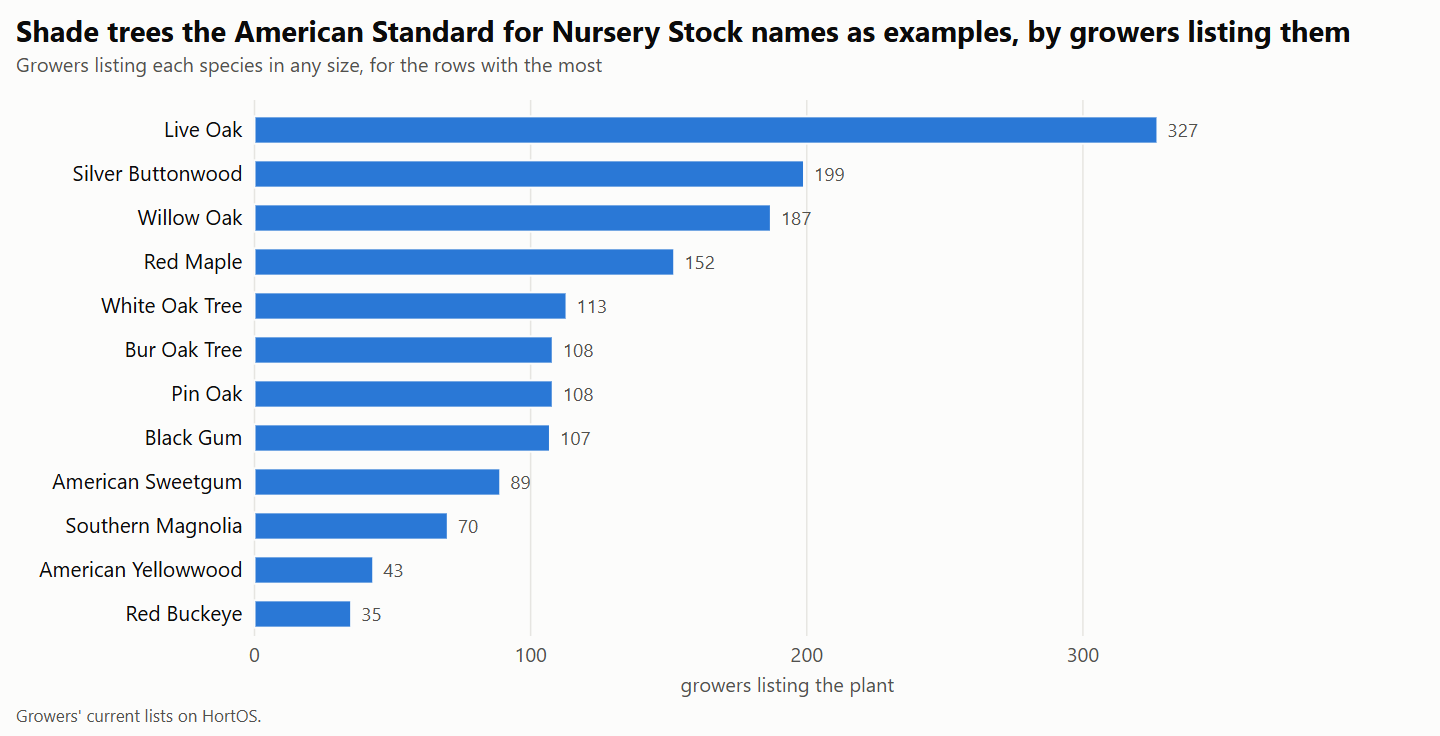
ANSI Z60.2-2025 sorts shade trees into types and names example species for each. Among its Type 1 examples are red maple (Acer rubrum), Japanese zelkova (Zelkova serrata) and live oak (Quercus virginiana), which it marks for southeastern climates. The table holds 22 of the species the 2025 standard names as examples of its two shade tree types, each with a page on HortOS, ranked by the growers listing them. 15 of the standard's example names are not shown, and most of those are given by genus only or have no page here. Grower counts are the growers listing each plant on HortOS, in any size. A count here is growers listing the plant, not how many plants exist or how well it suits a site.
The last column names the states with the most growers listing each plant, three at most, and stops where states tie for the next place.
The table carries counts only, and this page prints no price for these trees. A median needs three growers pricing a size. The guide to what a tree costs at the nursery prints trade medians for widely grown trees by container size. A buyer working under a state specification can open that state's hub, such as Oregon or North Carolina, to see its growers.
What the counts and the documents leave out
The counts say nothing of the caliper, height, root ball or container class of any grower's trees. They do not show whether a grower works to the standard, or to which edition. A count is growers listing the species in any size or form, not trees at the calipers the standard's shade tree rules cover. A grower's own list and quote say what it lists and at what size. The guide to reading an availability list explains the columns of such a list.
A species row is not the whole of a tree's trade either. Japanese zelkova is a row of the table, while 71 growers listed its Green Vase cultivar on HortOS, in any size, on a page of its own. The standard's examples name neither that cultivar nor bald cypress, which 368 growers listed on the same date.
The documents table holds 8 documents, each as dated. Two of its rows are a city's own manual and planting standards, not that city's code. Nothing here says how any agency applies its clause to a delivery.
What to watch for
- Reading a gallon figure as a class. Under ANSI Z60.2-2025 a class is a range of volumes, and a specification written only in gallons is not in accordance with the standard.
- Giving a container class with no plant size. Where a plant size is required, the 2025 standard treats that specification as incomplete.
- Assuming a reference means the 2025 edition. The documents in the table name the 1996 edition, ANSI Z60.1-2014, the latest or current edition, or none.
- Counting soil above the root flare as ball depth. ANSI Z60.2-2025 measures root ball depth from the root flare.
- Leaving out the method for a multi-trunk caliper. With no method named, the 2025 standard applies its Method C.
- Reading a grower count as trees of a size. A count on this page is growers listing a species in any size.
Getting it right
- Find the clause that calls the standard up in the contract, specification or code. Ask the contracting agency or the city which edition it applies.
- Read the 2025 edition itself, which AmericanHort's page for the standard offers as a download.
- Write each line with genus, species and cultivar, a size by caliper, height or width, a container class for container trees, and a method for any multi-trunk caliper.
- Settle the minimum root ball with the grower before the order, as the 2025 standard encourages.
- Ask who inspects and when. It is the contracting officer under FP-14 (2014), the Engineer under the California Department of Transportation's 2024 specifications, and under a private contract whoever the contract names.
- Shortlist growers from the plant pages in the table or from the directory. Ask each for the caliper, height and container class or ball size of the trees on its list.
A word of caution
This page paraphrases ANSI Z60.2-2025 and is not the standard, which AmericanHort publishes. The specifications, the zoning text and the city and program documents are reported as each stood when read, and the agency or city that issued each one says what applies now. Between a buyer and a grower the contract decides, and on public work the officer or engineer the specification names decides what is accepted. Grower counts are what HortOS showed.
Sources
- AmericanHort, American Standard for Nursery Stock, ANSI Z60.2-2025: the 2025 standard itself.
- AmericanHort, American Nursery Stock Standards and Best Practices: the publisher's page and download.
- U.S. Federal Highway Administration, Standard Specifications for Construction of Roads and Bridges on Federal Highway Projects, FP-14: federal highway plant material clauses.
- Washington State Department of Transportation, Standard Specifications for Road, Bridge, and Municipal Construction, M 41-10 (2027): state highway plant material clause.
- Oregon Department of Transportation, Oregon Standard Specifications for Construction, 2024: state highway plant material clause.
- North Carolina Department of Transportation, Standard Specifications for Roads and Structures, January 2024: state highway plant material clause.
- California Department of Transportation, Standard Specifications, 2024 Edition: plant sizes and root inspection.
- City of Columbia, South Carolina, Zoning Ordinance and Land Development Regulations, Sec. 17-5.3 Landscaping: a city zoning text on trees.
- City of New York Parks and Recreation, Street Tree Planting Standards for New York City: city street tree standards.
- City of Kalamazoo, Michigan, City of Kalamazoo Tree Manual: trees planted on city property.
- Illinois Department of Natural Resources, Urban and Community Forestry Program, Tree Planting Guide and Standards: Illinois program tree planting standards.
More guides

Nursery Pot Sizes Explained: Millimetres, Litres and Gallons
Australian growers name a pot by its rim diameter up to 400 mm and by its volume in litres above that, while American growers use gallon classes. This guide explains each step of the ladder, the approximate height and age behind it, how to convert between systems, and what the trade pays at every size.

What a Tree Costs at the Nursery, by Container Size and Caliper
A tree has a knowable wholesale price before freight, planting and margin are added, and the container size sets it far more than the species does. This page gives the trade prices for seven widely grown American trees at every size three or more growers publish, with the sizing rules behind them.

Reading a Wholesale Availability List, and Pricing the Plants in a Bid
For landscape contractors, designers, estimators and students: what each column of a wholesale availability list means, how much the same plant at the same size varies between growers and states, how the low, median and high on the price pages are built, and how to carry the plant line of a bid from the list to the client.