Box tree moth quarantines and the boxwood alternatives growers list
For landscape designers, extension volunteers and associations with boxwood hedges: what the federal and state box tree moth quarantines say about moving boxwood, as read on October 5, 2026, with a dated timeline of APHIS reports. Two tables show how many growers list boxwood and the plants named beside it, with trade medians where three growers price a size.
Updated October 18, 2026. Figures are what the live us.hortosapp.com price and plant pages printed.
On this page
- Quick facts
- What a box tree moth quarantine regulates
- Federal quarantine steps since 2022, report by report
- Keeping boxwood or planting something else: what extension services report
- Boxwood and the plants named beside it, by growers and trade median
- What the listings, medians and timeline leave out
- What to watch for
- Getting it right
- A word of caution
- Sources
A landscape designer is buying boxwood from a nursery in a county newly under a box tree moth quarantine. The designer asks what must be in place before the plants leave it, and which of the plants named beside boxwood are on growers' lists. APHIS's official pest reports of 2024 and 2026 say boxwood plants may leave a federally quarantined area for another state only from an establishment under a compliance agreement, with a state-issued certificate.
This page draws on APHIS's official pest reports on the NAPPO Phytosanitary Alert System, on the agriculture departments of Maryland, New Jersey and Virginia, and on what Purdue, Cornell and other extension services say about boxwood. It adds grower counts and trade medians from HortOS, a free directory of American wholesale plant growers with their published availability and trade prices. It is not the legal description of any quarantined area, rates no plant against the moth, and is not treatment advice.
Quick facts
| The federal movement rule | APHIS is the U.S. Department of Agriculture's Animal and Plant Health Inspection Service. APHIS's official pest report posted on August 11, 2026 (United States) says an establishment in a quarantined area may ship boxwood plants to another state only under a compliance agreement, with a state-issued certificate for the shipment. |
|---|---|
| Maryland | The Maryland Department of Agriculture's page names nine counties under the state quarantine as of September 2026: Allegany, Frederick, Garrett and Washington, with Cecil, Harford, Kent, Caroline and Queen Anne's. |
| New Jersey | The New Jersey State Board of Agriculture's order of August 26, 2026 quarantines Cape May, Cumberland and Atlantic counties. APHIS's official pest report posted on September 1, 2026 adds Cape May County to the federal quarantine area. |
| Virginia | Virginia's Department of Agriculture and Consumer Services announced its quarantine on December 3, 2025, for Clarke and Frederick counties and the city of Winchester. APHIS's official pest report posted on April 14, 2026 adds the same areas to the federal quarantine. |
| What the moth feeds on | University of Maryland Extension (Maryland, page updated October 1, 2026) says that in the United States the caterpillars have so far been found feeding on boxwood alone. |
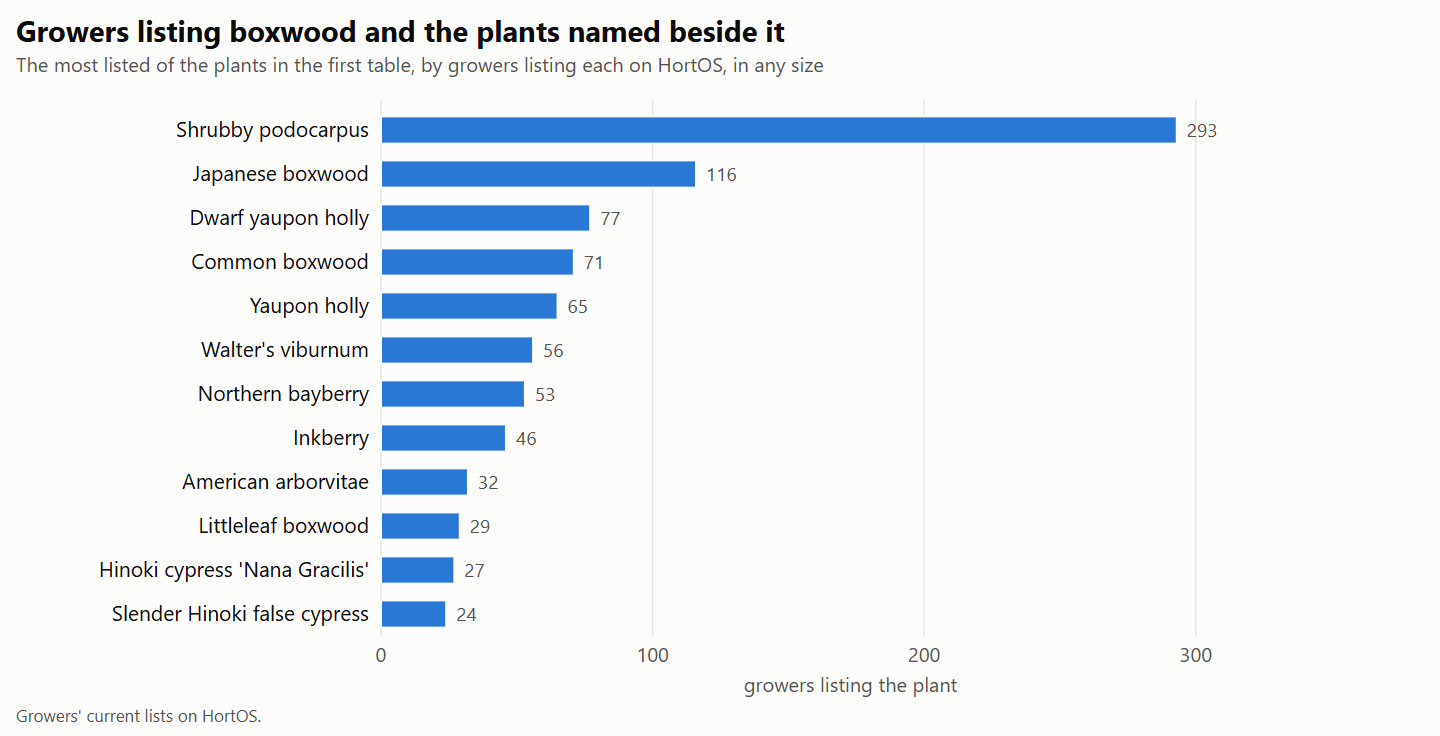
| Growers and a trade median | 116 growers listed Japanese boxwood on HortOS, 77 dwarf yaupon holly and 46 inkberry, in any size. The national median trade price of Japanese boxwood at #3 was $6.50 across 75 growers pricing it, one price per grower, ex tax, freight not included. |
What a box tree moth quarantine regulates
The federal conditions below come from official pest reports that APHIS filed on the North American Plant Protection Organization's (NAPPO) Phytosanitary Alert System, which (page read 2026) calls such a report its country's official communication.
The report APHIS posted on May 23, 2024 (United States) says boxwood plants may go from a quarantined area to another state only from an establishment under a compliance agreement, with a certificate from a state agricultural authority. APHIS's report posted on August 11, 2026 repeats the condition, and says that APHIS prohibits moving every other regulated boxwood article, cuttings, clippings and debris among them, except for decorative purposes. The same 2026 APHIS report says state agricultural authorities may set further safeguards.
Maryland's Department of Agriculture says on its page (Maryland, 2026) that its quarantine order bars regulated articles from being moved out of the quarantine zone or within it. The Maryland page (2026) puts the whole Buxus genus, plant parts and debris included, among those articles. The Maryland page (2026) says a business that grows and ships boxwood signs a compliance agreement with the Maryland department, then gets a certificate of inspection. The Maryland department's notice of August 24, 2026 says it and APHIS widened the quarantine that day into Kent, Caroline, Cecil and Queen Anne's counties. APHIS's report posted on August 25, 2026 adds Allegany, Frederick, Garrett and Washington counties, which it says mirrors the quarantine Maryland set on March 6, 2026.
Under the New Jersey order of August 26, 2026, a business may take a regulated article out of the quarantine area only with a signed compliance agreement and a certification from the Department of Agriculture. Under the same 2026 order, a private individual or other non-business entity needs the New Jersey department's prior written authorization to do so. The New Jersey order (2026) also says the department is not to order homeowners to pay for treating boxwood, and is not to remove a homeowner's boxwood or order it removed. APHIS's report posted on September 1, 2026 says its Cape May County step aligns with the quarantine New Jersey's department set on June 24, 2026.
Virginia's department page (Virginia, 2026) says its quarantine restricts taking the live moth, boxwood plants or their parts out of the quarantined area, unless a business first has a permit or compliance agreement from the department.
These areas are as read on October 5, 2026. They changed month to month through 2026, and each agency's own page is the place to check a county.
Federal quarantine steps since 2022, report by report
The table follows the eleven APHIS official pest reports on box tree moth quarantines listed under Sources, oldest first. Each row is one state in one report and gives what that report added. The third column is the day a report was posted, not the date of a federal order or of a state quarantine.
| State | Added to the federal quarantine | APHIS report posted | State quarantine the report names |
|---|---|---|---|
| New York | Erie, Niagara and Orleans counties | April 4, 2022 | New York's own, set December 10, 2021 |
| Michigan | Lenawee and Washtenaw counties in full; Jackson and Monroe counties in part | June 23, 2023 | Michigan's own, set April 10, 2023 |
| Michigan | Widened to ten whole counties, from Clinton and Ingham to Wayne | October 18, 2023 | Michigan's own, widened July 31, 2023 |
| Massachusetts | The whole Commonwealth | May 23, 2024 | The state's own interior quarantine (no date given) |
| Ohio | Butler, Clermont, Hamilton and Warren counties; parts of Greene and Montgomery | May 23, 2024 | The state's own interior quarantine (no date given) |
| Michigan | Ten whole counties named, Macomb and St. Clair among them | May 23, 2024 | The state's own interior quarantine (no date given) |
| New York | A further 31 counties, from Allegany to Yates | May 23, 2024 | The state's own interior quarantine (no date given) |
| Delaware | The whole State | December 17, 2024 | None named |
| Pennsylvania | Erie County | December 17, 2024 | Pennsylvania's own, matching the federal area |
| Michigan | Lapeer County | July 24, 2025 | Michigan's own, set January 8, 2025 |
| Ohio | Miami County; Greene and Montgomery counties in full | July 24, 2025 | Ohio's own, set March 10, 2025 |
| West Virginia | The whole State | January 7, 2026 | None named |
| Virginia | Clarke and Frederick counties and the city of Winchester | April 14, 2026 | Virginia's own, set December 3, 2025 |
| Ohio | Seven more counties, Cuyahoga, Lucas and Preble among them | August 11, 2026 | Ohio's own, widened January 30, 2026 |
| Maryland | Allegany, Frederick, Garrett and Washington counties | August 25, 2026 | Maryland's own, set March 6, 2026 |
| Pennsylvania | Franklin County | August 25, 2026 | Pennsylvania's own, set May 6, 2026 |
| New Jersey | Cape May County | September 1, 2026 | New Jersey's own, set June 24, 2026 |
The rows cannot be added up: the Michigan rows of October 2023 and May 2024 name many of the same counties. The table is not a list of what is under quarantine today. Maryland's page and New Jersey's order each name counties that no row names.
Keeping boxwood or planting something else: what extension services report
The Purdue Landscape Report (Indiana, 2024) asks whether boxwood should still be used, and credits it with deer resistance, hardiness and evergreen foliage. Purdue (Indiana, 2024) calls its problems manageable, given newer varieties that resist blight and leafminer and a number of chemical options against the moth. Purdue (Indiana, 2024) leaves the decision to the landscape professional and the homeowner, who it says should consider what managing those problems may cost. Purdue's native evergreen alternatives (Indiana, 2024) include American yew, arborvitae (Thuja occidentalis) and inkberry.
Cornell IPM (New York, read 2026) also says boxwood resists deer browse well, and that box tree moth and boxwood blight each need regular spraying, which is why some gardeners look for substitutes. Cornell's fact sheet on the moth (New York, read 2026) says to consider another shrub where replanting is necessary. Cornell's list of evergreen shrubs for New York (read 2026) has inkberry, blue holly and bayberry among them. Rutgers Cooperative Extension's damage ratings for common boxwood, inkberry and bayberry are in the guide to deer resistant plants for the Northeast.
The University of Georgia's Circular 1107 (Georgia, reviewed in full on August 11, 2026) was written about boxwood blight, not the moth. The University of Georgia circular (Georgia, 2026) says that until that disease can be managed it may be best to look past boxwood. Among the plants the University of Georgia circular (Georgia, 2026) names are Hinoki cypress cultivars, little-leaved viburnum (Viburnum obovatum), and cultivars of inkberry and dwarf yaupon; its asterisk marks podocarpus 'Maki' as limited to Georgia's Coastal Plains.
University of Maryland Extension (2026) says the caterpillars have been found feeding only on boxwood in the United States so far. Maryland's Department of Agriculture (2026) says certain Ilex, Euonymus and Murraya species may serve as hosts in the laboratory, and that this has not been seen in the field in North America. New Jersey's Department of Agriculture (2026) names four secondary hosts for when boxwood is depleted: burning bush, Japanese spindletree, purple holly (Ilex chinensis) and orange jessamine. Purple holly is not in either plant table.
Boxwood and the plants named beside it, by growers and trade median
The first table is this page's own selection, not any one publication's list. Five boxwood rows come first. The rest are plants named beside or in place of boxwood by Cornell IPM, the University of Georgia's circular, the Purdue Landscape Report or NC State Extension's page for common boxwood. That NC State page (North Carolina, read 2026) names inkberry and yaupon as native alternatives. A plant is shown only where NC State's Plant Toolbox and HortOS each have a page for it. The zones column gives the first and last USDA hardiness zone on NC State's list for each plant, from a North Carolina database read in 2026. NC State (North Carolina, read 2026) files dwarf yaupon as 'Dwarf' with 'Nana' as a synonym, and the podocarpus as the variety maki. Grower counts are the growers listing each plant on HortOS, in any size. Prices are medians across growers' current trade lists on HortOS: one price per grower, ex tax, freight not included, with the number of growers pricing each size in brackets. Anyone can see the prices on HortOS, and only the trade can order.
Most of the growers listing the plants in this table are in Florida and Oregon. The size shown for each plant is the container size most growers price; field grown lines are not counted.
The medians in this table are not like for like: common boxwood is shown at #1, the species yaupon at #15 and podocarpus 'Maki' at #7. The second table reads three sizes side by side. The first row is the HortOS page for the genus name Buxus, a separate page from each species page. One grower can be in several boxwood rows, so the rows are not added together. A median needs three growers pricing a size. In this table 5 rows carry a count only. A count here is growers listing the plant, not how many plants exist or how well it suits a site.
Common boxwood was listed by 71 growers, and its #1 median of $4.38 rests on 6 growers pricing that size. Japanese boxwood is the widely priced line, at $6.50 at #3 across 75 growers pricing it. The median for dwarf Hinoki cypress 'Nana' rests on 3 growers pricing it, the minimum, so one grower's list can move it.
On NC State's list (North Carolina, read 2026) yaupon, dwarf yaupon, Walter's viburnum and podocarpus 'Maki' start at zone 7a, while American yew, American arborvitae and northern bayberry start at zone 3a. NC State's list for American yew (North Carolina, read 2026) runs from 3a to 7b without 4b. Cornell IPM (New York, read 2026) gives inkberry zones 5 to 9. American arborvitae is also a row in the guide to evergreens that replace a hemlock screen, which reports two states' rules on moving hemlock plants.
The second table is also this page's own selection. It holds common and Japanese boxwood, the species inkberry, and named cultivars that the University of Georgia's circular (Georgia, 2026) gives as examples and that HortOS lists under the same cultivar name. Each cultivar row carries that cultivar's own count and medians.
| Plant | Growers listing it | #1 median (growers pricing) | #3 median (growers pricing) | #7 median (growers pricing) |
|---|---|---|---|---|
| Common boxwood (Buxus sempervirens) | 71 | $4.38 (6) | $12.50 (6) | Fewer than three growers |
| Japanese boxwood (Buxus microphylla var. japonica) | 116 | $3.00 (13) | $6.50 (75) | $19.50 (48) |
| Inkberry (Ilex glabra) | 46 | $8.00 (7) | $12 (13) | Fewer than three growers |
| Inkberry 'Compacta' (Ilex glabra 'Compacta') | 23 | Fewer than three growers | $12.43 (12) | $32.50 (6) |
| Inkberry 'Shamrock' (Ilex glabra 'Shamrock') | 71 | $5.30 (4) | $13.50 (35) | $33.50 (8) |
| Dwarf yaupon holly (Ilex vomitoria 'Nana') | 77 | $3.38 (8) | $8.50 (45) | $22.50 (23) |
| Common waxmyrtle 'Don's Dwarf' (Myrica cerifera 'Don's Dwarf') | 19 | Fewer than three growers | $13.78 (12) | $27.50 (6) |
| Japanese falsecypress 'Golden Mop' (Chamaecyparis pisifera 'Golden Mop') | 53 | $5.00 (4) | $14.50 (34) | $32 (11) |
| Japanese falsecypress 'Filifera Aurea' (Chamaecyparis pisifera 'Filifera Aurea') | 9 | Fewer than three growers | $14 (3) | Fewer than three growers |
The growers listing the plants in this table are spread across many states; the most are in Florida, North Carolina and New Jersey.
Japanese falsecypress 'Filifera Aurea' has one median, at #3, on 3 growers pricing it, the minimum. The medians here are worked across every grower in the country pricing that size, and none is a price for Maryland, New Jersey or any quarantined county. A plant's price page shows a state's own median where three growers in that state price a size. The hubs for Maryland, New Jersey and Virginia show who lists plants in those states.
What the listings, medians and timeline leave out
A listing on HortOS does not show where the grower is relative to any quarantine line, whether the grower holds a compliance agreement, or whether a certificate will travel with a shipment. Each of the three is a matter to raise with the grower and with the state's department of agriculture.
No figure here shows how a plant fares against the moth or blight, and the page rates none. The medians are trade prices on one date, and none is a price a homeowner pays.
The New Jersey order (2026) names Kentucky among ten states where APHIS had already detected the moth, and says each of the ten set up its own quarantine. No APHIS report in the table adds an area in Kentucky, so the timeline has no Kentucky row.
What to watch for
- Reading the timeline as today's map. Each row is what one APHIS report says was added, beside the day that report was posted.
- Reading a state's county list and a federal report as one list. New Jersey's order of August 26, 2026 names three counties, and the APHIS report posted on September 1, 2026 names one; each document speaks for its own date.
- Moving clippings as if only whole plants were regulated. APHIS's report posted on August 11, 2026 covers cuttings, clippings and debris.
- Reading a blight or leafminer finding as a moth finding. Purdue (Indiana, 2024) reports a 2022 study that found five boxwood cultivars resistant to both leafminer and blight.
Getting it right
- Find the county on the state department of agriculture's box tree moth page, and note the date of its county list.
- Before boxwood is moved out of a quarantined county, or within one in Maryland, ask that state's department of agriculture whether it may move and what paperwork is needed.
- Ask the grower in writing where the boxwood was grown, and whether a state-issued certificate will come with the shipment.
- For another plant, compare the site's hardiness zone with the zones column, then ask the local extension office about the site.
- From a table row, open the plant's page (a price page links on to every grower listing the plant) and note which states those growers are in. Ask a grower what a shipment into or out of a quarantined county needs, and request a quote in writing, freight included.
A word of caution
APHIS and each state's agriculture authority set the quarantine areas and the conditions for moving boxwood, and the federal order and the state's own order are the legal text. This page reports those rules from APHIS's official pest reports and from each department's page, notice or order, as read on October 5, 2026. The county extension office is the body to ask about treating, keeping or replacing a hedge, and the state's department of agriculture is the body to ask what the quarantine order requires of the owner.
Sources
- APHIS official pest report, New York (April 4, 2022): first federal quarantine area.
- APHIS official pest report, Michigan (June 23, 2023): Michigan's first federal area.
- APHIS official pest report, Michigan (October 18, 2023): ten Michigan counties.
- APHIS official pest report, four states (May 23, 2024): interstate movement conditions.
- APHIS official pest report, Delaware and Pennsylvania (December 17, 2024): Delaware and Erie County.
- APHIS official pest report, Michigan and Ohio (July 24, 2025): Lapeer and Miami counties.
- APHIS official pest report, West Virginia (January 7, 2026): the whole state added.
- APHIS official pest report, Virginia (April 14, 2026): Virginia's federal quarantine area.
- APHIS official pest report, Ohio (August 11, 2026): seven Ohio counties, movement rule.
- APHIS official pest report, Maryland and Pennsylvania (August 25, 2026): four Maryland counties, Franklin County.
- APHIS official pest report, New Jersey (September 1, 2026): Cape May County added.
- NAPPO Phytosanitary Alert System, About us: what an official report is.
- Maryland Department of Agriculture, Box Tree Moth: state quarantine, regulated articles, hosts.
- Maryland Department of Agriculture, notice of August 24, 2026: four counties added that day.
- University of Maryland Extension, Box Tree Moth (updated October 1, 2026): boxwood as the host.
- New Jersey State Board of Agriculture, Box Tree Moth Quarantine Order (August 26, 2026): the order's own text.
- New Jersey Department of Agriculture, Box Tree Moth: primary and secondary hosts.
- Virginia Department of Agriculture and Consumer Services, Box Tree Moth: Virginia quarantine and permits.
- Cornell Integrated Pest Management, Box Tree Moth fact sheet: control and replanting.
- Cornell Integrated Pest Management, Alternatives to Boxwood: evergreen shrubs for New York.
- University of Georgia Cooperative Extension, Circular 1107, Think Outside the Boxwood (2026): other plants grouped by form.
- Purdue Landscape Report, Blight, Leafminers, and Moths: The Plight of Boxwoods (2024): whether to keep using boxwood.
- NC State Plant Toolbox, Buxus: boxwood genus zones.
- NC State Plant Toolbox, Buxus sempervirens: zones and native alternatives.
- NC State Plant Toolbox, Buxus microphylla: littleleaf boxwood zones.
- NC State Plant Toolbox, Buxus microphylla var. japonica: Japanese boxwood zones.
- NC State Plant Toolbox, Buxus sempervirens 'Suffruticosa': English boxwood zones.
- NC State Plant Toolbox, Ilex glabra: inkberry hardiness zones.
- NC State Plant Toolbox, Ilex vomitoria: yaupon hardiness zones.
- NC State Plant Toolbox, Ilex vomitoria 'Dwarf': dwarf yaupon zones.
- NC State Plant Toolbox, Ilex x meserveae: blue holly zones.
- NC State Plant Toolbox, Cephalotaxus harringtonia: plum yew zones.
- NC State Plant Toolbox, Taxus canadensis: American yew zones.
- NC State Plant Toolbox, Chamaecyparis obtusa 'Nana': dwarf Hinoki zones.
- NC State Plant Toolbox, Chamaecyparis obtusa 'Nana Gracilis': Hinoki cultivar zones.
- NC State Plant Toolbox, Chamaecyparis obtusa 'Gracilis': slender Hinoki zones.
- NC State Plant Toolbox, Thuja occidentalis: American arborvitae zones.
- NC State Plant Toolbox, Myrica pensylvanica: northern bayberry zones.
- NC State Plant Toolbox, Viburnum obovatum: Walter's viburnum zones.
- NC State Plant Toolbox, Podocarpus macrophyllus var. maki: shrubby podocarpus zones.
More guides
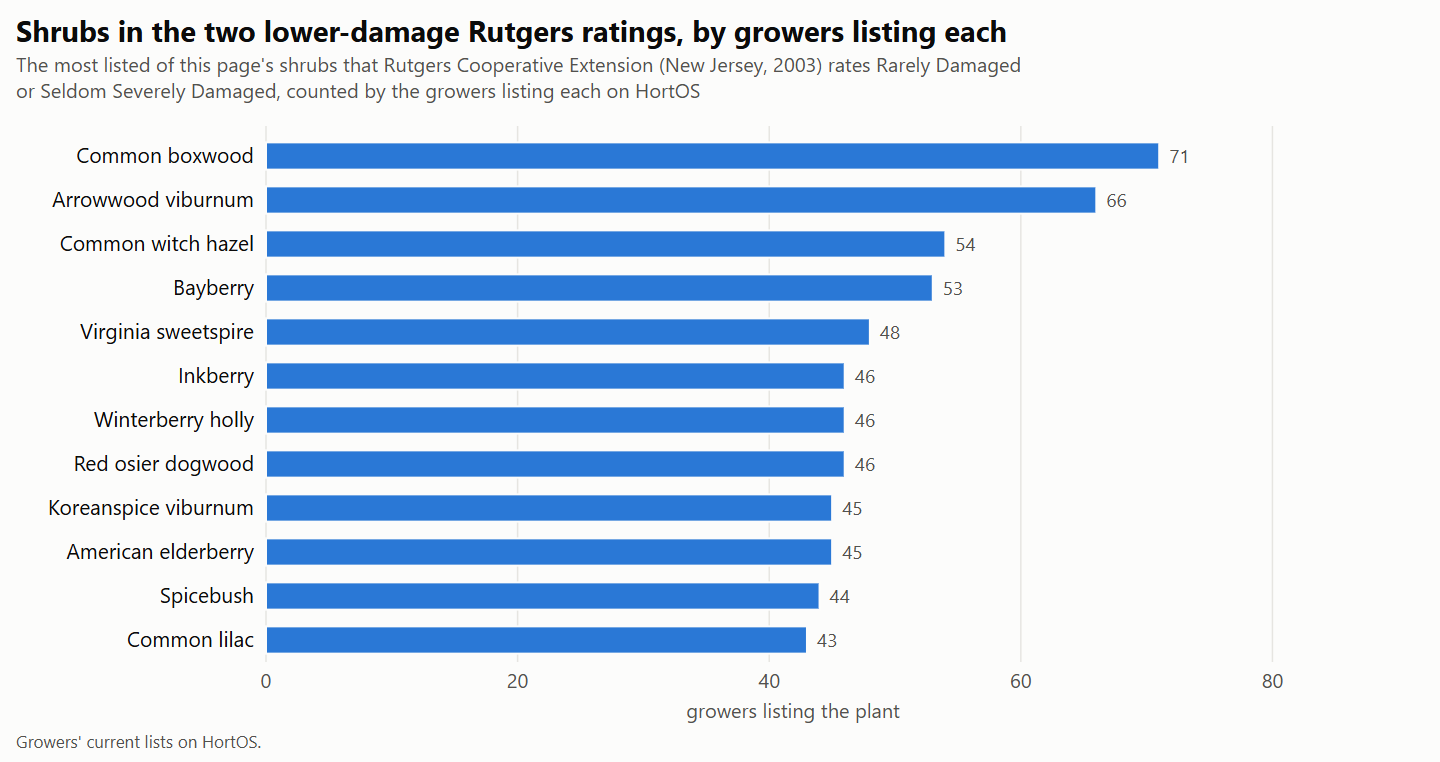
Deer Resistant Plants for the Northeast by Rating and Trade Price
Rutgers Cooperative Extension (New Jersey, 2003) rates landscape plants in four classes by how often deer damage them. This page sets those ratings beside how many growers list each plant and, where enough growers price a size, its median trade price. It shows where a Maryland list and a New York county list differ, and what a rating leaves out.
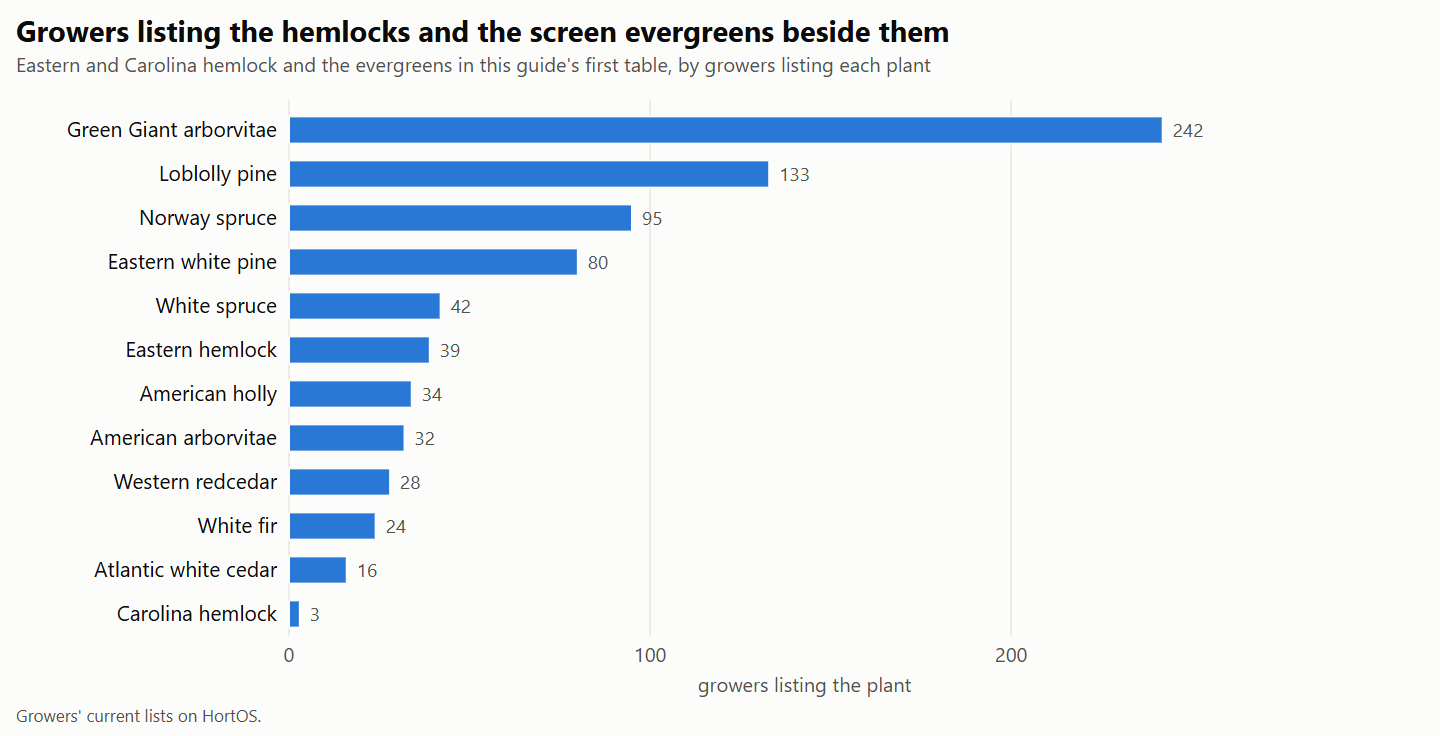
Hemlock woolly adelgid and evergreens that replace a hemlock screen
For homeowners, watershed groups and arborists facing a hemlock screen with woolly adelgid. It reports what the USDA Forest Service, Penn State Extension and Pennsylvania's conservation department say on treating or replanting, and what Maine and Wisconsin say on moving hemlock. It adds NC State Extension's light classes, growers listing each evergreen by state, and container medians for named selections.

The Most Grown Native Plants in the United States, by State
A data page, not an essay: the American native plants held by the most wholesale growers, counted grower by grower and state by state from growers' current lists on HortOS, with the median trade price at the size most growers price. Two paragraphs on what the tables show and what they do not, then the tables, refreshed each edition.