Southeast and Chesapeake yard certification with trade plant prices
How five extension programs certify a yard, each from its own pages: Tennessee Smart Yards, Carolina Yards, Georgia Green Landscape Stewards, Maryland's Bay-Wise and Watershed-Friendly PA. Three tables then set plants from the Tennessee program's native plant database and from University of Maryland Extension's recommended native list against the growers listing each, with a trade median.
Updated September 7, 2026. Figures are what the live us.hortosapp.com price and plant pages printed.
On this page
A Master Gardener asks what a yard must do to be certified, and which plants on a program's own list wholesale growers list. Four of the five extension programs read for this guide score a yard on a count of actions: inches in Tennessee, scorecard items in South Carolina and Georgia, and points in Maryland. In Maryland the score may qualify an owner for a certification visit, and Pennsylvania's program qualifies a property through an online application.
This page reports what the programs' own pages said when read in 2026: UT Extension on Tennessee Smart Yards, University of Maryland Extension on Bay-Wise, University of Georgia Extension, Clemson Online and Watershed-Friendly PA. HortOS, a free directory of American wholesale plant growers with their published availability and trade prices, adds grower counts and trade medians for plants in the Tennessee program's native plant database and on University of Maryland Extension's recommended native list. It is not a scoring guide, and no program named here endorsed or supplied it.
Quick facts
| Tennessee Smart Yards | A yard qualifies at 36 inches of actions out of the 72 on the program's yardstick, and each action counts 1 to 3 inches (UT Extension, Path To Certification, Tennessee, read 2026). |
|---|---|
| Bay-Wise in Maryland | A score of 80 to 100 points on the Maryland Living Landscapes Metric, at 3 points an action, may qualify an owner for a certification visit (University of Maryland Extension, 2025 Metric and program page read 2026). |
| Georgia Green Landscape Stewards | At least 25 actions on the program's scorecard are needed for Certified Georgia Landscape status, and practices already in place count (University of Georgia Extension, read 2026). |
| Carolina Yards | Clemson Online's course page (read 2026) says a participant completes 18 or more scorecard items to receive Carolina Yard Certification, and that only yards in South Carolina are eligible. |
| Watershed-Friendly PA | Pennsylvania's program takes an online application in three versions by property size: under 10,500 square feet, 0.25 to 15 acres, and over 15 acres (Watershed-Friendly PA, read 2026). |
| The plant lists tabled here | Tennessee Smart Yards describes its Native Plant Database as holding more than 800 plants native to Tennessee (UT Extension, read 2026). University of Maryland Extension updated its Recommended Native Plants for Maryland page on October 20, 2025. |
How the five programs count a yard
Quick facts gives each program's threshold in its own units. The table adds who leads each program, how a yard is checked and what the owner receives, with one row for each extension yard certification program in the Southeast or the Chesapeake Bay watershed read for this guide. Each cell reports what the program's own page says. The Chesapeake Bay Program (2026) names Pennsylvania among the six states with land in the watershed.
| Program, lead body and state | How the yard is checked | What the owner receives | Source read |
|---|---|---|---|
| Tennessee Smart Yards (UT-TSU Extension with partner municipal governments, Tennessee) | The owner reports the actions on an online form | A printable certificate by email; a yard sign can be bought | UT Extension, Path To Certification, read 2026 |
| Carolina Yards (Clemson, South Carolina yards only) | A course participant submits the scorecard for yard certification | A Certified Yard certificate, sent electronically once the course closes | Clemson Online, Carolina Yards course page, read 2026 |
| Georgia Green Landscape Stewards (University of Georgia Extension, Georgia) | The owner submits the scorecard by web form and the program coordinator reviews it | A certificate; an aluminum yard sign can be ordered | UGA Cooperative Extension, the program page on how to certify, read 2026 |
| Bay-Wise (University of Maryland Extension and its Master Gardeners, Maryland) | Bay-Wise certifiers review the checklist and application, then visit the site | A certificate, a yard sign, or both | University of Maryland Extension, Maryland Living Landscapes Metric, 2025 |
| Watershed-Friendly Property Certification (Master Watershed Stewards of Penn State Extension with the Nurture Nature Center, Pennsylvania) | The owner fills in the online application, in one of three versions by property size | A certificate and a decal for a window or door; a property sign can be ordered | Watershed-Friendly PA, home page and Certifying your Mid-sized Property, read 2026 |
- Tennessee. UT Extension (2026) sets out four steps: get the workbook and yardstick, watch the video lessons, take actions, then certify. Its About Us page (2026) says the development team formed in 2007 patterned itself on Florida-Friendly Landscaping and on Carolinas Yards and Neighborhoods. The guide to Florida's landscaping law for homeowners associations covers the Florida program.
- Maryland. University of Maryland Extension (2026) says a Master Gardener team evaluates the landscape. The 2025 Metric says certifiers schedule the site visit "depending on availability in your county". It reports more than 3,500 landscapes certified in over a quarter century (University of Maryland Extension, 2025).
- Georgia. The scorecard lists 64 numbered actions under ten topics (University of Georgia Extension, 2026). Once the certification form is completed, the owner may order the program's yard sign at $16.20 (University of Georgia Extension, 2026).
- South Carolina. Clemson Online (2026) describes a ten-week course on the twelve Carolina Yards principles. It says completing the scorecard items is encouraged and is not required for the course.
UT Extension (2026) recognizes a homeowners association, a school community, a garden club or a neighborhood organization as a Tennessee Smart Yard Community. The group keeps a Community Action Plan with at least two activities under each of its three categories. Maryland's 2025 application has the owner state that the community or homeowners association gave permission to display the sign (University of Maryland Extension, 2025). The association decides that, not the program.
Where plants earn inches and points
On the scorecards read, planting is one action among many and is scored like any other.
- Tennessee. The action that covers adding native plants is worth 2 inches (UT Extension, 2026). The program's 2016 workbook (UT Extension) lists Right Plant, Right Place first among nine principles. It gives 2 inches for keeping native trees, shrubs, grasses and wildflowers together along the water's edge.
- Maryland. Under its native plants habit the 2025 Metric names kinds of plants and gives no plant list (University of Maryland Extension, 2025). Its examples run from ground cover layers and native evergreens to keystone trees such as oaks and hickories and native shrubs that bear berries. Another action puts native plants in swales, rain gardens and buffer strips.
- Georgia. The ninth of the scorecard's ten topics is native plants and low maintenance landscapes, and its first action is to plant natives adapted to the local climate (University of Georgia Extension, 2026).
Plant figures follow for Tennessee and Maryland only, because their plant lists were read as lists for this guide. Tennessee Smart Yards describes its Native Plant Database as searchable, with more than 800 plants that are native to Tennessee, sold commercially and suited to managed landscapes (UT Extension, 2026).
Tennessee's database shrubs and grasses on growers' lists
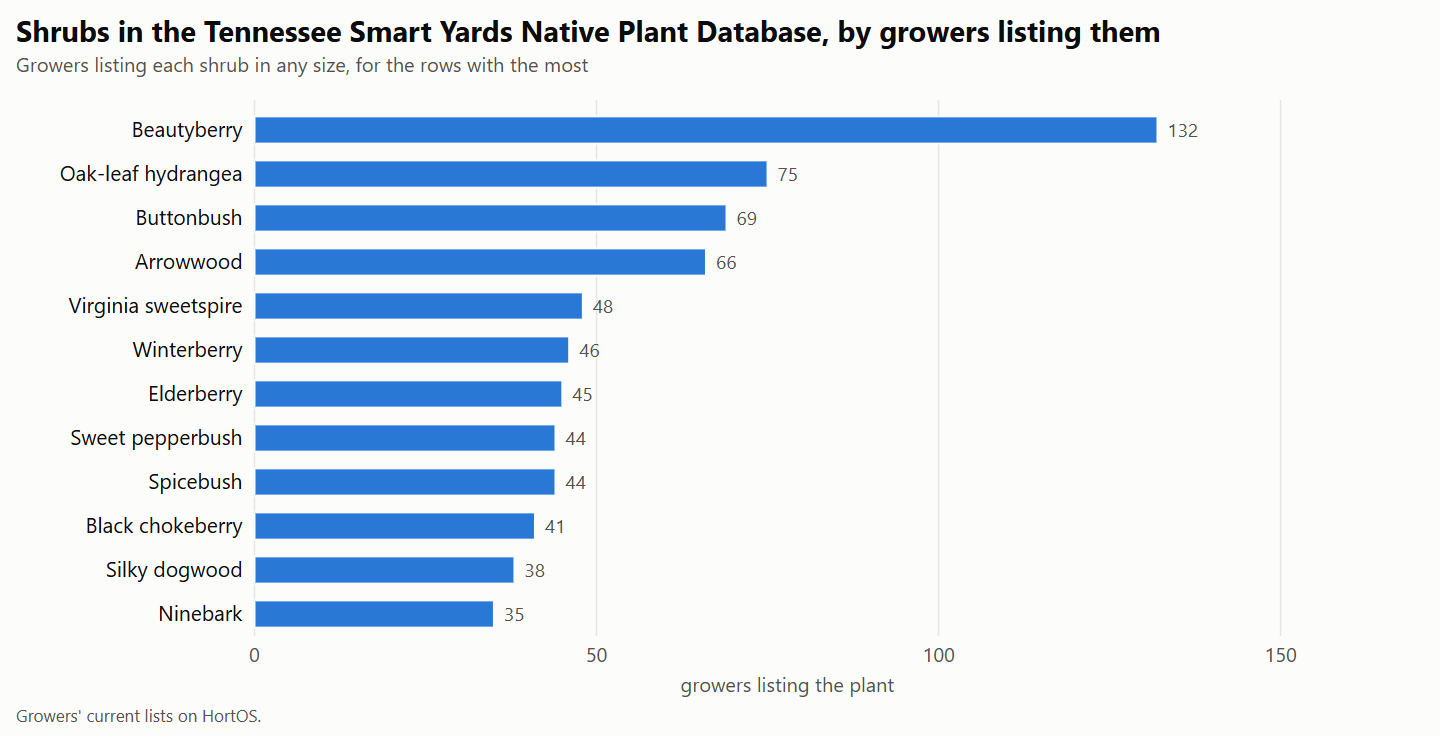
The first plant table holds 36 shrubs: every entry in the database's index of shrubs by scientific name, read in 2026, that is entered as a single species and has a price page for that species on HortOS. A plant is matched under the database's name or a synonym it gives: the database files the two chokeberries under Photinia. The index holds 45 more shrub entries that are not shown. Prices are medians across growers' current trade lists on HortOS: one price per grower, ex tax, freight not included, with the number of growers pricing each size in brackets. Anyone can see the prices on HortOS, and only the trade can order.
The growers listing the plants in this table are spread across many states; the most are in Florida, North Carolina and New Jersey. The size shown for each plant is the container size most growers price; field grown lines are not counted, and palms and other plants sold by height are not priced above #15.
The second holds 24 grasses, sedges and rushes: every entry in the database's index of grasses and sedges that has such a price page and a median at a container size. Another 78 entries of that index are not shown. A count here is growers listing the plant, not how many plants exist or how well it suits a site.
The growers listing the plants in this table are spread across many states; the most are in Florida, North Carolina and Pennsylvania. The size shown for each plant is the container size most growers price; field grown lines are not counted.
Where the bracket beside a median shows fewer than five growers, the median rests on a thin basis and can move when one grower changes a price. In the shrub table those rows are American filbert, the three sumacs, New Jersey tea, mountain laurel, the swamp and sweet azaleas, the Virginia and Carolina roses, shrubby St. John's-wort, mapleleaf viburnum, farkleberry and silky willow. In the grass table they are bushy and splitbeard bluestem, purpletop, and Gray's, seersucker and owlfruit sedge.
Each database entry gives the plant's light, moisture, soil, size, growth rate and native region within Tennessee, and the tables carry none of that. Buttonbush, for one, is entered as full sun, wet to moderately wet, and native statewide (Tennessee Smart Yards Native Plants, 2026).
Maryland's recommended natives on growers' lists
University of Maryland Extension's Recommended Native Plants for Maryland page, updated October 20, 2025, sets out species it recommends for home gardens and landscapes in the state. The page says most are native to one or more of Maryland's ecoregions, and a few to ecoregions of the nearest states to the south. It is the university's general list, from the body that conducts Bay-Wise, and it is not a Bay-Wise list.
The table takes the page's Shrubs, Trees and Native grasses, sedges and rushes groups and no others. It shows every entry in them whose own page names one species with a price page on HortOS, under the name the page gives or the former name it gives. That makes 18 rows, in the page's order, with 7 entries of the three groups not shown. The second column is where the university's page for each plant says it grows in Maryland, not a HortOS view of where to plant.
| Plant | Maryland distribution, per University of Maryland Extension (plant pages updated 2023 or 2024) | Growers listing it | Size most growers price | Median (growers pricing) |
|---|---|---|---|---|
| Black chokeberry (Aronia melanocarpa) | Throughout the state | 41 | #3 | $17.02 (12) |
| Common witchhazel (Hamamelis virginiana) | Throughout the state; woodland understory | 54 | #3 | $22 (11) |
| Inkberry holly (Ilex glabra) | Coastal Plain | 46 | #3 | $12 (13) |
| Mapleleaf viburnum (Viburnum acerifolium) | Throughout the state; mainly upland woods | 10 | #3 | $17.50 (3) |
| Northern bayberry (Myrica pensylvanica) | Coastal Plain; marshes, tidal areas, dunes and swamps | 53 | #3 | $19.98 (16) |
| Red chokeberry (Aronia arbutifolia) | Mountain, Piedmont and Coastal Plain | 27 | #3 | $14 (9) |
| Spicebush (Lindera benzoin) | Throughout the state; wooded understory and edges | 44 | #3 | $18 (16) |
| Summersweet (Clethra alnifolia) | Coastal Plain | 44 | #3 | $22 (9) |
| Virginia sweetspire (Itea virginica) | Coastal Plain | 48 | #3 | $12.13 (14) |
| Winterberry holly (Ilex verticillata) | Mountain, Piedmont and Coastal Plain; swamps and wet forest | 46 | #3 | $18.98 (8) |
| American hornbeam (Carpinus caroliniana) | Throughout the state; woodland understory and edges | 97 | #3 | $14 (7) |
| Blackgum (Nyssa sylvatica) | Forests of wet to average moisture | 107 | #3 | $14.50 (17) |
| Eastern redbud (Cercis canadensis) | Piedmont, Mountain and Coastal Plain | 194 | #15 | $77.50 (28) |
| Eastern redcedar (Juniperus virginiana) | Mountain, Piedmont and Coastal regions | 151 | #15 | $65 (27) |
| Flowering dogwood (Cornus florida) | Throughout the state; woodland understory and edges | 52 | #5 | $40 (4) |
| White oak (Quercus alba) | Moist to dry woodland | 113 | #15 | $60 (14) |
| Little bluestem (Schizachyrium scoparium) | Throughout the state; dry, sunny sites | 58 | #1 | $3.98 (20) |
| Yellow indiangrass (Sorghastrum nutans) | Throughout the state; dry to moist meadows | 35 | #1 | $4.00 (11) |
The growers listing the plants in this table are spread across many states; the most are in North Carolina, Florida and New Jersey. The size shown for each plant is the container size most growers price; field grown lines are not counted.
A species can be a row in both states' tables under the common name each authority uses: summersweet here and sweet pepperbush in the Tennessee table are both Clethra alnifolia. The medians for mapleleaf viburnum and flowering dogwood rest on fewer than five growers. The guide to the most grown native plants ranks natives by the growers listing them, state by state.
What the tables cannot tell a certifier
A median pools growers wherever they are, so none is a Tennessee or a Maryland price. The hubs for Tennessee and Maryland show the growers in each state. The medians are trade prices by container size, not what a homeowner pays, and nothing here adds up to the cost of a yard that certifies.
The directory does not show where a grower's seed or cuttings came from, whether a line is the straight species or a selection beyond the name on the list, or how the plants were grown. A native plant society or a watershed group that needs those answers asks the grower for each. Every row here is the page for the species, and named selections have pages of their own.
A plant missing from a table has not been judged: the tables hold only entries that have a price page on HortOS. Each list is its own state's, and a plant in the Tennessee database is not by that fact native to a Maryland, Georgia, South Carolina or Pennsylvania yard. The Tennessee and Maryland scorecards score actions, so neither state's tables are a list of plants a yard needs in order to certify.
What to watch for
- Converting one program's units into another's. Tennessee awards 1 to 3 inches an action and Maryland 3 points an action, while Georgia and South Carolina count scorecard items (program pages, 2025 and 2026). A threshold in one unit says nothing about another.
- Reading Maryland's score as the certificate. University of Maryland Extension (2026) says a score of 80 to 100 "may qualify" an owner for a certification visit. A Master Gardener team evaluates the landscape.
- Carrying a list across a state line. Each list is its own state's. Even inside Maryland, University of Maryland Extension (2023) gives the distribution of inkberry and of Virginia sweetspire as the Coastal Plain.
- Treating a trade median as a local quote. A median pools growers in many states, and one resting on three or four growers is thin. The grower sets the price, the minimum order and the freight.
Getting it right
- The first table names the program for each state, and that program's own page is in Sources. The program decides which yards it certifies: Clemson Online (2026), for one, says Carolina Yard Certification is open only to yards in South Carolina.
- Each program scores from its own document: Tennessee's workbook and yardstick, Maryland's 2025 Metric and Georgia's scorecard. University of Georgia Extension (2026) says practices already in place count.
- In Maryland a visit is requested from the local Bay-Wise committee, and University of Maryland Extension keeps a county contact list (updated July 8, 2026). The university's Anne Arundel and Howard county pages (2026) describe yard visits or consultations at no charge.
- Each state's own list names its plants, and the tables above and the price pages show which of them growers list. Seed origin, selection, growing practice, minimum order and sales outside the trade are questions for the grower. The guide to buying from a wholesale grower sets out how groups outside the trade order.
A word of caution
The thresholds here are what UT Extension, University of Maryland Extension, University of Georgia Extension, Clemson Online and Watershed-Friendly PA published when read in 2026, and Maryland's Metric is its 2025 version. The program decides whether a yard is certified, so questions go to its coordinator, the county Extension office or the local Bay-Wise committee. The trade medians are HortOS figures, not a quote from any grower.
Sources
- UT Extension, Tennessee Smart Yards: the program and who leads it.
- UT Extension, Tennessee Smart Yards: Path To Certification: the four steps and 36 inches.
- UT Extension, Tennessee Smart Yards: Right Plant, Right Place: plant actions and their inches.
- UT Extension, Tennessee Smart Yards: About Us: the program's history.
- UT Extension, Tennessee Smart Yard Communities: recognition for community groups.
- UT Extension and Tennessee Water Resources Research Center, Tennessee Yardstick Workbook: the nine principles and actions, 2016.
- Tennessee Smart Yards Native Plants: shrubs by scientific name: the database's shrub index.
- Tennessee Smart Yards Native Plants: grasses and sedges by scientific name: the grass and sedge index.
- Tennessee Smart Yards Native Plants: Buttonbush: what one database entry holds.
- University of Maryland Extension, Bay-Wise Program: the program and who evaluates.
- University of Maryland Extension, Bay-Wise Program: Landscape Certification: the steps to a visit.
- University of Maryland Extension, Maryland Living Landscapes Metric, 2025: the checklist, points and application.
- University of Maryland Extension, Bay-Wise Committee Websites and Contact Information: county Bay-Wise contacts.
- University of Maryland Extension, Bay-Wise in Anne Arundel County: the county program's yard visits.
- University of Maryland Extension, Howard County: Bay-Wise Landscape Management: how one county certifies.
- UGA Cooperative Extension, Georgia Green Landscape Stewards: the Georgia program.
- UGA Cooperative Extension, How to Certify Your Georgia Green Landscape: the steps and 25 actions.
- UGA Cooperative Extension, Application to Certify your Georgia Green Landscape: the scorecard's actions.
- Watershed-Friendly PA: the Pennsylvania certification.
- Watershed-Friendly PA, Certifying your Mid-sized Property: how a property is certified.
- Watershed-Friendly PA, About Us: who runs and funds it.
- Clemson Online, Carolina Yards course page: the course and yard certification.
- Chesapeake Bay Program, The Watershed: which states the watershed covers.
- University of Maryland Extension, Recommended Native Plants for Maryland: the recommended native plant list.
- University of Maryland Extension, Black chokeberry: its Maryland distribution.
- University of Maryland Extension, Common witchhazel: its Maryland distribution.
- University of Maryland Extension, Inkberry holly: its Maryland distribution.
- University of Maryland Extension, Mapleleaf viburnum: its Maryland distribution.
- University of Maryland Extension, Northern bayberry: its Maryland distribution.
- University of Maryland Extension, Red chokeberry: its Maryland distribution.
- University of Maryland Extension, Spicebush: its Maryland distribution.
- University of Maryland Extension, Summersweet: its Maryland distribution.
- University of Maryland Extension, Virginia sweetspire: its Maryland distribution.
- University of Maryland Extension, Winterberry holly: its Maryland distribution.
- University of Maryland Extension, American hornbeam: its Maryland distribution.
- University of Maryland Extension, Blackgum: its Maryland distribution.
- University of Maryland Extension, Eastern redbud: its Maryland distribution.
- University of Maryland Extension, Eastern redcedar: its Maryland distribution.
- University of Maryland Extension, Flowering dogwood: its Maryland distribution.
- University of Maryland Extension, White oak: its Maryland distribution.
- University of Maryland Extension, Little bluestem: its Maryland distribution.
- University of Maryland Extension, Yellow indiangrass: its Maryland distribution.
More guides
Florida's HOA landscaping law and the plants the state program lists
What two sections of the Florida Statutes say about homeowners' association covenants and Florida-friendly landscaping, what they leave with the association, and who decides a dispute. Two tables follow: groundcovers, grasses and shrubs from the UF/IFAS program's plant list, the Florida growers listing each, and a trade median for each at the container size most growers price.

The Most Grown Native Plants in the United States, by State
A data page, not an essay: the American native plants held by the most wholesale growers, counted grower by grower and state by state from growers' current lists on HortOS, with the median trade price at the size most growers price. Two paragraphs on what the tables show and what they do not, then the tables, refreshed each edition.

Buying From a Wholesale Grower When You Are Not in the Trade
Native plant societies, watershed districts, land trusts, schools and church committees can buy from wholesale growers when they order like the trade: in quantity, ahead of the season, on the grower's terms. This page explains who sells to whom, resale certificates and exemptions, minimums and pooling, the sizes to buy, straight species and ecotype, lead times and shipping.