Stormwater fee credits, rain garden rebates and the plants they name
American stormwater utilities help in four ways: a percentage off the fee, a fixed credit, a rebate after the work, or a garden the city builds. This guide reports what programs in the District of Columbia, Philadelphia, Portland, Seattle and four other places say, what planting each counts, and trade medians for the plants the Philadelphia and District guides name.
Updated October 6, 2026. Figures are what the live us.hortosapp.com price and plant pages printed.
On this page
A property manager with a stormwater charge on the water bill wants to know what a rain garden or a few trees can take off that charge. The answer that matters most is that each utility sets its own help, and the help differs in kind. It may be a percentage off the fee, a fixed dollar credit, a rebate paid after the work, or a garden the city builds itself.
This page reports what the program pages of the District of Columbia's Department of Energy and Environment, the Philadelphia Water Department, the City of Portland, Seattle's RainWise, Minneapolis, Ann Arbor, the Northeast Ohio Regional Sewer District and Austin say. It adds what is printed on HortOS, a free directory of American wholesale plant growers with their published availability and trade prices. That means grower counts and trade medians for the plants the Philadelphia and District guides name. It is a summary, and the utility decides.
Quick facts
| District of Columbia, fee discount | The Department of Energy and Environment (DOEE) says in 2026 that RiverSmart Rewards is capped at 55 percent of the DC Government Stormwater Fee and at 20 percent of the Clean Rivers Impervious Area Charge. |
|---|---|
| District of Columbia, rain garden rebate | DOEE's 2026 rebate is $41 for each square foot of garden, to a ceiling of $3,000, for a garden of at least 50 square feet planted only with natives of the Chesapeake Bay watershed. |
| Philadelphia, Pennsylvania | The Philadelphia Water Department's 2026 pages open stormwater credits to non-residential, condominium and multi-family customers, and say credits are not currently open to residential properties. |
| Portland, Oregon | The City of Portland says in 2026 that its Clean River Rewards discount can reach 35 percent of the total stormwater fee. |
| Minneapolis, Minnesota | The City of Minneapolis gives a residential stormwater credit in 2026 at a flat 35 percent, or 45 percent within a Green Zone, and takes applications from May 1 to October 1. |
| Ann Arbor and Greater Cleveland | The City of Ann Arbor, Michigan, says in 2026 that installing a rain garden can be worth $8.59 a quarter. The Northeast Ohio Regional Sewer District's manual, revised November 2025, takes a flat 25 percent off the fee for a customer who puts in a measure the district approves. |
Four kinds of help and who may claim each
The first kind is a percentage off the fee. In the District of Columbia, DOEE's 2026 page describes RiverSmart Rewards as two incentives reached through one application, one on each of two charges that appear on the DC Water bill. DOEE's 2026 page says an approval runs for three years. DOEE also states in 2026 that the program is a reward for installing and keeping up green infrastructure, not financial assistance.
DOEE prints the sum for one tree. Its fiscal year 2026 table for the District puts the total monthly reward under the simple application at $0.76 for a tree with an average spread under 40 feet and $1.52 for a wider one. The full reward, DOEE says in 2026, goes to a District property whose practices hold all the runoff its hard surfaces shed in a storm of 1.2 inches.
Portland works the same way. The City of Portland, Oregon, says in 2026 that the other 65 percent of the fee goes toward the stormwater system that all properties share. Minneapolis and the Northeast Ohio district give one flat rate instead of a sliding one.
The second kind is a fixed dollar credit, as in Ann Arbor. The third is a rebate against the cost of the work. DOEE's 2026 RiverSmart Rebates page says a District resident pays for and installs the feature first and is then paid back in part. Philadelphia's Rain Check program, the Philadelphia Water Department says in 2026, puts $22 a square foot toward a home rain garden, up to $2,500. Seattle's RainWise, run by Seattle Public Utilities and King County, says in 2026 that its rebates cover 90 to 100 percent of an installation on eligible properties.
The fourth kind is a garden the city builds. Through RiverSmart Homes, DOEE's 2026 page says, the District plants shade trees at no charge and installs a rain garden of about 50 square feet for a $200 copayment.
Who may claim matters as much as how much. The Philadelphia Water Department's credits manual, September 2026 version, opens credits to non-residential and condominium parcels with a gross area of 500 square feet or more whose accounts are not past due. It counts multi-family buildings of five or more dwelling units as non-residential. The department's 2026 residential page says Philadelphia homes pay a standard flat rate, and that taking part in Rain Check does not lower the monthly charge.
What each program asks of the planting
The table below has 12 rows, one for each program read for this page, and shows the planting each program's own page says counts. Every row is in this page's words, with the authority and the year of the page read.
| City and program | Planting that counts | Authority and year |
|---|---|---|
| Washington, DC: RiverSmart Rewards | Rain gardens built with an underdrain, and tree planting; shrubs and native plantings on their own are not eligible | DOEE, District of Columbia, 2026 |
| Washington, DC: rain garden rebate | Chesapeake Bay watershed natives only, in a garden of 50 square feet or more | DOEE, District of Columbia, 2026 |
| Washington, DC: tree rebate | A canopy that will spread wider than 40 feet earns the $100 rebate | Casey Trees for DOEE, District of Columbia, 2026 |
| Washington, DC: RiverSmart Homes | Plants, mulch and labor come with the garden, set out by the program's landscaper | DOEE, District of Columbia, 2026 |
| Philadelphia: Stormwater Credits | Tree canopy over ground-level hard surface counts at half of the overlapping area | Philadelphia Water Department, Pennsylvania, 2026 |
| Philadelphia: Rain Check | The program's own gardens are typically planted with native perennials that tolerate drought, set out as young plants | Philadelphia Water Department, Pennsylvania, 2026 |
| Portland, Oregon: Clean River Rewards | A rain garden at least one tenth the size of the roof and paving that drain to it; trees over 15 feet tall on the property count toward part of the discount | City of Portland, Oregon, 2026 |
| Seattle: RainWise | A rain garden built with a program-trained contractor, in an eligible area tied to the combined sewer | Seattle Public Utilities and King County, Washington, 2026 |
| Minneapolis: residential stormwater credit | A raingarden on the owner's land, built to the city's best management practices | City of Minneapolis, Minnesota, 2026 |
| Ann Arbor: rain garden credit | A rain garden no smaller than 130 square feet and 3 to 6 inches deep, with plenty of plants | City of Ann Arbor, Michigan, 2026 |
| Greater Cleveland: Individual Residential Property Credit | A rain garden that takes the runoff of at least a quarter of the roof | Northeast Ohio Regional Sewer District, Ohio, 2025 |
| Austin: WaterWise Rainscape rebate | Landscape features that hold rainwater on the land | City of Austin, Texas, 2026 |
The rules differ on what a plant must be. DOEE's 2026 page for the District lists a rain garden with an underdrain and tree planting among the practices that earn RiverSmart Rewards, and lists native plantings and shrubs among those that do not. The District's tree rebate, run by Casey Trees with DOEE funding, pays $100 in 2026 for a tree whose canopy will spread wider than 40 feet and $50 for one that will spread 40 feet or less.
Portland counts area and height. The City of Portland, Oregon, says in 2026 that a property relying on trees needs four of them at 15 feet or taller, or fewer large trees with a canopy of 200 square feet or more. The city's 2026 Treebate page says that program has ended. The Philadelphia Water Department's credits manual, September 2026 version, gives tree canopy over ground-level hard surface a reduction worth half the overlapping area.
Ann Arbor's criteria call for plenty of plants. The City of Ann Arbor, Michigan, also says in 2026 that large rain gardens generally hold at least 15 species at about one plant a square foot.
The plants the Philadelphia and District guides name
Philadelphia and the District each point to a plant guide. The Philadelphia Water Department's residential rain garden guide, prepared in September 2014, sorts its plants by moisture into three planting areas. They are the wettest area at the lowest point, the perimeter, and the outermost edge, which is the highest and driest. That 2014 Philadelphia guide places black chokeberry in the wettest area, for example. It gives spacing by container for its fast-growing plants: large plugs 18 inches on center, #1 containers 24 inches and #3 containers 48 inches.
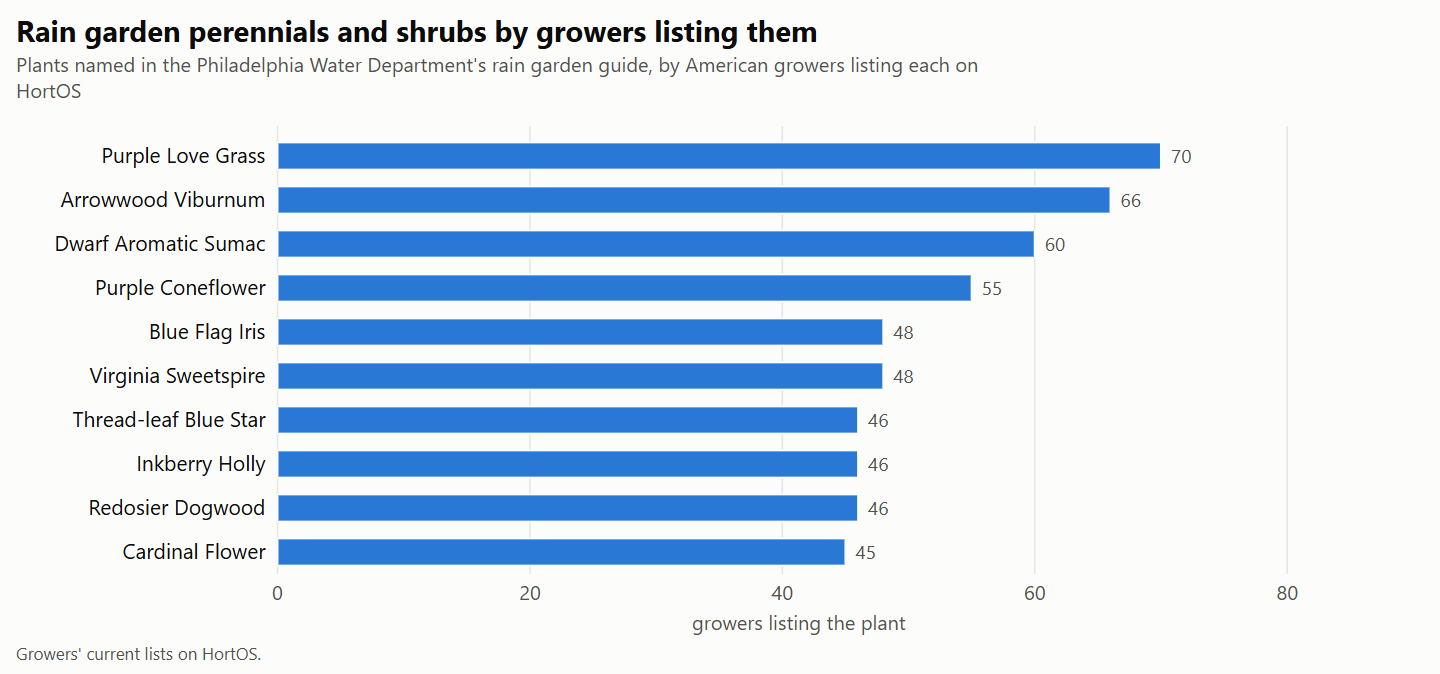
The first table holds every herbaceous perennial and shrub that guide names and that has a page on HortOS; the guide's trees are not in it, and 1 plant the guide names is not shown. It has 24 rows, ordered by growers listing each plant, and 20 carry a median. Prices are medians across growers' current trade lists on HortOS: one price per grower, ex tax, freight not included, with the number of growers pricing each size in brackets. A count here is growers listing the plant, not how many plants exist or how well it suits a site.
The growers listing the plants in this table are spread across many states; the most are in New Jersey, Maryland and Florida. The size shown for each plant is the container size most growers price; field grown lines are not counted.
A median needs three growers pricing a size. Some medians above stand on few growers and are thin figures: sweetflag on 3, New England aster on 3, swamp azalea on 4 and New Jersey tea on 4. Anyone can see the prices on HortOS, and only the trade can order.
The second table holds trees named in the Residential Tree Selection Guide that Casey Trees last updated in July 2021. DOEE's 2026 shade tree page for the District links it as the list of trees offered to residents through RiverSmart Homes, which plants in spring and fall. The table has 19 rows, 16 with a median, and 2 of the guide's trees are not shown.
| Plant | Growers listing it | Size most growers price | Median (growers pricing) |
|---|---|---|---|
| Bald Cypress (Taxodium distichum) | 368 | #30 | $120 (89) |
| Eastern Redbud (Cercis canadensis) | 194 | #15 | $77.50 (28) |
| Sweetbay Magnolia (Magnolia virginiana) | 152 | #15 | $62.50 (32) |
| River Birch (Betula nigra) | 114 | #30 | $125 (20) |
| Blackgum (Nyssa sylvatica) | 107 | #3 | $14.50 (17) |
| American Hornbeam (Carpinus caroliniana) | 97 | #3 | $14 (7) |
| Sycamore (Platanus occidentalis) | 91 | #15 | $60 (16) |
| Southern Magnolia (Magnolia grandiflora) | 70 | #15 | $80 (13) |
| Witchhazel (Hamamelis virginiana) | 54 | #3 | $22 (11) |
| Pawpaw (Asimina triloba) | 49 | #3 | $16 (15) |
| American Beech (Fagus grandifolia) | 46 | #3 | $16 (7) |
| Yellowwood (Cladrastis kentukea) | 43 | #7 | $38 (3) |
| Serviceberry (Amelanchier species) | 42 | #15 | $80 (3) |
| Oak (Quercus species) | 35 | Fewer than three growers | |
| Basswood (Tilia americana) | 34 | #3 | $15 (3) |
| American Holly (Ilex opaca) | 34 | #3 | $29.75 (6) |
| Honey Locust (Gleditsia triacanthos) | 28 | Fewer than three growers | |
| Black Willow (Salix nigra) | 20 | #1 | $8.00 (3) |
| London Plane (Platanus x acerifolia) | 14 | Field grown only |
The growers listing the plants in this table are spread across many states; the most are in Florida, North Carolina and Tennessee. The size shown for each plant is the container size most growers price; field grown lines are not counted. Where a row says Field grown only, its growers price that plant as field grown stock and no container median is shown.
The serviceberry median stands on 3 growers and is a thin figure too. The Philadelphia guide of 2014 names trees as well, among them river birch, sycamore and bald cypress for the wettest area, and all three are on the District's list above. Bald cypress is listed by 368 growers. The guide to street trees and canopy sets out how trees of this kind are sized and priced at trade, which the short table here does not.
What the figures do not show
A trade median is the price of the plant alone at the grower. It says nothing of digging, soil, an underdrain, labor or design, and this page sets no plant price beside any rebate or credit.
The tables do not show whether a grower's plant is the straight species or where its seed came from. That matters where a program names an origin, as DOEE's 2026 District rebate does with the Chesapeake Bay watershed. The grower is the one to ask, and the guide to buying from a wholesale grower covers how to ask about species, origin and order size.
The medians are for containers. They do not show which growers list plugs, the smallest of the three sizes the 2014 Philadelphia guide spaces by. Nor do they show whether a planting will be accepted, which the utility decides.
Both guides come from the Mid-Atlantic, and other climates use other plants. The City of Portland's 2026 rain garden page sends builders to its Stormwater Management Manual plant list or the Portland Plant List. The City of Ann Arbor links an undated Washtenaw County, Michigan, list that names buttonbush and switch grass. RainWise says in 2026 that some Seattle properties cannot take a rain garden, where soil drains poorly or the ground is steep. Growers by state are on the hubs for Pennsylvania, Oregon, Washington and Michigan.
What to watch for
- Reading a ceiling as the amount. DOEE in the District and the City of Portland, Oregon, both say in 2026 that the full discount goes to a property that manages all of its runoff.
- Assuming homes qualify. The Philadelphia Water Department says in 2026 that its credits are not currently open to residential properties, while the 2026 pages of Minneapolis and Ann Arbor describe credits for homes.
- Treating any planting as a rain garden. DOEE's 2026 list for the District leaves native plantings and shrubs on their own out of RiverSmart Rewards, and Minneapolis says in 2026 that rain barrels do not earn its credit.
- Planting food in the garden. Rain Check in Philadelphia tells participants in 2026 not to grow food plants in a rain garden, because the stormwater running in may carry dirt and debris.
- Counting on a program that has closed. The City of Portland's 2026 page says its Treebate has ended.
Getting it right
- Find who bills the stormwater charge. The utility named on the bill decides what earns a credit, so its current program page is the place to start.
- Ask the utility which property classes may apply, and whether a home, a condominium or a commercial parcel is treated differently.
- Ask what the planting must be before buying anything: the minimum size of the garden, the area that must drain to it, the plant list or origin it accepts, and the size a tree must reach.
- Ask whether the utility must see the plan first, whether a program contractor must build it, and when applications open and close.
- Take the program's plant guide to growers, and ask each grower for the species, the origin and the container sizes it lists.
A word of caution
Stormwater credits and rebates are set by each utility and change with its rates and budget. The figures here are what each utility or agency printed on the pages listed below when they were read in October 2026, among them the Department of Energy and Environment and the Philadelphia Water Department. Ask the utility that sends the bill what applies to a given property, and ask the grower what a plant is and where it was raised.
Sources
- District of Columbia Department of Energy and Environment, RiverSmart Rewards and Clean Rivers IAC Incentive Programs: the District's two fee discounts.
- DOEE, Calculating Your RiverSmart Rewards: ceilings, rates and reward tables.
- DOEE, RiverSmart Homes: gardens and trees the District installs.
- DOEE, RiverSmart Rebates: the District's rebate amounts.
- DOEE, RiverSmart Rain Garden Rebates: size and native plant conditions.
- DOEE, RiverSmart Homes: Rain Gardens: what the installed garden includes.
- DOEE, RiverSmart Homes: Shade Tree Planting: planting seasons and the tree list.
- Casey Trees, Residential Tree Selection Guide: trees offered through RiverSmart Homes.
- Casey Trees, Tree Rebate: the District's tree rebate rules.
- Philadelphia Water Department, Stormwater Credits: who may earn Philadelphia credits.
- Philadelphia Water Department, Stormwater Management Service Charge Credits and Appeals Manual: credit classes and tree canopy.
- Philadelphia Water Department, Residential Stormwater Charge: the flat rate for homes.
- Philadelphia Water Department, Rain Check: Rain Gardens: the home rain garden cost share.
- Philadelphia Water Department, Residential Rain Garden Design Guidelines: the plant list and planting areas.
- City of Portland, Clean River Rewards: Portland's stormwater discount rules.
- City of Portland, Treebate: the program has ended.
- City of Portland, Residential Rain Gardens: Portland's plant lists for gardens.
- City of Portland, How trees work to manage rain and stormwater: trees that count toward the discount.
- RainWise, home page: who runs the Seattle program.
- RainWise, Rebate Process: Seattle rebate coverage and steps.
- RainWise, Eligibility: sites that rule out a garden.
- City of Minneapolis, Residential stormwater credits: credit rates and application window.
- City of Ann Arbor, Residential Stormwater Credits: the quarterly rain garden credit.
- City of Ann Arbor, Rain gardens: the credit's garden criteria.
- Washtenaw County Water Resources Commissioner's Office, Rain garden plant list: a Michigan rain garden plant list.
- Northeast Ohio Regional Sewer District, Individual Residential Property Credit Manual: the Cleveland area residential credit.
- City of Austin, Watershed Protection, Rebates, Free Stuff and Grants: Austin's rainscape rebate.
More guides

Street Trees and Canopy: What Advanced Stock Costs and Who Holds It
A standing reference for urban forestry programs and tree nonprofits: the trees the American trade grows for streets and parks, the nursery-gate median at #15, #30, #45 and #65 and as field grown stock, how many growers in each state hold advanced stock, why lead times run to years, and what a street tree costs against a giveaway.

Buying From a Wholesale Grower When You Are Not in the Trade
Native plant societies, watershed districts, land trusts, schools and church committees can buy from wholesale growers when they order like the trade: in quantity, ahead of the season, on the grower's terms. This page explains who sells to whom, resale certificates and exemptions, minimums and pooling, the sizes to buy, straight species and ecotype, lead times and shipping.

The Most Grown Native Plants in the United States, by State
A data page, not an essay: the American native plants held by the most wholesale growers, counted grower by grower and state by state from growers' current lists on HortOS, with the median trade price at the size most growers price. Two paragraphs on what the tables show and what they do not, then the tables, refreshed each edition.