Salt ratings and tidal flooding on the Lowcountry and Gulf coast
For yards and streets from the Carolina Lowcountry to the Gulf: the University of Georgia's salt ratings for native trees and N.C. State's salt and wet soil entries for shrubs, palms and grasses, beside the growers listing each plant on HortOS. The page says where the two universities differ and which coasts their ratings speak for.
Updated October 16, 2026. Figures are what the live us.hortosapp.com price and plant pages printed.
On this page
- Quick facts
- What the tide gauges show from Charleston to the Gulf
- Trees the University of Georgia rates above low for salt
- Shrubs, palms and grasses in N.C. State's Plant Toolbox
- Where the two universities part, and what each says of flooding
- What a salt rating and a grower count leave out
- What to watch for
- Getting it right
- A word of caution
- Sources
A property manager in Charleston, Savannah or Mobile looks after grounds that salt spray reaches and that a king tide now and then floods. The question is which trees and shrubs the extension services rate for salt, and what the same services say about flooding. The idea that matters most is that a salt rating is not a flood rating. N.C. State's Plant Toolbox (North Carolina, read October 2026) calls sand live oak salt tolerant, and says flooding by brackish or salt water is more than the tree takes.
The salt ratings on this page are University of Georgia Cooperative Extension's and N.C. State Extension's. The flood figures are NOAA's and the National Weather Service's, and the Gulf coast statements come from Mississippi State University Extension and UF/IFAS Extension. The page adds what HortOS, a free directory of American wholesale plant growers with their published availability and trade prices, shows for each rated plant. It is not a planting plan or a site assessment, it rates nothing itself, and it reprints neither university's full list.
Quick facts
| King tides | NOAA's National Ocean Service (United States, 2026) calls king tide a non-scientific term for an exceptionally high tide, and counts high tide flooding as minor at 1.8 feet (0.55 meters) above average high tide. |
|---|---|
| Flood days ahead | For May 2026 to April 2027 NOAA's annual outlook (United States, 2026) gives the Eastern Gulf a predicted median of 2 to 7 high tide flood days, and predicts that the Southeast will average 7 more such days a year than in 2000. |
| Charleston Harbor | The National Weather Service office in Charleston (South Carolina, 2026) puts the minor flood threshold of the Charleston Harbor tide gauge at 7.0 feet above mean lower low water. On a record that starts in 1921, the year with the most such tides is 2019, with 89. |
| The salt ratings | University of Georgia Extension's Bulletin 1477 (Georgia, 2022) ranks trees native to Georgia high, medium or low for salt. Its authors drew on what they had seen between St. Augustine and Charleston and on other literature. |
| How far salt travels | Mississippi State University Extension (Mississippi, 2024) says sea spray can travel up to 15 miles inland, and that the surge of a hurricane or tropical storm may leave salt in soil and fresh water 30 miles from the coast. |
| Pink muhly grass at trade | Pink muhly grass, which N.C. State's Plant Toolbox calls highly salt-tolerant (North Carolina, read October 2026), is listed by 291 growers on HortOS. 165 of them price a #3 container, at a median of $6.00, one price per grower, ex tax. |
What the tide gauges show from Charleston to the Gulf
NOAA (United States, 2026) says coastal communities now flood at high tide twice as often as 20 years ago. Its outlook for May 2026 to April 2027 predicts a national median of between 7 and 12 high tide flood days, which NOAA calls a new record (United States, 2026). On the Eastern Gulf, NOAA says, severe weather routinely adds to flooding, and the extreme floods are usually the work of Atlantic hurricanes (United States, 2026).
The National Weather Service office in Charleston counts each tide that reaches the minor flood threshold at the Charleston Harbor and Fort Pulaski gauges. At Charleston Harbor none of the ten years with the most such tides is earlier than 2015: 2019 leads with 89, then 2023 with 75 and 2022 with 70 (National Weather Service, South Carolina, 2026).
Salt arrives by air as well as by water. UF/IFAS Extension (Florida, 2026) says anything planted closer than about an eighth of a mile to a saltwater coast should have at least some salt tolerance.
Trees the University of Georgia rates above low for salt
University of Georgia Cooperative Extension (UGA Extension) ranks trees native to Georgia in Table 1 of its Bulletin 1477 (Georgia, 2022). In the table's key, high "withstands direct salt spray and moderate soil salinity", medium "protects from salt spray but withstands moderate soil salinity" and low is "sensitive to salt" (UGA Extension, Georgia, 2022). The key speaks of salt in the air and salt in the soil, and of nothing else.
The first table shows 24 trees and tree-sized shrubs: every one that Table 1 rates above low, alone or in a split rating, where the same plant has a page on HortOS. Table 1 rates 59 more plants that are not shown, nearly all of them low. Grower counts are the growers listing each plant on HortOS, in any size. The last column names the states with the most growers listing each tree. There is no price column, because several of these trees have no container size that three growers price. A median needs three growers pricing a size.
| Plant | UGA Extension salt rating (2022) | Growers listing it | States with most growers |
|---|---|---|---|
| Yaupon holly (Ilex vomitoria) | High | 65 | Florida 26, Texas 14 |
| Southern redcedar (Juniperus silicicola) | High | 59 | Florida 52, Georgia 4, South Carolina 2 |
| Pyramid magnolia (Magnolia pyramidata) | High | 2 | Tennessee 1, Florida 1 |
| Southern waxmyrtle (Myrica cerifera) | High | 225 | Florida 131, Texas 26, North Carolina 21 |
| Southern live oak (Quercus virginiana) | High | 327 | Florida 198, Texas 57, South Carolina 14 |
| Cabbage palm (Sabal palmetto) | High | 67 | Florida 56, Texas 5, South Carolina 2 |
| Tough bully (Sideroxylon tenax) | High, medium | 6 | Florida 5, Tennessee 1 |
| Hercules' club (Zanthoxylum clava-herculis) | High, medium | 4 | Florida 4 |
| Common serviceberry (Amelanchier arborea) | Medium | 14 | North Carolina 3, Nebraska 2 |
| Devil's walking stick (Aralia spinosa) | Medium | 2 | Pennsylvania 1, Tennessee 1 |
| Mockernut hickory (Carya tomentosa) | Medium | 7 | Florida 2 |
| Sugarberry (Celtis laevigata) | Medium | 17 | Florida 7, North Carolina 4, Pennsylvania 2 |
| American beech (Fagus grandifolia) | Medium | 46 | North Carolina 6, Tennessee 6, Maryland 6 |
| Dahoon holly (Ilex cassine) | Medium | 109 | Florida 103, Louisiana 3, South Carolina 2 |
| American holly (Ilex opaca) | Medium | 34 | New Jersey 5, North Carolina 5, Florida 5 |
| Eastern redcedar (Juniperus virginiana) | Medium | 151 | Florida 28, Texas 27, Maryland 11 |
| Sweetgum (Liquidambar styraciflua) | Medium | 89 | Florida 35, Tennessee 9, Texas 9 |
| Redbay (Persea borbonia) | Medium | 6 | Florida 6 |
| Slash pine (Pinus elliottii) | Medium | 101 | Florida 93, Georgia 5 |
| Chapman oak (Quercus chapmanii) | Medium | 2 | Florida 2 |
| Myrtle oak (Quercus myrtifolia) | Medium | 5 | Florida 5 |
| Bald cypress (Taxodium distichum) | Medium | 368 | Florida 163, Texas 48, Georgia 25 |
| Two-wing silverbells (Halesia diptera) | Medium, low | 1 | Florida 1 |
| Cherry-laurel (Prunus caroliniana) | Medium, low | 34 | Florida 15, Georgia 4 |
The last column names the states with the most growers listing each plant, three at most, and stops where states tie for the next place.
A rating and a listing are separate facts. Pyramid magnolia, rated high by UGA Extension (Georgia, 2022), is listed by 2 growers, and southern live oak, also rated high, by 327. Two names differ. UGA Extension's Bumelia tenax is the tough bully that N.C. State's Toolbox files under Sideroxylon tenax, and its Juniperus silicicola is the Toolbox's southern redcedar, Juniperus virginiana var. silicicola (North Carolina, 2026).
UGA Extension (Georgia, 2022) attaches conditions to any rating: plants stand less soluble salt in sandy soil than in loam or clay, and some cope with the coast only where they are sheltered from salt spray or strong wind. Wind has ratings of its own, and the guide to hurricane wind resistance of trees reports the University of Florida's findings for several of these trees.
Shrubs, palms and grasses in N.C. State's Plant Toolbox
Each plant page of N.C. State's Extension Gardener Plant Toolbox has a field headed "Resistance To Challenges", defined in its glossary as the landscape and environmental concerns a plant particularly resists (North Carolina, 2026). Salt is one entry a page may carry there, and Wet Soil is another. Its plant pages carry no date, and each was read in October 2026.
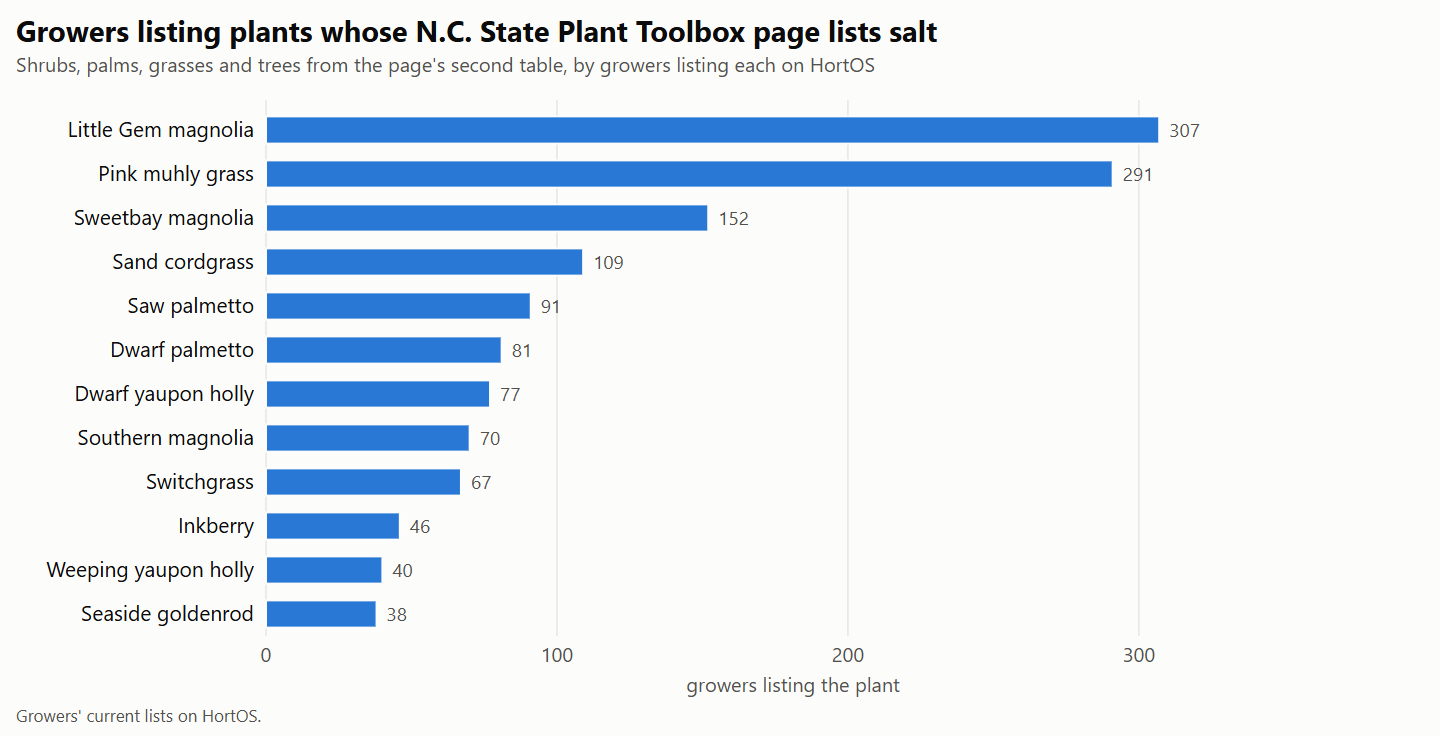
The second table holds 19 plants that HortOS chose, starting from the plants this page set out to cover and adding near relatives. They are shrubs, palms, grasses and marsh-edge perennials, with four trees that UGA's table rates low or does not rate. Each has its own Toolbox page that lists Salt in that field, and a page on HortOS. The column adds wet soil where the same field lists Wet Soil. It is a selection and not the Toolbox's list: the Toolbox's separate salt tolerant tag held 339 plants on October 5, 2026 (N.C. State, North Carolina, 2026).
Prices are medians across growers' current trade lists on HortOS: one price per grower, ex tax, freight not included, with the number of growers pricing each size in brackets. Anyone can see the prices on HortOS, and only the trade can order.
| Plant | N.C. State lists resistance to (2026) | Growers listing it | Size most growers price | Median (growers pricing) |
|---|---|---|---|---|
| Dwarf yaupon holly (Ilex vomitoria 'Nana') | Salt | 77 | #3 | $8.50 (45) |
| Weeping yaupon holly (Ilex vomitoria 'Pendula') | Salt, wet soil | 40 | #15 | $75 (13) |
| Inkberry (Ilex glabra) | Salt, wet soil | 46 | #3 | $12 (13) |
| Groundsel bush (Baccharis halimifolia) | Salt, wet soil | 27 | #3 | $16.50 (7) |
| Japanese pittosporum (Pittosporum tobira) | Salt | 33 | #3 | $8.25 (12) |
| Dwarf palmetto (Sabal minor) | Salt, wet soil | 81 | #7 | $35 (44) |
| Saw palmetto (Serenoa repens) | Salt | 91 | #7 | $35 (40) |
| Adam's needle yucca (Yucca filamentosa) | Salt | 35 | #3 | $11 (15) |
| Spanish bayonet (Yucca aloifolia) | Salt | 13 | #3 | $12.50 (4) |
| Mound lily yucca (Yucca gloriosa) | Salt | 6 | Fewer than three growers | |
| Pink muhly grass (Muhlenbergia capillaris) | Salt | 291 | #3 | $6.00 (165) |
| Sand cordgrass (Spartina bakeri) | Salt, wet soil | 109 | #3 | $5.25 (66) |
| Switchgrass (Panicum virgatum) | Salt, wet soil | 67 | #1 | $4.00 (15) |
| Seaside goldenrod (Solidago sempervirens) | Salt, wet soil | 38 | #1 | $3.50 (17) |
| Seashore mallow (Kosteletzkya pentacarpos) | Salt, wet soil | 2 | Fewer than three growers | |
| Little Gem magnolia (Magnolia grandiflora 'Little Gem') | Salt | 307 | #30 | $125 (90) |
| Southern magnolia (Magnolia grandiflora) | Salt, wet soil | 70 | #15 | $80 (13) |
| Sweetbay magnolia (Magnolia virginiana) | Salt, wet soil | 152 | #15 | $62.50 (32) |
| Sand live oak (Quercus geminata) | Salt | 30 | #3 | $9.75 (6) |
Most of the growers listing the plants in this table are in Florida and North Carolina. The size shown for each plant is the container size most growers price; field grown lines are not counted, and palms and other plants sold by height are not priced above #15.
Spanish bayonet's median rests on 4 growers, and a median on so few moves when one of them changes a price. For mound lily yucca and seashore mallow no size is priced by three growers.
The text of a plant's page can narrow its field. N.C. State's Toolbox says Japanese pittosporum takes salt spray, heat and drought, and tells gardeners to avoid wet or badly drained soil, where root rot is more likely (North Carolina, 2026). UGA Extension's bulletin on native grasses (Georgia, 2024) separates two look-alikes by habitat: pink muhly grass on upland soils and well-drained Coastal Plain soils, purple muhly grass in sand between coastal dunes and at marsh edges.
Where the two universities part, and what each says of flooding
The third table sets the two universities side by side for 12 trees and tree-sized shrubs that both cover, chosen because one of them states a limit or the two differ. Each cell is one statement in this page's words.
| Plant | UGA Extension salt rating (2022) | N.C. State Plant Toolbox (2026) | A limit one of them states |
|---|---|---|---|
| Southern live oak (Quercus virginiana) | High | Copes with flooding from time to time and with salt spray | Described for acid soil that drains well (N.C. State) |
| Yaupon holly (Ilex vomitoria) | High | Withstands salt spray, drought and a flood now and then | Ice and storms can damage it (UGA Bulletin 987, 2024) |
| Southern waxmyrtle (Myrica cerifera) | High | Takes high wind and salt spray; grown at the seaside | Weak wood, broken by ice storms (UGA Bulletin 987, 2024) |
| Cabbage palm (Sabal palmetto) | High | Highly salt tolerant | Not hardy in North Carolina's piedmont or its mountains (N.C. State) |
| Southern redcedar (Juniperus silicicola) | High | Tolerates drought and salt | Dislikes too much water, though it grows wild by marshes (N.C. State) |
| Tough bully (Sideroxylon tenax) | High, medium | Some tolerance of salty air | Salt spray itself is not tolerated (N.C. State) |
| Eastern redcedar (Juniperus virginiana) | Medium | Highly salt tolerant | Not for soil that stays wet (N.C. State) |
| American holly (Ilex opaca) | Medium | Moderately salt tolerant | Soil that is wet or dry at times suits it; flooding does not (N.C. State) |
| Bald cypress (Taxodium distichum) | Medium | Slightly salt tolerant | Stands long flooding; the Toolbox puts its salt tolerance at slight (N.C. State) |
| Redbay (Persea borbonia) | Medium | Highly salt tolerant | Very prone to laurel wilt disease (N.C. State) |
| Southern magnolia (Magnolia grandiflora) | Low | Salt and wet soil both listed as resisted | Not for swampy soil or long flooding (N.C. State); the two sources differ on salt |
| Sweetbay magnolia (Magnolia virginiana) | Low | Moderately salt tolerant | The two sources differ on salt |
The two universities read the magnolias differently. UGA Extension (Georgia, 2022) rates southern magnolia low for salt, while N.C. State's Toolbox lists Salt and Wet Soil for the species and says it does not take swampy soil or prolonged flooding (North Carolina, 2026). The Toolbox's page for the cultivar 'Little Gem' calls that tree moderately salt-tolerant and generally intolerant of very dry or very wet soil (North Carolina, 2026). This page does not say which reading is right.
Other rows differ the other way: eastern redcedar and redbay are medium for UGA Extension (Georgia, 2022) and highly salt tolerant for N.C. State's Toolbox (North Carolina, 2026). The Toolbox also calls redbay very prone to laurel wilt (North Carolina, 2026), the disease covered in the guide to laurel wilt.
On flooding the sources speak mostly in general terms. Mississippi State University Extension (Mississippi, 2024) says roots need oxygen, so few tree species stand a flood in the growing season. N.C. State Extension (North Carolina, 2026) names Indian hawthorn, Japanese holly, Japanese boxwood and hybrid azaleas among the plants that flooding often kills, and says flood stress can take several years to show in full.
The third table carries the few flood statements made by name, live oak's and American holly's among them. UGA Extension's native plant bulletin (Georgia, 2024) adds that cabbage palm stands salt spray, flooding and wind very well. None of these says whether the flood water is fresh or salt.
What a salt rating and a grower count leave out
The rated tables speak for the Georgia coast and for North Carolina. UGA Extension's ratings are for trees native to Georgia, drawn from observation between St. Augustine and Charleston and from other literature (Georgia, 2022). N.C. State's Toolbox says it is designed to help North Carolina consumers find plants for their gardens (North Carolina, 2026). No rating on this page was made for Alabama, Mississippi, Louisiana or Texas. For the Gulf the page carries NOAA's outlook and general statements from Mississippi State University Extension and UF/IFAS Extension.
Each source read for this page treats salt and flooding as separate things, and none rates plants one by one for flooding by salt water. Wet Soil in the Toolbox is an entry in a field and not a flood rating.
A rating is not a growth forecast either. UGA Extension (Georgia, 2022) cautions growers and landscapers that a plant able to tolerate saline conditions may still grow far less in them, and says mature plants generally stand salty conditions better than seedlings. No rating speaks of the container size a grower lists.
A count here is growers listing the plant, not how many plants exist or how well it suits a site. The medians in the second table are national, and none is a Lowcountry or a Gulf coast price. Each state's growers are on its hub: South Carolina, Georgia, North Carolina, Florida, Alabama, Mississippi, Louisiana and Texas.
A listing does not show where a plant was grown, whether it was raised within reach of salt, where its seed was collected, whether it is the straight species or a selection, or how it was grown. Each is a question for the grower.
What to watch for
- Reading a salt rating as a flood rating. UGA Extension's key (Georgia, 2022) speaks of salt spray and soil salinity only.
- Reading medium as proof against spray. UGA Extension (Georgia, 2022) keys its medium class with the words "protects from salt spray but withstands moderate soil salinity".
- Giving a cultivar the rating of its species. UGA Extension's low rating is for southern magnolia (Georgia, 2022), and the Toolbox's moderate one is for 'Little Gem' (North Carolina, 2026).
- Carrying a rating to another climate. N.C. State's Toolbox calls cabbage palm highly salt tolerant and says it is not hardy in North Carolina's piedmont or mountains (North Carolina, 2026).
Getting it right
- Find out what reaches the site: spray, salt in the soil, or tidal water. NOAA's outlook gives predicted flood days by region, and the National Weather Service's Charleston database gives the count at each gauge.
- Open Bulletin 1477 under Sources and read each tree's rating against the key. Then read the plant's own Toolbox page for its field and its text on wet soil and flooding.
- Where the two universities differ, or the site is on the Gulf, ask the extension office of the site's own state which rating it works from.
- For a tree in a public right-of-way, start with the city. The City of Charleston (South Carolina, 2026) asks residents to contact its Parks Department first, because that department manages all street trees.
- Ask the grower where the plants were grown and whether the line is the species or a named cultivar. The grower decides price, minimum order and terms, and the guide to buying from a wholesale grower explains who can order.
A word of caution
The salt ratings here are UGA Extension's (Georgia, 2022) and N.C. State's (North Carolina, 2026). Neither was made for the Gulf coast, and neither rates flooding by salt water. For a site, the extension office of its own state is the one to ask, and for a street tree the city. Grower counts and medians are what HortOS showed, and each grower sets its own prices and terms.
Sources
- NOAA National Ocean Service, What is a King Tide?: the king tide term.
- NOAA National Ocean Service, What is high tide flooding?: high tide flooding levels.
- NOAA Center for Operational Oceanographic Products and Services, Annual High Tide Flooding Outlook, 2026-2027: predicted flood days by region.
- National Weather Service Charleston, Coastal Flood Event Database: tides over the threshold.
- University of Georgia Cooperative Extension, Bulletin 1477, Selecting Salt-Tolerant Native Trees for the Georgia Coast: salt ratings for native trees.
- University of Georgia Cooperative Extension, Bulletin 987, Native Plants for Georgia Part I: Trees, Shrubs, and Woody Vines: native trees and shrubs, habitat.
- University of Georgia Cooperative Extension, Bulletin 987-4, Native Plants for Georgia Part IV: Grasses and Sedges: native grasses, habitat.
- NC State Extension, Handling Flooding and Storm Damage in the Landscape: plants after flooding.
- N.C. Cooperative Extension, Extension Gardener Plant Toolbox, Help: what the Toolbox fields mean.
- N.C. State Plant Toolbox, plants tagged salt tolerant: the salt tolerant tag.
- Mississippi State University Extension Service, Publication 3111, Storm-Resistant Trees for Mississippi Landscapes: storm surge, salt spray, flooding.
- University of Florida IFAS Extension, Gardening Solutions, Salt-Tolerant Plants: planting distance from salt water.
- City of Charleston, Tree Canopy: who manages street trees.
- N.C. State Plant Toolbox, Quercus virginiana: southern live oak entries.
- N.C. State Plant Toolbox, Ilex vomitoria: the yaupon entries.
- N.C. State Plant Toolbox, Myrica cerifera: southern waxmyrtle entries.
- N.C. State Plant Toolbox, Juniperus virginiana var. silicicola: southern redcedar entries.
- N.C. State Plant Toolbox, Juniperus virginiana: eastern redcedar entries.
- N.C. State Plant Toolbox, Sabal palmetto: cabbage palm entries.
- N.C. State Plant Toolbox, Ilex opaca: American holly entries.
- N.C. State Plant Toolbox, Taxodium distichum: bald cypress entries.
- N.C. State Plant Toolbox, Tamala borbonia (Persea borbonia): the redbay entries.
- N.C. State Plant Toolbox, Magnolia grandiflora: southern magnolia entries.
- N.C. State Plant Toolbox, Magnolia virginiana: sweetbay magnolia entries.
- N.C. State Plant Toolbox, Sideroxylon tenax: tough bully entries.
- N.C. State Plant Toolbox, Magnolia grandiflora 'Little Gem': the cultivar's entries.
- N.C. State Plant Toolbox, Quercus geminata: sand live oak entries.
- N.C. State Plant Toolbox, Ilex vomitoria 'Dwarf': dwarf yaupon entries.
- N.C. State Plant Toolbox, Ilex vomitoria 'Pendula': weeping yaupon entries.
- N.C. State Plant Toolbox, Ilex glabra: the inkberry entries.
- N.C. State Plant Toolbox, Baccharis halimifolia: groundsel bush entries.
- N.C. State Plant Toolbox, Sabal minor: dwarf palmetto entries.
- N.C. State Plant Toolbox, Serenoa repens: saw palmetto entries.
- N.C. State Plant Toolbox, Yucca filamentosa: Adam's needle entries.
- N.C. State Plant Toolbox, Yucca aloifolia: Spanish bayonet entries.
- N.C. State Plant Toolbox, Yucca gloriosa: mound lily entries.
- N.C. State Plant Toolbox, Muhlenbergia capillaris: pink muhly entries.
- N.C. State Plant Toolbox, Spartina bakeri: sand cordgrass entries.
- N.C. State Plant Toolbox, Panicum virgatum: the switchgrass entries.
- N.C. State Plant Toolbox, Solidago sempervirens: seaside goldenrod entries.
- N.C. State Plant Toolbox, Kosteletzkya pentacarpos: seashore mallow entries.
- N.C. State Plant Toolbox, Pittosporum tobira: Japanese pittosporum entries.
More guides
Hurricane wind resistance of trees and what they cost at trade
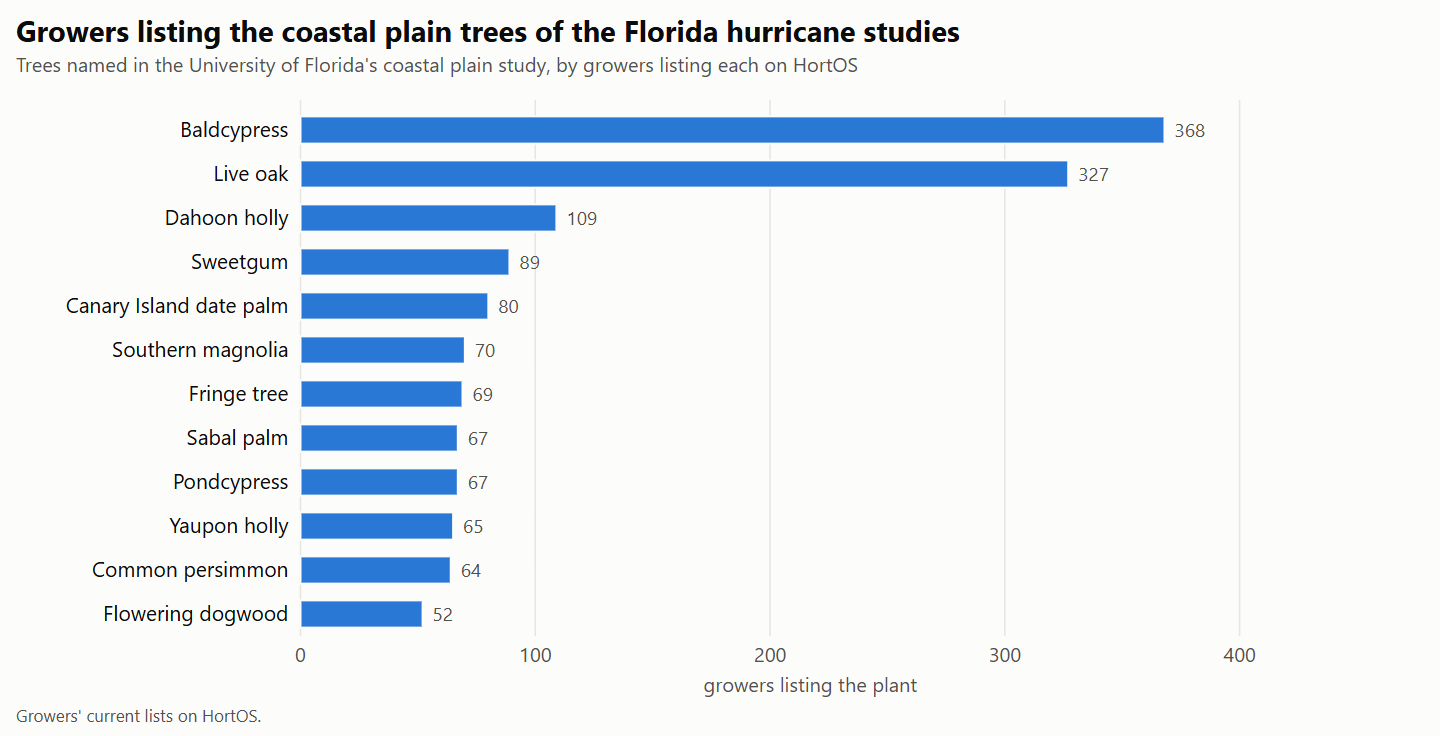
What the University of Florida's hurricane studies found for trees on the coastal plain and in south Florida, set beside the growers listing each tree on HortOS and the median trade price of a #15 container. The page describes the UF/IFAS wind resistance classes, links the full lists and says what neither the studies nor the figures show.
Laurel wilt and replanting where redbay, sassafras or spicebush died
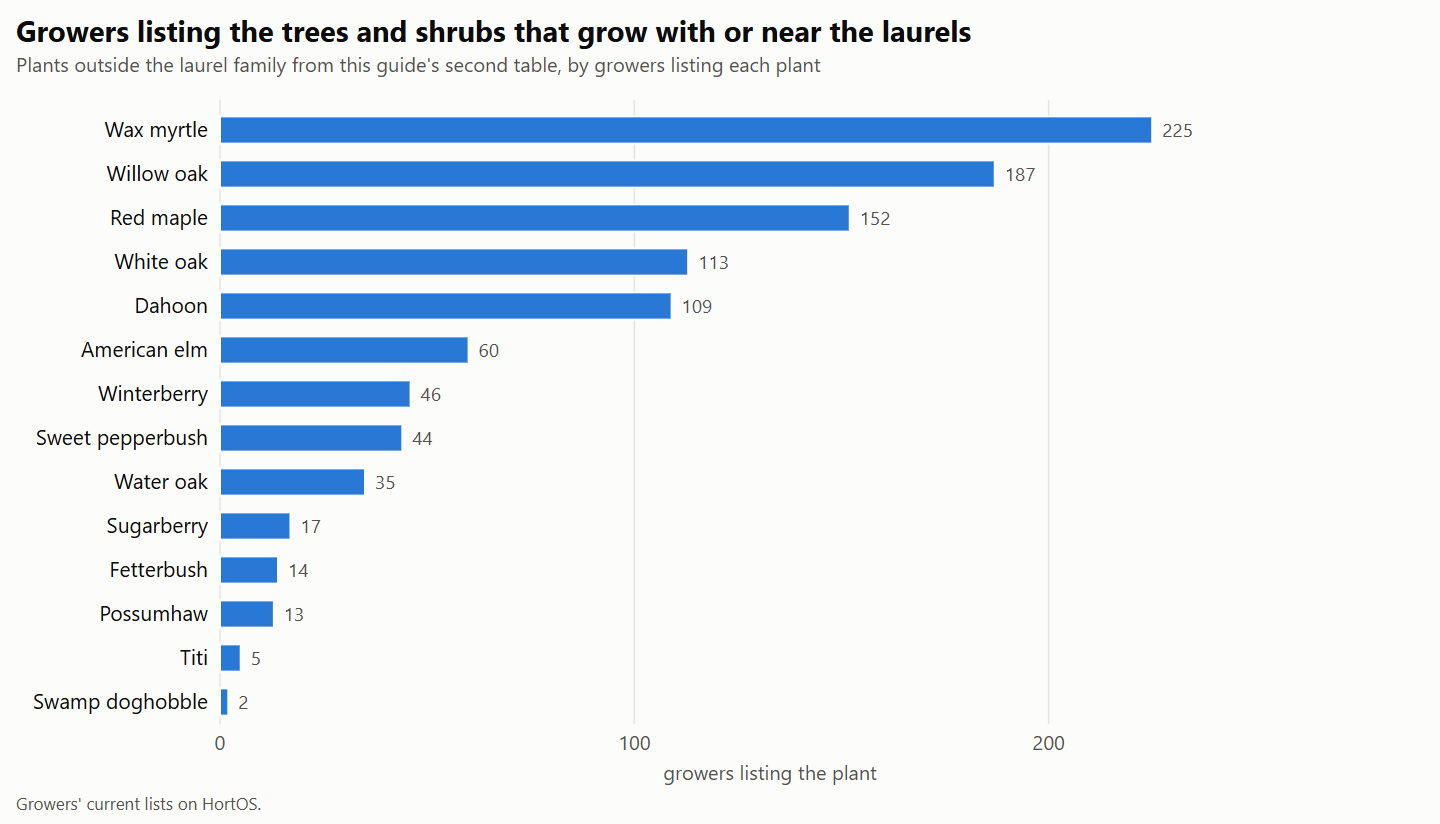
For native plant societies, butterfly groups and coastal tree programs where laurel wilt has killed redbay, sassafras or spicebush. It reports which plants the N.C. Forest Service and UF/IFAS Extension list as susceptible and not, what they say on replanting and moving host material, and dated reports from ten states, beside growers listing each plant and container medians.

Buying From a Wholesale Grower When You Are Not in the Trade
Native plant societies, watershed districts, land trusts, schools and church committees can buy from wholesale growers when they order like the trade: in quantity, ahead of the season, on the grower's terms. This page explains who sells to whom, resale certificates and exemptions, minimums and pooling, the sizes to buy, straight species and ecotype, lead times and shipping.