Laurel wilt and replanting where redbay, sassafras or spicebush died
For native plant societies, butterfly groups and coastal tree programs where laurel wilt has killed redbay, sassafras or spicebush. It reports which plants the N.C. Forest Service and UF/IFAS Extension list as susceptible and not, what they say on replanting and moving host material, and dated reports from ten states, beside growers listing each plant and container medians.
Updated October 7, 2026. Figures are what the live us.hortosapp.com price and plant pages printed.
On this page
- Quick facts
- Susceptible and not susceptible, as the agencies list them
- Plants outside the laurel family that grow with or near the laurels
- State by state, in each state's own report
- Replanting a host and moving host material
- What the counts, medians and host lists leave open
- What to watch for
- Getting it right
- A word of caution
- Sources
A native plant society on the Georgia or Carolina coast has lost its redbays and sassafras to laurel wilt. It asks which plants the forestry agencies list as not susceptible, how many growers list each one, and at what trade median. The N.C. Forest Service (North Carolina, 2026) says susceptibility to laurel wilt is confined to the laurel family, and that two swallowtail butterflies depend almost wholly on redbay and spicebush.
This page reports what the N.C. Forest Service, UF/IFAS Extension and a U.S. Department of Agriculture summary of the Forest Service's pest alert say about hosts, replanting and moving host material. It adds nine states' forest health reports, NC State Extension's plant pages, and growers' lists on HortOS, a free directory of American wholesale plant growers with their published availability and trade prices. It rates no plant, and no authority read for it prescribes a list of replacements.
Quick facts
| The disease | The N.C. Forest Service (North Carolina, 2026) describes laurel wilt as a fungal disease of laurel family plants that the redbay ambrosia beetle carries between trees, and says an infected tree wilts and dies within weeks or months. |
|---|---|
| Listed as susceptible | The N.C. Forest Service (North Carolina, 2026) calls redbay the species hit hardest, and names spicebush, sassafras, pondberry and pondspice as the other susceptible plants of the laurel family in the state. Its detection map (read 2026) adds swamp bay. |
| Listed as not susceptible | The N.C. Forest Service (North Carolina, 2026) lists sweetbay magnolia, loblolly bay, mountain laurel and rhododendron as not susceptible to laurel wilt. |
| Redbay losses | The N.C. Forest Service (North Carolina, 2026) says laurel wilt often kills more than 90% of redbay over an inch in diameter in affected areas, while seedlings are common and the beetle attacks them less readily. |
| Swallowtails | The N.C. Forest Service (North Carolina, 2026) says two swallowtail species depend almost wholly on redbay and spicebush. NC State Extension (North Carolina, read 2026) names sweetbay magnolia as a larval host of the spicebush swallowtail. |
| Growers and a median | Sweetbay magnolia was listed by 152 growers on HortOS, in any size, and wax myrtle by 225. At #15, sweetbay's national trade median was $62.50, from 32 growers pricing that size: one price a grower, before tax and freight. |
Susceptible and not susceptible, as the agencies list them
Every host named by the N.C. Forest Service (North Carolina, 2026) or by UF/IFAS Extension (Florida, read 2026) belongs to the laurel family. The N.C. Forest Service's detection map (North Carolina, read 2026) reports that within the state the disease had been detected only in redbay and, from 2018, in sassafras. UF/IFAS (Florida, read 2026) puts the susceptible trees of that family at nine or more native species and four from elsewhere, and its table of Florida hosts includes avocado and bay laurel. The same UF/IFAS publication (read 2026) says no case is on record outside the laurel family, and that oaks and maples, which belong to other families, are not susceptible to the fungus.
A U.S. Department of Agriculture page (read 2026), summarizing the Forest Service's Southern Region pest alert, says laurel wilt has killed hundreds of millions of redbay trees on the southeastern Atlantic Coastal Plain. That USDA summary (read 2026) expects the disease to keep moving through sassafras in the eastern United States.
The first table sets the listed plants side by side. Its first rows are the plants the N.C. Forest Service (North Carolina, 2026) names as susceptible in the state that have a plant page on HortOS: redbay, swamp bay, sassafras and spicebush. Then come three of the four it lists as not susceptible: sweetbay magnolia, loblolly bay and mountain laurel. A further 3 plants it names are not shown: pondspice and pondberry, which have no such page, and rhododendron, which is a whole genus and not one plant. The N.C. Forest Service's map (read 2026) notes that the laurel family does not take in mountain laurel or rhododendron. The swallowtail column is not the Forest Service's: it comes from each plant's page in NC State Extension's Plant Toolbox (North Carolina, read 2026). Grower counts are the growers listing each plant on HortOS, in any size. Prices are medians across growers' current trade lists on HortOS: one price per grower, ex tax, freight not included, with the number of growers pricing each size in brackets. Anyone can see the prices on HortOS, and only the trade can order.
| Plant | Swallowtail larvae it supports, NC State Extension (read 2026) | Growers listing it | Size most growers price | Median (growers pricing) |
|---|---|---|---|---|
| Redbay (Persea borbonia) | Palamedes and spicebush swallowtails | 6 | Fewer than three growers | |
| Swamp bay (Persea palustris) | Spicebush and Palamedes swallowtails | 7 | Fewer than three growers | |
| Sassafras (Sassafras albidum) | Spicebush swallowtail | 24 | #5 | $35 (6) |
| Spicebush (Lindera benzoin) | Palamedes and spicebush swallowtails | 44 | #3 | $18 (16) |
| Sweetbay magnolia (Magnolia virginiana) | Spicebush and eastern tiger swallowtails | 152 | #15 | $62.50 (32) |
| Loblolly bay (Gordonia lasianthus) | None named on its page | 8 | #3 | $12.75 (3) |
| Mountain laurel (Kalmia latifolia) | None named on its page | 19 | #2 | $21.50 (4) |
The growers listing the plants in this table are spread across many states; the most are in Florida, North Carolina and New Jersey. The size shown for each plant is the container size most growers price; field grown lines are not counted.
A median needs three growers pricing a size. Redbay and swamp bay therefore show a count alone. Two medians rest on few growers: loblolly bay's #3 figure on 3 growers pricing it, and mountain laurel's #2 figure on 4. NC State Extension (North Carolina, read 2026) describes loblolly bay as usually short-lived and says it can be hard to raise in cultivation. Where the column reads "None named on its page", the wildlife text of that plant's NC State page names no swallowtail.
NC State Extension (North Carolina, read 2026) places redbay in dunes, hammocks and maritime forests and calls it highly salt tolerant. NC State (North Carolina, read 2026) says sweetbay magnolia copes with wet and boggy soils, and that mountain laurel does poorly in wet soils and heavy clay. So the table does not present mountain laurel as a stand-in for a swamp or maritime redbay.
Plants outside the laurel family that grow with or near the laurels
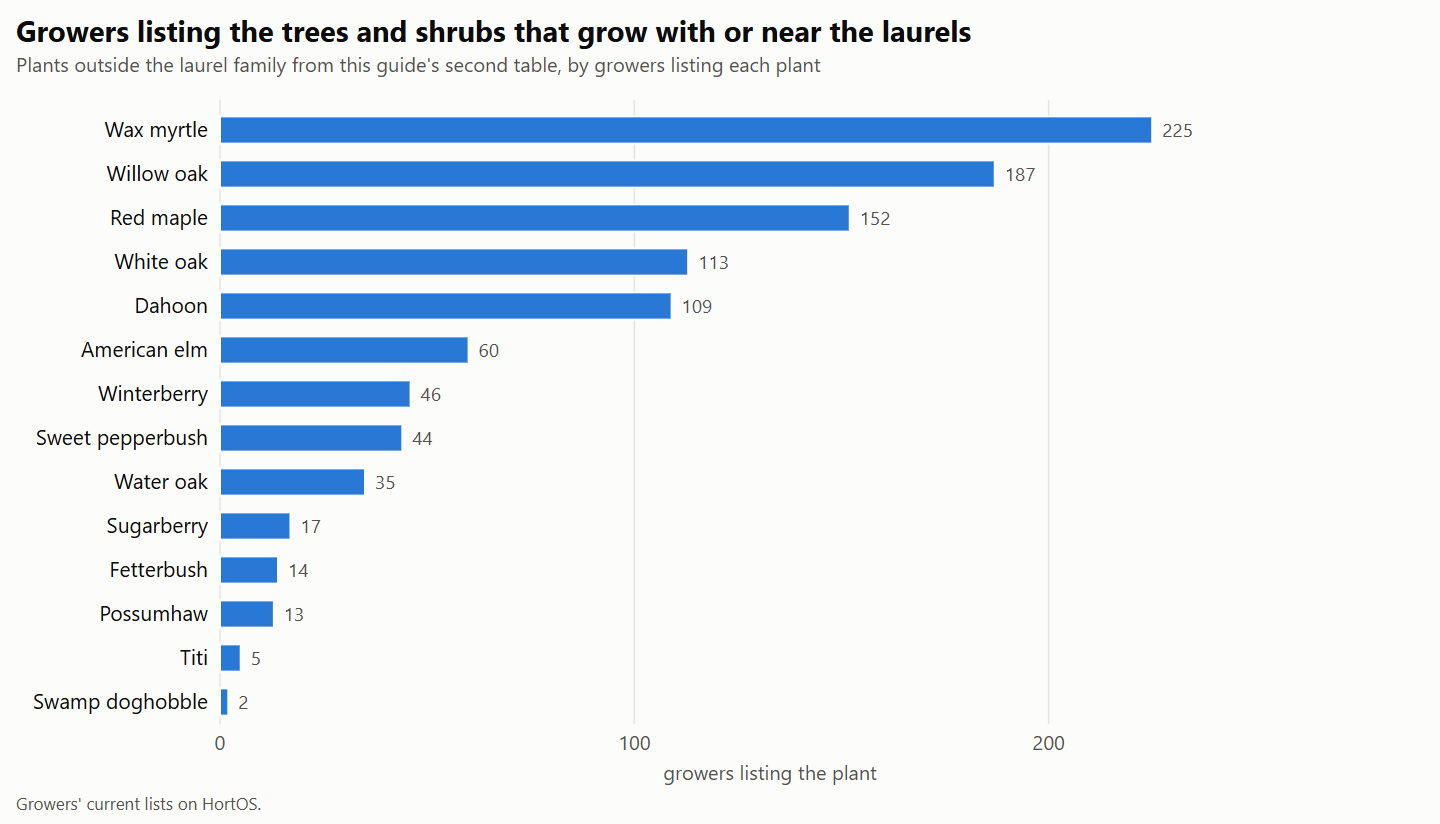
No authority read for this page prescribes what to plant where a laurel died. The second table is this page's own selection from two sources. Its upper rows, from sugarberry to winterberry, are plants outside the laurel family that NC State Extension's Plant Toolbox (North Carolina, read 2026) names as filling a similar niche to redbay, swamp bay, sassafras or spicebush. The rows from red maple down are broadleaf trees and shrubs that the USDA Forest Service's species review of redbay (1991) names as growing with it. Only plants with a page on HortOS are rows. A further 12 plants those sources name are not shown, among them conifers, a palm and a vine, which fall outside the rule, and sweetbay magnolia and loblolly bay, which are rows of the first table.
The review predates the disease: the N.C. Forest Service (2026) dates the beetle's first detection, in Georgia, to 2002. Its lists describe redbay's company, not what follows a loss.
| Plant | Growers listing it | Size most growers price | Median (growers pricing) |
|---|---|---|---|
| Sugarberry (Celtis laevigata) | 17 | #3 | $8.07 (6) |
| Willow oak (Quercus phellos) | 187 | #15 | $60 (35) |
| Possumhaw (Ilex decidua) | 13 | Fewer than three growers | |
| White oak (Quercus alba) | 113 | #15 | $60 (14) |
| Water oak (Quercus nigra) | 35 | #3 | $9.75 (7) |
| American elm (Ulmus americana) | 60 | #3 | $9.00 (15) |
| Winterberry (Ilex verticillata) | 46 | #3 | $18.98 (8) |
| Red maple (Acer rubrum) | 152 | #15 | $60 (20) |
| Dahoon (Ilex cassine) | 109 | #25 | $145 (33) |
| Titi (Cyrilla racemiflora) | 5 | Fewer than three growers | |
| Fetterbush (Lyonia lucida) | 14 | #3 | $10 (5) |
| Swamp doghobble (Leucothoe racemosa) | 2 | Fewer than three growers | |
| Sweet pepperbush (Clethra alnifolia) | 44 | #3 | $22 (9) |
| Wax myrtle (Myrica cerifera) | 225 | #3 | $8.00 (91) |
Most of the growers listing the plants in this table are in Florida, North Carolina and Texas. The size shown for each plant is the container size most growers price; field grown lines are not counted.
NC State Extension (North Carolina, read 2026) lists dahoon and fetterbush as broadleaf evergreens and titi as deciduous to semi-evergreen. It gives water oak and wax myrtle both evergreen and deciduous classes, and lists every other row as deciduous. NC State's heights (read 2026) run from 3 to 6 feet for fetterbush to 50 to 135 feet for white oak.
NC State Extension (North Carolina, read 2026) also lists Dutch elm disease among American elm's common disease problems, and says wax myrtle withstands strong wind and salt spray and can be planted near the sea. Neither the N.C. Forest Service nor UF/IFAS Extension rates a plant in this table, and this page does not either. For coastal sites, the guide to hurricane wind resistance of trees reports how the University of Florida's hurricane studies class trees.
State by state, in each state's own report
The third table gives one dated statement from each of nine states: eight from the state's forest health report on the USDA Forest Service's site, and Florida's from the UF/IFAS Extension publication. Of the eight reports, Tennessee's is for 2024 and the rest are for 2025. County totals are as each report states them, and this page does not add them up.
| State | Reported status of laurel wilt | Source and year |
|---|---|---|
| Georgia | Confirmed in 79 counties by September 2025; no county was added during 2025. | Georgia Forestry Commission, 2025 |
| South Carolina | Many coastal redbays are dead, spread goes on along interior bottomlands, and infected sassafras is still being found. | South Carolina Forestry Commission, 2025 |
| North Carolina | Greene and Beaufort counties were added in 2025, making 21 counties; the mountains have no detection yet. | N.C. Forest Service, 2025 |
| Alabama | First detected in 2011; confirmed in Pike County sassafras in fiscal 2025, then in Bullock and Talladega counties. | Alabama Forestry Commission, 2025 |
| Mississippi | The beetle was first detected in Jackson County in July 2009, and the affected area is still growing. | Mississippi Forestry Commission, 2025 |
| Louisiana | Reached Union Parish in September 2014; nothing was added in 2025. | Louisiana Department of Agriculture and Forestry, 2025 |
| Tennessee | First detected in 2019; three more counties in 2024 brought the total to 26. | Tennessee Department of Agriculture, 2024 |
| Kentucky | First documented in 2019; 24 counties so far, 6 of them found in summer 2025. | Kentucky Division of Forestry, 2025 |
| Florida | Detected in all 67 counties. | UF/IFAS Extension, publication HS1358, read 2026 |
A ninth report, from the Texas A&M Forest Service (2025), gives 24 Texas counties with laurel wilt, and names Anderson, Gregg, Henderson, Smith and Van Zandt as counties where the fungus has been confirmed. The Kentucky Division of Forestry (2025) says the state's first detections were all in sassafras, with spicebush confirmed since.
These are yearly reports, not a live map. The USDA Forest Service's Southern Region forest health page (last updated in March 2026) leads to the regional map, and the N.C. Forest Service keeps a detection map for North Carolina.
Replanting a host and moving host material
Whether to plant a host again is not a question this page answers. It reports what two authorities say. The N.C. Forest Service (North Carolina, 2026) says laurel wilt often kills more than 90% of redbay over an inch in diameter where the disease is present, while redbay seedlings are plentiful and the beetle attacks them less readily. UF/IFAS Extension (Florida, read 2026), writing about avocado in home landscapes, says a dead avocado can be replaced with a new one, because the beetles are generally not drawn to young trees with small stems. The same UF/IFAS publication (Florida, read 2026) says the pathogen lives only in a living host, not in the soil.
The N.C. Forest Service (North Carolina, 2026) says nothing yet prevents or cures laurel wilt reliably: insecticides have failed to stop the beetle, and fungicides cost a lot and need a fresh application each year.
The N.C. Forest Service (North Carolina, 2026) asks that dead host material stay on the site, chips and debris bound for a landfill included. The same N.C. page (2026) says trees killed by the disease can be cut and left, buried or burned there under state and local rules. UF/IFAS Extension (Florida, read 2026) urges extreme caution in moving live host trees, redbay and avocado among them, into places where laurel wilt has not been found. The UF/IFAS publication (Florida, read 2026) says containerized host trees should be bought only from registered nurseries.
The N.C. Forest Service's laurel wilt page, read in October 2026, says there is no federal or state quarantine for the pest in North Carolina. What another state requires is for its own plant regulator to say.
What the counts, medians and host lists leave open
A count here is growers listing the plant, not how many plants exist or how well it suits a site. The directory does not show, for any grower, where seed or cuttings were collected, whether a line is the straight species or a selection, or how it was raised. It does not show whether a nursery stands in a county with laurel wilt, or anything about the health of a plant listed. Each is a question to put to the grower in writing.
Each median is a national figure, not a price for the Lowcountry, the Carolina coast or the Gulf, and none includes freight. The hubs for Georgia, South Carolina, North Carolina and Florida show the growers in each state.
On the NC State Extension pages read for this guide (North Carolina, 2026), no plant outside the laurel family is named as a larval host of the Palamedes swallowtail. Those pages name sweetbay magnolia as a larval host of the spicebush swallowtail. The tables cannot show that any plant does a laurel's work for either butterfly. No source read ranks the plants of the second table or says which suits a given site, and NC State's notes are written for North Carolina.
What to watch for
- Reading the word laurel as the laurel family. The N.C. Forest Service's map (North Carolina, read 2026) notes that mountain laurel and rhododendron are outside it.
- Expecting a plant outside the laurel family to host the same caterpillars. Of the plants the N.C. Forest Service (2026) lists as not susceptible, NC State (North Carolina, read 2026) names a swallowtail only on sweetbay magnolia's page among those read.
- Hauling dead host wood or chips away. The N.C. Forest Service (North Carolina, 2026) says even chips taken to a landfill can carry the beetle and the disease somewhere new.
- Reading the second table as an agency's replacement list. It is this page's selection from an extension database and a 1991 USDA Forest Service review, and no agency read endorses it.
Getting it right
- Have the cause confirmed. The N.C. Forest Service (North Carolina, 2026) asks anyone who suspects laurel wilt has killed a tree outside the mapped range to contact the county forest ranger, and not to send samples. In another state, ask the state forestry agency.
- Ask the state forestry agency or the county extension office which plants suit the site's soil, water and salt, and whether any rule there covers moving host plants or wood.
- Where swallowtails are the aim, ask the extension office which larval hosts it records for the Palamedes and spicebush swallowtails.
- For a plant in the second table, open its page from the table to see its growers by state. Then write to each grower about seed source, species or selection, propagation and the nursery's county.
- Compare the median at the size wanted on the price pages, and ask for a written quote with freight. The guides to buying from a wholesale grower and reading a wholesale availability list cover ordering from outside the trade and container classes.
A word of caution
The host lists here are the N.C. Forest Service's and UF/IFAS Extension's as read in October 2026, and the state reports are yearly, so the disease may since have been found in more counties or plants. What to plant on a site is for the state forestry agency or the county extension office to advise, and what may be moved is for the state's plant regulator. The HortOS figures are what the pages showed, and they change as growers update their lists.
Sources
- N.C. Forest Service, Laurel Wilt Frequently Asked Questions: hosts, non-hosts, spread, disposal.
- N.C. Forest Service, Laurel Wilt in North Carolina Detection Map: susceptible plants, state detections.
- N.C. Forest Service, North Carolina 2025 Forest Health Highlights: county count for 2025.
- Georgia Forestry Commission, Forest Health Highlights, October 2024 to September 2025: Georgia county count.
- South Carolina Forestry Commission, Forest Health 2025 South Carolina Highlights: South Carolina status.
- Alabama Forestry Commission, Forest Health Highlights 2025: Alabama detections.
- Mississippi Forestry Commission, Mississippi 2025 Forest Health Highlights: Mississippi first detection.
- Louisiana Department of Agriculture and Forestry, Louisiana Forest Health Highlights 2025: Louisiana arrival and status.
- Texas A&M Forest Service, 2025 Forest Health Highlights in Texas: Texas county count.
- Tennessee Department of Agriculture, Tennessee Forest Health Highlights 2024: Tennessee county count.
- Kentucky Division of Forestry, Kentucky Forest Health Highlights 2025: Kentucky counties and hosts.
- UF/IFAS Extension, Recommendations for the Detection and Mitigation of Laurel Wilt Disease in Avocado and Related Tree Species in the Home Landscape (HS1358): hosts, replanting, moving host trees.
- USDA National Invasive Species Information Center, Laurel Wilt: summary of the pest alert.
- USDA Forest Service, Southern Region, Forest Health: leads to the regional map.
- USDA Forest Service, Fire Effects Information System, Persea borbonia (species review, 1991): plants growing with redbay.
- NC State Extension, Tamala borbonia (redbay): habitat, swallowtails, similar niche.
- NC State Extension, Tamala palustris (swamp bay): swallowtails, similar niche.
- NC State Extension, Sassafras albidum: swallowtail, similar niche.
- NC State Extension, Lindera benzoin: spicebush swallowtails, similar niche.
- NC State Extension, Magnolia virginiana: sweetbay swallowtails, wet soils.
- NC State Extension, Gordonia lasianthus: loblolly bay in cultivation.
- NC State Extension, Kalmia latifolia: mountain laurel and soils.
- NC State Extension, Celtis laevigata: sugarberry height, habit.
- NC State Extension, Quercus phellos: willow oak height, habit.
- NC State Extension, Ilex decidua: possumhaw height, habit.
- NC State Extension, Quercus alba: white oak height, habit.
- NC State Extension, Quercus nigra: water oak height, habit.
- NC State Extension, Ulmus americana: American elm, leaf habit, disease.
- NC State Extension, Ilex verticillata: winterberry height, habit.
- NC State Extension, Acer rubrum: red maple height, habit.
- NC State Extension, Ilex cassine: dahoon height, habit.
- NC State Extension, Cyrilla racemiflora: titi height, habit.
- NC State Extension, Lyonia lucida: fetterbush height, habit.
- NC State Extension, Eubotrys racemosa (swamp doghobble): height, habit.
- NC State Extension, Clethra alnifolia: sweet pepperbush height, habit.
- NC State Extension, Myrica cerifera: wax myrtle, wind and salt.
More guides
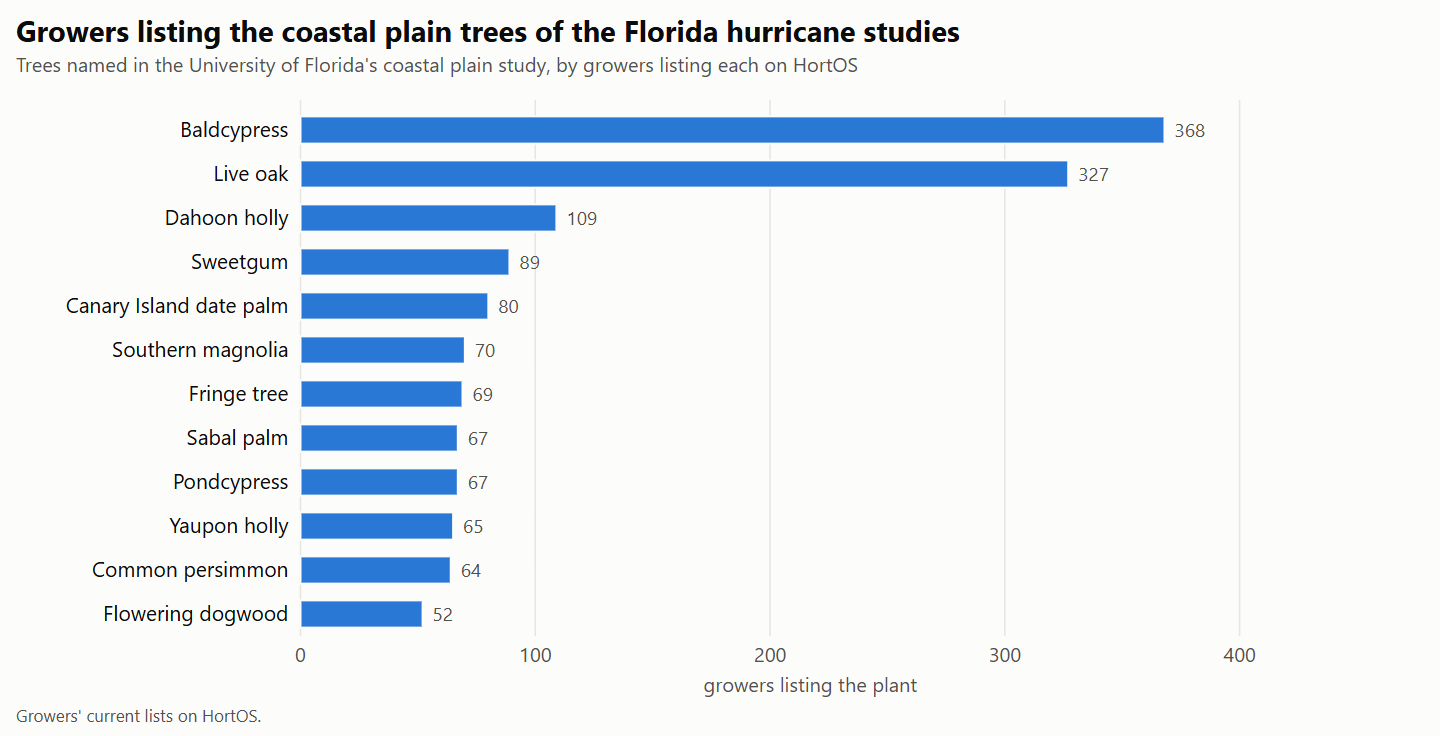
Hurricane wind resistance of trees and what they cost at trade
What the University of Florida's hurricane studies found for trees on the coastal plain and in south Florida, set beside the growers listing each tree on HortOS and the median trade price of a #15 container. The page describes the UF/IFAS wind resistance classes, links the full lists and says what neither the studies nor the figures show.

Buying From a Wholesale Grower When You Are Not in the Trade
Native plant societies, watershed districts, land trusts, schools and church committees can buy from wholesale growers when they order like the trade: in quantity, ahead of the season, on the grower's terms. This page explains who sells to whom, resale certificates and exemptions, minimums and pooling, the sizes to buy, straight species and ecotype, lead times and shipping.

Reading a Wholesale Availability List, and Pricing the Plants in a Bid
For landscape contractors, designers, estimators and students: what each column of a wholesale availability list means, how much the same plant at the same size varies between growers and states, how the low, median and high on the price pages are built, and how to carry the plant line of a bid from the list to the client.