Road salt tolerant trees and shrubs for northern streets and driveways
Road salt harms plants two ways, spray on buds and salt in the soil, and extension services rate the two apart. This guide sets Wisconsin Extension's spray ratings beside what growers list on HortOS, with trade medians where growers price a size, and draws on Penn State, Virginia, Purdue and Iowa State for placement.
Updated September 16, 2026. Figures are what the live us.hortosapp.com price and plant pages printed.
On this page
A public works crew in a snowbelt town replants a boulevard every few springs because the evergreens along the plowed edge turn brown by April. The shade tree commission wants to know which trees and shrubs will last there. The idea that matters most is that road salt injures plants in two separate ways, through spray on buds and through salt in the soil, and a plant that shrugs off one may fail under the other.
The ratings and the account of injury on this page come from extension services in Pennsylvania, Wisconsin, Virginia, Indiana and Iowa, each named where it is used. Beside each rated plant sits what growers list on HortOS, a free directory of American wholesale plant growers with their published availability and trade prices. A roadside planting plan can then be checked against the trade's lists. This page reports what those services say; it is not a soil test or a planting specification for any street.
Quick facts
| Two kinds of injury | Penn State Extension (2026) separates deicer damage into salt spray and salt carried in the soil. |
|---|---|
| How far spray travels | Up to 1,000 feet from a salted road, carried by fast traffic and wind (Penn State Extension, 2026). |
| Where soil salt builds | Usually within 30 to 50 feet of a road (Virginia Cooperative Extension, publication 430-031, 2022). |
| The riskiest months | March and April, when buds grow far more prone to salt injury (Wisconsin Extension, A3877, 2026). |
| Spray and soil rated apart | Wisconsin Extension's A3877, revised 6 March 2026, warns that a plant's soil salt tolerance can differ from its spray tolerance. |
| A sensitive screen | Penn State Extension (2026) describes arborvitae, a common roadside screen, as very salt sensitive. |
Spray on the buds, salt in the root zone
Penn State Extension's 2026 page on deicer damage describes the first kind of injury as spray. Fast traffic throws it up and wind carries it, as far as 1,000 feet from a treated road. Purdue University's forestry department put the reach at often as far as 75 to 100 yards in its 2000 note on white pine, and farther in wind. Spray lands on twigs and buds, and the extension services agree on its timing.
Penn State Extension (2026) says spray does the most harm toward the end of winter and into spring, once leaf buds start to swell. Wisconsin Extension's A3877 (2026) adds that plants resist salt best in early winter. Their buds then grow far more prone to injury in March and April. A hedge that looks sound in January can show its damage only when it fails to leaf out.
The second kind is salt that meltwater carries into the soil. Penn State Extension (2026) notes that clay holds more salt than sand. Wisconsin Extension (2026) says plants tend to tolerate salt better in sandy, well drained ground than in heavy clay. Virginia Cooperative Extension's 2022 publication places most of this build up within 30 to 50 feet of the pavement. Wisconsin Extension (2026) describes soil salt injury as slow, progressing over several years. Penn State Extension (2026) calls it hard to diagnose because its symptoms look like other problems.
On the deicers themselves, Penn State Extension (2026) ranks the chloride products made with calcium, potassium or magnesium as gentler on plants than rock salt when used as directed. For plants damaged by soil-borne salt, the same 2026 page describes gypsum applied in spring at 40 pounds per 1,000 square feet. It also says six inches of water leaches out half of the salt in a soil.
Wisconsin's spray ratings beside what growers list
Salt ratings differ between sources. Purdue's compiled table of 2000 shows several species marked tolerant, moderate and sensitive on a single line, depending on the list it drew from. The table below therefore uses one source throughout: the spray ratings in Wisconsin Extension's A3877, revised 6 March 2026. That article rates soil salt in a separate column, and its soil ratings are worth reading beside these for any site where meltwater collects.
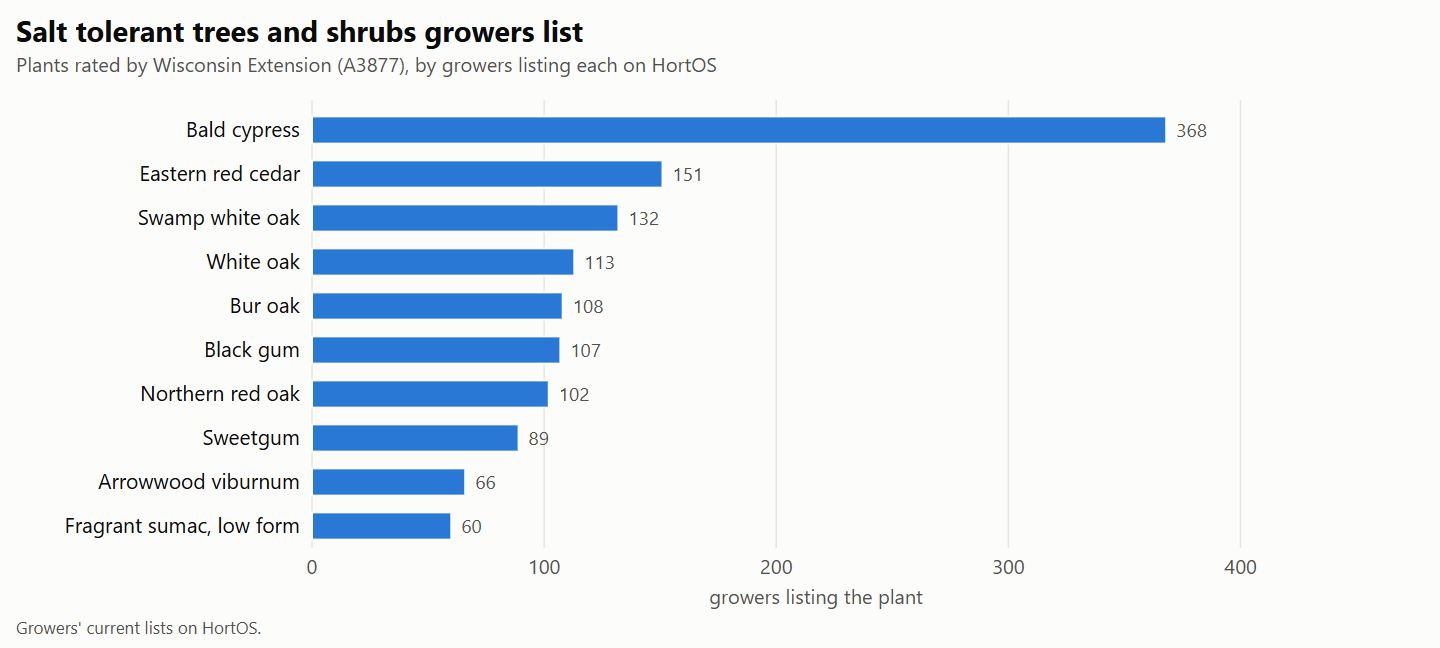
The rows are a selection of 25 trees and shrubs that article rates high or moderate for spray salt, each with a price page here, trees first and then shrubs. The article rates more plants than the table carries. Prices are medians across growers' current trade lists on HortOS: one price per grower, ex tax, freight not included, with the number of growers pricing each size in brackets.
| Plant | Spray rating, Wisconsin Extension (2026) | Growers listing it | Size most growers price | Median (growers pricing) |
|---|---|---|---|---|
| Eastern red cedar (Juniperus virginiana) | High | 151 | #15 | $65 (27) |
| Thornless honeylocust (Gleditsia triacanthos var. inermis) | High | 8 | Fewer than three growers | |
| Kentucky coffeetree (Gymnocladus dioicus) | High | 37 | Field grown only | |
| Sweetgum (Liquidambar styraciflua) | High | 89 | #3 | $11 (10) |
| Japanese tree lilac (Syringa reticulata) | High | 12 | Field grown only | |
| Bald cypress (Taxodium distichum) | High | 368 | #30 | $120 (89) |
| Ginkgo (Ginkgo biloba) | Moderate | 58 | #15 | $65 (5) |
| Bur oak (Quercus macrocarpa) | Moderate | 108 | #30 | $117.50 (12) |
| Northern red oak (Quercus rubra) | Moderate | 102 | #3 | $12.50 (7) |
| Swamp white oak (Quercus bicolor) | Moderate | 132 | #7 | $37.75 (10) |
| Northern catalpa (Catalpa speciosa) | Moderate | 30 | Field grown only | |
| Black gum (Nyssa sylvatica) | Moderate | 107 | #3 | $14.50 (17) |
| White oak (Quercus alba) | Moderate | 113 | #15 | $60 (14) |
| Mugo pine (Pinus mugo) | High | 42 | #3 | $19.33 (6) |
| Northern bayberry (Myrica pensylvanica) | High | 53 | #3 | $19.98 (16) |
| Fragrant sumac, low form (Rhus aromatica 'Gro-Low') | High | 60 | #3 | $19 (22) |
| Common snowberry (Symphoricarpos albus) | High | 19 | #5 | $16 (3) |
| American elderberry (Sambucus canadensis) | High | 45 | #3 | $15 (11) |
| Creeping juniper (Juniperus horizontalis) | High | 26 | #3 | $9.00 (7) |
| Arrowwood viburnum (Viburnum dentatum) | High | 66 | #3 | $16 (17) |
| Nannyberry (Viburnum lentago) | High | 17 | #3 | $19 (4) |
| Sweet fern (Comptonia peregrina) | High | 18 | #1 | $12.85 (5) |
| Black chokeberry (Aronia melanocarpa) | Moderate | 41 | #3 | $17.02 (12) |
| Red chokeberry (Aronia arbutifolia) | Moderate | 27 | #3 | $14 (9) |
| Summersweet (Clethra alnifolia) | Moderate | 44 | #3 | $22 (9) |
The growers listing the plants in this table are spread across many states; the most are in Florida, North Carolina and Texas. The size shown for each plant is the container size most growers price; field grown lines are not counted. Where a row says Field grown only, its growers price that plant as field grown stock and no container median is shown.
Anyone can see the prices on HortOS, and only the trade can order. A median needs three growers pricing a size. That is why the thornless honeylocust row shows none although 8 growers list it. The common snowberry median rests on 3 growers and the nannyberry median on 4. A median on so few moves when one grower changes a price.
Several of the plants a city forester is most likely to want carry no container median. Kentucky coffeetree is listed by 37 growers and Japanese tree lilac by 12. Both are priced only as field grown trees. Eastern red cedar, which Penn State Extension (2026) names as tolerating both spray and soil salt, is listed by 151 growers. Its median is $65 at #15 across 27. Among the shrubs, northern bayberry is listed by 53 growers.
Other services name further plants. Penn State Extension (2026) names blue spruce and inkberry holly as evergreen choices for salted sites. Virginia Cooperative Extension (2022) lists inkberry and beach plum among shrubs that tolerate saline conditions.
Where the plants go matters as much as which
The extension services put almost as much weight on placement as on choice. Penn State Extension (2026) suggests a row of eastern red cedar along the road. It says a row of tolerant trees can shield sensitive ones behind it from spray. Virginia Cooperative Extension (2022) suggests setting sensitive plants at least 50 to 60 feet back from paving where deicers may be used.
Wisconsin Extension (2026) suggests raised, mounded beds where soil salt is the problem, so that salty runoff stays out of the root zone. The same article says newly planted trees and shrubs suffer more winter salt injury than established ones. Virginia Cooperative Extension (2022) goes further, describing the bulk of landscape plants as salt sensitive, young ones above all. Iowa State University Extension and Outreach advises choosing salt tolerant species for trees planted near a major street or highway.
Some familiar roadside choices fare badly in these sources. Penn State Extension (2026) calls arborvitae very salt sensitive. Purdue's forestry department wrote in 2000 that white pines browning beside salted roads are simply the wrong species for that place. Iowa State's short list of tolerant trees and shrubs takes in bur oak, honeylocust, Kentucky coffeetree and eastern red cedar, all four also in the table, honeylocust as its thornless variety. A wider guide to street trees and canopy covers the choices beyond salt that a boulevard tree also has to meet.
What the figures do not show
A count here is growers listing the plant, not how many plants exist or how well it suits a site. No figure on HortOS rates a grower's plants for salt tolerance; the rating in each row is Wisconsin Extension's, for the species. The directory cannot show a plant's seed origin or how it was grown either. A buyer who needs that detail asks the grower directly.
The medians cover one container size per plant, the size most growers price. A boulevard tree is often bought larger and field grown, and those lines are not counted. A row's median therefore says little about the price of a caliper tree. Virginia Cooperative Extension's 2022 publication also covers saline conditions in general, the coast included, and not road salt alone. The guide to reading an availability list explains how to read a grower's own sizes, root forms and dates, the next step once a shortlist is drawn from the table.
What to watch for
- Choosing on the spray rating alone for a low spot where meltwater pools, when Wisconsin Extension (2026) rates soil tolerance separately and the two can differ.
- Planting a screen of arborvitae or eastern white pine along a plowed edge, two plants Penn State (2026) and Purdue (2000) describe as salt sensitive.
- Judging winter survival in January, when Wisconsin Extension (2026) says buds turn most prone to injury in March and April.
- Treating heavy clay beside a road like sandy ground: Penn State and Wisconsin both describe clay holding more salt.
- Reading a row marked Field grown only as a plant nobody prices, when its growers simply price it in the ground.
Getting it right
- Ask the public works or highway department which roads are salted, with what, and how heavily. That decides whether spray, soil salt or both reach the site.
- Ask the county extension office or the city forester which salt rating list they follow for the region, as ratings vary between sources.
- Have the soil tested where salt is suspected, and ask the testing lab what the result means for the species on the shortlist.
- Ask the grower what size, root form and delivery season the plant comes in, and whether a field grown tree can be dug for the planned date.
- Let the shade tree commission or HOA board set the final list, setback and spacing, with the extension ratings and the growers' quotes in front of it.
A word of caution
The ratings and advice here are those of the extension services at Penn State, Wisconsin, Virginia, Purdue and Iowa State, each for its own region and year. Salt tolerance is not a guarantee. A county extension office or a certified arborist is the one to ask about a particular street, soil or deicer.
Sources
- Penn State Extension, Minimize Deicer Damage with Salt Tolerant Plants: spray and soil salt injury.
- University of Wisconsin-Madison Division of Extension, Winter Salt Injury and Salt-tolerant Landscape Plants (A3877): spray and soil ratings by plant.
- Virginia Cooperative Extension, Trees and Shrubs that Tolerate Saline Soils, Salt Spray and De-icing Salts (430-031): saline soil trees and shrubs.
- Purdue University Forestry and Natural Resources, White Pine and Salt Tolerance (FNR-FAQ-10-W): white pine injury, mixed ratings.
- Iowa State University Extension and Outreach, preventing damage from deicing salts: short tolerant tree list.
More guides

Street Trees and Canopy: What Advanced Stock Costs and Who Holds It
A standing reference for urban forestry programs and tree nonprofits: the trees the American trade grows for streets and parks, the nursery-gate median at #15, #30, #45 and #65 and as field grown stock, how many growers in each state hold advanced stock, why lead times run to years, and what a street tree costs against a giveaway.

Reading a Wholesale Availability List, and Pricing the Plants in a Bid
For landscape contractors, designers, estimators and students: what each column of a wholesale availability list means, how much the same plant at the same size varies between growers and states, how the low, median and high on the price pages are built, and how to carry the plant line of a bid from the list to the client.

The Most Grown Native Plants in the United States, by State
A data page, not an essay: the American native plants held by the most wholesale growers, counted grower by grower and state by state from growers' current lists on HortOS, with the median trade price at the size most growers price. Two paragraphs on what the tables show and what they do not, then the tables, refreshed each edition.