Mast trees for deer and turkey with grower counts and trade prices
For conservation districts, land trusts and woodland owners planting food for deer and wild turkey. Native hard and soft mast trees are set beside the Forest Service's seed-bearing ages and crop intervals, the number of growers listing each tree and a median trade price at the container size most growers price.
Updated October 24, 2026. Figures are what the live us.hortosapp.com price and plant pages printed.
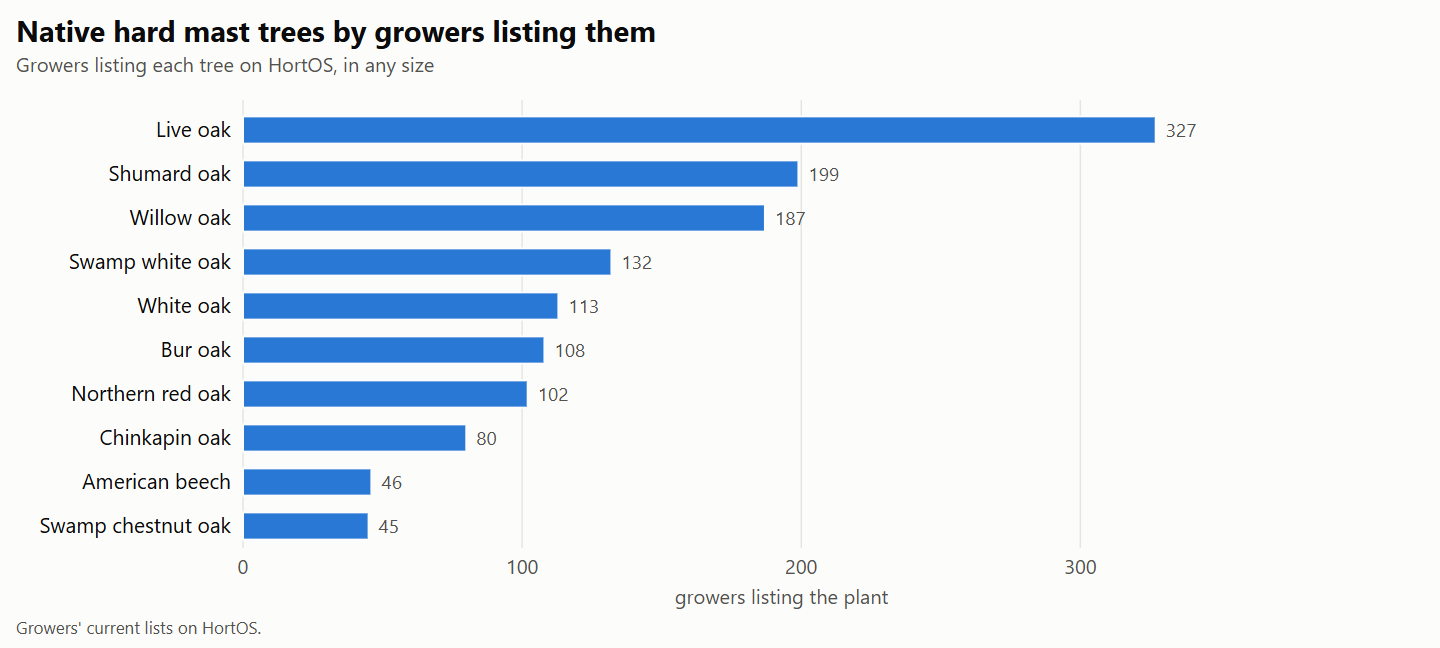
On this page
A conservation district forester, a land trust steward or a woodland owner planning food for white-tailed deer and wild turkey asks two things: which native mast trees do growers list, and how long before each one bears. The idea that matters most is this. A mast tree is bought in a season and waited on for decades, so this page sets the age at which each species is recorded bearing seed beside its trade price.
This page draws on the USDA Forest Service's Woody Plant Seed Manual and its Fire Effects Information System reviews. It also draws on extension services in Pennsylvania, Florida and Mississippi, the South Carolina Department of Natural Resources and the National Wild Turkey Federation. HortOS, a free directory of American wholesale plant growers with their published availability and trade prices, adds how many growers list each tree and a median trade price. It is not a planting plan, a wildlife management plan or a statement of what any one grower charges.
Quick facts
| What hard mast is | Mississippi State University Extension (Mississippi, 2024) uses the term for the nuts of oak, hickory, pecan, walnut and beech, and calls them an important food of wildlife that includes deer and wild turkeys. |
|---|---|
| Acorns in the fall diet | University of Florida IFAS Extension (Florida, 2024) says acorns can be as much as 70 percent of what white-tailed deer and wild turkey eat in autumn. |
| The wait for acorns | Mississippi State University Extension (Mississippi, 2024) says oaks in natural settings usually need about 25 to 30 years before they bear acorns steadily. |
| Hickory and pecan crops | The USDA Forest Service's Woody Plant Seed Manual (2008) says good crops of every hickory, pecan included, come 1 to 3 years apart. |
| Age of a potted tree | The National Wild Turkey Federation (United States, 2025) says tree seedlings sold in 1 to 3 gallon pots are 3 to 5 years old. |
| The handbook behind the tables | The Woody Plant Seed Manual is USDA Forest Service Agriculture Handbook 727, dated April 2008. |
Hard mast: oaks, hickories, pecan, walnut and beech
The first table holds native nut trees of the kinds Mississippi State University Extension (Mississippi, 2024) names as hard mast. A tree is a row where the Woody Plant Seed Manual gives it a line in a seed-bearing table, a Forest Service review or an extension source was read for it, and it has a page on HortOS. The Manual's tables hold 47 more species that are not shown. Prices are medians across growers' current trade lists on HortOS: one price per grower, ex tax, freight not included, with the number of growers pricing each size in brackets. Anyone can see the prices on HortOS, and only the trade can order.
The second column is the Forest Service's, not a grower's. It gives the youngest age at which the species is recorded bearing seed, then the gap in years between large crops, as the Manual compiled them for seed collectors. It is not the age of a nursery tree, it is not a count of years after planting, and it promises nothing for a tree in a container. "Not given" means the Manual prints no figure there. Mockernut hickory sits in the Manual under the name Carya alba, with Carya tomentosa given as a synonym for that tree.
| Plant | Minimum seed-bearing age, then years between large seed crops (USDA Forest Service, 2008) | Growers listing it | Size most growers price | Median (growers pricing) |
|---|---|---|---|---|
| White oak (Quercus alba) | 20; 4 to 10 | 113 | #15 | $60 (14) |
| Swamp white oak (Quercus bicolor) | 20; 3 to 5 | 132 | #7 | $37.75 (10) |
| Swamp chestnut oak (Quercus michauxii) | 20; 3 to 5 | 45 | #3 | $15 (11) |
| Chinkapin oak (Quercus muehlenbergii) | Not given; not given | 80 | #30 | $135 (9) |
| Bur oak (Quercus macrocarpa) | 35; 2 to 3 | 108 | #30 | $117.50 (12) |
| Post oak (Quercus stellata) | 25; 2 to 3 | 11 | Fewer than three growers | |
| Live oak (Quercus virginiana) | Not given; 1 | 327 | #45 | $265 (107) |
| Northern red oak (Quercus rubra) | 25; 3 to 5 | 102 | #3 | $12.50 (7) |
| Shumard oak (Quercus shumardii) | 25; 2 to 3 | 199 | #30 | $125 (40) |
| Southern red oak (Quercus falcata) | 25; 1 to 2 | 25 | #3 | $12.47 (4) |
| Cherrybark oak (Quercus pagoda) | 25; 1 to 2 | 14 | Field grown only | |
| Water oak (Quercus nigra) | 20; 1 to 2 | 35 | #3 | $9.75 (7) |
| Willow oak (Quercus phellos) | 20; 1 | 187 | #15 | $60 (35) |
| Pecan (Carya illinoinensis) | 10 to 20; 1 to 2 | 28 | #1 | $5.00 (4) |
| Shagbark hickory (Carya ovata) | 40; 1 to 3 | 16 | Fewer than three growers | |
| Pignut hickory (Carya glabra) | 30; 1 to 2 | 22 | #3 | $13.75 (6) |
| Mockernut hickory (Carya tomentosa) | 25; 2 to 3 | 7 | Fewer than three growers | |
| Black walnut (Juglans nigra) | 12; 2 to 3 | 24 | #3 | $17 (4) |
| American beech (Fagus grandifolia) | 40; 2 to 3 | 46 | #3 | $16 (7) |
The growers listing the plants in this table are spread across many states; the most are in Florida, Texas and North Carolina. The size shown for each plant is the container size most growers price; field grown lines are not counted. Where a row says Field grown only, its growers price that plant as field grown stock and no container median is shown.
The table has 19 trees and 15 of them carry a median. The medians are not all at one container size: they run from the small pot most growers price for pecan to the large one most price for live oak. The column cannot be read down as a ranking of species by price. Some medians rest on few growers: 4 for southern red oak, 4 for black walnut and 4 for pecan. A figure that thin is a marker, not a going rate. A median needs three growers pricing a size. Post oak, shagbark hickory and mockernut hickory fall short of that, with 11, 16 and 7 growers listing them.
The Forest Service's Fire Effects Information System reviews say which animals eat each nut, and they do not name deer and turkey for every row. Its 1992 reviews name both white-tailed deer and wild turkey for the acorns of post oak, southern red oak, cherrybark oak, willow oak and live oak. Its 1993 review says the same of Shumard oak. Wild turkey is named for white oak acorns (1991), for water oak acorns (1992) and for the nuts of shagbark and pignut hickory (1991). The 1991 review of northern red oak calls its acorns a particularly important turkey food.
Of the two animals, deer alone are named for swamp white oak acorns (1992), chinkapin oak acorns (1991), bur oak acorns (2011) and the mast of American beech (1991). The 1992 review of mockernut hickory says deer browse its leaves, twigs and nuts, and calls the nuts a minor food for turkey. For pecan and walnut the page rests on other sources. Mississippi State University Extension (Mississippi, 2024) counts both as hard mast, which it calls an important food of deer and wild turkeys among other wildlife. The South Carolina Department of Natural Resources, in an undated guide read in 2026, names pecan among the mast foods of wild turkey. The National Wild Turkey Federation (United States, 2025) describes black walnut as a food for smaller wildlife. Swamp chestnut oak is here because Mississippi State (2024) names it among native oaks that can yield good mast crops and quality timber together.
Soft mast: persimmon, plums, cherry, mulberry and dogwood
The second table holds native fruit trees. A tree is a row where the National Wild Turkey Federation, the South Carolina Department of Natural Resources or a Forest Service review names it as wildlife food. It must also have a seed-bearing age in the Woody Plant Seed Manual and a page on HortOS. The Manual's tables for these genera hold 48 more species that are not shown. The columns and the basis of the medians are those of the first table.
| Plant | Minimum seed-bearing age, then years between large seed crops (USDA Forest Service, 2008) | Growers listing it | Size most growers price | Median (growers pricing) |
|---|---|---|---|---|
| Common persimmon (Diospyros virginiana) | 10; about 2 | 64 | #3 | $12 (14) |
| Chickasaw plum (Prunus angustifolia) | 2; not given | 13 | #3 | $14 (5) |
| American plum (Prunus americana) | 4; 1 to 2 | 21 | Fewer than three growers | |
| Black cherry (Prunus serotina) | 5; 1 to 5 | 24 | #3 | $18 (4) |
| Red mulberry (Morus rubra) | 10; 2 to 3 | 27 | #3 | $15 (9) |
| Flowering dogwood (Cornus florida) | 6; 1 to 2 | 52 | #5 | $40 (4) |
The growers listing the plants in this table are spread across many states; the most are in Florida, North Carolina and Pennsylvania. The size shown for each plant is the container size most growers price; field grown lines are not counted.
The medians for black cherry and flowering dogwood rest on 4 and 4 growers, and American plum, listed by 21 growers, has none. The National Wild Turkey Federation (United States, 2025) names red mulberry, Chickasaw plum and flowering dogwood among small trees that give food and cover to wild turkey and deer. It calls common persimmon a soft mast tree for wildlife, without naming the animals. The Forest Service's 1991 review of black cherry says the fruit matters in the summer and fall diet of wild turkey. Its 1991 review of flowering dogwood says the fruit is particularly important to wild turkey in the Missouri Ozarks from September to February, and that white-tailed deer eat the berries. Its 2010 review of American plum lists white-tailed deer among the animals that eat the plums, and says good crops come about every other year.
Two rows need a second reading. The Woody Plant Seed Manual (USDA Forest Service, 2008) prints 10 years as red mulberry's minimum age in its table, while its text says open-grown red mulberry starts to bear at 2 years and understory trees at 4. The same handbook says common persimmon may begin at age 10 and bears best between 25 and 50 years. University of Florida IFAS Extension (Florida, 2024) adds that red mulberry and persimmon carry male and female flowers on separate trees, so only the female trees fruit.
How the sources differ on the wait
The sources do not all measure the wait the same way, and this page does not settle it. The third table sets eight statements side by side, each from one source read for this page and put in this page's own words. They cover a national handbook, three state extension services, a state wildlife agency and a conservation organization, so each row says where it applies.
| Authority and year | Where it applies | What it says about when mast comes |
|---|---|---|
| USDA Forest Service, Woody Plant Seed Manual, 2008 | A Missouri study cited in the national handbook | Good acorn crops came every 2 years for black oak, every 3 for white oak and every 4 for northern red oak. |
| University of Florida IFAS Extension, 2024 | Florida | Oaks bear light or middling acorn crops in most years and a heavy crop every 2 to 5 years. |
| Mississippi State University Extension, 2024 | Mississippi | Oaks growing in natural settings take roughly 25 to 30 years before they bear acorns steadily. |
| South Carolina Department of Natural Resources, undated guide read in 2026 | South Carolina | Acorns, beechnuts and pecans for turkeys come from hardwood stands older than 25 years, and most of all from stands aged 50 to 100. |
| National Wild Turkey Federation, 2025 | United States | Stock in 1 to 3 gallon pots is 3 to 5 years old; balled and burlapped trees ready to bear are 10 to 15 years old or more. |
| Penn State Extension, 2019 | Pennsylvania | Red oaks and white oaks may bear in different years, so a woodland with more than one oak species is likelier to have acorns each year. |
| USDA Forest Service, Fire Effects Information System, 1991 | White oak across its range | White oak mostly fruits from age 50 to age 200; a tree grown in the open on a good site can bear by age 20. |
| USDA Forest Service, Fire Effects Information System, 1992 | Willow oak across its range | Willow oak bears a heavy acorn crop in nearly every year. |
The spread shows most plainly for white oak. The Woody Plant Seed Manual (USDA Forest Service, 2008) gives 20 years as its minimum, and the Forest Service's 1991 review says white oak generally bears from age 50 to age 200. For swamp white oak the Manual (2008) gives 3 to 5 years between large crops, while the Forest Service's 1992 review says good crops come every 4 to 7 years. Mississippi State University Extension (Mississippi, 2024) says most oak species bear a good acorn crop only every 3 to 4 years. The same publication says Nuttall oak given fertilizer and irrigation can bear in as little as 5 to 10 years, and more typically in 25 to 30.
Two of the sources point to variety. Penn State Extension's statement is in the table. The South Carolina Department of Natural Resources, in its undated guide read in 2026, says a mix of hardwood species buffers the swings in mast from year to year. The Forest Service's 1992 review of southern red oak says red oak acorns count most in winter, because white oak acorns sprout soon after they fall.
What the listings do not show
A grower count says how many growers list a tree, and a median says what the middle grower asks at one container size. Neither shows a price for every size, and this page gives no bare root, seedling or field grown price. The listings do not show where the seed was collected, so they cannot say whether a tree suits a restoration site in a given county. They do not show whether a line is the straight species or a named selection, how old the tree is, how it was grown, or whether a persimmon or red mulberry is female.
Each of those is a question for the grower, in writing, before an order: the seed source by state or county, the age of the trees, the container size, and whether the line is seed grown. The guide to buying from a wholesale grower covers how growers set minimums and terms, which matters to a district or trust ordering for the first time. The guide to the most grown native plants gives grower counts for natives beyond these, which helps when a planting also needs shrubs and cover. State hubs such as Pennsylvania, South Carolina and Mississippi show growers by town.
Nor does any of this show which animals will come. Penn State Extension (Pennsylvania, 2019) says a landowner with a small acreage cannot expect to meet every habitat need of wild turkeys, and treats mast and fruit trees as one draw among several.
What to watch for
- Reading the seed-bearing age as years after planting. The Forest Service column is the youngest recorded age for the species, compiled for seed collectors. A tree in a pot already has some years behind it, and the grower is the one who knows how many.
- Reading the median column as a ranking. Each row is priced at its own container size, so two rows cannot be set against each other.
- Planting a single oak. Penn State Extension (Pennsylvania, 2019) says red and white oaks may bear in different years, so more than one oak species raises the chance of acorns every year.
- Ordering one persimmon or one red mulberry. University of Florida IFAS Extension (Florida, 2024) says only female trees of these two bear fruit.
- Assuming every row feeds both animals. The reviews name deer for some trees, turkey for others and both for a few.
Getting it right
- The species list belongs to the forester or biologist who knows the ground. Ask the state wildlife agency or the county extension office which mast trees are native to the site and suit its soil.
- The mix of species is that person's call as well: which oaks of the white and red groups, and which fruit trees beside them.
- Use the tables to see which of those trees growers list, then open each tree's page for the other sizes growers price.
- Write to more than one grower. Ask for the seed source, the age of the trees, the container size, whether the line is the straight species, and a dispatch date.
- Ask the forester about protection after planting. University of Florida IFAS Extension (Florida, 2024) says a device such as a tree shelter may be needed where deer or rabbits browse or girdle new seedlings heavily.
A word of caution
Two of the sources carry warnings about livestock. The USDA Forest Service's 1992 review of post oak says tannin makes the leaves, buds and acorns of post oak toxic to goats, cattle and sheep. The USDA Forest Service's 1991 review of black cherry says the tree's leaves, twigs, bark and seeds poison livestock, while white-tailed deer browse the leaves and twigs unharmed. Where livestock share the ground, a veterinarian or the county extension agent is the one to ask. The grower counts and medians here are those of one date, and the grower's own quote is the price that counts.
Sources
- USDA Forest Service, National Seed Laboratory, Woody Plant Seed Manual contents: the handbook's number and date.
- USDA Forest Service, Woody Plant Seed Manual, Quercus: oak seed-bearing ages and intervals.
- USDA Forest Service, Woody Plant Seed Manual, Carya: hickory and pecan seed bearing.
- USDA Forest Service, Woody Plant Seed Manual, Juglans: black walnut seed bearing.
- USDA Forest Service, Woody Plant Seed Manual, Fagus: American beech seed bearing.
- USDA Forest Service, Woody Plant Seed Manual, Diospyros: persimmon seed bearing.
- USDA Forest Service, Woody Plant Seed Manual, Prunus: plum and cherry seed bearing.
- USDA Forest Service, Woody Plant Seed Manual, Morus: red mulberry seed bearing.
- USDA Forest Service, Woody Plant Seed Manual, Cornus: dogwood seed bearing.
- USDA Forest Service, Fire Effects Information System, white oak: bearing age and acorn eaters.
- USDA Forest Service, Fire Effects Information System, swamp white oak: crop interval and acorn eaters.
- USDA Forest Service, Fire Effects Information System, chinquapin oak: animals eating the acorns.
- USDA Forest Service, Fire Effects Information System, bur oak: animals eating the acorns.
- USDA Forest Service, Fire Effects Information System, post oak: acorn eaters and livestock.
- USDA Forest Service, Fire Effects Information System, northern red oak: acorns as turkey food.
- USDA Forest Service, Fire Effects Information System, Shumard oak: animals eating the acorns.
- USDA Forest Service, Fire Effects Information System, southern red oak and cherrybark oak: acorn eaters, winter food.
- USDA Forest Service, Fire Effects Information System, water oak: animals eating the acorns.
- USDA Forest Service, Fire Effects Information System, willow oak: yearly crops and acorn eaters.
- USDA Forest Service, Fire Effects Information System, southern live oak: acorn eaters, fall sprouting.
- USDA Forest Service, Fire Effects Information System, shagbark hickory: birds eating the nuts.
- USDA Forest Service, Fire Effects Information System, pignut hickory: birds eating hickory nuts.
- USDA Forest Service, Fire Effects Information System, mockernut hickory: deer browse and turkey food.
- USDA Forest Service, Fire Effects Information System, American beech: animals eating beech mast.
- USDA Forest Service, Fire Effects Information System, black cherry: fruit eaters and livestock.
- USDA Forest Service, Fire Effects Information System, flowering dogwood: fruit eaters by season.
- USDA Forest Service, Fire Effects Information System, American plum: crop interval and fruit eaters.
- Mississippi State University Extension, Managing Hardwood Stands for Acorn Production: hard mast and acorn timing.
- University of Florida IFAS Extension, Establishing and Maintaining Wildlife Food Sources: acorn crops and fruiting trees.
- Penn State Extension, Forest Stewardship: Wildlife: oak mix and turkey habitat.
- South Carolina Department of Natural Resources, Wild Turkey Management Guide: turkey foods by stand age.
- National Wild Turkey Federation, Diversifying Your Tree Portfolio: mast trees and potted tree age.
More guides

Buying From a Wholesale Grower When You Are Not in the Trade
Native plant societies, watershed districts, land trusts, schools and church committees can buy from wholesale growers when they order like the trade: in quantity, ahead of the season, on the grower's terms. This page explains who sells to whom, resale certificates and exemptions, minimums and pooling, the sizes to buy, straight species and ecotype, lead times and shipping.

The Most Grown Native Plants in the United States, by State
A data page, not an essay: the American native plants held by the most wholesale growers, counted grower by grower and state by state from growers' current lists on HortOS, with the median trade price at the size most growers price. Two paragraphs on what the tables show and what they do not, then the tables, refreshed each edition.
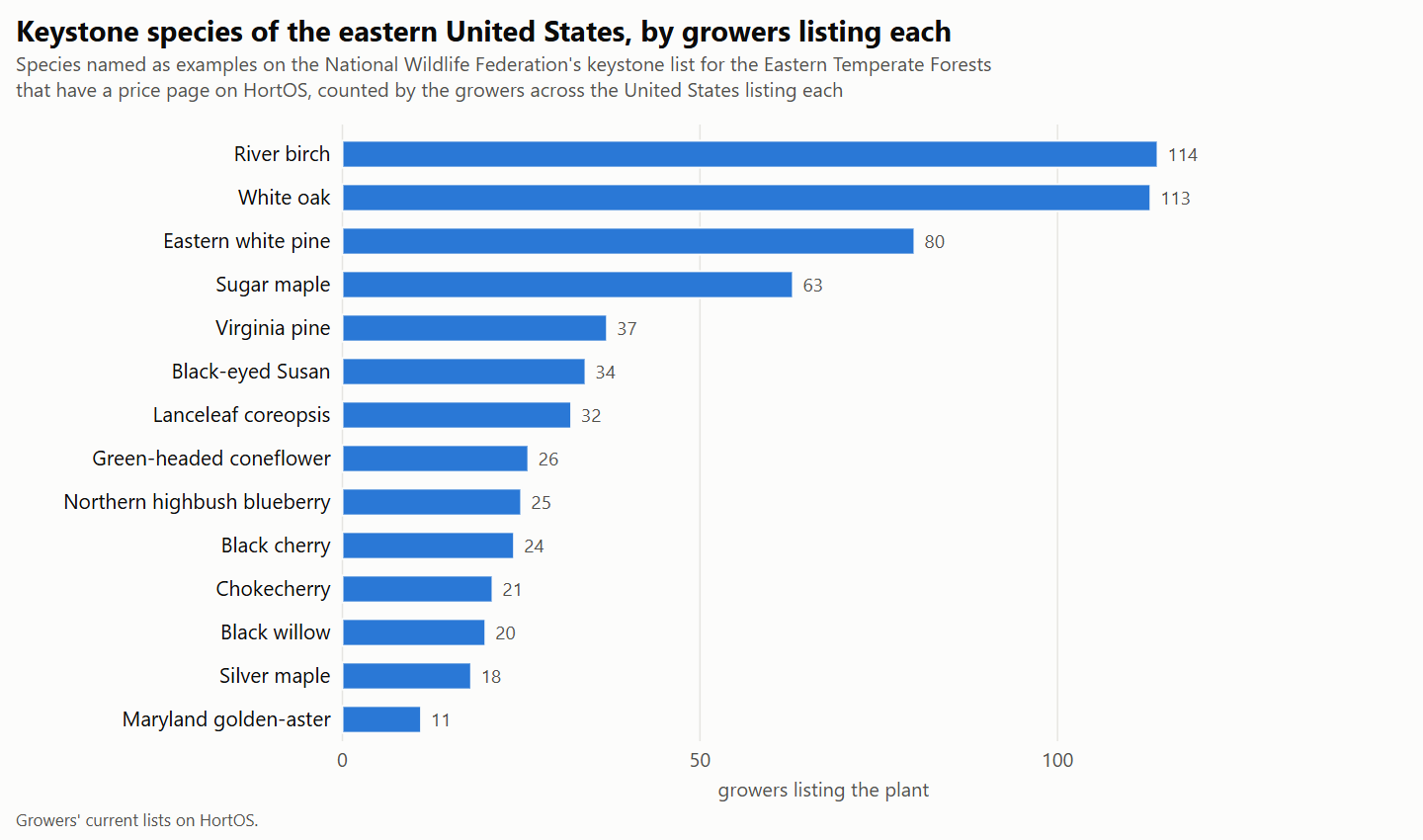
Keystone Plants of the Eastern United States by Growers Listing Each
The National Wildlife Federation's keystone list for the Eastern Temperate Forests is organized by genus and names sample species. This page sets out what the keystone figures count. It then shows how many growers list most of those species on HortOS, a median trade price where at least three price a size, and what a grower count cannot show.