Keystone Plants of the Eastern United States by Growers Listing Each
The National Wildlife Federation's keystone list for the Eastern Temperate Forests is organized by genus and names sample species. This page sets out what the keystone figures count. It then shows how many growers list most of those species on HortOS, a median trade price where at least three price a size, and what a grower count cannot show.
Updated October 8, 2026. Figures are what the live us.hortosapp.com price and plant pages printed.
On this page
A land trust steward in Pennsylvania has the keystone genera in hand: oaks, birches, cherries, willows, asters and goldenrods. A planting list needs species, so the next question is a practical one. It is which of the species named for those genera wholesale growers list, and at what trade price. For each genus, the National Wildlife Federation's list for the Eastern Temperate Forests counts caterpillar species, pollen specialist bee species, or both. A keystone list says which plants support the most caterpillars and bees; it does not say who grows them.
This page reports what the National Wildlife Federation, the University of Delaware and three state extension services have published on keystone plants, and what the U.S. Fish and Wildlife Service's 2003 Chesapeake guide says about buying native plants. HortOS, a free directory of American wholesale plant growers with their published availability and trade prices, adds how many growers list most of the named species, with a median trade price where at least three price one size. It is not a planting plan, and it speaks for the United States only.
Quick facts
| What a keystone plant is | The National Wildlife Federation's list for Ecoregion 8, read in October 2026, defines keystone plants as native plants that the food web depends on. It sorts them into two kinds: host plants for caterpillars, and plants that pollen specialist bees depend on. |
|---|---|
| The share finding | The University of Delaware reported in December 2020 that 14 percent of native plant species make 90 percent of the food caterpillars eat. It says the pattern holds wherever one goes in the United States. |
| Oaks across the country | Ohio State University Extension (2023) puts the oak genus at more than 500 butterfly and moth species across the country. |
| Where the region lies | The Commission for Environmental Cooperation (1997) describes the Eastern Temperate Forests as running from the Great Lakes south to the Gulf of Mexico, and from the Atlantic Coast west into Minnesota, Iowa, Missouri, Oklahoma and eastern Texas. It is one of 15 Level I regions in the framework the U.S. Environmental Protection Agency publishes (read 2026). |
| On growers' lists | White oak, one of the two oaks the Federation's list names, was listed by 113 growers across the United States on HortOS. Its national median trade price at #15 was $60 across 14 growers, ex tax, freight not included. |
| Asking where plants come from | The U.S. Fish and Wildlife Service's Chesapeake guide (2003) says plants should ideally come from the same physiographic province, within about 200 miles. Minnesota's Board of Water and Soil Resources (2025 update) recommends sources as near the project as possible. |
What a keystone list counts
The National Wildlife Federation's list for Ecoregion 8 (read October 2026) says University of Delaware researchers identified its keystone plants for butterflies and moths. The university reported in December 2020 that its researchers had worked out which plants matter most to food webs nationwide, down to the county and the bioregion. Its summary is that 14 percent of native plant species make 90 percent of the food caterpillars eat, and that 5 percent of what it calls the powerhouse plants account for 75 percent of that food. For the mid-Atlantic it reported 38 powerhouse genera among more than 2,000 plant genera. The National Wildlife Federation's magazine (2022) says the study appeared in the journal Nature Communications late in 2020.
Penn State Extension (Pennsylvania, 2026) says roughly 5% of the native plants of a region host 70 to 75% of its butterfly and moth species, and that those plants are the ones called keystone species. The Federation's keystone page (read October 2026) words it as 14% of native plants supporting 90% of butterfly and moth species.
The Federation's Ecoregion 8 list (read October 2026) says 96% of land birds rely on insects that keystone plants support. The Federation's Native Plant Finder (read October 2026) says a pair of Carolina chickadees needs 6,000 to 9,000 caterpillars to raise one brood.
The Ecoregion 8 list is organized by genus. For each genus it gives a count of caterpillar species, a count of pollen specialist bee species, or both, and it names a few common species as a sample. The Federation says the sample is not complete. So a count belongs to the genus: the Federation's 436 caterpillar species (Ecoregion 8 list, read October 2026) are for oaks, not for white oak alone. On the same Federation list (read October 2026), goldenrods have 104 caterpillar species and 42 pollen specialist bee species. In its magazine (2022), the Federation puts oaks at 952 caterpillar species, a count it says no other North American tree matches. The Federation's magazine (2022) says that, as a rule, trees lead for caterpillars while bees depend on plants that are not woody. Ohio State University Extension (2023) gives the cherry and plum genus more than 450 butterfly and moth species, second only to oaks, and birches more than 400.
The Federation released its keystone lists in 2021, covering 10 ecoregions, and says a few genera turn up on nearly all of them, cherries and oaks included (magazine, 2022). It said then that it also wanted the lists to push the nursery industry to grow more keystone native species.
Where the region lies and what changes inside it
The U.S. Environmental Protection Agency publishes the ecoregion framework the keystone lists use (read 2026). The agency's framework (read 2026) divides North America into 15 broad Level I regions, 50 Level II regions and 182 Level III ecoregions. The Eastern Temperate Forests are Level I region 8. Penn State Extension (2026) describes that region as the greater part of eastern North America: Maine down to Florida, west as far as Illinois and eastern Texas, and parts of eastern Canada. The Commission for Environmental Cooperation (1997) puts its western edge in Minnesota, Iowa, Missouri, Oklahoma and eastern Texas.
One list covers all that ground. The Federation's Ecoregion 8 list (read October 2026) sends readers to its Native Plant Finder for species by ZIP code, and that tool ranks plants by the number of caterpillar species each supports. The National Audubon Society's native plants database (read 2026) also searches by ZIP code. Penn State Extension (2026) says the Federation's lists work at Level I, while Homegrown National Park publishes fuller ones at Level II.
The table sets out what authorities for particular states and areas say about range and about where plants should come from. The last row is the Federation's own tool.
| State or area | What the authority says | Authority and year |
|---|---|---|
| Pennsylvania | The state falls in two Level I ecoregions: Northern Forests (5) and Eastern Temperate Forests (8). | Penn State Extension, 2026 |
| Ohio | Of the crabapples, only wild crabapple (Malus coronaria), also known as sweet crabapple, is native right across the state. | Ohio State University Extension, 2023 |
| Virginia | Virginia's online Digital Atlas of the Virginia Flora and the state conservation department's brochures show which natives grow in the coastal, piedmont or mountain parts of the state. | Virginia Cooperative Extension, 2026 |
| Chesapeake Bay watershed | Plants should ideally be grown from sources in the same physiographic province, within roughly 200 miles. | U.S. Fish and Wildlife Service, 2003 |
| Any ZIP code | The Federation says its Native Plant Finder returns only plants historically present in the county, and that species native to adjoining counties also suit garden planting. | National Wildlife Federation, Native Plant Finder (read October 2026) |
Nor is a keystone genus uniform. Ohio State University Extension (Ohio, 2023) says most birches cope poorly with the state's heat and humidity, and names river birch as a notable exception. Ohio State University Extension (Ohio, 2023) says black willow prefers wet ground, though it also adapts to uplands and is drought resistant. The same fact sheet advises against planting it close to buildings because its brittle branches are prone to wind and ice damage. A separate guide covers native plants for conservation landscaping in the Chesapeake Bay watershed, the area of the 2003 federal guide.
The named species on growers' lists
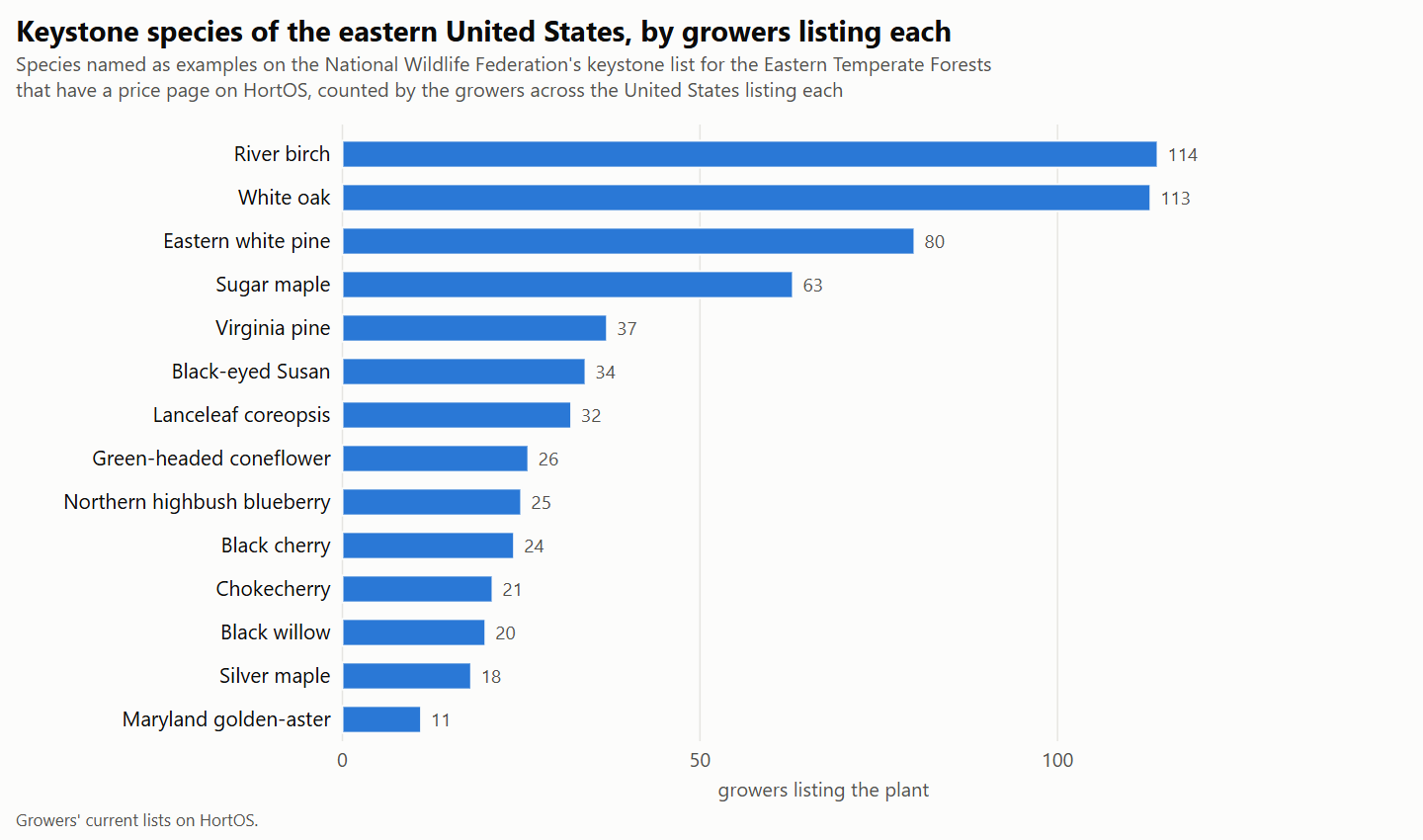
The Federation's Ecoregion 8 list (read October 2026) names species as examples of its keystone genera. The first table holds the 14 of them that have both a plant page and a price page on HortOS, ordered by the number of growers listing each. Another 24 species named on that list are not in this table, and 17 of them make up the second table. Prices are medians across growers' current trade lists on HortOS: one price per grower, ex tax, freight not included, with the number of growers pricing each size in brackets. Grower counts are the growers listing each plant on HortOS, in any size. A count here is growers listing the plant, not how many plants exist or how well it suits a site. Anyone can see the prices on HortOS, and only the trade can order.
| Plant | Growers listing it | Size most growers price | Median (growers pricing) |
|---|---|---|---|
| River birch (Betula nigra) | 114 | #30 | $125 (20) |
| White oak (Quercus alba) | 113 | #15 | $60 (14) |
| Eastern white pine (Pinus strobus) | 80 | #3 | $18 (7) |
| Sugar maple (Acer saccharum) | 63 | #5 | $35 (4) |
| Virginia pine (Pinus virginiana) | 37 | #3 | $11.13 (4) |
| Black-eyed Susan (Rudbeckia hirta) | 34 | #1 | $3.25 (15) |
| Lanceleaf coreopsis (Coreopsis lanceolata) | 32 | #1 | $3.88 (12) |
| Green-headed coneflower (Rudbeckia laciniata) | 26 | #1 | $4.00 (5) |
| Northern highbush blueberry (Vaccinium corymbosum) | 25 | #3 | $18 (7) |
| Black cherry (Prunus serotina) | 24 | #3 | $18 (4) |
| Chokecherry (Prunus virginiana) | 21 | Field grown only | |
| Black willow (Salix nigra) | 20 | #1 | $8.00 (3) |
| Silver maple (Acer saccharinum) | 18 | #5 | $34.50 (4) |
| Maryland golden-aster (Chrysopsis mariana) | 11 | #1 | $4.00 (5) |
The growers listing the plants in this table are spread across many states; the most are in Florida, North Carolina and Pennsylvania. The size shown for each plant is the container size most growers price; field grown lines are not counted. Where a row says Field grown only, its growers price that plant as field grown stock and no container median is shown.
Of the 14 rows, 13 carry a median, and several of those rest on few growers. The median for black cherry rests on 4 growers, for silver maple on 4, for sugar maple on 4, for Virginia pine on 4 and for black willow on 3. A median on so few growers is an indication, and it can move when one grower reprices. For sugar maple, Virginia pine and black willow, container sizes tie for the most growers pricing them, and the table shows the smallest of the tied sizes.
The second table holds the 17 named species that have a plant page on HortOS and no price page. It prints counts only: a median needs three growers pricing one size. The split between the two tables is whether a plant has a price page, not how widely it is listed. American plum, in the second table, was listed by 21 growers, and black willow, in the first, by 20.
| Plant | Growers listing it | States with most growers |
|---|---|---|
| American plum (Prunus americana) | 21 | Pennsylvania 3 |
| Black oak (Quercus velutina) | 18 | Pennsylvania 3, Maryland 2, Massachusetts 2 |
| Box elder (Acer negundo) | 18 | North Carolina 4, Pennsylvania 3, Texas 2 |
| Eastern cottonwood (Populus deltoides) | 15 | Texas 2, Pennsylvania 2 |
| Stiff leaf goldenrod (Solidago rigida) | 13 | Maryland 3, New York 2, Pennsylvania 2 |
| Sweet birch (Betula lenta) | 10 | Pennsylvania 2 |
| Southern crabapple (Malus angustifolia) | 9 | Florida 4 |
| Pitch pine (Pinus rigida) | 8 | Pennsylvania 3, New Jersey 2, Massachusetts 2 |
| Smooth aster (Symphyotrichum laeve) | 7 | Pennsylvania 2 |
| Large flower coreopsis (Coreopsis grandiflora) | 5 | 5 states with 1 each |
| Sweet crabapple (Malus coronaria) | 4 | 4 states with 1 each |
| Blue wood aster (Symphyotrichum cordifolium) | 3 | Pennsylvania 2, Connecticut 1 |
| Woodland sunflower (Helianthus divaricatus) | 3 | Missouri 1, New Jersey 1, Maryland 1 |
| Black highbush blueberry (Vaccinium fuscatum) | 1 | Florida 1 |
| Camphorweed (Heterotheca subaxillaris) | 1 | Florida 1 |
| Devil's beggartick (Bidens frondosa) | 1 | Pennsylvania 1 |
| Wingstem (Verbesina alternifolia) | 1 | Pennsylvania 1 |
The last column names the states with the most growers listing each plant, three at most, and stops where states tie for the next place.
Species of one genus can sit far apart. White oak was listed by 113 growers and black oak, the other oak the Federation's list names, by 18. River birch was listed by 114 growers and sweet birch, the other birch named, by 10. In the second table, 4 rows show 1 grower each.
These are national figures. They take in every grower listing the plant, whatever its state, inside or outside the Eastern Temperate Forests. So a count is not a count of growers in the reader's region, and a national median is not a local price. The listings on HortOS are deepest in Florida and the Southeast and thin in New England and the Midwest. Each state's hub lists its growers: Pennsylvania, Ohio, Virginia, Maryland and Minnesota. The guide to the most grown native plants ranks natives of every kind by growers, state by state.
The authorities speak of nurseries in general, not of the growers on HortOS. Ohio State University Extension (2023) says native plants, once hard to buy, are now sold by many nurseries and by mail order. The U.S. Fish and Wildlife Service's Chesapeake guide (2003) chose plants that nurseries generally sold, black oak and sweet birch among them. The Federation's Native Plant Finder (read October 2026) says some species it returns are not yet sold at retail nurseries and garden centers.
What a count of growers cannot tell a restoration buyer
A count says that a grower lists a species. The questions a native plant society, a land trust or a conservation district asks next are ones the directory cannot answer for any grower.
- Seed source. HortOS does not show where a grower's seed or cuttings were collected. The U.S. Fish and Wildlife Service's Chesapeake guide (2003) tells buyers to ask nurseries whether native plants were raised from local seed or cuttings or brought from another region.
- Straight species or selection. A species page counts growers listing the plant under its species name. It does not gather that species' cultivars or show whether a line is seed grown. The Fish and Wildlife Service guide (2003) says to choose the true species, not a cultivar, for a habitat project, and that cultivars suit garden use.
- Growing practice. The directory shows nothing of how a plant was grown, insecticide use included. Section 2 of the guidelines of Minnesota's Board of Water and Soil Resources (2025 update) says seed and plants of native species going to projects must be free of insecticide treatment, neonicotinoids included. The Fish and Wildlife Service guide (2003) says to buy plants that were nursery grown, not collected from the wild.
- Local range. A count does not show whether a species is native to the reader's county or state. The table above names where that is answered.
- The rest of the genus. Only the species the Federation names as examples are counted here, not the other native oaks, willows, cherries, goldenrods and asters of the same genera.
Minnesota's Board of Water and Soil Resources says on its guidelines page (2025 update) that for some of its grants and programs the source order in Section 2 is a requirement. The Board's page (Minnesota, 2025 update) says the requirements and any exceptions are set out in each grant agreement. Section 2 of the Board's guidelines (Minnesota, 2025 update) says seed and plants should suit the site and come from as near the project as can be found.
What to watch for
- Reading a genus figure as a species figure. The Federation's count for oaks in Ecoregion 8 covers the genus. It is not a count for white oak or black oak alone.
- Quoting a figure without its area. The oak figures on this page come from an ecoregion list, a magazine article and a state fact sheet, and each is counted over its own area. A figure quoted without its area and year can be read as contradicting the others.
- Taking a named example as native to the county. The Federation says (read October 2026) that its Native Plant Finder returns only plants historically present in the county searched. Ohio State University Extension (2023) says only one native crabapple grows across Ohio.
- Taking a species name as proof of the straight species. The U.S. Fish and Wildlife Service's Chesapeake guide (2003) says a cultivar is written as the species name followed by a further name set in single quotation marks. Whether a line is a cultivar is a question for its grower.
Getting it right
- Find the site's ecoregion in the framework the U.S. Environmental Protection Agency publishes. A state line does not settle it: Penn State Extension (2026) notes that Pennsylvania falls in two Level I ecoregions.
- Narrow the keystone genera to local species. Both the Federation's Native Plant Finder and the National Audubon Society's database are searched by ZIP code, and the Federation says (read October 2026) that its tool works from county ranges. The state's native plant society or extension office is the one to ask what is local.
- Write the list in scientific names. Penn State Extension (2026) says that is the way to be sure of buying the plant intended, because plants that share a common name are not all the same.
- Look up each species on HortOS. Its plant page shows who lists it and in which states, and the directory holds each grower's own page.
- Ask each grower, in writing, where the seed or cuttings were collected, whether the plants are the straight species, whether they were nursery grown and whether any insecticide was used. Minimum orders, lead times and who a grower will sell to are the subject of another guide, buying from a wholesale grower.
- Where a grant or program pays for the planting, ask its officer which plant source rules apply before ordering. The funder decides.
A word of caution
The figures for caterpillars, bees and birds on this page belong to the National Wildlife Federation, the University of Delaware and the extension services named, each for its own area and year. HortOS has measured none of them. What is native to a county is a question for the state's native plant society or extension service, and what a grant requires is the funding agency's to say. Grower counts and medians are what HortOS printed, and on seed source, straight species and growing practice the grower is the one to ask.
Sources
- National Wildlife Federation, Keystone Plants by Ecoregion (read 5 October 2026): what keystone plants are.
- National Wildlife Federation, Keystone Native Plants, Eastern Temperate Forests, Ecoregion 8, PDF list (read 5 October 2026): keystone genera and sample species.
- National Wildlife Federation, National Wildlife magazine, Power Plants, April-May 2022 (read 5 October 2026): its magazine article on keystone plants.
- National Wildlife Federation, Native Plant Finder, About (read 5 October 2026): how the ZIP code tool works.
- University of Delaware, UDaily, Powerhouse plants: the 2020 study, summarized.
- Penn State Extension, Keystone Species: A Framework for Selecting Native Plants: keystone lists, ecoregions, Pennsylvania.
- Ohio State University Extension, Native Trees: Creating Living Landscapes for Birds, Butterflies, Bees, and Other Beneficials: host counts and Ohio notes.
- Virginia Cooperative Extension, Native Plants in the Landscape: Incorporating Native Plants: Virginia's native plant references.
- U.S. Fish and Wildlife Service, Native Plants for Wildlife Habitat and Conservation Landscaping: Chesapeake Bay Watershed: choosing and buying native plants.
- U.S. Environmental Protection Agency, Ecoregions of North America: the three ecoregion levels.
- Commission for Environmental Cooperation, Ecological Regions of North America: Toward a Common Perspective, the copy the U.S. Environmental Protection Agency links: where the region lies.
- National Audubon Society, Native Plants: plant search by ZIP code.
- Minnesota Board of Water and Soil Resources, Native Vegetation Establishment and Enhancement Guidelines: where the guidelines are required.
- Minnesota Board of Water and Soil Resources, Native Vegetation Establishment and Enhancement Guidelines, Section 2: seed and plant source.
More guides
Native plants for Chesapeake Bay conservation landscaping
The U.S. Fish and Wildlife Service's 2003 guide classes the Chesapeake Bay natives it holds by light, soil moisture, region and state. This page sets plants from the Alliance for the Chesapeake Bay's database beside how many growers list each and a median trade price, and reports what the watershed's authorities and a 2023 Maryland law say about cultivars.

The Most Grown Native Plants in the United States, by State
A data page, not an essay: the American native plants held by the most wholesale growers, counted grower by grower and state by state from growers' current lists on HortOS, with the median trade price at the size most growers price. Two paragraphs on what the tables show and what they do not, then the tables, refreshed each edition.

Buying From a Wholesale Grower When You Are Not in the Trade
Native plant societies, watershed districts, land trusts, schools and church committees can buy from wholesale growers when they order like the trade: in quantity, ahead of the season, on the grower's terms. This page explains who sells to whom, resale certificates and exemptions, minimums and pooling, the sizes to buy, straight species and ecotype, lead times and shipping.