Native plants for Chesapeake Bay conservation landscaping
The U.S. Fish and Wildlife Service's 2003 guide classes the Chesapeake Bay natives it holds by light, soil moisture, region and state. This page sets plants from the Alliance for the Chesapeake Bay's database beside how many growers list each and a median trade price, and reports what the watershed's authorities and a 2023 Maryland law say about cultivars.
Updated October 14, 2026. Figures are what the live us.hortosapp.com price and plant pages printed.
On this page
A watershed steward knows a site's light and soil moisture. The question is which native species for such a site appear on wholesale growers' lists, how many growers list each, and at what trade price. The U.S. Fish and Wildlife Service's 2003 guide, Native Plants for Wildlife Habitat and Conservation Landscaping, gives the light, soil moisture, region and states of each species it holds.
This page draws on that guide and on the Alliance for the Chesapeake Bay's Native Plant Center. On cultivars and seed source it reports the Chesapeake Conservation Landscaping Council, the Chesapeake Bay Trust, University of Maryland Extension, Virginia Cooperative Extension and a 2023 Maryland law. HortOS, a free directory of American wholesale plant growers with their published availability and trade prices, adds the counts and medians. It is not a planting plan or any program's plant list, and no body named here endorsed or supplied it.
Quick facts
| The guide | Native Plants for Wildlife Habitat and Conservation Landscaping: Chesapeake Bay Watershed is an 82-page guide published in 2003 by the U.S. Fish and Wildlife Service's Chesapeake Bay Field Office. Copies were read in October 2026 on the sites of the Maryland Department of Natural Resources and University of Maryland Extension. |
|---|---|
| Where it applies | The 2003 guide covers Maryland, Virginia and Pennsylvania for the most part, the District of Columbia, south central New York, West Virginia's eastern panhandle and the part of Delaware west of Delaware Bay (U.S. Fish and Wildlife Service, 2003). |
| Light and moisture classes | Full sun is six hours or more of direct sun a day in the growing season, partial shade about three to six hours, and shade under three hours or filtered light. Dry is ground where water does not stay after rain, moist is damp soil that is sometimes saturated, and wet is soil saturated through much of the growing season (U.S. Fish and Wildlife Service, 2003 guide for the Bay watershed). |
| The database | The Alliance for the Chesapeake Bay's Native Plant Center listed 418 plants on October 5, 2026. It filters them by region, plant type, sun exposure, soil texture and soil moisture. |
| Seed source | The 2003 guide's ideal is plants that come from the same region as the planting, within about 200 miles and in the same physiographic province (U.S. Fish and Wildlife Service, 2003). Virginia Cooperative Extension (2026) describes local ecotypes as plants sourced and grown within 100 to 200 miles of the site. |
| Maryland's 2023 definition | For Maryland's Native Plants Program, section 10-401 of the Agriculture Article (Chapter 490, Laws of Maryland 2023) says a native plant "does not include a plant that is a named or unnamed cultivar or hybrid". |
How the 2003 guide reads a site
The U.S. Fish and Wildlife Service's 2003 guide defines conservation landscaping as landscaping aimed at cutting pollution and improving the local environment. The same 2003 guide of the Service says to check the sun, the soil moisture and the soil type where the planting will go, then choose plants that grow in those conditions.
Each species entry in the U.S. Fish and Wildlife Service's 2003 guide gives a light class and a moisture class, both set out in Quick facts, and a region: coastal plain, Piedmont plateau or mountain zone. The 2003 guide of the Service names a state only where the plant is common there and recommended for planting. The Service's 2003 guide also encourages a reader whose state or region is not marked to pick another plant suited to the site.
The U.S. Fish and Wildlife Service's 2003 guide does not hold every native species of the watershed: it says its plants were chosen for ornamental and wildlife value and because they are generally sold.
Bay species set beside growers' lists
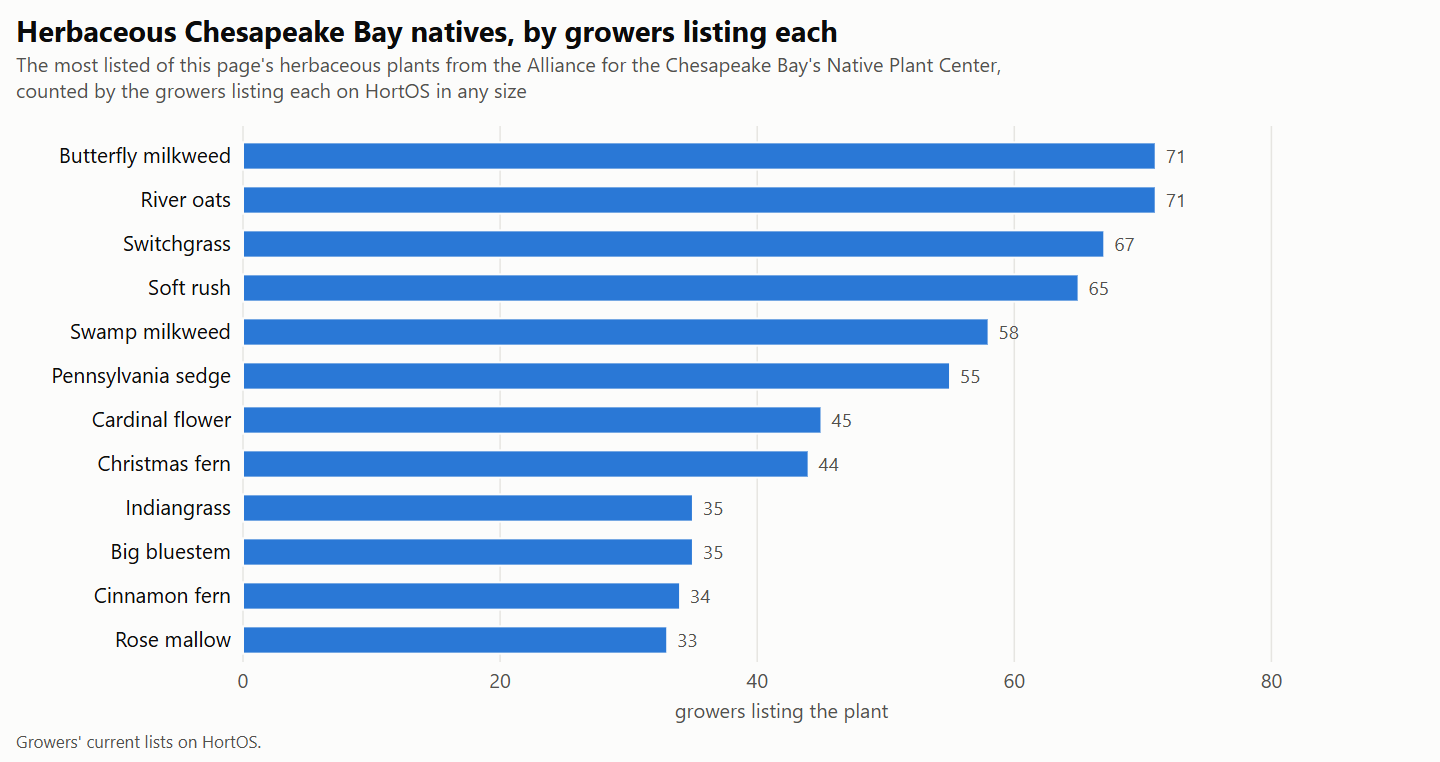
The next three tables hold 13 trees, 18 shrubs and 22 herbaceous plants from the Alliance for the Chesapeake Bay's Native Plant Center. They are a selection chosen to span the database's range of sun and soil moisture among species that growers list on HortOS. Rows run from the driest sites to the wettest and, within each, from sun to shade. On October 5, 2026 the database filed 84 plants as trees, 75 as shrubs and 261 as herbaceous, emergent, grass-like or fern, which leaves 71, 57 and 239 outside that type's table. A plant can be filed under more than one type, so a few are rows of another table.
Prices are medians across growers' current trade lists on HortOS: one price per grower, ex tax, freight not included, with the number of growers pricing each size in brackets. Anyone can see the prices on HortOS, and only the trade can order. A count here is growers listing the plant, not how many plants exist or how well it suits a site.
The second column gives what each plant's own page in the database said on October 5, 2026, in this page's words. Part sun stands for its Partial Sun, dry to wet for a run of its moisture classes, and all three regions for coastal plain, Piedmont and mountain. Flooded is the database's own class. The Chesapeake Bay Trust's guide, in a file dated May 2021, says the database draws its data from the U.S. Fish and Wildlife Service's 2003 guide.
| Plant | Sun, soil moisture and region, Alliance for the Chesapeake Bay Native Plant Center (read 2026) | Growers listing it | Size most growers price | Median (growers pricing) |
|---|---|---|---|---|
| White oak (Quercus alba) | Sun to part sun; dry to moist; all three regions | 113 | #15 | $60 (14) |
| White fringetree (Chionanthus virginicus) | Sun to shade; dry to moist; all three regions | 69 | #3 | $20 (12) |
| Flowering dogwood (Cornus florida) | Part sun; dry to moist; all three regions | 52 | #5 | $40 (4) |
| Eastern redbud (Cercis canadensis) | Part sun to shade; dry to moist; all three regions | 194 | #15 | $77.50 (28) |
| Black gum (Nyssa sylvatica) | Sun to part sun; dry to flooded; all three regions | 107 | #3 | $14.50 (17) |
| American holly (Ilex opaca) | Sun to shade; moist; all three regions | 34 | #3 | $29.75 (6) |
| American hornbeam (Carpinus caroliniana) | Part sun to shade; moist; Piedmont and mountain | 97 | #3 | $14 (7) |
| Red maple (Acer rubrum) | Sun to part sun; moist to wet; all three regions | 152 | #15 | $60 (20) |
| River birch (Betula nigra) | Sun to part sun; moist to wet; all three regions | 114 | #30 | $125 (20) |
| Willow oak (Quercus phellos) | Sun to part sun; moist to wet; coastal plain and Piedmont | 187 | #15 | $60 (35) |
| Sweetbay magnolia (Magnolia virginiana) | Sun to shade; moist to wet; coastal plain and Piedmont | 152 | #15 | $62.50 (32) |
| Serviceberry (Amelanchier canadensis) | Part sun to shade; moist to wet; all three regions | 35 | #3 | $21.98 (4) |
| Swamp white oak (Quercus bicolor) | Sun to part sun; wet; all three regions | 132 | #7 | $37.75 (10) |
The growers listing the plants in this table are spread across many states; the most are in Florida, North Carolina and Tennessee. The size shown for each plant is the container size most growers price; field grown lines are not counted.
River birch is priced at #30 and black gum at #3: the size differs from row to row, so the medians cannot be read down the column as a ranking. Other sizes are on each plant's linked page, some with state medians.
A region is not a state. A cell that reads all three regions does not say the plant is marked for every Bay state, and the tables carry no states. White fringetree's cell reads all three regions, and its page in the database, read in October 2026, names Delaware, the District of Columbia, Maryland, Virginia and West Virginia.
| Plant | Sun, soil moisture and region, Alliance for the Chesapeake Bay Native Plant Center (read 2026) | Growers listing it | Size most growers price | Median (growers pricing) |
|---|---|---|---|---|
| Inkberry (Ilex glabra) | Sun to shade; dry to moist; coastal plain | 46 | #3 | $12 (13) |
| Maple-leaved arrowwood (Viburnum acerifolium) | Sun to shade; dry to moist; all three regions | 10 | #3 | $17.50 (3) |
| Witch hazel (Hamamelis virginiana) | Part sun to shade; dry to moist; all three regions | 54 | #3 | $22 (11) |
| Black chokeberry (Aronia melanocarpa) | Sun to part sun; dry to wet; all three regions | 41 | #3 | $17.02 (12) |
| Northern bayberry (Myrica pensylvanica) | Sun to part sun; dry to wet; coastal plain | 53 | #3 | $19.98 (16) |
| Red chokeberry (Aronia arbutifolia) | Sun to part sun; dry to wet; all three regions | 27 | #3 | $14 (9) |
| Wax myrtle (Myrica cerifera) | Sun to part sun; dry to wet; coastal plain | 225 | #3 | $8.00 (91) |
| Black haw (Viburnum prunifolium) | Sun to shade; dry to wet; all three regions | 30 | #3 | $16 (7) |
| Highbush blueberry (Vaccinium corymbosum) | Sun to shade; dry to wet; all three regions | 25 | #3 | $18 (7) |
| Southern arrowwood (Viburnum dentatum) | Sun to shade; dry to wet; all three regions | 66 | #3 | $16 (17) |
| Ninebark (Physocarpus opulifolius) | Sun to part sun; moist to wet; Piedmont and mountain | 35 | #3 | $16 (5) |
| Silky dogwood (Cornus amomum) | Sun to part sun; moist to wet; all three regions | 38 | #3 | $16 (11) |
| Swamp azalea (Rhododendron viscosum) | Sun to part sun; moist to wet; all three regions | 19 | #3 | $24.25 (4) |
| Winterberry (Ilex verticillata) | Sun to shade; moist to wet; all three regions | 46 | #3 | $18.98 (8) |
| Spicebush (Lindera benzoin) | Part sun to shade; moist to wet; all three regions | 44 | #3 | $18 (16) |
| Summersweet (Clethra alnifolia) | Part sun to shade; moist to wet; coastal plain | 44 | #3 | $22 (9) |
| Buttonbush (Cephalanthus occidentalis) | Sun to shade; moist to flooded; all three regions | 69 | #3 | $10.18 (24) |
| Virginia sweetspire (Itea virginica) | Sun to shade; moist to flooded; coastal plain | 48 | #3 | $12.13 (14) |
The growers listing the plants in this table are spread across many states; the most are in Florida, North Carolina and New Jersey. The size shown for each plant is the container size most growers price; field grown lines are not counted.
The U.S. Fish and Wildlife Service's 2003 guide files the two chokeberries under Photinia and northern bayberry and wax myrtle under Morella, with Aronia and Myrica as their other names. The rows above use Aronia and Myrica; listings under another botanical name may sit on a separate page.
| Plant | Sun, soil moisture and region, Alliance for the Chesapeake Bay Native Plant Center (read 2026) | Growers listing it | Size most growers price | Median (growers pricing) |
|---|---|---|---|---|
| Indiangrass (Sorghastrum nutans) | Full sun; dry to moist; all three regions | 35 | #1 | $4.00 (11) |
| Butterfly milkweed (Asclepias tuberosa) | Sun to part sun; dry to moist; all three regions | 71 | #1 | $4.50 (21) |
| River oats (Chasmanthium latifolium) | Sun to part sun; dry to moist; all three regions | 71 | #1 | $4.63 (22) |
| Wild columbine (Aquilegia canadensis) | Sun to part sun; dry to moist; all three regions | 30 | #1 | $6.50 (7) |
| Alumroot (Heuchera americana) | Part sun to shade; dry to moist; Piedmont and mountain | 11 | Fewer than three growers | |
| Pennsylvania sedge (Carex pensylvanica) | Part sun to shade; dry to moist; coastal plain and Piedmont | 55 | #1 | $5.95 (15) |
| Big bluestem (Andropogon gerardii) | Sun to part sun; dry to wet; Piedmont and mountain | 35 | #1 | $3.83 (6) |
| Joe-Pye weed (Eupatorium fistulosum) | Sun to part sun; dry to wet; all three regions | 19 | #1 | $5.75 (4) |
| Switchgrass (Panicum virgatum) | Sun to part sun; dry to wet; all three regions | 67 | #1 | $4.00 (15) |
| Common sneezeweed (Helenium autumnale) | Sun to shade; moist; all three regions | 17 | #1 | $4.13 (4) |
| Foamflower (Tiarella cordifolia) | Sun to shade; moist; all three regions | 15 | #1 | $8.00 (3) |
| Christmas fern (Polystichum acrostichoides) | Part sun to shade; moist; all three regions | 44 | #1 | $6.94 (12) |
| Woodland phlox (Phlox divaricata) | Part sun to shade; moist; Piedmont and mountain | 16 | #1 | $4.80 (5) |
| Cardinal flower (Lobelia cardinalis) | Sun to part sun; moist to wet; all three regions | 45 | #1 | $6.50 (13) |
| Swamp milkweed (Asclepias incarnata) | Sun to part sun; moist to wet; all three regions | 58 | #1 | $4.75 (18) |
| White turtlehead (Chelone glabra) | Sun to part sun; moist to wet; all three regions | 20 | #1 | $7.00 (3) |
| Cinnamon fern (Osmunda cinnamomea) | Sun to shade; moist to wet; all three regions | 34 | #1 | $6.49 (10) |
| Great blue lobelia (Lobelia siphilitica) | Sun to shade; moist to wet; Piedmont and mountain | 32 | #1 | $6.50 (7) |
| Virginia bluebells (Mertensia virginica) | Part sun to shade; moist to wet; all three regions | 12 | Liner | $2.36 (3) |
| Tussock sedge (Carex stricta) | Full sun; moist to flooded; all three regions | 22 | #1 | $5.75 (8) |
| Rose mallow (Hibiscus moscheutos) | Sun to part sun; moist to flooded; coastal plain | 33 | #1 | $5.75 (6) |
| Soft rush (Juncus effusus) | Sun to part sun; moist to flooded; all three regions | 65 | #1 | $4.50 (19) |
The growers listing the plants in this table are spread across many states; the most are in Maryland, New Jersey and Florida. The size shown for each plant is the container size most growers price; field grown lines are not counted.
Alumroot has a count and no median: a median is printed only where three or more growers price a size. A bracket under five marks a thin median, one that a single grower's price change can move. Those are flowering dogwood (4) and serviceberry (4) among the trees, and maple-leaved arrowwood (3) and swamp azalea (4) among the shrubs. In the third table they are Joe-Pye weed (4), common sneezeweed (4), foamflower (3), white turtlehead (3) and Virginia bluebells (3, for a liner).
Named cultivars are separate listings
Growers also list named cultivars of some of these species, and a cultivar's figures are its own, never the species'. The table holds 14 cultivars of Virginia sweetspire, summersweet, red chokeberry and switchgrass that growers list under a plain cultivar name, ordered by the growers listing each. It is a selection. Winterberry's named selections are in the guide to native shrubs with winter berries. The medians for 'Cloud Nine', 'Rotstrahlbusch' and 'Hot Rod' rest on 4, 3 and 4 growers.
| Plant | Growers listing it | Size most growers price | Median (growers pricing) |
|---|---|---|---|
| Virginia sweetspire (Itea virginica 'Henry's Garnet') | 93 | #3 | $11.50 (57) |
| Switchgrass (Panicum virgatum 'Heavy Metal') | 83 | #3 | $10.50 (31) |
| Switchgrass (Panicum virgatum 'Shenandoah') | 80 | #3 | $11 (29) |
| Switchgrass (Panicum virgatum 'Northwinds') | 55 | #1 | $5.47 (20) |
| Summersweet (Clethra alnifolia 'Ruby Spice') | 52 | #3 | $15 (26) |
| Summersweet (Clethra alnifolia 'Hummingbird') | 47 | #3 | $18 (27) |
| Red chokeberry (Aronia arbutifolia 'Brilliantissima') | 38 | #3 | $18 (16) |
| Summersweet (Clethra alnifolia 'Sixteen Candles') | 24 | #3 | $18.15 (15) |
| Switchgrass (Panicum virgatum 'Dallas Blues') | 22 | #3 | $11 (7) |
| Switchgrass (Panicum virgatum 'Cape Breeze') | 19 | #1 | $4.98 (7) |
| Virginia sweetspire (Itea virginica 'Merlot') | 14 | #3 | $18 (5) |
| Switchgrass (Panicum virgatum 'Cloud Nine') | 14 | #1 | $6.40 (4) |
| Switchgrass (Panicum virgatum 'Rotstrahlbusch') | 10 | #1 | $5.30 (3) |
| Switchgrass (Panicum virgatum 'Hot Rod') | 9 | #3 | $10.13 (4) |
The growers listing the plants in this table are spread across many states; the most are in New Jersey, North Carolina and Virginia. The size shown for each plant is the container size most growers price; field grown lines are not counted.
The watershed's authorities separate cultivars from the species:
- The U.S. Fish and Wildlife Service's 2003 guide says cultivars are suitable for gardening use, and that the true species gives the greatest ecological value, above all in a planting for wildlife.
- The Chesapeake Conservation Landscaping Council's 2013 guidelines do not count cultivars as native plants and say they do not give a conservation landscape the true species' benefits, though they may serve a garden's aesthetic goals.
- The Chesapeake Bay Trust's 2021 guide says cultivars are fine in garden settings such as pollinator gardens and bioretention, asks larger restoration projects to avoid them where possible and recommends the straight species whenever it can be used.
- University of Maryland Extension (Maryland, 2023) says cultivars of native species come from artificial selection and hold little genetic diversity. The same Maryland page (2023) calls sterile cultivars benign, since they cannot cross with wild relatives, and gives disease-resistant selections of native trees, which breeders are working on, as its example of cultivars that benefit ecosystems.
- Virginia Cooperative Extension (2026) says a cultivar may fall short of the straight species in the benefits it provides.
Chapter 490 of the Laws of Maryland 2023 (Senate Bill 836), approved by the Governor on May 8, 2023, added sections 10-401 to 10-407 to the Agriculture Article, and Quick facts gives the definition in section 10-401. Section 10-405, as added by that 2023 Maryland chapter, has the Department of Agriculture create a voluntary certification program, open only to growers and retailers selling native plants that the Commercial Maryland Native Plant List includes. The Maryland Department of Natural Resources said in June 2025 that the list held more than 650 straight species, and that a cultivar or hybrid is added only where the straight species is "no longer viable".
HortOS does not recommend a species or a cultivar: the funder, the program or the designer decides which a planting uses.
Plant lists and guidelines by jurisdiction
The last table sets out plant lists, databases and guidelines published for the watershed or for one of its jurisdictions, one row each. Each row comes from the publisher's own page, except that Maryland's commercial list is given as the Maryland Department of Natural Resources described it in June 2025. The table has no row for New York or West Virginia, parts of which the U.S. Fish and Wildlife Service's 2003 guide covers, and Pennsylvania's lists are described below it.
| Area covered | Resource, publisher and year | What it holds |
|---|---|---|
| Whole watershed | Native Plants for Wildlife Habitat and Conservation Landscaping: Chesapeake Bay Watershed, U.S. Fish and Wildlife Service, 2003 | An 82-page guide. Each species entry gives light, moisture, soil, habitat, region and states. |
| Whole watershed | Native Plant Center, Alliance for the Chesapeake Bay, read October 2026 | A database of 418 plants that can be filtered by region, plant type, sun, soil texture and soil moisture. |
| Whole watershed | Conservation Landscaping Guidelines: The Eight Essential Elements of Conservation Landscaping, Chesapeake Conservation Landscaping Council, 2013 | Eight elements of practice. The second is planting locally native species that fit the site. |
| Maryland | Recommended Native Plants for Maryland, University of Maryland Extension, updated October 2025 | A short list for home gardens in five groups, from groundcovers and ferns to trees, with a page for each plant. |
| Maryland | Commercial Maryland Native Plant List, Maryland Native Plants Program, as described by the Maryland Department of Natural Resources in June 2025 | More than 650 straight species. The list is the yardstick for certifying growers and retailers. |
| Maryland and the watershed | Native Plant Species Selection Guide, Chesapeake Bay Trust, 2021 | Steps for choosing native species and for checking that a plant on a planting list is native. |
| Virginia | Plant Virginia Natives, a statewide initiative with ten regional campaigns, read October 2026 | Regional native plant guides that can be downloaded. |
| Virginia | Native Plants in the Landscape: Understanding Native Plants (SPES-797P), Virginia Cooperative Extension, July 2026 | Points readers to Virginia's ten regional guides and to the state's native plant finder and its brochures for the coast, Piedmont and mountains. |
| Delaware | Native Plants for Delaware Landscapes, University of Delaware Cooperative Extension, reviewed February 2025 | Native trees and shrubs sorted by height, with fall color and a fruit color or main feature for each. |
| District of Columbia | RiverSmart Homes BayScaping, District of Columbia Department of Energy and Environment, read October 2026 | An account of BayScaping, in which turf gives way to plants native to the Bay region, and of the District's own installation program. |
Pennsylvania's Department of Conservation and Natural Resources (read October 2026) publishes native plant lists for four kinds of site: shady and dry, shady and moist, sunny and dry, and sunny and moist.
What a grower count leaves unanswered
Every count and median here is a whole-country figure, not a Bay-state one. The hubs for Maryland, Virginia, Pennsylvania and Delaware show the growers in each state.
The directory shows a grower's state, not where its seed or cuttings came from. University of Maryland Extension (Maryland, 2024) puts the question as where the seed was collected in the wild, not where the business selling the plant is located.
For each grower the directory also does not show:
- whether a line listed under a species name is the straight species, a seed-grown plant or a selection;
- how the plants were grown, or whether they were grown or collected (the U.S. Fish and Wildlife Service's 2003 guide says to buy grown plants);
- whether the grower holds Maryland's certification.
The tables leave out the states a plant is marked for, its soil texture and height, which the U.S. Fish and Wildlife Service's 2003 guide and the database give, and the guide's wildlife value. Wildlife value is the subject of the guide to keystone plants of the eastern United States. Each row shows one container size, and the medians are trade prices from wholesale growers.
What to watch for
- Taking a label's word for native. The Chesapeake Conservation Landscaping Council's 2013 guidelines say a plant labeled native or wildflower is not necessarily native to the Bay region, and send the buyer to an independent local reference.
- Reading a cultivar's figures as the species'. The U.S. Fish and Wildlife Service's 2003 guide shows a cultivar by the third name set in single quotes after the species name. A listing with that third name has its own page.
- Budgeting from a median as if it were a Bay price. A median pools growers across the country and is not a quote. The grower sets the price, the minimum order and the freight.
- Expecting a planting that looks after itself. The U.S. Fish and Wildlife Service's 2003 guide says a conservation landscape still needs upkeep, with new plantings watered and watched through their first season.
Getting it right
- Record the site's hours of direct sun, its soil moisture and its soil type, and find its region, using the classes of the U.S. Fish and Wildlife Service's 2003 guide.
- Filter the Native Plant Center by those conditions, then confirm on each plant's page that the site's state is named. Check the jurisdiction's own list in the last table as well.
- Ask whoever funds or runs the planting whether it calls for straight species: the funder or the program decides.
- Find the growers listing each species through the tables and the price pages. Put the question from the U.S. Fish and Wildlife Service's 2003 guide to each grower: were the plants raised from seed or cuttings of plants growing locally, or do they come from another region? Ask too whether the line is the straight species and nursery grown.
- Minimums, lead times and how a group outside the trade can order are in the guide to buying from a wholesale grower.
A word of caution
The plant traits here are those of the U.S. Fish and Wildlife Service's 2003 guide and of the Alliance for the Chesapeake Bay's Native Plant Center as read in October 2026. The 2003 guide of the Service says its lists for particular uses are not complete and recommends professional advice for restoration projects. Whether a funded planting takes cultivars is for its funder or program to say. The grower counts and trade medians are HortOS figures, not a quote from any grower.
Sources
- U.S. Fish and Wildlife Service, Native Plants for Wildlife Habitat and Conservation Landscaping: Chesapeake Bay Watershed, 2003 (Maryland Department of Natural Resources copy): the guide's classes and entries.
- The same 2003 guide (University of Maryland Extension copy): a second copy.
- Chesapeake Conservation Landscaping Council, Conservation Landscaping Guidelines: The Eight Essential Elements of Conservation Landscaping, 2013: natives, cultivars and labels.
- Chesapeake Bay Trust, Native Plant Species Selection Guide, 2021: choosing and checking natives.
- University of Maryland Extension, What is a Native Plant, 2024: ecotype and seed source.
- University of Maryland Extension, Cultivars of Native Plants, 2023: cultivars and wild populations.
- University of Maryland Extension, Recommended Native Plants for Maryland, 2025: Maryland's recommended list.
- Virginia Cooperative Extension, Native Plants in the Landscape: Understanding Native Plants (SPES-797P), July 2026: ecotypes, cultivars, Virginia's resources.
- Laws of Maryland 2023, Chapter 490 (Senate Bill 836), Maryland Native Plants Program: the law's text.
- Maryland Department of Natural Resources, The NEW Maryland Native Plant Program: Better Resourced for Growers and Gardeners, June 2025: the commercial list.
- Pennsylvania Department of Conservation and Natural Resources, Landscaping with Native Plants: Pennsylvania's lists by site.
- Plant Virginia Natives, About Plant Virginia Natives: Virginia's regional campaigns.
- University of Delaware Cooperative Extension, Native Plants for Delaware Landscapes, 2025: Delaware trees and shrubs.
- District of Columbia Department of Energy and Environment, RiverSmart Homes: BayScaping: BayScaping in the District (credit: District of Columbia, DC.gov, Creative Commons Attribution 3.0).
- Alliance for the Chesapeake Bay, Native Plant Center: the database's filters.
- Alliance for the Chesapeake Bay, Native Plant Center: all plants: its plant count. The plant pages below give each row's sun, moisture and region.
- Native Plant Center: plants filed as trees: the tree count.
- Native Plant Center: plants filed as shrubs: the shrub count.
- Native Plant Center: plants filed as herbaceous, emergent, grass-like or fern: the herbaceous count.
- Native Plant Center: Quercus alba
- Native Plant Center: Chionanthus virginicus
- Native Plant Center: Cornus florida
- Native Plant Center: Cercis canadensis
- Native Plant Center: Nyssa sylvatica
- Native Plant Center: Ilex opaca
- Native Plant Center: Carpinus caroliniana
- Native Plant Center: Acer rubrum
- Native Plant Center: Betula nigra
- Native Plant Center: Quercus phellos
- Native Plant Center: Magnolia virginiana
- Native Plant Center: Amelanchier canadensis
- Native Plant Center: Quercus bicolor
- Native Plant Center: Ilex glabra
- Native Plant Center: Viburnum acerifolium
- Native Plant Center: Hamamelis virginiana
- Native Plant Center: Photinia melanocarpa
- Native Plant Center: Morella pensylvanica
- Native Plant Center: Photinia pyrifolia
- Native Plant Center: Morella cerifera
- Native Plant Center: Viburnum prunifolium
- Native Plant Center: Vaccinium corymbosum
- Native Plant Center: Viburnum dentatum
- Native Plant Center: Physocarpus opulifolius
- Native Plant Center: Cornus amomum
- Native Plant Center: Rhododendron viscosum
- Native Plant Center: Ilex verticillata
- Native Plant Center: Lindera benzoin
- Native Plant Center: Clethra alnifolia
- Native Plant Center: Cephalanthus occidentalis
- Native Plant Center: Itea virginica
- Native Plant Center: Sorghastrum nutans
- Native Plant Center: Asclepias tuberosa
- Native Plant Center: Chasmanthium latifolium
- Native Plant Center: Aquilegia canadensis
- Native Plant Center: Heuchera americana
- Native Plant Center: Carex pensylvanica
- Native Plant Center: Andropogon gerardii
- Native Plant Center: Eupatorium fistulosum
- Native Plant Center: Panicum virgatum
- Native Plant Center: Helenium autumnale
- Native Plant Center: Tiarella cordifolia
- Native Plant Center: Polystichum acrostichoides
- Native Plant Center: Phlox divaricata
- Native Plant Center: Lobelia cardinalis
- Native Plant Center: Asclepias incarnata
- Native Plant Center: Chelone glabra
- Native Plant Center: Osmunda cinnamomea
- Native Plant Center: Lobelia siphilitica
- Native Plant Center: Mertensia virginica
- Native Plant Center: Carex stricta
- Native Plant Center: Hibiscus moscheutos
- Native Plant Center: Juncus effusus
More guides
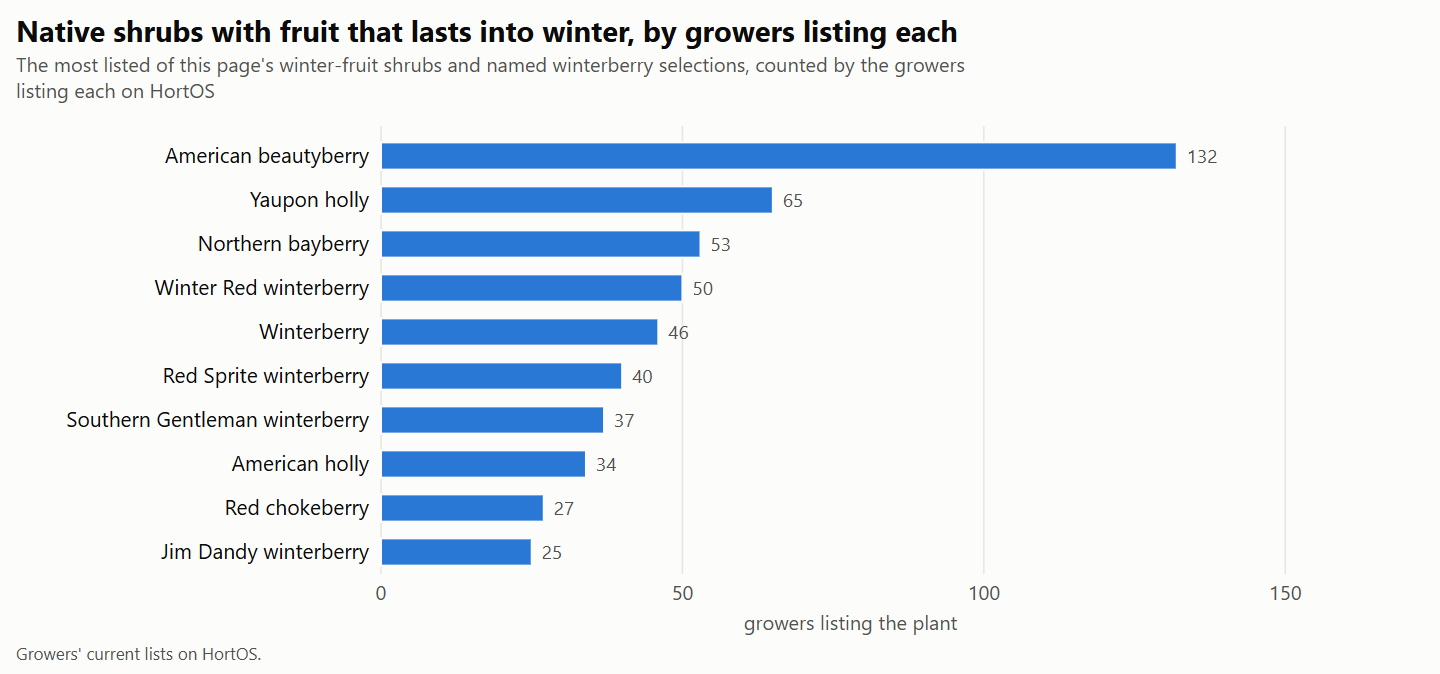
Native Shrubs with Winter Berries for Birds and Their Trade Prices
By what NC State Extension's plant pages say, this page sorts native shrubs into fruit that lasts into winter and fruit that finishes in fall, and reports which need a second plant to set fruit. It sets those statements beside how many growers list each shrub and a median trade price in a #3 container.
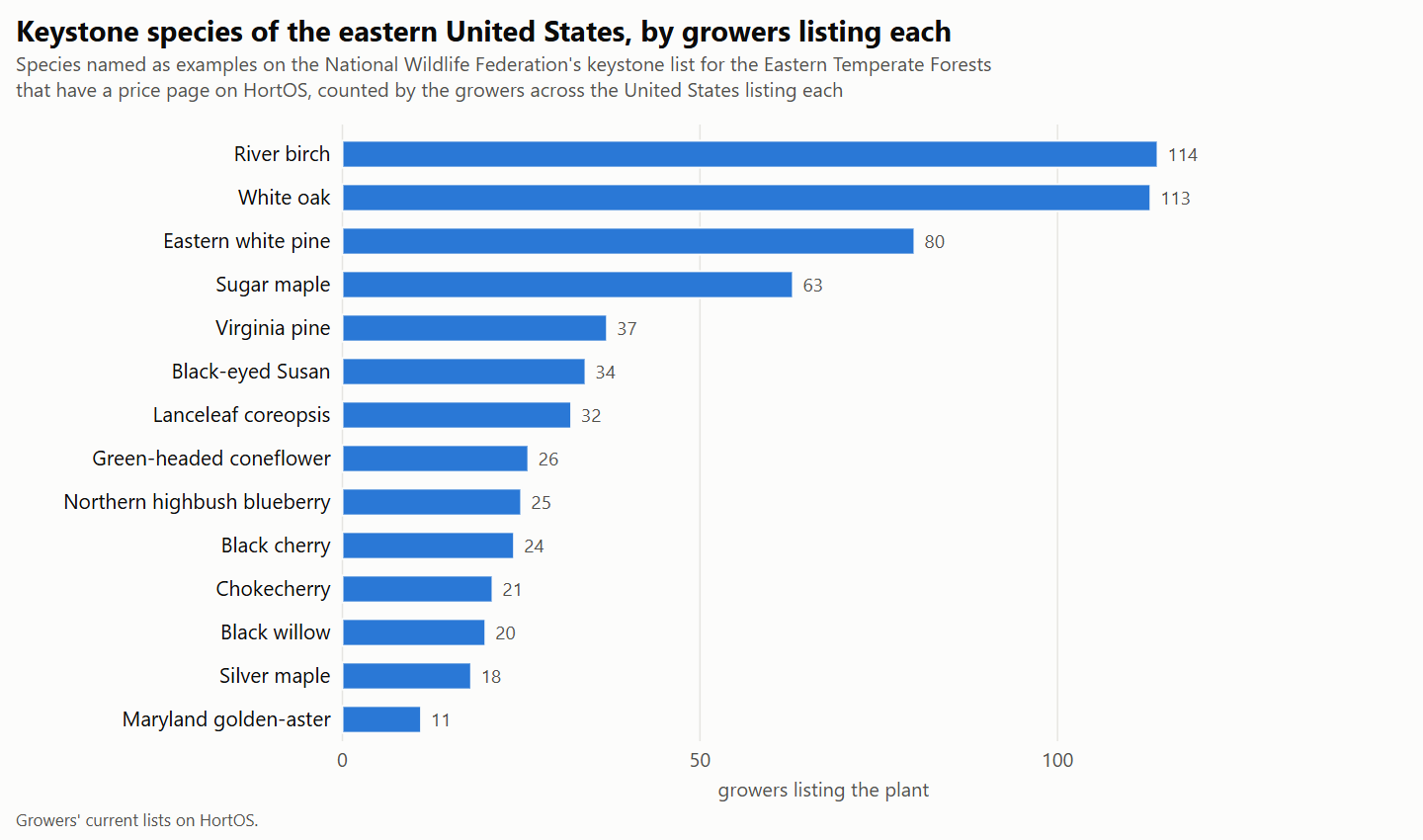
Keystone Plants of the Eastern United States by Growers Listing Each
The National Wildlife Federation's keystone list for the Eastern Temperate Forests is organized by genus and names sample species. This page sets out what the keystone figures count. It then shows how many growers list most of those species on HortOS, a median trade price where at least three price a size, and what a grower count cannot show.

Buying From a Wholesale Grower When You Are Not in the Trade
Native plant societies, watershed districts, land trusts, schools and church committees can buy from wholesale growers when they order like the trade: in quantity, ahead of the season, on the grower's terms. This page explains who sells to whom, resale certificates and exemptions, minimums and pooling, the sizes to buy, straight species and ecotype, lead times and shipping.