Native Shrubs with Winter Berries for Birds and Their Trade Prices
By what NC State Extension's plant pages say, this page sorts native shrubs into fruit that lasts into winter and fruit that finishes in fall, and reports which need a second plant to set fruit. It sets those statements beside how many growers list each shrub and a median trade price in a #3 container.
Updated October 9, 2026. Figures are what the live us.hortosapp.com price and plant pages printed.
On this page
A volunteer who orders the shrubs for a conservation district plant sale, or for an Audubon chapter's bird planting, asks which native shrubs still carry fruit in midwinter and which wholesale growers list them. By the plant pages of NC State Extension (North Carolina, read October 2026), the answer comes in two sets. Fruit that ripens in fall is not always fruit that lasts into winter, and on many of these shrubs it forms only when a second plant of the right kind grows nearby.
This page reports what NC State Extension's Plant Toolbox says about each shrub's fruit. It adds statements from the extension services of Maryland, Pennsylvania and Ohio, a 2003 U.S. Fish and Wildlife Service guide, and the National Audubon Society on birds. HortOS, a free directory of American wholesale plant growers with their published availability and trade prices, adds how many growers list each shrub and, where three or more price a #3 container, its median trade price. It is not planting advice, and its tables are selections.
Quick facts
| Winterberry in winter | NC State Extension (North Carolina, read October 2026) says winterberry fruit ripens from August to December and stays into winter on female plants. Penn State Extension (Pennsylvania, 2025) and Ohio State University Extension (Ohio, 2023) also say the berries persist in winter. |
|---|---|
| The male plant | NC State Extension's winterberry page (North Carolina, read October 2026) calls for one male for every 10 to 20 females, planted within 50 feet and matched for bloom time. Its page for the male selection 'Southern Gentleman' gives one male for every 6 to 10 females. |
| Fruit until spring | Northern bayberry fruit forms in late summer and stays on pollinated female plants until April, says NC State Extension (North Carolina, read October 2026). Penn State Extension (Pennsylvania, 2025) also has it lasting through April. |
| Fall fruit | NC State Extension (North Carolina, read October 2026) gives arrowwood viburnum's fruit as July to September, spicebush's as August to September and blackhaw's as September to October. |
| Inkberry, two statements | NC State Extension (North Carolina, read October 2026) says inkberry fruit matures in September and lasts through November. The U.S. Fish and Wildlife Service guide to native plants of the Chesapeake Bay watershed (2003) gives September to March and says the berries persist through winter. |
| Male plants on growers' lists | 'Southern Gentleman' winterberry, a male selection, was listed by 37 growers on HortOS. Its national median trade price in a #3 container was $16 across 21 growers, ex tax, freight not included. |
Fruit that lasts into winter, shrub by shrub
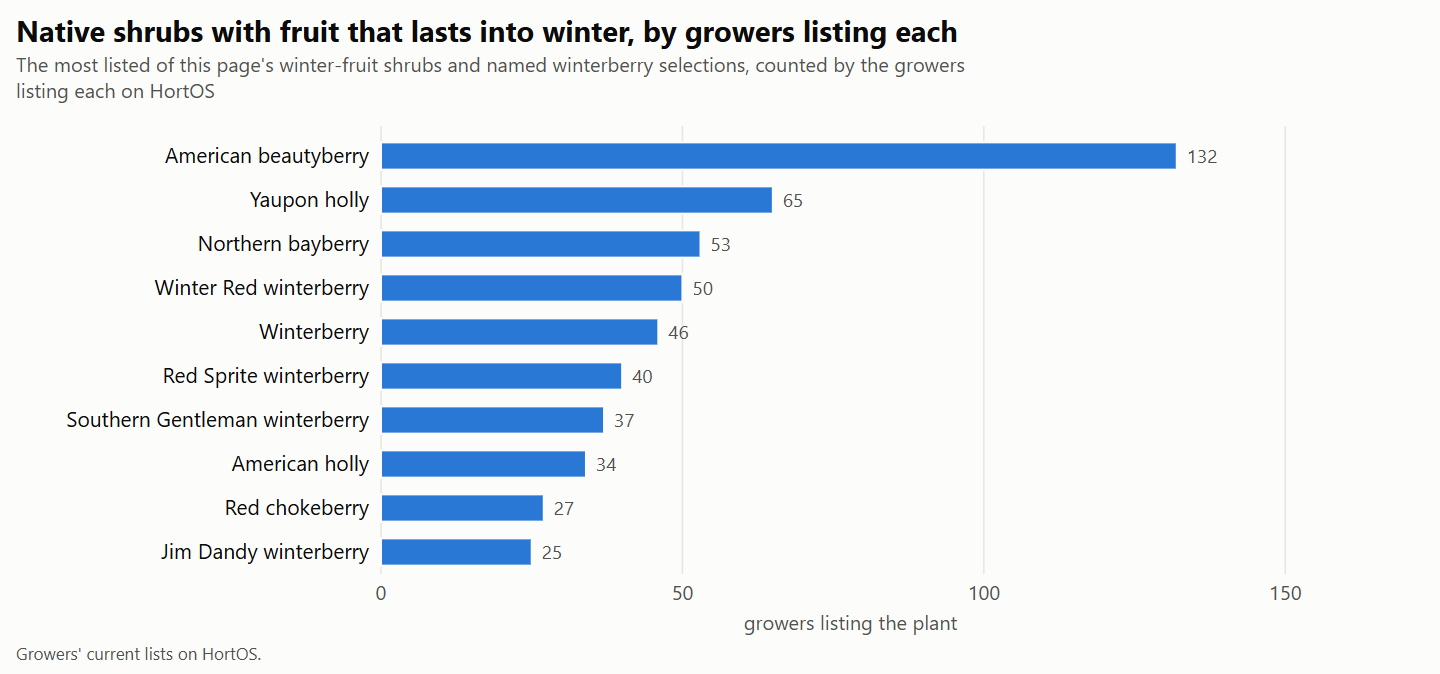
The first table holds 14 rows. They are native shrubs with a page on HortOS whose NC State Extension Plant Toolbox page says the fruit persists, lasts or shows into or through winter. With them are five named selections of winterberry, female and male, that NC State Extension's winterberry pages describe. The table is a selection, not a full list of such shrubs. Its middle column gives NC State's statement in this page's own words; the Plant Toolbox pages carry no date and were read in October 2026. Prices are medians across growers' current trade lists on HortOS: one price per grower, ex tax, freight not included, with the number of growers pricing each size in brackets. Anyone can see the prices on HortOS, and only the trade can order.
| Plant | What NC State Extension says about the fruit (read 2026) | Growers listing it | #3 median (growers pricing) |
|---|---|---|---|
| Winterberry (Ilex verticillata) | Ripens August to December and stays into winter, on female plants | 46 | $18.98 (8) |
| Winter Red winterberry (Ilex verticillata 'Winter Red') | Female; bright red fruit that can stay through winter | 50 | $14.55 (25) |
| Wintergold winterberry (Ilex verticillata 'Wintergold') | Female; orange-yellow fruit from late summer through winter | 8 | $13 (4) |
| Red Sprite winterberry (Ilex verticillata 'Red Sprite') | Female and dwarf; vivid red fruit | 40 | $18 (19) |
| Southern Gentleman winterberry (Ilex verticillata 'Southern Gentleman') | Male: bears no fruit; a late-blooming pollen source | 37 | $16 (21) |
| Jim Dandy winterberry (Ilex verticillata 'Jim Dandy') | Male: an early-blooming pollen source | 25 | $18 (9) |
| American holly (Ilex opaca) | On female trees from September through February | 34 | $29.75 (6) |
| Northern bayberry (Myrica pensylvanica) | Late summer until April, on pollinated female plants | 53 | $19.98 (16) |
| Red chokeberry (Aronia arbutifolia) | Matures September to November; may stay all winter | 27 | $14 (9) |
| American beautyberry (Callicarpa americana) | August to October; may last through winter | 132 | $9.00 (63) |
| Possumhaw holly (Ilex decidua) | Ripe in September and kept through winter | 13 | Fewer than three growers |
| Yaupon holly (Ilex vomitoria) | Ripe by fall and held into winter | 65 | $8.95 (10) |
| Virginia rose (Rosa virginiana) | Scarlet hips that stay into winter | 18 | Fewer than three growers |
| Common snowberry (Symphoricarpos albus) | White fruit shown on bare winter stems | 19 | Fewer than three growers |
The growers listing the plants in this table are spread across many states; the most are in Florida, North Carolina and New Jersey.
A median needs three growers pricing a size. One is printed for 11 of the 14 rows. Possumhaw holly, Virginia rose and common snowberry show a grower count and the words Fewer than three growers, so no median is printed for them. The median for Wintergold winterberry rests on 4 growers, and a single changed price would move it.
Five of the rows are named selections of winterberry, not the straight species. NC State Extension (North Carolina, read October 2026) describes 'Winter Red', 'Winter Gold' and 'Red Sprite' as female and 'Southern Gentleman' and 'Jim Dandy' as male. It spells one of them 'Winter Gold', and the table uses 'Wintergold', the name on its HortOS page. Each row's count is that plant page's own, so this page does not add the winterberry rows together.
Extension services further north describe the same winterberry fruit. University of Maryland Extension (Maryland, 2023) says the red berries persist into the winter months. The U.S. Fish and Wildlife Service guide to native plants of the Chesapeake Bay watershed (2003), the federal guide below, gives the fruit as August to February.
Northern bayberry is the one row whose NC State statement names a spring month. Penn State Extension (Pennsylvania, 2025) says its fruit persists through April, and the federal guide (Chesapeake Bay watershed, 2003) gives September to April. For common snowberry, NC State Extension (North Carolina, read October 2026) says only that the white fruit stands out on bare stems in a winter garden. The National Audubon Society's magazine (2026) says snowberry's white fruit clusters stay through winter.
What birds do with the fruit is reported here from the National Audubon Society alone. Its magazine (2025) says several native plants bear or keep fruit through the part of winter when food is scarcest, and names winterberry as one that birds especially favor. Its magazine (2026) calls the hollies it covers lifelines for birds in winter. Its native plants database (read October 2026) says red chokeberry fruit ripens in fall and hangs on far into winter, and that the red berries on female yaupon plants usually draw birds in late winter.
Fruit that ripens and finishes in fall
The second table holds 6 native shrubs with a page on HortOS whose NC State Extension page gives a fruit period that ends in fall. The rows run in order of the last month each page gives. This table is a selection as well, and every statement in it is NC State's for North Carolina, read in October 2026.
| Plant | What NC State Extension says about the fruit (read 2026) | Growers listing it | #3 median (growers pricing) |
|---|---|---|---|
| Arrowwood viburnum (Viburnum dentatum) | Blue-black fruit, July to September | 66 | $16 (17) |
| Black chokeberry (Aronia melanocarpa) | August to September | 41 | $17.02 (12) |
| Possumhaw viburnum (Viburnum nudum) | Pink to blue-black fruit, August to October | 16 | $18 (5) |
| Carolina rose (Rosa carolina) | Red hips, August to October | 16 | $20.98 (4) |
| Swamp rose (Rosa palustris) | Red hips, September to October | 26 | $17.50 (7) |
| Inkberry (Ilex glabra) | Black fruit, ripe in September and lasting through November | 46 | $12 (13) |
The growers listing the plants in this table are spread across many states; the most are in New Jersey, Pennsylvania and Maryland.
Every row of the second table carries a median. The one for Carolina rose rests on 4 growers, so it is as thin as the Wintergold figure above.
Sources differ on two of these shrubs. For arrowwood viburnum, NC State Extension (North Carolina, read October 2026) gives July to September, and the federal guide (Chesapeake Bay watershed, 2003) gives September to November. The National Audubon Society's magazine (2025) says arrowwood's blue-black berries often stay on through winter. For inkberry, NC State Extension (North Carolina, read October 2026) says the fruit matures in September and lasts through November, which is why it sits in this table. The federal guide (Chesapeake Bay watershed, 2003) gives September to March and says the berries persist through winter.
Audubon reports a use for fall fruit too. The National Audubon Society's magazine (2026) says the fat-rich red fruit of spicebush ripens in fall, in time for birds on migration and for birds that stay the winter.
Which shrubs need a second plant to set fruit
The third table carries no HortOS figure. It gives, in this page's words, what each shrub's NC State Extension page says about setting fruit. Its 13 rows are the species of the first two tables whose page says, of that plant, that a second plant is needed for fruit or improves it. With them is the male winterberry selection whose page gives a ratio.
| Shrub | What its NC State Extension page says about setting fruit | Authority and year |
|---|---|---|
| Winterberry (Ilex verticillata) | Needs cross-pollination: one male for every 10 to 20 females, planted within 50 feet and matched for bloom time. | NC State Extension Plant Toolbox, read October 2026 |
| Winterberry 'Southern Gentleman' (male) | Blooms late and bears no fruit itself; its own page gives one male for every 6 to 10 females and names 'Winter Red' among the late bloomers it suits. | NC State Extension Plant Toolbox, read October 2026 |
| American holly (Ilex opaca) | Male and female trees are separate; only females fruit, and a male has to grow nearby. | NC State Extension Plant Toolbox, read October 2026 |
| Inkberry (Ilex glabra) | Berries take both a male and a female plant. | NC State Extension Plant Toolbox, read October 2026 |
| Possumhaw holly (Ilex decidua) | Mostly separate male and female plants, though some carry complete flowers; females fruit best planted with one male or more. | NC State Extension Plant Toolbox, read October 2026 |
| Yaupon holly (Ilex vomitoria) | Male and female plants are separate, and the two must flower over the same weeks. | NC State Extension Plant Toolbox, read October 2026 |
| Northern bayberry (Myrica pensylvanica) | Every group of plants needs one male or more. | NC State Extension Plant Toolbox, read October 2026 |
| Wax myrtle (Myrica cerifera) | A good berry crop usually takes male and female plants together. | NC State Extension Plant Toolbox, read October 2026 |
| Spicebush (Lindera benzoin) | Fruit forms on female shrubs, and only where a male pollinates them. | NC State Extension Plant Toolbox, read October 2026 |
| Arrowwood viburnum (Viburnum dentatum) | Fruit takes plants of two or more genetic strains. | NC State Extension Plant Toolbox, read October 2026 |
| Possumhaw viburnum (Viburnum nudum) | Bears the most fruit where more than one shrub is planted. | NC State Extension Plant Toolbox, read October 2026 |
| Blackhaw (Viburnum prunifolium) | Sets fruit better where a second shrub can pollinate it. | NC State Extension Plant Toolbox, read October 2026 |
| American beautyberry (Callicarpa americana) | Appears to fruit more heavily when several are planted together. | NC State Extension Plant Toolbox, read October 2026 |
NC State's own pages give two ratios for winterberry. The species page (North Carolina, read October 2026) asks for one male to each 10 to 20 females, no more than 50 feet away, and the 'Southern Gentleman' page gives one male for every 6 to 10. The species page (North Carolina, read October 2026) also says to match bloom times, and that winterberry may fail to set fruit in dry soil.
How the trade labels a plant's sex is a separate matter. University of Maryland Extension (Maryland, 2023) says northern bayberry is hard to find in nurseries marked as male or female, and that nursery-grown spicebush generally carries no such label. The same service (Maryland, 2023) names 'Compacta', 'Densa', 'Shamrock' and 'Nigra' among the female inkberry cultivars and says there is no specific male cultivar. The National Audubon Society's magazine (2025) treats a plant's sex as a question for the nursery or a native plant society.
What the directory does not show about a berry shrub
For a row listed under the species name alone, the directory does not show whether a grower's plants are male or female. For any row it does not show where the seed or cuttings came from, whether a plant under a species name is the straight species or a selection, or how the plant was grown. Each is a question to put to the grower in writing before an order. The guide to buying from a wholesale grower covers minimum orders, straight species and local ecotype for groups outside the trade.
A fruit month here is one source's statement for its own region. NC State Extension writes for North Carolina and the federal guide for the Chesapeake Bay watershed, and neither gives a calendar for another state or another year.
The medians have limits too. Each pools growers across the country at one container size, #3, and leaves out freight. None is the price of a state, of another size or of one grower. A count here is growers listing the plant, not how many plants exist or how well it suits a site. The guide to reading an availability list shows how a grower's own list sets out sizes and prices, which is what a quote will follow.
What to watch for
- Reading a fall fruit month as winter fruit. NC State Extension (North Carolina, read October 2026) gives arrowwood viburnum, spicebush and black chokeberry fruit periods that end in September.
- Ordering females with no male. NC State Extension (North Carolina, read October 2026) says only female American holly trees fruit and need a male nearby, and that winterberry must be cross-pollinated to bear berries.
- Pairing a male that blooms at the wrong time. NC State Extension (North Carolina, read October 2026) says to match bloom times, and describes 'Jim Dandy' as early blooming and 'Southern Gentleman' as late blooming.
- Taking a species name as a statement of sex. University of Maryland Extension (Maryland, 2023) says northern bayberry is hard to find marked male or female.
- Treating a #3 median as a quote. A median pools growers in many states and leaves out freight, and those for Wintergold winterberry and Carolina rose rest on fewer than five growers each.
Getting it right
- Look up each shrub on the extension service of the planting's own state and note what it says about how long the fruit lasts.
- Check that the shrub is native where it will go. The chapter, the land manager or the owner of the site decides what is planted, and a state native plant society can say what grows locally.
- For each shrub in the third table, note what its NC State Extension page says about a second plant. For winterberry, note which male that page pairs with the female chosen.
- Open the shrub's plant page on HortOS, or the directory, to see which growers list it.
- Ask the grower in writing whether the plants are male, female or unsexed, where the seed or cuttings came from, and for the size, the price, the minimum order and the freight. The grower decides who it sells to and on what terms.
A word of caution
NC State Extension (North Carolina, read October 2026) rates winterberry's poison severity for people as low, names the fruits and leaves as the poisonous parts and says eating them may cause vomiting or diarrhea. The same authority (North Carolina, read October 2026) rates American holly's poison severity for people as low and names the fruits as the poisonous part. Those are two of this page's shrubs, and the page says nothing either way about the others: NC State Extension's page for each plant carries its own entry. A poison control center or a doctor is who to ask about a person who has eaten part of a plant, and a grower's own list and quote settle what it lists and at what price.
Sources
- NC State Extension Plant Toolbox, Ilex verticillata (winterberry): fruit, male ratio, cultivars, poison entry.
- NC State Extension Plant Toolbox, Ilex verticillata 'Southern Gentleman': the late-blooming male and its ratio.
- NC State Extension Plant Toolbox, Ilex verticillata 'Winter Red': a female selection's fruit.
- NC State Extension Plant Toolbox, Ilex verticillata 'Winter Gold': orange-yellow fruit through winter.
- NC State Extension Plant Toolbox, Ilex opaca (American holly): fruit months, sexes, poison entry.
- NC State Extension Plant Toolbox, Myrica pensylvanica (northern bayberry): fruit until April, sexes.
- NC State Extension Plant Toolbox, Aronia arbutifolia (red chokeberry): fruit months and persistence.
- NC State Extension Plant Toolbox, Callicarpa americana (American beautyberry): fruit months and fruit set.
- NC State Extension Plant Toolbox, Ilex decidua (possumhaw): fruit through winter, sexes.
- NC State Extension Plant Toolbox, Ilex vomitoria (yaupon): fruit into winter, sexes.
- NC State Extension Plant Toolbox, Rosa virginiana (Virginia rose): hips that stay into winter.
- NC State Extension Plant Toolbox, Symphoricarpos albus (common snowberry): white fruit in winter.
- NC State Extension Plant Toolbox, Viburnum dentatum (arrowwood viburnum): fruit months and fruit set.
- NC State Extension Plant Toolbox, Lindera benzoin (spicebush): fruit months, male and female.
- NC State Extension Plant Toolbox, Aronia melanocarpa (black chokeberry): fruit months.
- NC State Extension Plant Toolbox, Viburnum nudum (possumhaw viburnum): fruit months and fruit set.
- NC State Extension Plant Toolbox, Rosa carolina (Carolina rose): hips and their months.
- NC State Extension Plant Toolbox, Viburnum prunifolium (blackhaw): fruit months and fruit set.
- NC State Extension Plant Toolbox, Rosa palustris (swamp rose): hips and their months.
- NC State Extension Plant Toolbox, Ilex glabra (inkberry): fruit months, male and female.
- University of Maryland Extension, Winterberry Holly: winterberry fruit in Maryland.
- University of Maryland Extension, Northern Bayberry: bayberry sexes in nurseries.
- University of Maryland Extension, Inkberry Holly: the female inkberry cultivars.
- University of Maryland Extension, Spicebush: spicebush sexes in nurseries.
- Penn State Extension, Rain Garden Plants: Winterberry: winterberry fruit in Pennsylvania.
- Penn State Extension, Rain Garden Plants: Northern Bayberry: bayberry fruit through April.
- Ohio State University Extension, Native Shrubs: Creating Living Landscapes for Birds, Butterflies, Bees, and Other Beneficials: winterberry fruit in Ohio.
- U.S. Fish and Wildlife Service, Native Plants for Wildlife Habitat and Conservation Landscaping: Chesapeake Bay Watershed: fruit months by species.
- National Audubon Society, Audubon magazine, 11 Berry-Bearing Native Plants to Keep Birds Full and Happy: winter berries and birds.
- National Audubon Society, Audubon magazine, 11 Native Shrubs to Make Your Yard a Wonderland for Birds: native shrubs birds use.
- National Audubon Society, Native Plants database, Red Chokeberry: red chokeberry fruit and birds.
- National Audubon Society, Native Plants database, Yaupon: yaupon fruit in late winter.
More guides

Buying From a Wholesale Grower When You Are Not in the Trade
Native plant societies, watershed districts, land trusts, schools and church committees can buy from wholesale growers when they order like the trade: in quantity, ahead of the season, on the grower's terms. This page explains who sells to whom, resale certificates and exemptions, minimums and pooling, the sizes to buy, straight species and ecotype, lead times and shipping.

Reading a Wholesale Availability List, and Pricing the Plants in a Bid
For landscape contractors, designers, estimators and students: what each column of a wholesale availability list means, how much the same plant at the same size varies between growers and states, how the low, median and high on the price pages are built, and how to carry the plant line of a bid from the list to the client.
Keystone Plants of the Eastern United States by Growers Listing Each
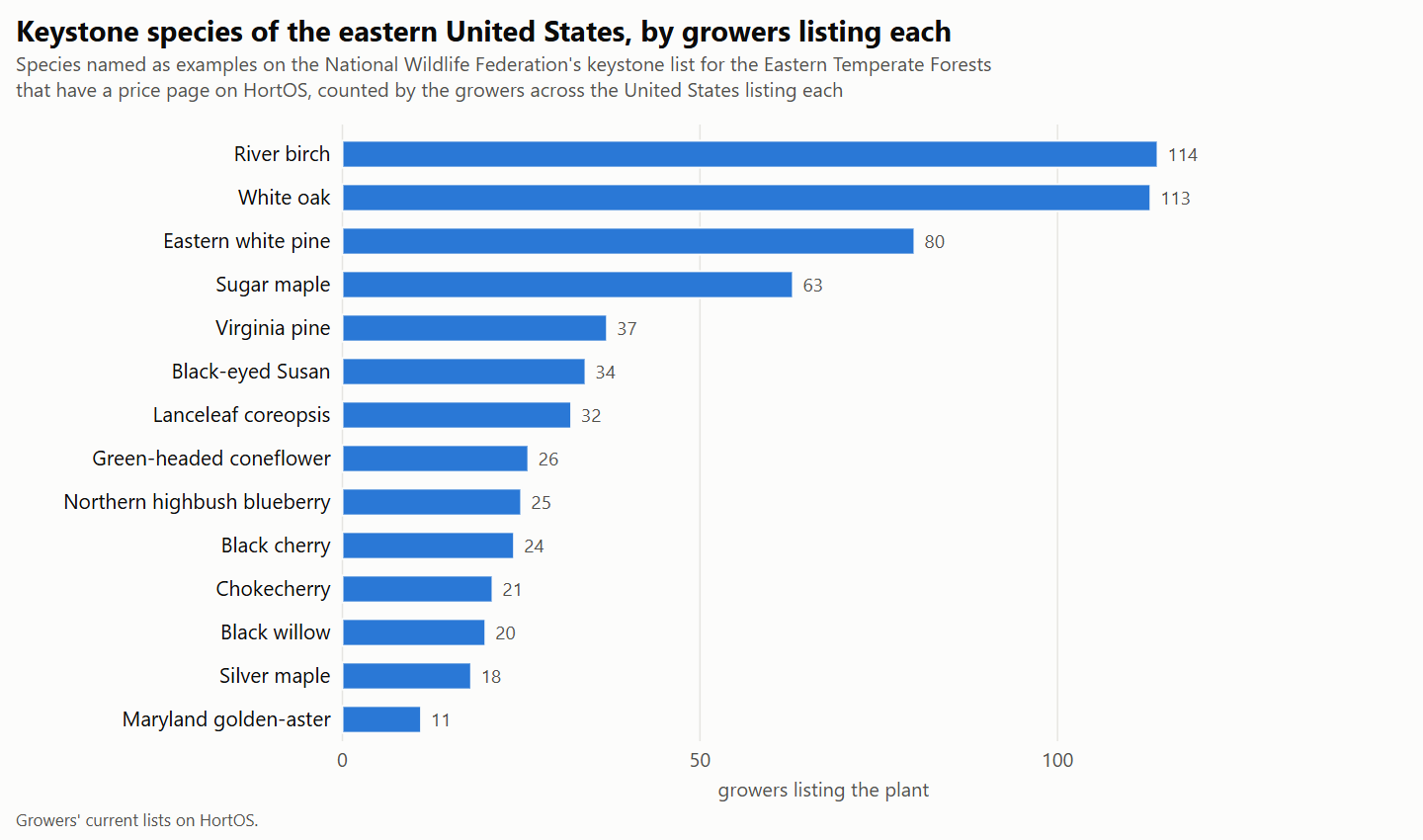
The National Wildlife Federation's keystone list for the Eastern Temperate Forests is organized by genus and names sample species. This page sets out what the keystone figures count. It then shows how many growers list most of those species on HortOS, a median trade price where at least three price a size, and what a grower count cannot show.