Longleaf pine for restoration and the trade price of container trees
Longleaf pine is sold as a forestry seedling and as a container tree. This guide sets out what restoration bodies, NRCS and four state extension services say about seedlings, planting seasons and funding dates, and gives the median trade price of longleaf by container size, with the grasses, oaks and shrubs the sources name with it.
Updated October 14, 2026. Figures are what the live us.hortosapp.com price and plant pages printed.
On this page
A native plant society, a conservation district or a landscape committee in Georgia, the Carolinas, Alabama or Florida is asked the same thing each fall. Where can longleaf pine (Pinus palustris) be bought, and what does a container tree cost at trade. Longleaf is sold as two different products, a forestry seedling ordered by the season and a container tree that wholesale growers list by size, and only the container tree has a trade median.
This page draws on America's Longleaf Restoration Initiative, the USDA Natural Resources Conservation Service, the Longleaf Alliance, the N.C. Forest Service, and the extension services of Florida, Georgia, North Carolina and Mississippi. It adds what is printed on HortOS, a free directory of American wholesale plant growers with their published availability and trade prices: who lists longleaf and the plants named with it, and at which sizes. It is not a planting plan, it gives no guidance on burning, and it prices no forestry seedling.
Quick facts
| Acres of longleaf | America's Longleaf Restoration Initiative, on its home page read in 2026, puts the low point at an estimated 3.4 million acres and today's figure at approximately 5.2 million acres across its range in the United States. |
|---|---|
| The goal | The Initiative's range-wide conservation plan for the United States, 2023, says almost 3 million new acres must be established to reach its goal of eight million acres. |
| Federal assistance | USDA NRCS reports 743 Longleaf Pine Initiative contracts on 91,110 acres in nine states of the United States for fiscal year 2024, in its progress report of June 2025. |
| Seedling funding window | The Longleaf Alliance's planting fund page for the United States, read on 5 October 2026, showed the 2026-2027 round with requests taken from March 1 to June 1. |
| Planting season | October through February in North Carolina (N.C. Forest Service, 2011); November to the beginning of March in Florida (UF/IFAS Extension, 2024). |
| Longleaf on HortOS | 73 growers list longleaf pine. The size most growers price is #3, at a median of $10 across 23 growers. |
Two products under one name
The first product is the forestry seedling. The N.C. Forest Service, in a North Carolina leaflet of 2011, describes a containerized seedling as one whose roots sit inside a small plug of potting material. Its companion leaflet of 2011 says North Carolina landowners can buy longleaf seedlings from the state nursery or from commercial nurseries.
UF/IFAS Extension, writing for Florida in 2024, says longleaf can be regenerated with bareroot seedlings, with containerized seedlings or by direct seeding, and that container-grown seedlings generally survive best. The same Florida publication of 2024 names cost as their main drawback. It adds that longleaf seedlings never go fully dormant, so planting crews must handle them with more care than other southern pines. The N.C. Forest Service, for North Carolina in 2011, says containerized seedlings planted by hand survive better than bareroot ones, and that bareroot seedlings do best when a machine plants them.
The second product is the container tree a wholesale grower lists at #1, #3 or larger. University of Georgia Extension, in a Georgia bulletin of 2024, calls longleaf a canopy tree best used as a specimen. The bulletin says it does best on sandy Coastal Plain soils, will adapt to Piedmont clay, and is best planted as a seedling. UF/IFAS Extension, in a Florida publication of 2018, says landscapes seldom include longleaf, though it would suit large ones such as golf courses and parks. N.C. Cooperative Extension, on a North Carolina plant page read in 2026, says longleaf is hard to move because it quickly grows a deep taproot.
University of Georgia Extension, in 2024, gives the native range as southeastern Virginia to Florida and west to Texas, with a mountain race on ridges from Paulding County to Rome in Georgia that reaches the Talladega National Forest in Alabama.
What growers list for longleaf and the plants named with it
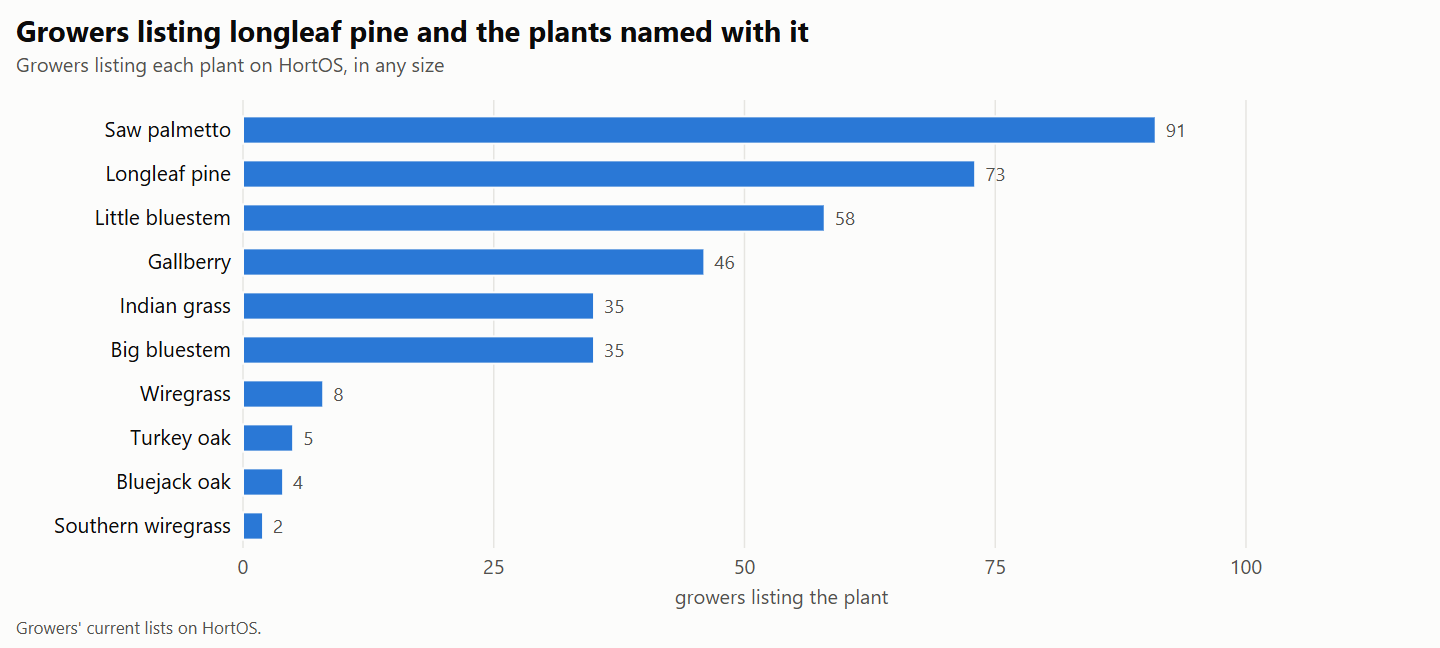
The table below holds longleaf pine and the plants that five publications of four authorities place with it, each named to species or variety. Those publications are the N.C. Forest Service seedling catalog (North Carolina, 2026-2027), two University of Georgia Extension bulletins (Georgia, 2024), UF/IFAS Extension (Florida, 2024) and Mississippi State University Extension (Mississippi, 2026). 2 plants those publications mention are not shown, because none was given a single botanical name. Prices are medians across growers' current trade lists on HortOS: one price per grower, ex tax, freight not included, with the number of growers pricing each size in brackets. Anyone can see the prices on HortOS, and only the trade can order.
| Plant | Growers listing it | Size most growers price | Median (growers pricing) |
|---|---|---|---|
| Longleaf pine (Pinus palustris) | 73 | #3 | $10 (23) |
| Turkey oak (Quercus laevis) | 5 | #3 | $16.95 (3) |
| Bluejack oak (Quercus incana) | 4 | Fewer than three growers | |
| Wiregrass (Aristida stricta) | 8 | Liner | $1.00 (5) |
| Southern wiregrass (Aristida stricta var. beyrichiana) | 2 | Fewer than three growers | |
| Little bluestem (Schizachyrium scoparium) | 58 | #1 | $3.98 (20) |
| Indian grass (Sorghastrum nutans) | 35 | #1 | $4.00 (11) |
| Big bluestem (Andropogon gerardii) | 35 | #1 | $3.83 (6) |
| Pineywoods dropseed (Sporobolus junceus) | 2 | Fewer than three growers | |
| Gallberry (Ilex glabra) | 46 | #3 | $12 (13) |
| Saw palmetto (Serenoa repens) | 91 | #7 | $35 (40) |
Most of the growers listing the plants in this table are in Florida and North Carolina. The size shown for each plant is the container size most growers price; field grown lines are not counted, and palms and other plants sold by height are not priced above #15.
The median column is not one size. The table has 11 rows. Each one with a median sits at the size most growers price for that plant, from a liner for the grass to a #7 for the palmetto. The column cannot be read down as a ranking by price. 8 rows carry a median. A median needs three growers pricing a size.
Some figures are thin. Turkey oak (Quercus laevis) is listed by 5 growers, and its #3 median of $16.95 rests on 3 of them. The wiregrass (Aristida stricta) median is a liner price resting on 5 growers. Bluejack oak (Quercus incana) has 4 growers listing it and pineywoods dropseed (Sporobolus junceus) has 2, and neither has a median.
Wiregrass has two rows because the sources use two names. The N.C. Forest Service catalog (North Carolina, 2026-2027) sells it as Aristida stricta, and University of Georgia Extension (Georgia, 2024) calls the southern plant Aristida stricta var. beyrichiana, a dominant understory plant of longleaf savannahs. The two counts are separate and are not added together.
Each row is there for a stated reason. University of Georgia Extension (Georgia, 2024) places turkey oak in the sandhills of the upper Coastal Plain alongside longleaf and bluejack oak. Mississippi State University Extension (Mississippi, 2026) says dry sandy uplands usually carry a nearly continuous grass layer, often led by wiregrass and little bluestem (Schizachyrium scoparium). The same Mississippi publication of 2026 names gallberry (Ilex glabra) and saw palmetto (Serenoa repens) as shrubs of longleaf flatwoods. Big bluestem (Andropogon gerardii) and Indian grass (Sorghastrum nutans) belong to a group the N.C. Forest Service catalog (North Carolina, 2026-2027) describes as typical under longleaf and in other grassland and savanna ecosystems. University of Georgia Extension (Georgia, 2024) describes pineywoods dropseed as a groundcover of sandhill country within longleaf pine communities. The table is not a planting list.
Longleaf itself is priced at five container sizes. The medians were $3.50 at #1 across 11 growers, $10 at #3 across 23, and $25 at #7 across 17. At #15 the median was $55 across 17 growers, and at #30 it was $110 across 14. These are container trees for landscape planting, and none is the price of a bareroot or plug seedling.
The planting year as each authority gives it
The next table is compiled from six documents of five authorities and sets out what each says at each stage of a planting year. The first column names stages, not instructions. The ordering, shipping and planting rows belong to North Carolina and Florida alone, and the two N.C. Forest Service leaflets date from 2011. The Longleaf Alliance row is the 2026-2027 round as its page showed it on 5 October 2026, and that page gives no date for a later round.
| Stage | What the authority says | Authority and year |
|---|---|---|
| Seed for the 2026-2027 season | Seed reserves were nearly gone in summer 2025 and a poor cone crop was forecast. Partners then searched the whole range for cones to collect. | America's Longleaf Restoration Initiative, 2025 accomplishment report |
| Seedling funding requests | The planting fund takes requests from March 1 to June 1, looks at them in late summer and expects to tell applicants in late fall. | The Longleaf Alliance, 2026-2027 round |
| Federal financial assistance | NRCS gives technical and financial help to producers on private land in nine states, with the effort focused on priority counties. | USDA NRCS, United States, progress report of June 2025 |
| Forestry seedling orders | Seedling supply can fall short of demand, so orders are placed no later than early summer. | UF/IFAS Extension, Florida, 2024 |
| State nursery orders open, North Carolina | The state nursery starts taking seedling orders on the first business day of July. | N.C. Forest Service seedling catalog, 2026-2027 |
| State nursery ships, North Carolina | UPS shipments leave weekly, starting in November for containerized seedlings and in January for bareroot ones. | N.C. Forest Service seedling catalog, 2026-2027 |
| Planting season, North Carolina | The season runs October to February. Late fall planting tends to do better, and planting in March or April carries more and more risk. | N.C. Forest Service, leaflet LL-4, 2011 |
| Planting season, Florida | Planting normally falls between November and early March, and the early part of that window is called best. Containerized seedlings can go in sooner when the soil holds enough moisture and rain occurs. | UF/IFAS Extension, Florida, 2024 |
| Spring check for competing plants, North Carolina | A check each year, late in March or early in April, shows whether competing vegetation needs control. | N.C. Forest Service, leaflet LL-4, 2011 |
The Longleaf Alliance says on its fund page for the United States, read in 2026, that a request does not guarantee a place in the program and that payment comes as a reimbursement. America's Longleaf Restoration Initiative says in its plan for the United States, 2023, that restoring longleaf typically costs more than restoring other southern pines.
USDA NRCS says in its progress report for the United States, June 2025, that it gives technical and financial assistance to producers on private land in nine states and focuses the effort on priority counties. The practices it names include establishing new trees and prescribed burning. For fiscal year 2024 the same NRCS report of June 2025 counts 743 contracts on 91,110 acres in the United States, with $19,412,364 in financial assistance obligations. Alabama accounts for 167 of those contracts and 36,058 of those acres, and Georgia for 250 contracts and 22,022 acres, in the NRCS report of June 2025 for the United States.
The N.C. Forest Service, for North Carolina in 2011, says fire can damage a longleaf tree in the period just after planting and again while it gains height. Whether and how a stand is burned is a matter for the landowner with the state forestry agency and the local NRCS office.
What the listings do not show
Seed source matters for longleaf. UF/IFAS Extension, for Florida in 2024, says local seed sources are generally best, and that seedlings from the Carolinas tend to grow poorly on the Florida peninsula and the reverse. The directory does not show the seed source of any grower's tree. It does not show whether a tree comes from local or improved seed, whether a plant is the straight species, or how it was grown. A buyer asks the grower, in writing, where the seed was collected and how long the tree has been in its container.
A listing is what a grower lists, not a count of trees on the ground. The medians are national: none is a Georgia, Alabama or Carolina price. The state pages for Florida, North Carolina and South Carolina show the growers in each. The page prices nothing above #30, puts no value on a mature tree, and gives no cost of planting and no cost per acre.
A society or district that is not in the trade can read how growers treat such buyers in the guide to buying from a wholesale grower. This table covers one plant community, so the guide to the most grown native plants by state is the place to see which natives most growers list.
What to watch for
- Reading a container median as the price of a forestry seedling.
- Reading the median column of the first table from top to bottom. The rows sit at different sizes.
- Adding the two wiregrass rows together.
- Carrying a planting month from North Carolina or Florida into another state.
- Treating a funding window that has closed as the date of the next round.
Getting it right
- Settle which product the project needs. The landowner decides with a forester of the state forestry agency.
- Ask the local NRCS office whether the county is a priority county and which practices its financial assistance covers. NRCS decides who is enrolled.
- Read the current round on the funding program's own page before planning around a date. The program decides which requests it accepts.
- Ask each grower for the seed source, the growing method and the container size in writing.
- Take any question about burning to the state forestry agency and the local NRCS office.
A word of caution
Planting dates and seedling types on this page are those of the N.C. Forest Service and of the extension services of Florida, Georgia, North Carolina and Mississippi, each for its own state and year. Funding terms are those of the USDA NRCS progress report of June 2025 and of the Longleaf Alliance page as it read on 5 October 2026. A landowner asks the state forestry agency or the local NRCS office about a site, and asks the grower about a tree.
Sources
- America's Longleaf Restoration Initiative, home page: longleaf acreage and the goal.
- America's Longleaf Restoration Initiative, Range-wide Conservation Plan for Longleaf Pine 2025 to 2040: new acres needed and cost.
- America's Longleaf Restoration Initiative, 2025 Range-wide Accomplishments: the seed and cone harvest.
- The Longleaf Alliance, Longleaf Pine Planting Fund: the seedling funding window.
- USDA Natural Resources Conservation Service, Longleaf Pine Initiative 2024 Progress Report: federal assistance by state.
- UF/IFAS Extension, Longleaf Pine Regeneration (SS-FOR-13, FR064): seedling types, season, seed source.
- UF/IFAS Extension, Pinus palustris: Longleaf Pine (ENH-628, ST469): longleaf as a landscape tree.
- N.C. Forest Service, Introduction to Longleaf Pine (leaflet LL-1): seedling plugs.
- N.C. Forest Service, Successfully Establishing Longleaf Pine (leaflet LL-4): planting season and seedling types.
- N.C. Forest Service, 2026-2027 North Carolina Tree Seedling Catalog: state nursery dates and understory grasses.
- N.C. Cooperative Extension, Extension Gardener Plant Toolbox: Pinus palustris: transplanting longleaf pine.
- University of Georgia Extension, Native Plants for Georgia Part I: Trees, Shrubs, and Woody Vines (Bulletin 987): longleaf and its oaks in Georgia.
- University of Georgia Extension, Native Plants for Georgia Part IV: Grasses and Sedges (Bulletin 987-4): wiregrass and dropseed in Georgia.
- Mississippi State University Extension, The Many Faces of Fire Forests: A Guide to Longleaf Pine Habitats for Better Stewardship (Publication 4187): longleaf site types and groundcover.
More guides

Buying From a Wholesale Grower When You Are Not in the Trade
Native plant societies, watershed districts, land trusts, schools and church committees can buy from wholesale growers when they order like the trade: in quantity, ahead of the season, on the grower's terms. This page explains who sells to whom, resale certificates and exemptions, minimums and pooling, the sizes to buy, straight species and ecotype, lead times and shipping.

The Most Grown Native Plants in the United States, by State
A data page, not an essay: the American native plants held by the most wholesale growers, counted grower by grower and state by state from growers' current lists on HortOS, with the median trade price at the size most growers price. Two paragraphs on what the tables show and what they do not, then the tables, refreshed each edition.
Florida's HOA landscaping law and the plants the state program lists
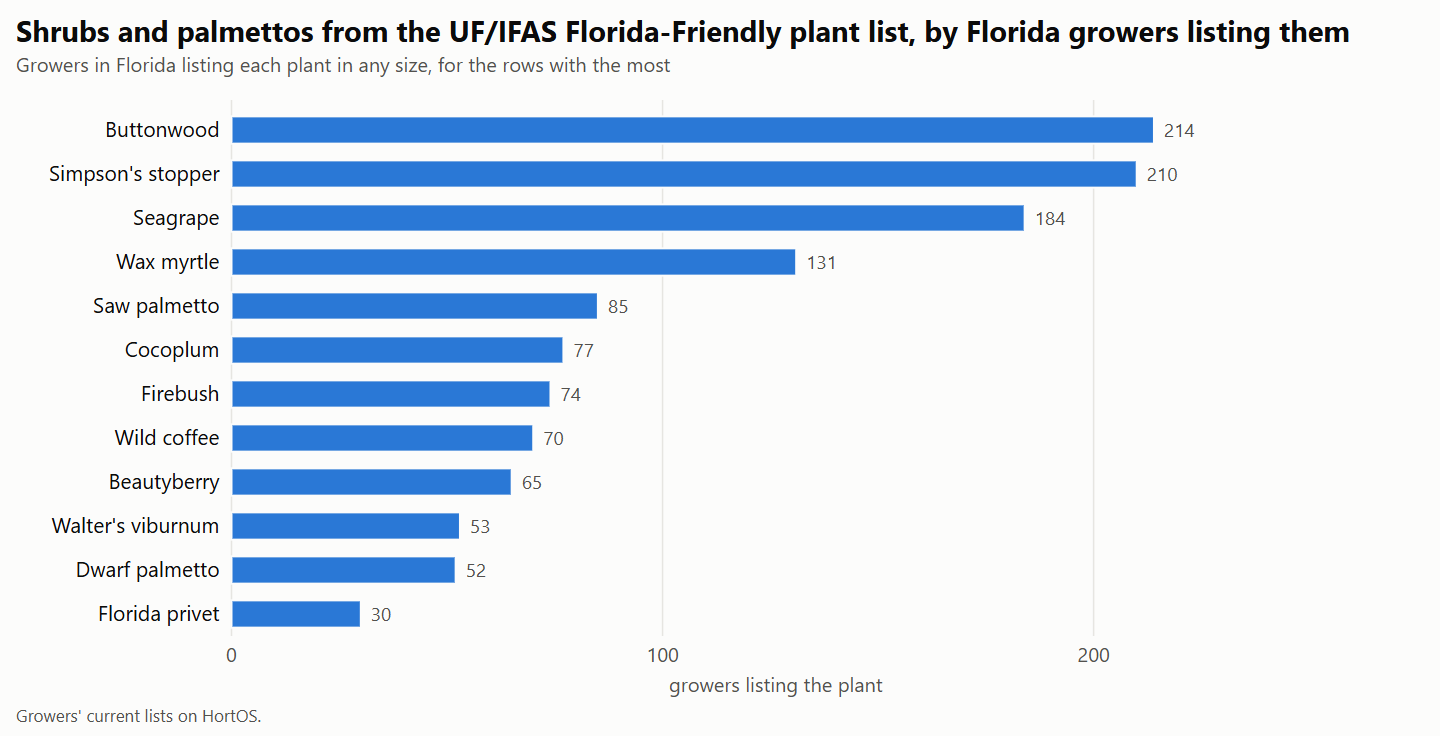
What two sections of the Florida Statutes say about homeowners' association covenants and Florida-friendly landscaping, what they leave with the association, and who decides a dispute. Two tables follow: groundcovers, grasses and shrubs from the UF/IFAS program's plant list, the Florida growers listing each, and a trade median for each at the container size most growers price.