Florida dune restoration plants and what growers list
For Florida dune care groups, beach towns and beachfront boards: what section 161.242 of the Florida Statutes (2026) forbids and what it lets nurseries sell, who decides seaward of the control line, and two agencies' planting figures. Two tables set the state's dune plant list beside the Florida growers listing each plant and a trade median by container size.
Updated October 17, 2026. Figures are what the live us.hortosapp.com price and plant pages printed.
On this page
- Quick facts
- What section 161.242 forbids and what it lets nurseries sell
- Who decides seaward of the control line
- The state's dune list beside Florida growers' lists
- Spacing, depth and season as two agencies give them
- What a grower's listing does not show
- What to watch for
- Getting it right
- A word of caution
- Sources
A beachfront condominium board or a dune care group in Florida wants to replant a dune, and asks what to plant and where the plants may lawfully come from. Section 161.242, Florida Statutes (2026), makes it unlawful to cut, harvest, remove or eradicate sea oats or sea grapes from public land or from private land without the consent of the land's owner or of whoever lawfully holds it. Section 161.242, Florida Statutes (2026), also permits licensed, certified nurserymen to sell sea oats and sea grapes they grew from seed or by vegetative propagation.
This page covers Florida only. It reports three sections of the 2026 Florida Statutes and the Florida Department of Environmental Protection's (Florida DEP) plant list and planting documents. It also draws on a 2007 publication of the USDA Natural Resources Conservation Service (NRCS) and on University of Florida (UF/IFAS) extension pages. HortOS, a free directory of American wholesale plant growers with their published availability and trade prices, adds the Florida growers listing each plant and trade medians by container size. It is not legal advice or a planting plan.
Quick facts
| What the law forbids | It is unlawful "to cut, harvest, remove, or eradicate" sea oats or sea grapes "from any public land or from any private land without consent of the owner of such land or person having lawful possession thereof" (s. 161.242(2), Florida Statutes, 2026). |
|---|---|
| What nurseries may sell | "Licensed, certified nurserymen" who grow sea oats or sea grapes "from seeds or by vegetative propagation are specifically permitted to sell these commercially grown plants" (s. 161.242(2), Florida Statutes, 2026). |
| Seaward of the control line | The Florida DEP's dune planting recommendations (August 2022 draft) say a permit "may be required" where work lies seaward of the state's Coastal Construction Control Line. The Florida DEP names its field inspectors as the staff who take questions on dune planting (page last modified February 24, 2025). |
| The state's plant list | The Florida DEP's list of recommended native beach and dune plants (August 3, 2021) gives each plant a salt tolerance class, the regions of Florida where it has historically grown and a soil moisture class. |
| Spacing | The Florida DEP (August 2022 draft) sets sea oat plugs in staggered rows, about 18 inches from center to center on average. For Florida the USDA NRCS (2007) gives an in-row spacing of 1 to 3 feet, and most often 18 inches for small potted plants. |
| Sea oats at trade | 23 growers in Florida list sea oats (Uniola paniculata) on HortOS. The median for a #1 container is $3.75 across 13 growers in any state, one price per grower, ex tax. |
What section 161.242 forbids and what it lets nurseries sell
Section 161.242(1), Florida Statutes (2026), gives the section's purpose: to guard Florida's beaches and shores against erosion by keeping the natural plant cover that holds the sand.
Section 161.242(2), Florida Statutes (2026), makes it unlawful "for any purpose to cut, harvest, remove, or eradicate" sea oats, named as Uniola paniculata, or sea grapes, named as "Coccolobis uvifera". The ban covers plants taken from public land or from private land without the consent of the land's owner or of whoever lawfully holds it (s. 161.242(2), Florida Statutes, 2026). The Florida DEP (March 2022) writes the sea grape as Coccoloba uvifera, as this page does.
Under s. 161.242(2), Florida Statutes (2026), possession of either plant "by other than the owner of such land shall constitute prima facie evidence of violation of this section". The same subsection excepts "licensed, certified nurserymen" who grow the plants it lists "from seeds or by vegetative propagation" (s. 161.242(2), Florida Statutes, 2026). They "are specifically permitted to sell these commercially grown plants", because "it is the intent of the law to preserve and encourage the growth of these native plants" (s. 161.242(2), Florida Statutes, 2026).
Who decides seaward of the control line
Under s. 161.053(2)(a), Florida Statutes (2026), once a coastal construction control line is in force no person, firm, corporation or government agency may damage a sand dune or its plants seaward of the line, except as the section allows.
The Florida DEP's dune planting recommendations (August 2022 draft) say a permit "may be required" where work lies seaward of the state's Coastal Construction Control Line (CCCL). The Florida DEP's draft (August 2022) does not cover regulated work, and gives sand fill, sand fences, irrigation systems and post and rope barriers as examples. It says planting and access to the site need the property owner's approval, or on public land the approval of the agency that manages it (Florida DEP, August 2022 draft). The Florida DEP's draft (August 2022) gives a sea turtle nesting season that ends on October 31 and begins on March 1, April 15 or May 1, depending on the county.
The Florida DEP's maintenance guidelines (March 2022) say that seaward of the line an owner, or anyone acting for the owner, needs a CCCL permit before cutting down or harming dune plants. The DEP says its CCCL field inspectors take questions on minor work such as dune planting, and issue the permits for it (Florida DEP, page last modified February 24, 2025).
The state's dune list beside Florida growers' lists
The Florida DEP says CCCL staff drew up its list of August 3, 2021 to show which native plants they expect to do well on Florida's dunes and to be sold by Florida nurseries. The list sets no grower and no price beside a plant.
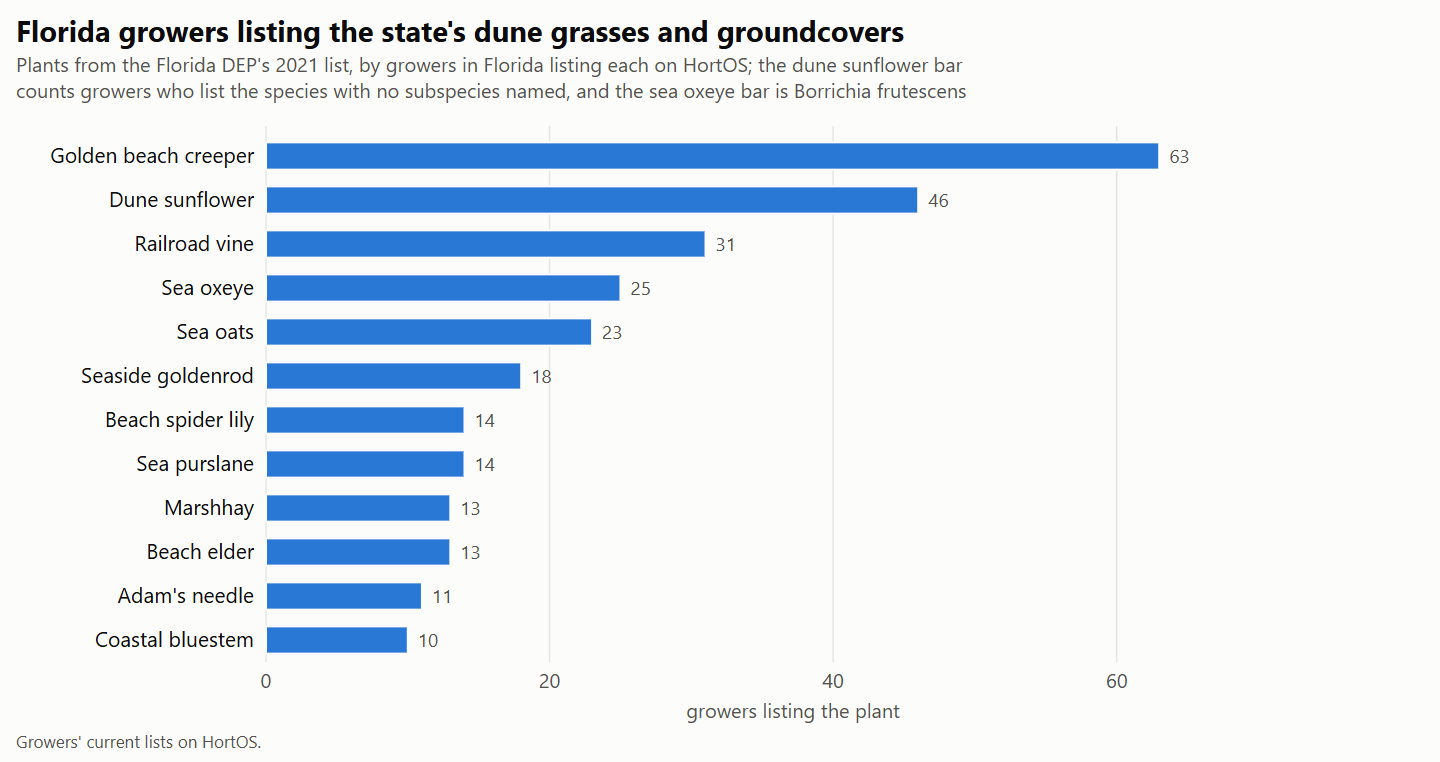
The first table adds both. Its rows are the plants in the Dune Grasses and Groundcovers groups of that list. The list marks 3 of them with an asterisk, and those are not shown. Its second column gives the DEP's regions and soil moisture class for each plant. Grower counts are the growers listing each plant on HortOS, in any size. Each count in these tables is of growers in Florida. Prices are medians across growers' current trade lists on HortOS: one price per grower, ex tax, freight not included, with the number of growers pricing each size in brackets. Anyone can see the prices on HortOS, and only the trade can order.
| Plant | Florida DEP regions and soil moisture (2021) | Growers listing it in Florida | #1 median (growers pricing) |
|---|---|---|---|
| Salt grass (Distichlis spicata) | All regions; moist | 8 | Fewer than three growers |
| Bitter panic grass (Panicum amarum) | All regions; dry | 8 | Fewer than three growers |
| Coastal bluestem (Schizachyrium scoparium) | All regions; moderate | 10 | $3.98 (20) |
| Marshhay (Spartina patens) | All regions; moderate | 13 | $2.98 (12) |
| Seashore dropseed (Sporobolus virginicus) | All regions; moist | 5 | Fewer than three growers |
| Sea oats (Uniola paniculata) | All regions; dry | 23 | $3.75 (13) |
| Sea oxeye (Borrichia arborescens) | SW, SE, Keys; moist | 8 | $3.38 (6) |
| Sea oxeye (Borrichia frutescens) | All regions; moist | 25 | $3.00 (11) |
| Beach rosemary (Conradina canescens) | NW; dry | 9 | $4.00 (5) |
| Golden beach creeper (Ernodea littoralis) | SW, SE, Keys; moderate to dry | 63 | $2.50 (39) |
| Dune sunflower (Helianthus debilis) | NE, SE, Keys; dry | 46 | $3.25 (33) |
| Cucumber leaf dune sunflower (Helianthus debilis subsp. cucumerifolius) | NW, SW; dry | 1 | Fewer than three growers |
| West Coast dune sunflower (Helianthus debilis subsp. vestitus) | SW; dry | 1 | Fewer than three growers |
| Beach spider lily (Hymenocallis latifolia) | SW, NE, SE, Keys; moist to dry | 14 | $4.50 (4) |
| Beach morning glory (Ipomoea imperati) | All regions; moderate, dry | 7 | $3.88 (4) |
| Railroad vine (Ipomoea pes-caprae) | All regions; moderate, dry | 31 | $3.00 (23) |
| Beach elder (Iva imbricata) | All regions; moist to dry | 13 | $3.00 (9) |
| Sea purslane (Sesuvium portulacastrum) | All regions; moist to moderate | 14 | $3.00 (11) |
| Seaside goldenrod (Solidago sempervirens) | NW, SW, NE, SE; moist to moderate | 18 | $3.50 (17) |
| Adam's needle (Yucca filamentosa) | NW, SW, NE, SE; dry | 11 | $4.00 (6) |
The Florida DEP (2021) uses five region codes: NW is the northwest Panhandle, SW runs from Pinellas to Collier counties, NE from Nassau to Volusia, SE from Brevard to Dade, and Keys means the Florida Keys and nearby islands. "All regions" stands for the DEP's "all". The Florida DEP (2021) says a region reflects where a plant has historically grown in the natural upland communities of Florida's coast, not every place it could survive. In its soil classes, moist means ground subject to flooding, such as a low dune swale, dry means deep sand and dune ridges, and moderate lies between (Florida DEP, 2021).
The price column is the median for a #1 container across every grower on HortOS pricing that size, in any state. A median needs three growers pricing a size, and 5 rows have none at #1. The coastal bluestem row counts growers who list Schizachyrium scoparium under the species name, and does not show whether a grower's plants are of coastal origin. Growers in other states price this species, marshhay and seaside goldenrod too, and the Florida medians at #1 are $3.25, $2.75 and $3.25, in that order. A Florida median is the median among only the growers in Florida pricing that size on the same date. HortOS shows one where three or more of them do, and prints no count with it. Beach morning glory's median rests on 4 growers and beach spider lily's on 4, and none is offered as a typical price.
Gulf hairawn muhly grass, the variety the DEP names, has no row: no grower in Florida listed it under that variety name, and the 3 growers who did are in other states. The Florida DEP (2021) lists Helianthus debilis under the name East Coast dune sunflower, for its NE, SE and Keys regions. The dune sunflower row counts growers who list the species with no subspecies named, and does not show which subspecies their plants are. The two subspecies rows count only growers who name the subspecies.
A #1 container is not the unit the two agencies write of most (third table). The Florida DEP (August 2022 draft) lays out plugs and names gallon pots as one option at wider spacing, and the USDA NRCS (2007) says pots of 2 to 4 inches do for most work. The median for sea oats in a 4-inch pot was $1.99 across 5 growers in any state, and $2.25 in Florida. For a liner of bitter panic grass it was $0.80 across 4 growers in any state, and $0.75 in Florida. Each of those two Florida figures rests on fewer growers than the count beside it. Container classes are explained in the guide to nursery pot sizes.
The sources differ on railroad vine. The Florida DEP (2021) lists it for all regions, and UF/IFAS Gardening Solutions (read October 2026) says it stands up to salt air and sandy ground and can help against erosion around dunes. The USDA NRCS (2007) calls it more sensitive to freezing than beach morning glory. It says the plant occurs north of a line from Tampa Bay to Cape Canaveral, but does not recommend it for revegetation at the northern end of its range (USDA NRCS, 2007).
The second table's rows are shrubs, trees and palms on both lists: the DEP's 2021 list and the NRCS's 2007 list of native plants for dune restoration in Florida. Coco plum, yaupon holly, wax myrtle and saw palmetto are on both lists too, and are priced in the guide to Florida's HOA landscaping law, not here. The DEP's Shrubs, Thorn/Scrub Plants, Trees and Palms groups are much longer, and 46 of their plants are not in this table. Its second column gives the DEP's salt tolerance class and regions, and its price columns are #3 and #7 containers. Those medians, like the first table's, are across growers in any state pricing the size.
| Plant | Florida DEP salt tolerance and regions (2021) | Growers listing it in Florida | #3 median (growers pricing) | #7 median (growers pricing) |
|---|---|---|---|---|
| Sea lavender (Argusia gnaphalodes) | High; SE, Keys | 5 | $15 (3) | Fewer than three growers |
| Sand live oak (Quercus geminata) | Moderate; NW, SW, NE, SE | 22 | $9.75 (6) | $30 (5) |
| Bay cedar (Suriana maritima) | High; SW, SE, Keys | 13 | $12 (4) | $45 (8) |
| Spanish bayonet (Yucca aloifolia) | High; all regions | 12 | $12.50 (4) | Fewer than three growers |
| Sea grape (Coccoloba uvifera) | High; SW, SE, Keys | 184 | $6.25 (50) | $18 (80) |
| Buttonwood (Conocarpus erectus) | High; SW, SE, Keys | 214 | $4.50 (49) | $15 (74) |
| Cabbage palm (Sabal palmetto) | High; all regions | 56 | $15 (3) | $40 (4) |
High, in the Florida DEP's classes (2021), means a plant tolerates heavy, frequent salt spray and flooding by salt water. Moderate means it tolerates spray but can show leaf burn under heavy spray (Florida DEP, 2021).
Some medians here rest on few growers: sea lavender's #3 median on 3, bay cedar's on 4, Spanish bayonet's on 4, and cabbage palm's #3 and #7 medians on 3 and 4.
The UF/IFAS and Florida Sea Grant manual for the western Panhandle (first published 2018, read in its 2026 online edition) says woody species should be held back until at least two or three small dunes have formed again. Sand live oak, sea grape and cabbage palm also appear in the guide to hurricane wind resistance of trees.
Spacing, depth and season as two agencies give them
The third table sets the Florida DEP's planting recommendations, headed as an August 2022 draft, beside the USDA NRCS's 2007 publication for Florida. Each cell reports one agency, and neither column is HortOS's advice.
| Subject | Florida DEP (August 2022 draft) | USDA NRCS (2007) |
|---|---|---|
| Spacing | Staggered rows with plant centers about 18 inches apart on average; plugs can go as close as 9 inches, and gallon or 6-inch pots at 3 feet or more. | In the row, 1 to 3 feet, and most often 18 inches for small potted plants or bare root plugs; rows 1 to 3 feet apart. |
| Planting depth | Top of the root ball at least 6 inches under the surface, in damp sand, with 3 inches or more of leaf left showing on small plants. | Grasses with the root ball 8 inches down; forbs just under the surface or as deep as 2 inches. |
| Plant size | A plug of about 1 square inch in a 2.5-inch pot is the smallest; a sea oat plug has five or more healthy leaves and dense white roots. | Pots of 2 to 4 inches do for most work; 1-inch liners in the rainy season, with irrigation or with polymer gel. |
| Mix of species | Bitter panicum as a quarter of the grasses, with groundcovers such as beach elder added, set out in clusters of 10 to 15 plants. | At least three species of the frontal zone where possible, matching the mix in natural areas nearby. |
| Position and width of the planting | As far landward as the site allows and never seaward of the existing line of dune plants. | A planted strip at least 10 feet wide, and wider on badly eroded sites. |
| Dry months and planting window | North Florida plantings may get too little rain in a very dry October or May; watering, above all at planting, can also help in central and south Florida's dry season, January to May. | March to November south of a line from Tampa Bay to Cape Canaveral; April to October north of it. |
| Fertilizer at planting | Where fertilizer is used, half a teaspoon of slow release 18-6-12 in the hole for each liner is one recipe; local fertilizer ordinances come first. | A controlled release fertilizer at planting, at one teaspoon for each non-woody plant or 1 ounce for each woody plant. |
| Watering | With well-timed rain a planting can establish unwatered. Research it reports found 70 percent survival over a year where good plants, set deep, got 1 to 2 inches of rain a month on average. | Irrigation is advised during establishment where practical, and not after the stand is established. |
The two differ on depth. The Florida DEP (August 2022 draft) wants the root ball's top 6 inches or more under the surface, and the NRCS (2007) gives 8 inches for grasses in general. Of sea oats the NRCS (2007) says the root ball's top must sit 4 inches or more below the surface. The UF/IFAS Panhandle manual (2026 online edition) gives at least 6 inches for sea oats, and names shallow planting as what most often kills plants.
Season is another difference. North of a line from Tampa Bay to Cape Canaveral the NRCS (2007) gives April to October as the planting window. For the Panhandle, the UF/IFAS and Florida Sea Grant manual (2026 online edition) gives December through April for beach elder, bitter panicgrass and sea oats.
On the mix of species the sources pull two ways. The Florida DEP (August 2022 draft) calls sea oats "an ideal choice for about any beach or dune site". The NRCS (2007) says Florida's frontal dunes are far from a stand of one species, even where sea oats dominate. The UF/IFAS Panhandle manual (2026 online edition) suggests at least three to four herbaceous species in separate blocks or rows, because sea oats set right beside bitter panicgrass replace it within one to two years.
What a grower's listing does not show
A count here is growers listing the plant, not how many plants exist or how well it suits a site. For any one grower, the directory does not show the five things below. Each is a question to put to that grower.
- Where the seed or cuttings came from. The Florida DEP (August 2022 draft) recommends buying from local nurseries that grow from plants native to the project's region, and says research shows sea oats of local origin perform best. The UF/IFAS Panhandle manual (2026 online edition) tells Gulf Coast buyers to ask whether a nursery's sea oats originate from the Gulf Coast.
- Which subspecies of dune sunflower. UF/IFAS Gardening Solutions (read October 2026) says three subspecies grow in Florida, and that the local one should be chosen because a subspecies from the other coast can hybridize with it. The USDA NRCS (2007) says no Helianthus debilis should be planted in the southwestern Florida counties unless it is identified as subspecies vestitus.
- How a plant was raised. Section 161.242(2), Florida Statutes (2026), permits licensed, certified nurserymen to sell sea oats and sea grapes they grow "from seeds or by vegetative propagation". A grower can say which applies to a line.
- A grower's registration. In a separate chapter, s. 581.131(1), Florida Statutes (2026), requires a nurseryman to apply for a certificate of registration before selling or distributing "nursery stock" in Florida. A buyer can ask a grower for its registration number.
- How many plants, and by when. The USDA NRCS wrote in 2007 that a project needing more than a few thousand plants should allow lead time to contract growers to raise them.
A separate guide covers how buyers outside the trade order from wholesale growers.
What to watch for
- Reading the #1 median as the price of a plug. The tables price #1, #3 and #7 containers, and the two agencies write mostly of plugs, liners and small pots.
- Treating the beach as a source of plants. Section 161.242(2), Florida Statutes (2026), makes possession of sea oats or sea grapes by anyone other than the landowner prima facie evidence of a violation.
- Carrying one coast's plants to another. The Florida DEP (2021) lists beach rosemary for the NW region alone and sea lavender for SE and the Keys.
- Reading the planting table as one current standard. One column is a Florida DEP draft of August 2022 and the other an NRCS publication of 2007, and they differ on depth, watering and fertilizer.
Getting it right
- Find the site's region in the Florida DEP's 2021 list (NW, SW, NE, SE or Keys) and read the list for that region and the site's soil moisture.
- Ask the Florida DEP's CCCL field inspector whether the planting needs a CCCL permit, and name any sand fill, fence, irrigation or barrier in the plan. The DEP says its field inspectors issue the permits for minor work such as dune planting (page last modified February 24, 2025).
- Ask each grower where the seed or cuttings came from, which subspecies a dune sunflower is, how the plants were raised, and how many it can raise by the planting date.
- Agree the planting unit (plug, liner, small pot or #1 container) and ask for a written quote for that unit. What a plug, a liner or a #1 container costs, and on what terms, is each grower's to say.
A word of caution
The statutes quoted here are the 2026 Florida Statutes as the Florida Senate's site printed them on October 5, 2026. Whether a planting seaward of the control line needs a CCCL permit is a question the Florida DEP says its field inspectors answer (page last modified February 24, 2025). The planting figures come from a Florida DEP draft of August 2022 and a USDA NRCS publication of 2007. The counts and medians on this page are those HortOS showed, and a grower's own word decides what it offers and where its plants came from.
Sources
- The Florida Senate, 2026 Florida Statutes, section 161.242: sea oats and sea grape law.
- The Florida Senate, 2026 Florida Statutes, section 161.053: coastal construction control line law.
- The Florida Senate, 2026 Florida Statutes, section 581.131: nursery certificate of registration.
- Florida Department of Environmental Protection, questions about the Coastal Construction Control Line: field inspectors and minor permits.
- Florida DEP, Recommended Florida Native Beach and Dune Plants for Beachfront Properties and Dune Restoration (2021): the state's full plant list.
- Florida DEP, CCCL Dune Planting Recommendations (August 2022 draft): how to plant sea oats.
- Florida DEP, CCCL Dune Plant Maintenance Guidelines (March 2022): permits for cutting dune plants.
- USDA NRCS, Native Plants for Coastal Dune Restoration: What, When, and How for Florida (2007): dune plants, planting, nursery notes.
- UF/IFAS Extension and Florida Sea Grant, Dune Restoration and Enhancement for the Florida Panhandle (first published 2018, 2026 online edition): the Panhandle planting manual.
- UF/IFAS Gardening Solutions, Railroad Vine: railroad vine profile.
- UF/IFAS Gardening Solutions, Beach Sunflower: the dune sunflower subspecies.
More guides

Nursery Pot Sizes Explained: Millimetres, Litres and Gallons
Australian growers name a pot by its rim diameter up to 400 mm and by its volume in litres above that, while American growers use gallon classes. This guide explains each step of the ladder, the approximate height and age behind it, how to convert between systems, and what the trade pays at every size.
Florida's HOA landscaping law and the plants the state program lists
What two sections of the Florida Statutes say about homeowners' association covenants and Florida-friendly landscaping, what they leave with the association, and who decides a dispute. Two tables follow: groundcovers, grasses and shrubs from the UF/IFAS program's plant list, the Florida growers listing each, and a trade median for each at the container size most growers price.
Hurricane wind resistance of trees and what they cost at trade
What the University of Florida's hurricane studies found for trees on the coastal plain and in south Florida, set beside the growers listing each tree on HortOS and the median trade price of a #15 container. The page describes the UF/IFAS wind resistance classes, links the full lists and says what neither the studies nor the figures show.