Crape myrtle bark scale and the small flowering trees growers list
For city foresters, HOA boards and property managers in the Southeast with bark scale on their crape myrtles. It reports what the University of Arkansas, Texas A&M AgriLife Extension and the Crapemyrtle Bark Scale Team say about the insect, then shows the crape myrtle cultivars and native small flowering trees growers list, with container medians.
Updated October 8, 2026. Figures are what the live us.hortosapp.com price and plant pages printed.
On this page
A city forester, an HOA board or a property manager in the Southeast finds white crust and black mold on the crape myrtles along a street. The question is what the extension services say about the scale, and which other small flowering trees growers list beside crape myrtle. Texas A&M AgriLife Extension wrote in 2020 that crape myrtle bark scale rarely kills a healthy crape myrtle, and that every crape myrtle cultivar sold commercially appears susceptible to it.
This page reports what the University of Arkansas Division of Agriculture, Texas A&M AgriLife Extension and the Crapemyrtle Bark Scale Team say about the insect. It draws on University of Georgia Extension and NC State Extension for the trees. It adds what is printed on HortOS, a free directory of American wholesale plant growers with their published availability and trade prices. It is not a treatment guide, and it is not a list of trees tested against the scale.
Quick facts
| First report | Texas A&M AgriLife Extension (2020) dates the first United States report of the scale to 2004, near Dallas, Texas. |
|---|---|
| States counted | A May 2022 update from the Crapemyrtle Bark Scale Team (United States) counted 18 states with infestations, among them Alabama, Georgia, Louisiana, North Carolina, South Carolina and Tennessee. |
| Where it lives | The Crapemyrtle Bark Scale Team (United States, 2020) describes the scale as found principally on crape myrtles across the Southeast, and says it has also been recorded in the United States feeding on American beautyberry. |
| Cultivars | Texas A&M AgriLife Extension (2020) wrote that all commercially sold crape myrtle cultivars appear susceptible, though some may be slightly less so than others. |
| Harm | Texas A&M AgriLife Extension (2020) says the scale rarely kills healthy crape myrtles, while infested cuttings and small container plants may be more vulnerable. |
| On HortOS | 294 growers listed the crape myrtle 'Natchez' and 194 listed eastern redbud on HortOS. |
What the extension services say about the scale
The University of Arkansas Division of Agriculture (Arkansas, 2014) calls the scale easy to identify: no other bark scale was known on crape myrtles in the United States. Texas A&M AgriLife Extension (Texas, 2020) describes white insects on bark and twigs that give off a pink fluid when crushed.
The Arkansas fact sheet (2014) traces the early spread beyond Texas. It records the scale at Ardmore, Oklahoma and Shreveport, Louisiana in 2012 and at Houma, Louisiana in 2013. Germantown, Tennessee followed in October 2013 and Little Rock, Arkansas in January 2014. The Crapemyrtle Bark Scale Team's update on Florida (2022) says a 2021 report from Pace, in Santa Rosa County, was later confirmed by molecular analysis.
On hosts, the team (United States, 2020) says the scale has been reported in Asia on plants of 16 genera in 13 families, and names persimmon and pomegranate. It does not list the other genera.
The sources report both a caution and a limit on treatment. The University of Arkansas reported in 2014 that a systemic insecticide drenched on the root zone was the most promising approach in the tests run up to then. Texas A&M AgriLife Extension (Texas, 2020) says insecticide is not always warranted in a landscape. Its reasons are that heavy infestations rarely kill trees, that yearly treatment is costly, and that treatment can affect pollinators and other beneficial insects.
Washing is another option the sources describe. Texas A&M AgriLife Extension (Texas, 2020) says a soft brush and soapy water take off adult scales and sooty mold and improve a tree's look, without lasting control. The Crapemyrtle Bark Scale Team (United States, 2020) says no data or research shows pruning or power washing to be an effective way to manage the scale.
The crape myrtles growers list
UF/IFAS Extension (Florida, 2018) says tree inventories from several large Southeastern cities show crape myrtle among the region's most commonly planted landscape trees. NC State Extension's Plant Toolbox (North Carolina, read 2026) says 'Natchez' was bred to resist mildew and tolerates drought, heat, clay soil and urban sites.
The first table shows the crape myrtle cultivars that the Plant Toolbox lists by cultivar name on its two crape myrtle pages and that have a price page on HortOS. A further 28 cultivars named on those two pages have no price page here and are not shown. Entries printed there under a trade or series name, and species entries, are not counted in either number. Grower counts are the growers listing each plant on HortOS, in any size. Prices are medians across growers' current trade lists on HortOS: one price per grower, ex tax, freight not included, with the number of growers pricing each size in brackets. Anyone can see the prices on HortOS, and only the trade can order.
Most of the growers listing the plants in this table are in Florida, North Carolina and Texas. The size shown for each plant is the container size most growers price; field grown lines are not counted. Where a row says Field grown only, its growers price that plant as field grown stock and no container median is shown.
The table is not a list of resistant cultivars: Texas A&M AgriLife Extension's 2020 statement that all commercial cultivars appear susceptible covers every row. The species word in a row is how HortOS files the cultivar, not a statement of parentage. The Plant Toolbox (North Carolina, read 2026) gives many of these cultivars as crosses between Lagerstroemia indica and L. subcostata var. fauriei.
The size differs from row to row, so one row's median is not set against another's. 'Natchez' is priced at #15, where 102 growers price it. The medians for 'Arapaho', 'Zuni', 'Hopi', 'Biloxi' and 'Centennial Spirit' rest on 3 growers each, and the median for 'Victor' on 4. A median needs three growers pricing a size.
Native small flowering trees growers list
Two authorities speak of mixing species. Mississippi State University Extension (Mississippi, 2026) encourages landscape planners to include some other species, to lower the risk that a large planting of crape myrtle alone carries. The N.C. Forest Service's urban forestry guidance (North Carolina, 2026) says to build species diversity into a planting area and the wider community, to limit the effect of insects and disease. The guide to street trees and canopy covers the larger trees growers list, for a planting that needs shade too.
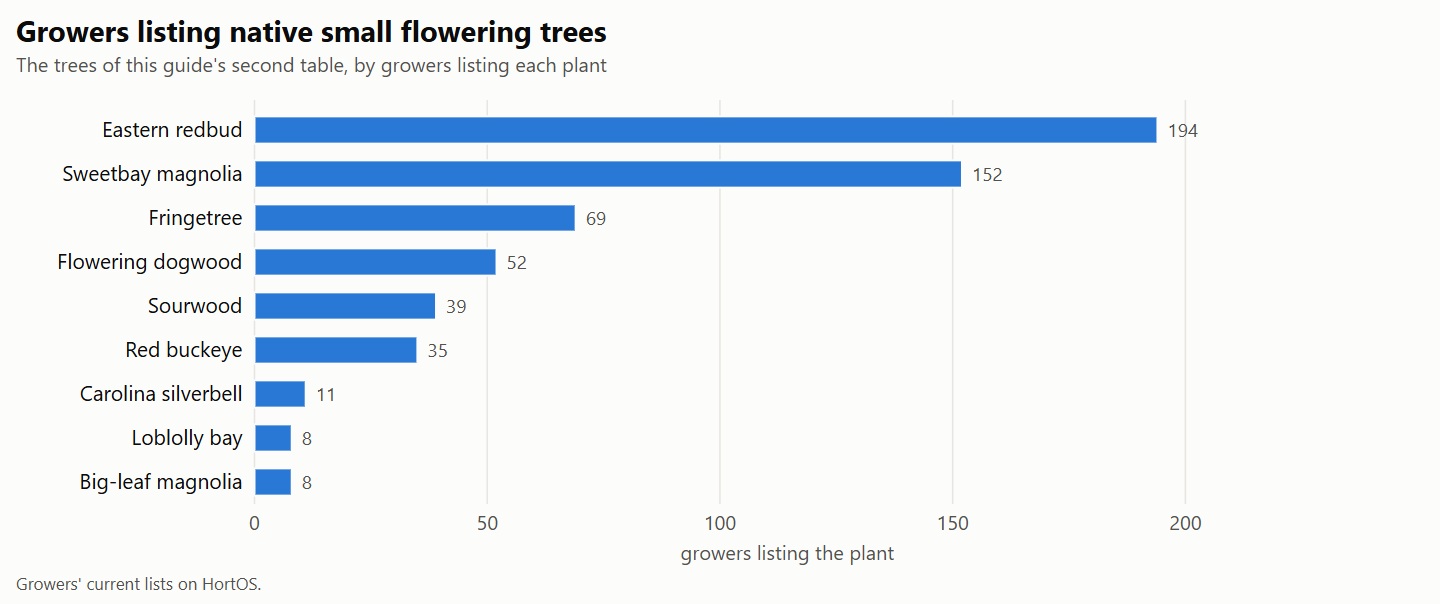
The second table is this page's own selection, not a recommendation by either authority. Some rows are native trees that University of Georgia Extension's Bulletin 987 (Georgia, 2024) describes as flowering trees among its small trees. Others are trees that NC State Extension's Plant Toolbox (North Carolina, read 2026) names as native alternatives for crape myrtle. Sweetbay magnolia is added, and each row has a page on HortOS. A further 6 plants that meet one of those descriptions are not shown, shrubs the Toolbox names among them. Native is Georgia's and North Carolina's description, not a claim for the whole South.
| Plant | Growers listing it | Size most growers price | Median (growers pricing) |
|---|---|---|---|
| Eastern redbud (Cercis canadensis) | 194 | #15 | $77.50 (28) |
| Sweetbay magnolia (Magnolia virginiana) | 152 | #15 | $62.50 (32) |
| Fringetree (Chionanthus virginicus) | 69 | #3 | $20 (12) |
| Flowering dogwood (Cornus florida) | 52 | #5 | $40 (4) |
| Sourwood (Oxydendrum arboreum) | 39 | #7 | $39 (7) |
| Red buckeye (Aesculus pavia) | 35 | #3 | $15.50 (4) |
| Carolina silverbell (Halesia tetraptera) | 11 | #3 | $16 (3) |
| Loblolly bay (Gordonia lasianthus) | 8 | #3 | $12.75 (3) |
| Big-leaf magnolia (Magnolia macrophylla) | 8 | Fewer than three growers |
The growers listing the plants in this table are spread across many states; the most are in Florida, North Carolina and Tennessee. The size shown for each plant is the container size most growers price; field grown lines are not counted.
Of the 9 rows, 8 carry a median. Sizes differ by row here too. The medians for Carolina silverbell and loblolly bay rest on 3 growers each. Those for flowering dogwood and red buckeye rest on 4 each. Big-leaf magnolia has a count and no median.
The sources give a bloom season for some of these trees. University of Georgia Extension (Georgia, 2024) says eastern redbud is grown mainly for its blooms in March and April, and fringetree, a slow grower, for its show in May and June. UF/IFAS Extension (Florida, 2018) notes that few other landscape trees bloom in summer as crape myrtle does. Three rows are described as doing so. University of Georgia Extension (Georgia, 2024) gives sourwood flowers in June and July and loblolly bay fragrant white flowers in summer. The Plant Toolbox (North Carolina, read 2026) says sweetbay magnolia blooms on and off through summer until the first frosts, and usually reaches 10 to 35 feet in height and spread.
The same sources give limits. University of Georgia Extension (Georgia, 2024) says flowering dogwood should never go on a wet site and names powdery mildew and leaf spot anthracnose as possible problems. It calls big-leaf magnolia temperamental and often hard to establish.
What the listings do not show
The team's host statement names persimmon and pomegranate and leaves the other Asian genera unnamed. This page therefore makes no claim about how any tree in the second table fares with the scale, and none of its sources reports a test of them.
The counts are growers across the United States who list a plant, not Southern growers alone. The hubs for Georgia, South Carolina, North Carolina, Tennessee, Louisiana and Alabama show the growers in each state. A count here is growers listing the plant, not how many plants exist or how well it suits a site.
A listing does not show whether a tree was inspected for the scale, or whether the nursery lies in a county where the scale is recorded. It does not show whether a listed native tree is the straight species or was raised from local seed. Only the grower can answer those questions. A median is a trade price for one container on growers' lists, not the cost of a planting.
What to watch for
- Reading the first table as a list of resistant crape myrtles. Texas A&M AgriLife Extension (Texas, 2020) found none among the cultivars sold commercially.
- Reading the second table as trees shown to be free of the scale. The Crapemyrtle Bark Scale Team (United States, 2020) reports hosts in 13 plant families in Asia and names only two of the plants.
- Assuming a light infestation will be seen. Mississippi State University Extension (Mississippi, 2026) notes that a light infestation is hard to detect on a plant.
- Treating pruning or power washing as control. The Crapemyrtle Bark Scale Team (United States, 2020) says no research supports either.
Getting it right
- Have the insect confirmed. The county extension office decides what it is; ask whether the white crust on the bark is crape myrtle bark scale.
- Ask the extension agent whether treatment is warranted for the site. Texas A&M AgriLife Extension (Texas, 2020) says it is not always warranted in landscapes.
- Ask the city forester or the HOA's arborist which species the planting plan allows. The N.C. Forest Service (North Carolina, 2026) describes diversity as a goal for the planting area and the community.
- Ask each grower what was inspected. UF/IFAS Extension (Florida, 2018) says all woody parts of a small plant should be inspected before it is bought or planted, and the N.C. Department of Agriculture and Consumer Services (North Carolina, 2023) asks that crape myrtle material be inspected before it is moved.
- Agree who looks at the trees on arrival. The N.C. Forest Service (North Carolina, 2026) tells communities to check trees at the nursery or on delivery, and Mississippi State University Extension (Mississippi, 2026) asks builders and landscape contractors to take the same care with crape myrtles for new sites. The guide to buying from a wholesale grower explains how a trade order is placed.
A word of caution
The statements on the scale here are those of the University of Arkansas Division of Agriculture (2014), Texas A&M AgriLife Extension (2020) and the Crapemyrtle Bark Scale Team (2020 and 2022), and each speaks for its own date. The state department of agriculture and the county extension office are the bodies to ask about a county today. University of Georgia Extension (Georgia, 2024) says the sizes in its bulletin are only estimates of a plant at 10 years old. A grower's list changes week to week, so the grower is the one to ask about any tree.
Sources
- University of Arkansas Division of Agriculture, FSA7086, Crapemyrtle Bark Scale: A New Insect Pest: early records, identification, control options.
- Texas A&M AgriLife Extension, EHT-146, Biology and Management of the Crapemyrtle Bark Scale: Landscape and Nursery Growers: biology, damage and management.
- Crapemyrtle Bark Scale Team, General Biology: hosts and life cycle.
- Crapemyrtle Bark Scale Team, Management: mechanical, biological and chemical options.
- Crapemyrtle Bark Scale Team, update of May 17, 2022: states with infestations that year.
- Crapemyrtle Bark Scale Team, update of September 16, 2022: the first Florida detection.
- UF/IFAS Extension, EENY-711, Crapemyrtle Bark Scale: crape myrtle in Southeastern landscapes, inspection.
- Mississippi State University Extension, Publication 2938, Crape Myrtle Bark Scale Management and Control: scouting and planting diversity.
- University of Georgia Cooperative Extension, Bulletin 987, Native Plants for Georgia Part I: Trees, Shrubs, and Woody Vines: native small flowering trees described.
- N.C. Department of Agriculture and Consumer Services, Pest Alert: Crape Myrtle Bark Scale: inspection before moving plants.
- N.C. Forest Service, Urban Forestation and Tree Planting: species diversity and tree inspection.
- NC State Extension, Plant Toolbox, Lagerstroemia indica: cultivars and native alternatives named.
- NC State Extension, Plant Toolbox, Lagerstroemia: cultivars and native alternatives named.
- NC State Extension, Plant Toolbox, Lagerstroemia 'Natchez': origin and traits of 'Natchez'.
- NC State Extension, Plant Toolbox, Magnolia virginiana: sweetbay magnolia size and bloom.
More guides

Street Trees and Canopy: What Advanced Stock Costs and Who Holds It
A standing reference for urban forestry programs and tree nonprofits: the trees the American trade grows for streets and parks, the nursery-gate median at #15, #30, #45 and #65 and as field grown stock, how many growers in each state hold advanced stock, why lead times run to years, and what a street tree costs against a giveaway.

Buying From a Wholesale Grower When You Are Not in the Trade
Native plant societies, watershed districts, land trusts, schools and church committees can buy from wholesale growers when they order like the trade: in quantity, ahead of the season, on the grower's terms. This page explains who sells to whom, resale certificates and exemptions, minimums and pooling, the sizes to buy, straight species and ecotype, lead times and shipping.
Florida's HOA landscaping law and the plants the state program lists
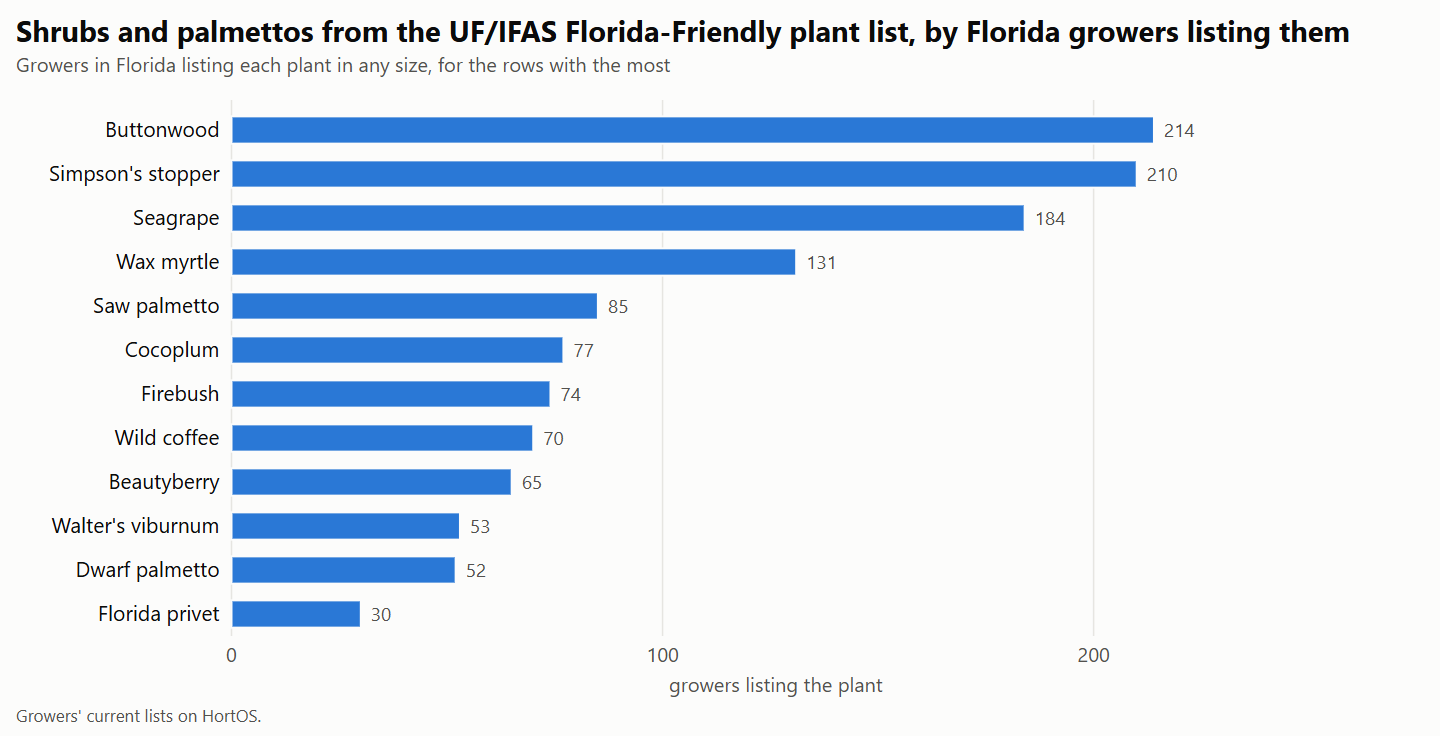
What two sections of the Florida Statutes say about homeowners' association covenants and Florida-friendly landscaping, what they leave with the association, and who decides a dispute. Two tables follow: groundcovers, grasses and shrubs from the UF/IFAS program's plant list, the Florida growers listing each, and a trade median for each at the container size most growers price.