Beech leaf disease and the trees planted where beech is lost
For urban foresters and land trusts in the Northeast, Ohio and Michigan. It reports what Penn State Extension and state agencies say about beech leaf disease, sets out the trees Rutgers Cooperative Extension and the Scott Arboretum name for replanting, and adds the growers listing each tree, with a container median where three growers price a size.
Updated October 21, 2026. Figures are what the live us.hortosapp.com price and plant pages printed.
On this page
An urban forester in Ohio sees beech leaf disease thin a stand and asks one thing. Which trees are named for planting where beech is lost, and how many wholesale growers list each one. The two published answers reported here each name a mix of trees, not a single substitute. Rutgers Cooperative Extension (New Jersey, 2023) names ten native trees that grow beside beech, and asks for 10 to 20 small trees in place of each beech.
This page reports the disease as Penn State Extension, the Ohio Department of Natural Resources and other state sources describe it, and replanting as Rutgers and the Scott Arboretum describe it. HortOS, a free directory of American wholesale plant growers with their published availability and trade prices, adds the growers listing each tree and, where three growers price a size, a trade median. The page is not treatment advice. It recommends no tree and takes no view on planting, keeping or felling a beech.
Quick facts
| Cause and first find | Penn State Extension (Pennsylvania, 2024) says a nematode that is a parasite of tree leaves causes beech leaf disease, and dates its first identification to 2012, in Lake County, Ohio. |
|---|---|
| Trees affected | Penn State Extension (Pennsylvania, 2024) calls the disease a substantial threat to American beech and to every other species of beech (Fagus). |
| Where it is | The USDA Forest Service's pest alert (revised April 2026) names Ohio, fifteen other states and Ontario as places where the disease has been detected since 2012. Its county map is linked under Sources. |
| Treatment | Penn State Extension (Pennsylvania, 2024) says single trees can be treated, which can be expensive, and that no large-scale treatment is feasible in forests. |
| Replanting | Rutgers Cooperative Extension (New Jersey, 2023) asks for small container-grown trees, planted 10 to 20 for each beech and protected from deer. |
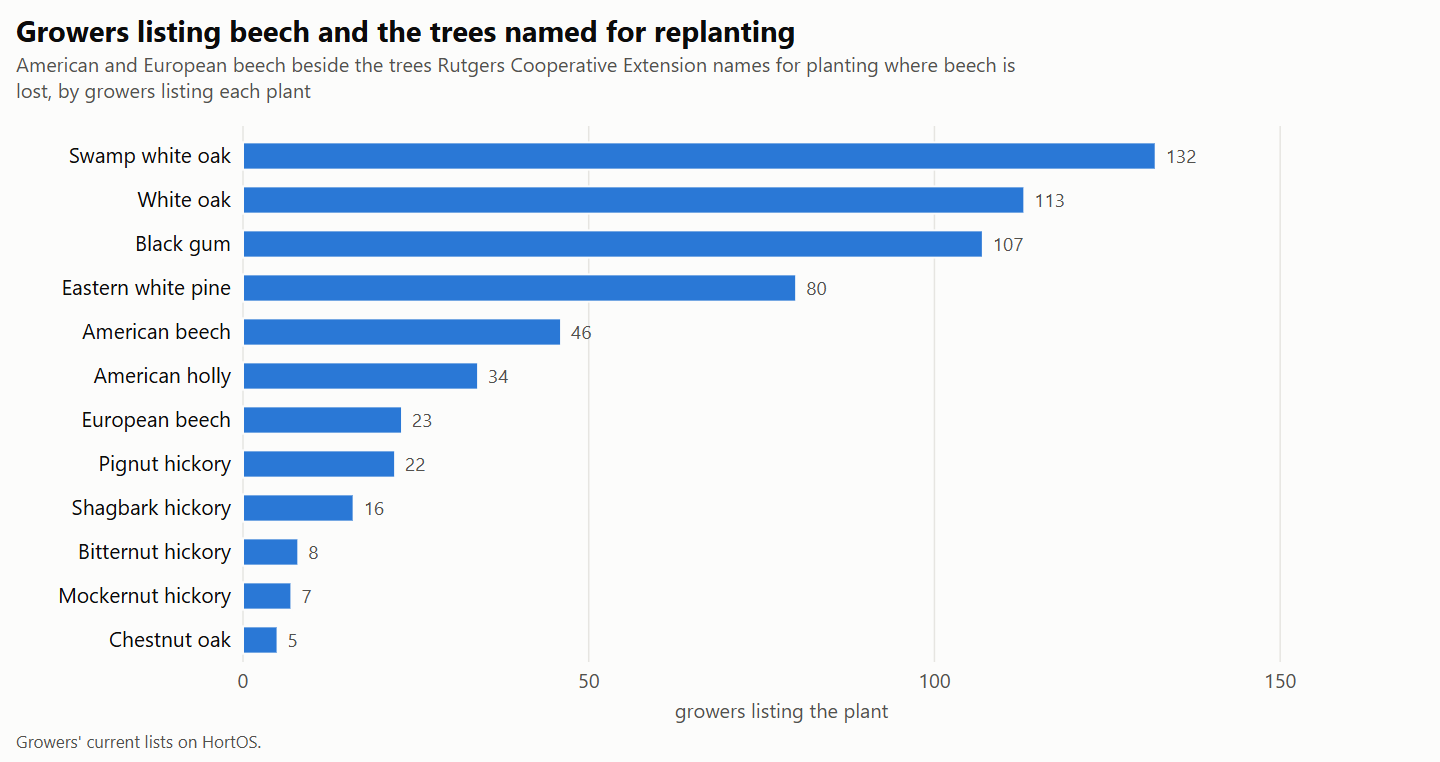
| Growers and a trade median | 107 growers listed black gum on HortOS in any size. Its median trade price at #3 was $14.50, from 17 growers pricing that size: one price per grower, ex tax, freight not included. |
The disease as the state sources describe it
Penn State Extension (Pennsylvania, 2024) names the cause as Litylenchus crenatae ssp. mccannii, a nematode. The sign Penn State (Pennsylvania, 2024) gives is dark banding between the leaf veins, visible as the leaves open in early spring. Penn State (Pennsylvania, 2024) says the banding is harder to spot early on dark-leaved trees such as copper beech (Fagus sylvatica 'Purpurea'). Penn State (Pennsylvania, 2024) also says repeated damage kills an infected beech, and that the way the nematode passes from tree to tree was not known.
The state sources report deaths among young trees. The Ohio Department of Natural Resources (2020) reports heavy losses of understory beech seedlings and saplings in some areas. The Connecticut Agricultural Experiment Station (2025) reports understory saplings dead in as few as three years in the Northeast.
State sources date the spread. New York's 2024 Forest Health Highlights give 2018 for the first find there. The Connecticut Agricultural Experiment Station (2025) gives 2019 for Connecticut and 2020 for Rhode Island and Massachusetts. Michigan's Department of Natural Resources (2025) reports the disease confirmed in eight counties of southeast Michigan, the first of them in 2022.
Keeping, treating and planting beech, authority by authority
The next table sets side by side what named authorities say about replanting, and about planting and keeping beech. Each row is one statement in this page's words.
| State | Authority and year | What it says about replanting, or about planting and keeping beech |
|---|---|---|
| New Jersey | Rutgers Cooperative Extension, 2023 | Plant the native trees that grow beside beech, fenced against deer. Ten species are named. |
| Pennsylvania | Scott Arboretum & Gardens, Swarthmore College, 2025 | Plans to replant its beech woods with white oak, hickories and maple (Acer rubrum), let tulip poplar seed itself, and plant redbud, chokeberry and dogwood (Cornus florida) beneath. |
| Pennsylvania | Penn State Extension, 2024 | Single trees can be treated, at a cost; no treatment is workable across a forest, and a tree damaged over several years may be past saving. |
| Ohio | Holden Forests & Gardens, 2026 | For now it does not recommend new beech plantings. |
| Ohio | Holden Forests & Gardens, 2026 | Asks owners not to fell beech ahead of symptoms, since a tree may prove resistant; a declining tree that has become a hazard is the exception. |
| Connecticut | Connecticut Agricultural Experiment Station, 2025 | Describes three treatments for a beech that is kept; of the three, only the phosphite treatment is described as one a homeowner can apply. |
| Michigan | Michigan Department of Natural Resources, 2025 | Chemical treatment may be workable for a high-value landscape tree; it is not a cure and is thought unlikely to slow the spread much. |
| New York | New York Forest Health Highlights, 2024 | No treatment is known for forest beech; the state agency and SUNY ESF are trialling canopy thinning and understory removal. |
| New Hampshire | NHBugs (University of New Hampshire), read October 2026 | Moving live beech plants should be kept to a strict minimum. |
The Pennsylvania, Michigan and New York rows put treatment at the scale of single trees, not forests. Rutgers Cooperative Extension (New Jersey, 2023) says the newer treatments do not suit most beech forest, and can succeed in some small woodlots, ornamental plantings and arboreta. On buying beech, one more state source stands beside the Holden and NHBugs rows. Vermont Invasives, which names the Vermont Department of Forests, Parks and Recreation among its information credits (read October 2026), asks buyers to look for the disease on every beech bought for planting. HortOS takes neither side. Growers list American and European beech, and both open the next table with their own counts.
The trees named for replanting and the growers listing them
Rutgers Cooperative Extension (New Jersey, 2023) names ten trees for New Jersey plantings: white, chestnut and swamp white oak, four hickories, American holly, white pine and black gum. The Scott Arboretum of Swarthmore College (Pennsylvania, 2025) plans to replant its own beech woods with white oak, hickories and red maple, and to let tulip poplar seed in. Beneath them it is planting redbud, chokeberry and flowering dogwood.
The table below is this page's own selection, and no authority compiled it. American and European beech come first, for reference. Then come the trees that Rutgers or the Scott Arboretum names to species. The last five rows are this page's choice. Sugar maple and American basswood are among the common associates of American beech in the USDA Forest Service's 1991 species account. NC State Extension (North Carolina, read 2026) describes American hornbeam and shadblow serviceberry as understory trees, and says eastern hop hornbeam prefers partial to deep shade. The Scott Arboretum gives 3 more names only to genus (hickories, redbud and chokeberry), and those are not rows.
Grower counts are the growers listing each plant on HortOS, in any size. Prices are medians across growers' current trade lists on HortOS: one price per grower, ex tax, freight not included, with the number of growers pricing each size in brackets. Anyone can see the prices on HortOS, and only the trade can order.
The growers listing the plants in this table are spread across many states; the most are in Florida, North Carolina and Tennessee. The size shown for each plant is the container size most growers price; field grown lines are not counted. Where a row says Field grown only, its growers price that plant as field grown stock and no container median is shown.
The size differs from row to row, so the medians do not rank the trees by price. A median needs three growers pricing a size. That is why 4 rows carry a count and no median: chestnut oak and shagbark, mockernut and bitternut hickory, all named by Rutgers. NC State Extension (North Carolina, read 2026) says pignut hickory may be hard to find for sale. 22 growers listed it, and 6 priced it at #3.
Some medians rest on few growers. Eastern hop hornbeam's median at #15 comes from 3 growers pricing that size, and American basswood's from 3. A median on so few moves when one grower changes a price. Each count and median is national, across every grower listing the tree, and is not a Northeast or Great Lakes figure. The hubs for Ohio, Pennsylvania, New Jersey, New York and Michigan show the growers in each state.
What a grower count does not show
A listing shows that a grower lists a tree, and no more. It does not show where the seed was collected. Rutgers Cooperative Extension (New Jersey, 2023) asks for local ecotypes from New Jersey, and the directory records no seed source for any grower. Nor does it show whether a line is the straight species, how a tree was grown, whether it has been inspected for disease, or whether the grower delivers into a given state. Those are questions for each grower. The guide to buying from a wholesale grower sets out how a land trust or a society places such an order.
The table gives one container size for each tree and no field grown or caliper price. The guide to street trees and canopy covers the larger sizes that cities and parks plant. Nothing here shows whether a given beech will resist the disease, and the page reports no state's rules on planting, selling or moving beech.
What to watch for
- Planting one tree for one beech. Rutgers Cooperative Extension (New Jersey, 2023) asks for a dense stand of 10 to 20 trees for each beech, behind a physical barrier against deer.
- Felling a beech that shows no symptoms. Holden Forests & Gardens (Ohio, 2026) asks owners not to cut ahead of symptoms, and excepts a declining tree that has become a hazard.
- Reading the county map as a map of stands. The USDA Forest Service's pest alert (revised April 2026) says a county on its map may stand for one infected tree or for spread across the whole county.
- Comparing medians across rows. White oak's median is at #15 and black gum's at #3, so the two figures are not for the same size of tree.
- Overlooking another disease or a hard move. NC State Extension (North Carolina, read 2026) describes swamp white oak as highly susceptible to oak wilt, and says black gum and American hornbeam are difficult to transplant.
Getting it right
- Ask the state forestry agency or the county extension office to confirm the disease before anything is cut or ordered.
- For a beech that is to be kept, ask a certified arborist whether treatment suits that tree and what it will cost.
- Settle the mix of trees with the state's extension service or urban forestry program. Michigan's Department of Natural Resources (2025) says its urban and community forestry program is releasing a Michigan Community Tree Species Selection Guide.
- Open each tree's page from the table to see its growers by state, and ask each grower about seed source, straight species and delivery.
- Look up the size wanted on the price pages, where every priced size is shown, and ask more than one grower for a written quote with freight.
A word of caution
This page reports the disease as Penn State Extension, the Ohio Department of Natural Resources and the other state sources named above describe it, and treatments only as options. Whether to treat, fell or replant is the owner's decision, and a certified arborist, the state forestry agency and the state's extension service are the ones to ask. The replanting names are Rutgers Cooperative Extension's for New Jersey and the Scott Arboretum's for its own woods. Counts and medians are what HortOS showed, and they change as growers update their lists.
Sources
- Penn State Extension, Beech Leaf Disease (2024): cause, hosts, signs, treatment.
- Ohio Department of Natural Resources, Beech Leaf Disease (2020): discovery and understory losses.
- USDA Forest Service, Pest Alert: Beech Leaf Disease (revised April 2026): states listed, county map.
- Connecticut Agricultural Experiment Station, Updated Beech Leaf Disease Biology and Management (2025): New England dates, treatments.
- Michigan Department of Natural Resources, Michigan 2025 Forest Health Highlights: counties, treatment, species guide.
- New York 2024 Forest Health Highlights: first find, silviculture trials.
- NHBugs, University of New Hampshire, Beech Leaf Disease: moving live beech plants.
- Vermont Invasives, Beech Leaf Disease: checking beech bought for planting.
- Rutgers Cooperative Extension of Salem County, Beech Leaf Disease: is Saving Beech Out of Reach (2023): ten trees for replanting.
- Scott Arboretum & Gardens, Swarthmore College, Beech Leaf Disease (2025): its own replanting plan.
- Holden Forests & Gardens, Beech Leaf Disease (2026): planting and felling beech.
- USDA Forest Service, Fire Effects Information System, Fagus grandifolia (1991): trees that grow with beech.
- NC State Extension, Carpinus caroliniana: American hornbeam, shade, transplanting.
- NC State Extension, Ostrya virginiana: hop hornbeam and shade.
- NC State Extension, Amelanchier canadensis: serviceberry, an understory tree.
- NC State Extension, Quercus bicolor: swamp white oak, oak wilt.
- NC State Extension, Carya glabra: pignut hickory in the trade.
- NC State Extension, Nyssa sylvatica: black gum and transplanting.
More guides

Buying From a Wholesale Grower When You Are Not in the Trade
Native plant societies, watershed districts, land trusts, schools and church committees can buy from wholesale growers when they order like the trade: in quantity, ahead of the season, on the grower's terms. This page explains who sells to whom, resale certificates and exemptions, minimums and pooling, the sizes to buy, straight species and ecotype, lead times and shipping.

Street Trees and Canopy: What Advanced Stock Costs and Who Holds It
A standing reference for urban forestry programs and tree nonprofits: the trees the American trade grows for streets and parks, the nursery-gate median at #15, #30, #45 and #65 and as field grown stock, how many growers in each state hold advanced stock, why lead times run to years, and what a street tree costs against a giveaway.
Florida's HOA landscaping law and the plants the state program lists
What two sections of the Florida Statutes say about homeowners' association covenants and Florida-friendly landscaping, what they leave with the association, and who decides a dispute. Two tables follow: groundcovers, grasses and shrubs from the UF/IFAS program's plant list, the Florida growers listing each, and a trade median for each at the container size most growers price.