Planting Trees at a Park or Street Tree Event
A tree planting day is judged two summers later, and the sizes, spacing and aftercare plan decided before it keep the trees alive. This page covers sizes volunteers can plant, spacing for the mature canopy, the planting method arborists publish, running the day and the first two summers.
Updated October 24, 2026. Plant counts and median trade prices from the live us.hortosapp.com plant and price pages on 25 October 2026; state grower counts from the hubs on 24 September 2026.
On this page
A tree planting day is judged two summers later, when the trees either stand in leaf or stand as dead sticks in a line of stakes. The one idea that matters most is that the planting day is the easy part, and the sizes, the spacing and the aftercare plan decided before it are what keep the trees alive.
This page is for the friends group, school, club or city or county staff running a park or street tree planting day with volunteers. It covers sizes volunteers can plant, spacing, the planting method the arborists' bodies publish, the day itself and the two years after it. It draws on those bodies and on HortOS, a free directory of American wholesale plant growers with their published availability and trade prices. Specifying and procuring trees covers the tree order itself.
Quick facts
| Sizes for volunteers | Volunteers plant liners to #15 containers by hand. Larger trees need a contractor and machinery. |
|---|---|
| The hole | Two to three times wider than the root ball and only as deep, with the trunk flare showing, according to the International Society of Arboriculture. |
| Spacing | Space for the tree's mature canopy, not its size on the day. Small trees about 4 to 6 meters apart, large trees 10 meters or more. |
| Mulch | A ring of mulch a few centimeters deep, kept off the trunk. Never a volcano of mulch against the bark. |
| Aftercare | Deep watering through the first two summers, weeding inside the mulch ring, and stakes and guards removed on time. |
| Where the trees are | Growers listing trees are on the state hubs: Florida, California, Pennsylvania. |
Sizes volunteers can plant
The size of tree decides who can plant it. Liners to #15 containers can be carried and planted by hand with a spade. Anything larger is heavy, needs a deep hole and usually a machine, and belongs to a contractor working beside the volunteers. Smaller trees also establish faster in a prepared site and cost far less, so a planting day gets more trees in the ground for the money.
The table lists trees often planted in parks and streets, with how many growers listed each on HortOS on 25 October 2026. Prices are medians across growers' current trade lists on HortOS on 25 October 2026: one price per grower, ex tax, freight not included, with the number of growers pricing each size in brackets. Grower counts are the growers listing each plant on HortOS on 25 October 2026, in any size. A median needs three growers pricing a size. Anyone can see the prices on HortOS, and only the trade can order.
| Tree | Growers listing it | Size most growers price | Median there |
|---|---|---|---|
| Bald cypress (Taxodium distichum) | 368 | #30 (89) | $120 |
| Southern live oak (Quercus virginiana) | 327 | #45 (107) | $265 |
| Shumard oak (Quercus shumardii) | 199 | #30 (40) | $125 |
| Eastern redbud (Cercis canadensis) | 194 | #15 (28) | $77.50 |
| Willow oak (Quercus phellos) | 187 | #15 (35) | $60.00 |
| Red maple (Acer rubrum) | 152 | #15 (20) | $60.00 |
| Tulip tree (Liriodendron tulipifera) | 134 | #15 (22) | $60.00 |
| Swamp white oak (Quercus bicolor) | 132 | #7 (10) | $37.75 |
| River birch (Betula nigra) | 114 | #30 (20) | $125 |
| Bur oak (Quercus macrocarpa) | 108 | #30 (12) | $118 |
| Black gum (Nyssa sylvatica) | 107 | #3 (17) | $14.50 |
| American sycamore (Platanus occidentalis) | 91 | #15 (16) | $60.00 |
Of the trees in the table, bald cypress (Taxodium distichum) had the most growers listing it, 368, and American sycamore (Platanus occidentalis) the fewest of those shown, 91. A tree many growers list is easier to order in numbers and to replace if it fails.
Choosing the trees
Choose trees for the site, not the day. A tree's mature height and spread, its tolerance of the soil, drainage and exposure, and how much water it will need once established decide whether it thrives. Natives suited to the district usually establish best and support local wildlife, and a mix of species protects a planting from losing every tree to one pest.
Ask the city or county's arborist or the landowner which species they want on the site, since many keep an approved list for parks and streets. Then check which of those species growers near the site list, in the sizes volunteers can plant, before fixing the plan.
Spacing and the site plan
Space trees for their mature canopy. A tree that will be ten meters wide planted four meters from the next will crowd it within fifteen years. Mark every planting spot on the ground before the day with a painted dot or a peg, set back from paths, roads and buildings, and away from overhead wires.
Underground services are the risk volunteers cannot see. Ask the city or county or the utility locating service for the area to mark pipes and cables before any hole is dug. Trees under power lines covers what may be planted near overhead lines.
Planting the tree
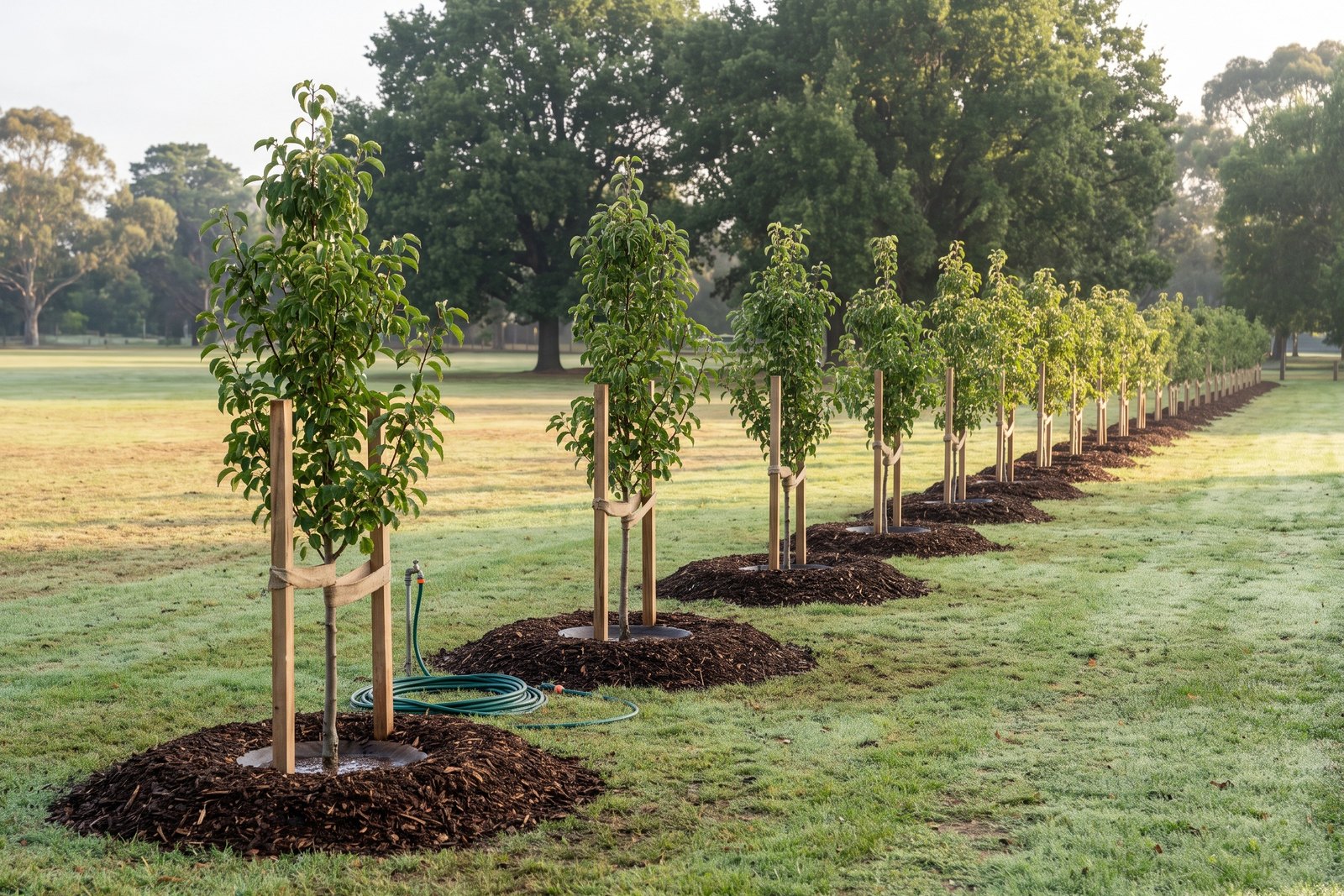
The International Society of Arboriculture's Trees Are Good guide says the planting hole should be two to three times wider than the root ball but only as deep. It says the trunk flare should be partly visible after planting, and that mulch should be 2 to 3 inches deep and kept 1 to 2 inches off the trunk. Clemson Cooperative Extension adds that in well-drained soil the hole should be at least twice and preferably five times wider than the root ball. It warns against piling mulch against the trunk.
- Find the trunk flare, where the roots spread from the trunk, and set it at or just above ground level.
- Dig a wide, shallow hole, and loosen the sides so roots can grow out.
- Tease out circling roots on a container tree, and remove any wrapping.
- Backfill with the soil from the hole, firming gently and watering as you go to settle it.
- Spread mulch in a wide ring, kept clear of the trunk.
- Stake only on windy sites, with loose ties, and remove the stakes after the first year.
Running the day
Many planting days are timed for Arbor Day, and the Arbor Day Foundation's Tree City USA program, begun in 1976, asks member communities to spend at least $2 per capita a year on community tree care.
- Brief in small groups. Show each group one tree planted correctly before they start. Ten volunteers watching one demonstration plant better than a hundred reading a sheet.
- Tools and water on site. Spades, gloves, a water source and buckets at each group, and the trees laid out at their spots before people arrive.
- Check every tree. Walk the row before people leave. A tree planted too deep or with mulch against the trunk is fixed in a minute on the day and dies if left.
The first two summers
Most losses happen in the first two summers. Agree before the day who waters, how often and with what. A deep soak once a week in dry weather is better than a sprinkle every day. Pull weeds inside the mulch ring, top up the mulch, and remove stakes and guards before they cut into the trunk. Planning a planting budget shows how to cost the watering.
Count the trees at the end of each summer. A simple survival count, with the dead trees marked on the site plan, tells the group how its method and watering worked, and which species to plant again. Replace losses in the next cool season from the same species that thrived, so the planting closes up evenly.
What to watch for
- Planting too deep. A tree buried past its trunk flare struggles for years. Find the flare before planting.
- Volcano mulch. Mulch piled against the trunk rots the bark. Keep a gap at the trunk.
- Big trees for a big day. Large trees look good in photographs and are hard for volunteers to plant well. Plant smaller and plant more.
- No watering plan. Trees planted and left die in the first dry spell. Name who waters before the day.
- Stakes left on. Ties left on for years cut into the trunk. Diary the removal.
Getting it right
- Agree the site, the trees and the aftercare with the city or county or landowner, and have services marked.
- Order liners to #15 containers from growers near the site, a season ahead.
- Mark every planting spot for the mature canopy, clear of paths, wires and services.
- Brief volunteers in small groups with a demonstration tree, and check every tree before they leave.
- Mulch in a wide ring, stake only where needed, and water in deeply.
- Water through two summers, weed the rings, and remove stakes and guards on time.
A word of caution
The planting method on this page is what the arborists' bodies named here publish, and the city or county's arborist or the landowner sets the rules for each site. The tree counts and prices are what HortOS printed on 25 October 2026, and the live pages change as growers update their lists.
Sources
- International Society of Arboriculture, Trees Are Good: planting a tree: planting depth, width and mulch.
- Clemson Cooperative Extension, Planting Trees Correctly: hole width, depth and mulch.
- Arbor Day Foundation, Tree City USA: community forestry standards since 1976.
- AmericanHort, American Standard for Nursery Stock (ANSI Z60.1): container classes, caliper and root balls.
More guides
Specifying and Procuring Trees for a Street or Park Planting
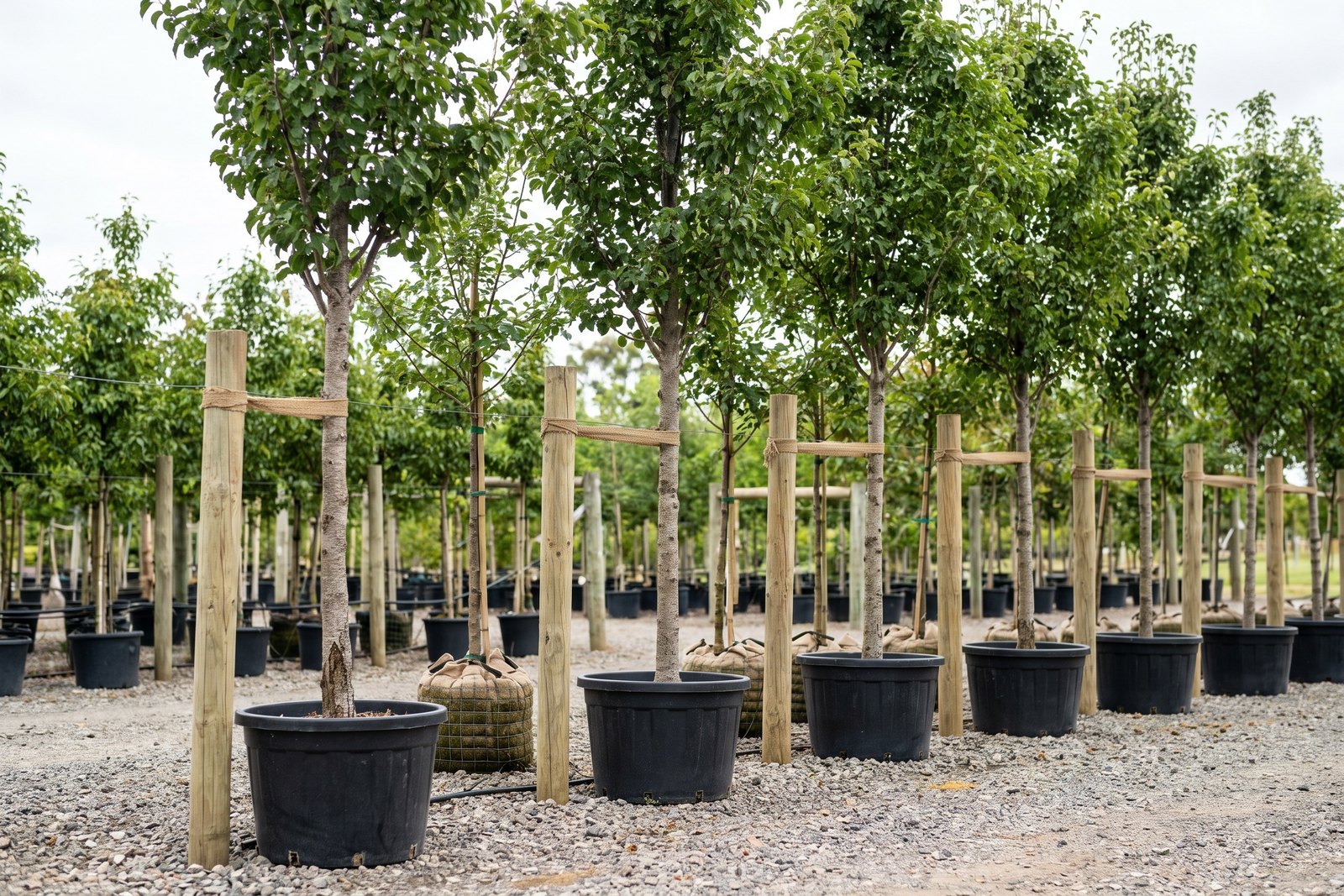
A street or park planting fails at the specification more often than at the planting. This page explains the nursery stock standard to specify against, what goes in the clause, how the trade grows and grades advanced trees, where the growers are, the quote and tender process, and the inspection at the nursery and at delivery.
Planting near power lines: utility rules and the plants they name
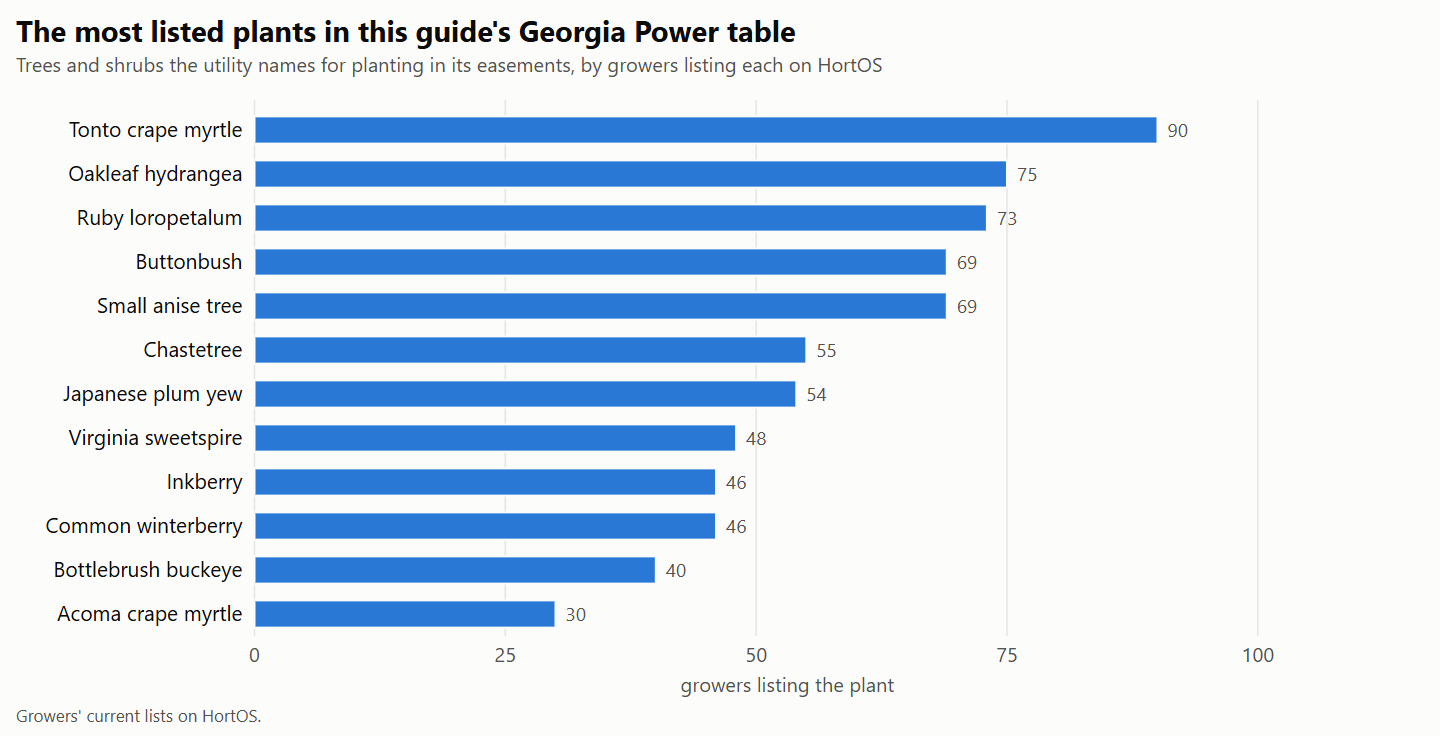
What Georgia Power, Florida Power & Light, Dominion Energy, Santee Cooper and Eversource publish about planting near distribution and transmission lines, beside a Florida statute, a New Jersey rule as published in 2010, a California general order and a national reliability standard. Tables set the plants Georgia Power and Santee Cooper name beside grower counts and median trade prices.
Planning a Planting Budget for a Council or School
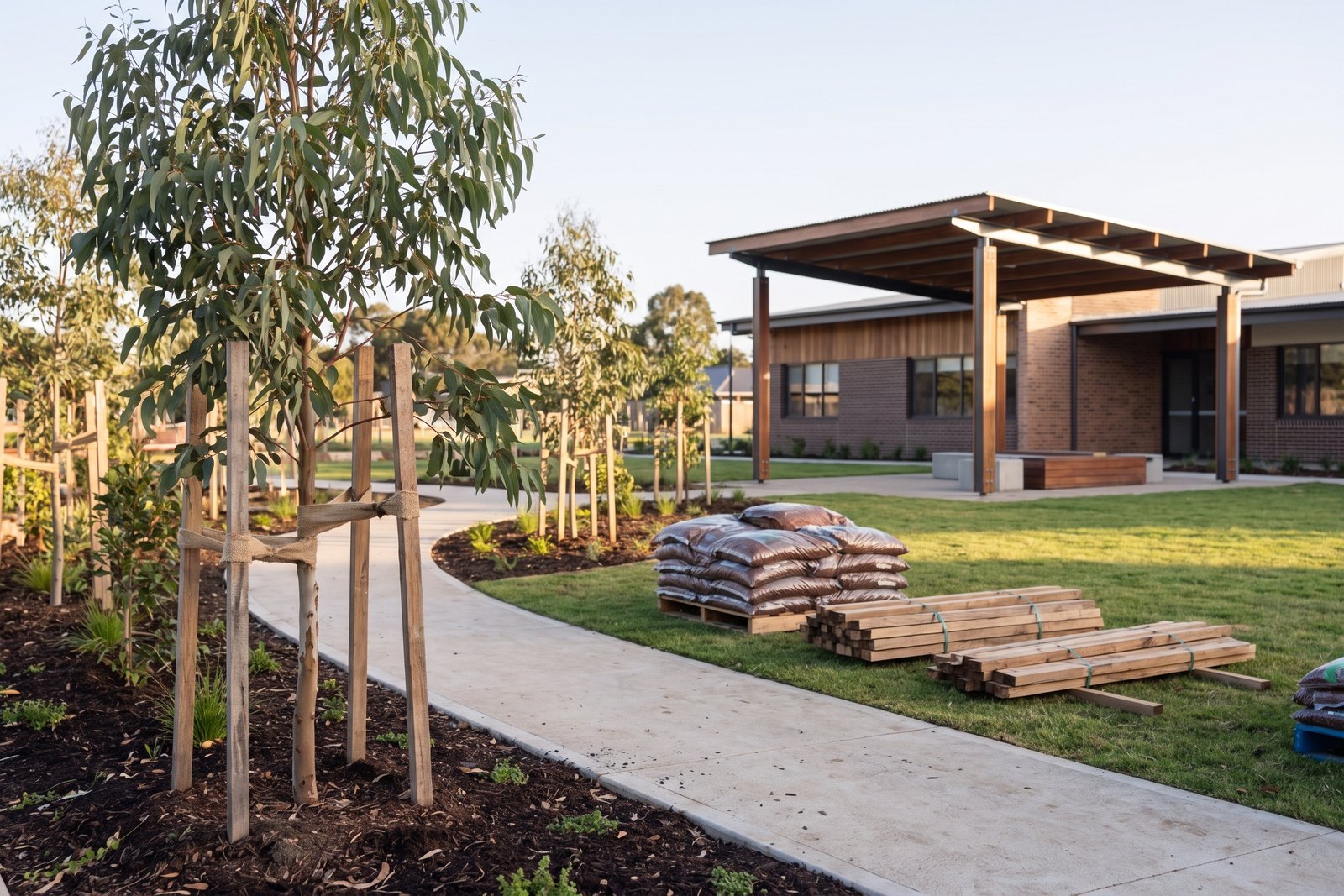
The plants are commonly a third to a half of a planting's real cost. This page builds a budget line by line for a park, a street, a school ground or a community site: plant lines at growers' trade prices, then site work, mulch, hardware, water for two summers, labor, delivery, replacements and maintenance, with a worked example.