Tree mitigation fees in Texas and Florida cities and replacement trees
The fees that Texas and Florida cities print for paying in place of replacement trees, each from the city's own dated document, with what the fee covers and when it may be paid. The page explains the Texas planting credit and Florida's section 163.045, then shows growers listing the trees those cities name.
Updated September 2, 2026. Figures are what the live us.hortosapp.com price and plant pages printed.
On this page
A builder in a Texas or Florida city holds a tree permit that counts the inches removed and asks for them back, in trees or in money. The builder wants to know which costs less. The city's own rule usually speaks first: in several of the cities read for this page, the fee is the fallback a city accepts when the site cannot take the replacement trees, not an open choice against planting. A fee and a grower's price also pay for different things.
This page draws on the Texas Legislature's H.B. 7 of 2017, on section 163.045 of the Florida Statutes, and on the fee sheets, pages and forms of cities in both states. It adds what growers list for the trees those cities name on HortOS, a free directory of American wholesale plant growers with their published availability and trade prices. It is a summary of public documents. It is not legal advice and not a quote for any site.
Quick facts
| The Texas planting credit | Section 212.905 of the Texas Local Government Code, added by H.B. 7 in 2017, requires a municipality that charges a tree mitigation fee to let the person apply for a tree planting credit against it. |
|---|---|
| The tree that earns it | Under the Texas act of 2017 (H.B. 7), a credited tree has a diameter of two inches or more at a point 4.5 feet up the trunk. |
| Florida's residential section | Section 163.045 of the Florida Statutes (2026) bars a local government from requiring a permit, fee or mitigation to remove a tree on residential property where the owner holds the documentation the section defines. |
| Dallas | The City of Dallas, Texas, standards sheet gives $193 per diameter inch for Class 1 trees as of July 2, 2018, charged only where payment takes the place of planting. |
| Grapevine | The City of Grapevine, Texas, prints $320.41 per caliper inch for 2026, a figure its page says includes tree planting costs and is recalculated each year. |
| What a trade price leaves out | A grower's price on HortOS is for the tree alone. Planting, delivery, watering and warranty are extra and are not quoted on this page. |
What a city's fee is and when it may be paid
Section 212.905 of the Texas Local Government Code, as added by H.B. 7 in 2017, defines a tree mitigation fee as a charge a municipality makes in connection with removing a tree from private property. Section 52 of the zoning ordinance of the City of Grapevine, Texas (2018), allows payment into its Tree Reforestation Fund, with a city director's approval, where replacement trees cannot feasibly go on the site or an alternate site. The Environmental Office FAQ of the City of Boca Raton, Florida (read 2026), describes payment to the tree trust fund where a lack of space rules out planting back on the property.
The table below holds 10 cities in Texas and Florida. A city has a row where its own sheet, page, form or brochure, as read for this page, states a fee paid in place of planting or says how one is set. Each figure carries the year of its document, or the year it was read where the document has no date.
| City | Fee in lieu of planting | What it covers and when it applies | City document and year |
|---|---|---|---|
| Dallas, Texas | $193 per diameter inch | Class 1 trees, which are replaced inch for inch. Class 2 trees are $135 and Class 3 trees $77. The rate is dated July 2, 2018 and is charged only where payment takes the place of planting. | City of Dallas, Article X standards sheet, 2018 |
| Grapevine, Texas | $320.41 per caliper inch | The 2026 figure, worked out each year from a 3 inch native shade tree plus planting. The city prints it under its heading for trees removed without a permit. | City of Grapevine, Tree Preservation page, 2026 |
| Bastrop, Texas | $400 per caliper inch | Non-residential sites, as the alternative to replanting the same caliper inches on site. Owner-occupied homes replant and pay no fee. | City of Bastrop, Tree Mitigation page, read 2026 |
| Houston, Texas | $225 to $500 per inch | Scaled to the removed tree: $225 up to 6 inches of caliper, $375 above 6 and up to 12, $500 above 12, and $127 for corridor trees. From a brochure revised in March 2009. | City of Houston, Landscape Regulations brochure, 2009 |
| Tarpon Springs, Florida | $10 to $100 per inch | Per inch removed, rising with trunk size: $10 to $50 on owner-occupied single-family lots and $25 to $100 on other properties. No fee where the replacement trees go in on site. | City of Tarpon Springs, tree FAQ, read 2026 |
| Boca Raton, Florida | $206 per inch | Paid to the tree trust fund where a lack of space rules out replanting. A palm is $225, and single family homes pay $412 a tree. | City of Boca Raton, Environmental Office FAQ, read 2026 |
| St. Cloud, Florida | $215 per caliper inch | Tree preservation rate, to the nearest whole inch: $145 for the tree and its installation plus $70 for a year of maintenance. | City of St. Cloud, Tree Bank Fund sheet, 2021 |
| Winter Park, Florida | $110 per caliper inch | The amount by which each extra caliper inch planted lowers the tree trust fund deposit. Planted trees must be Florida #1 and at least 3 inches in caliper. | City of Winter Park, tree removal permit page, read 2026 |
| St. Augustine, Florida | $300 per tree | Per required replacement tree, not per inch, where replanting on the site is not feasible. The city says it covers the tree, planting, upkeep and any replacement. | City of St. Augustine, Tree Mitigation Fund form, read 2026 |
| Fort Pierce, Florida | Set by resolution | A fee per inch DBH owed in mitigation, fixed by the city commission. The city's page prints no figure. | City of Fort Pierce, tree protection page, read 2026 |
The fees do not all pay for the same thing. The Tree Preservation page of the City of Grapevine, Texas (2026), says its $320.41 per caliper inch is worked out from a native shade tree of 3 inch caliper plus planting. The Tree Bank Fund sheet of the City of St. Cloud, Florida (revised June 2021), builds its $215 per caliper inch from $145 for the tree and installation and $70 for one year of maintenance. The Tree Mitigation Fund form of the City of St. Augustine, Florida (read 2026), says its $300 pays for the tree, for putting it in, for its upkeep and for replacing it where needed.
The City of Dallas, Texas, standards sheet dated July 2, 2018 derives its $193 per diameter inch from a plant appraisal trunk formula worked for a 3 inch caliper tree. A City of Austin, Texas, rule notice of October 5, 2022 proposed $200 per inch of mitigation, or $75 on certified affordable developments, and a city committee recommendation of June 27, 2024 recorded a rate last set in 2010.
Two state laws that change what is owed
The Texas act of 2017 (H.B. 7) sets the planting credit at the whole fee where the property is the person's own one-family or two-family home. The same Texas act of 2017 sets the credit at no less than 50 percent of the fee for residential building that is not for the person's own use, and no less than 40 percent for non-residential property. It also bars a fee for a tree that is diseased or dead (Texas, H.B. 7, 2017).
The documentation in section 163.045 of the Florida Statutes (2026) is an onsite assessment by an ISA certified arborist or a Florida licensed landscape architect, who signs it, finding that the tree "poses an unacceptable risk to persons or property". The same Florida section (2026) defines residential property as a "single-family, detached building" on a lot in active single-family use, and its definition names no other kind of building. The City of Tarpon Springs, Florida, says on its tree page (read 2026) that the statute took effect on July 1, 2019 and that a revised law took effect on July 1, 2022.
What growers list for the trees cities name
A city asks for a replacement tree by trunk size, and each city measures in its own way.
- Section 52 of the City of Grapevine, Texas (2018), asks for trees from the city's approved list that are three inches or more in caliper and seven feet or more in height at planting.
- The approved tree list of the City of Tarpon Springs, Florida (revised 2006), asks for a 15 gallon pot, a grade of Florida #1 or better, and a trunk of 1.5 inches or more measured 12 inches above ground.
- The tree protection page of the City of Fort Pierce, Florida (read 2026), asks for a height of 12 feet or more and a trunk of 2.5 inches DBH or more.
The two HortOS tables below price trees by container class, not by caliper. AmericanHort's American Standard for Nursery Stock, ANSI Z60.2-2025, names #45 among the container classes for a 2 inch caliper Type 1 shade tree and again for a 3 inch one. That is why both tables below are set at #45. A #45 median is still not the price of a tree that meets any one city's size rule.
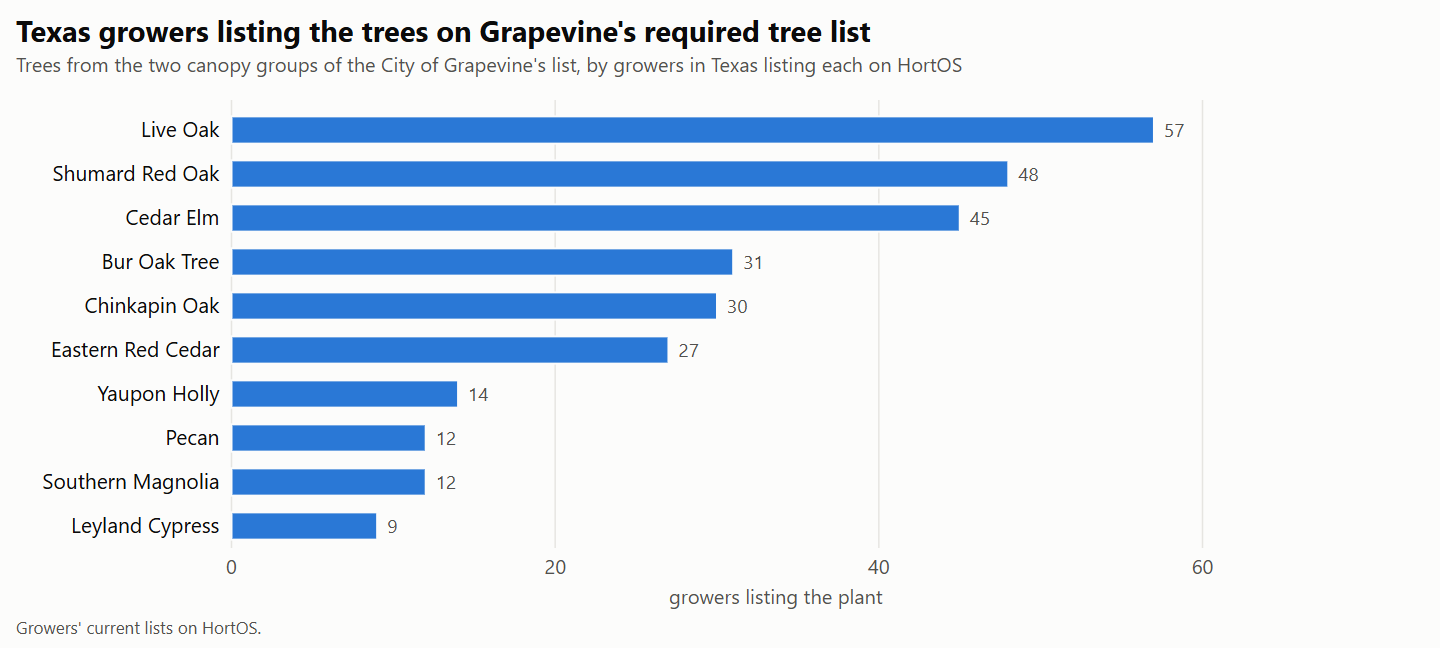
The first table takes the trees in two groups of the required tree list in Section 52 of the City of Grapevine, Texas (2018): its medium to large deciduous trees and its evergreen trees. Each was matched by botanical name to the same species on HortOS. A row is kept where a grower in Texas lists the tree. Of the entries in those groups, 5 are not shown. The count column is growers in Texas. The median column is not a Texas figure: it is the whole-country median at #45. Prices are medians across growers' current trade lists on HortOS: one price per grower, ex tax, freight not included, with the number of growers pricing each size in brackets.
| Plant | Growers listing it in Texas | Size | Median (growers pricing) |
|---|---|---|---|
| Live Oak (Quercus virginiana) | 57 | #45 | $265 (107) |
| Shumard Red Oak (Quercus shumardii) | 48 | #45 | $225 (25) |
| Cedar Elm (Ulmus crassifolia) | 45 | #45 | $227.50 (12) |
| Bur Oak Tree (Quercus macrocarpa) | 31 | #45 | $225 (9) |
| Chinkapin Oak (Quercus muehlenbergii) | 30 | #45 | $245 (7) |
| Eastern Red Cedar (Juniperus virginiana) | 27 | #45 | $237.50 (6) |
| Yaupon Holly (Ilex vomitoria) | 14 | #45 | $235 (7) |
| Pecan (Carya illinoinensis) | 12 | Fewer than three growers | |
| Southern Magnolia (Magnolia grandiflora) | 12 | #45 | $275 (7) |
| Leyland Cypress (Cupressocyparis leylandii) | 9 | #45 | $250 (3) |
| Eldarica Pine (Pinus eldarica) | 6 | Fewer than three growers | |
| Japanese Black Pine (Pinus thunbergii) | 4 | Fewer than three growers | |
| European Black Pine (Pinus nigra) | 1 | Fewer than three growers |
A median needs three growers pricing a size. Where a row prints Fewer than three growers, no #45 median is shown for that tree, and the Leyland cypress figure rests on three growers, the fewest a median may have. A count here is growers listing the plant, not how many plants exist or how well it suits a site.
The second table takes trees that more than one of three Florida cities name under one botanical name. The cities' documents are the approved tree list of the City of Tarpon Springs (revised 2006), the preferred tree list of the City of Tampa (updated 2023) and the City of Fort Pierce's tree protection page (read 2026). Palms are not shown, and 2 other trees that meet the rule are not shown. The count column is growers in Florida, and the median column is again the whole-country #45 figure. That is why live oak, eastern red cedar and southern magnolia print the same median in both tables.
| Plant | Growers listing it in Florida | Size | Median (growers pricing) |
|---|---|---|---|
| Live Oak (Quercus virginiana) | 198 | #45 | $265 (107) |
| Sea Grape (Coccoloba uvifera) | 184 | #45 | $282.50 (24) |
| Bald Cypress (Taxodium distichum) | 163 | #45 | $225 (66) |
| Dahoon Holly (Ilex cassine) | 103 | #45 | $275 (23) |
| Slash Pine (Pinus elliottii) | 93 | #45 | $255 (11) |
| Red Maple (Acer rubrum) | 70 | #45 | $260 (17) |
| Longleaf Pine (Pinus palustris) | 44 | Fewer than three growers | |
| Sweetbay Magnolia (Magnolia virginiana) | 40 | #45 | $250 (5) |
| American Sweetgum (Liquidambar styraciflua) | 35 | #45 | $210 (7) |
| American sycamore (Platanus occidentalis) | 33 | #45 | $240 (9) |
| Pond Cypress (Taxodium ascendens) | 29 | #45 | $235 (8) |
| Eastern Red Cedar (Juniperus virginiana) | 28 | #45 | $237.50 (6) |
| Southern Magnolia (Magnolia grandiflora) | 25 | #45 | $275 (7) |
| Laurel Oak (Quercus laurifolia) | 24 | Fewer than three growers | |
| Crape Myrtle (Lagerstroemia indica) | 18 | #45 | $250 (5) |
| Red Bay (Persea borbonia) | 6 | Fewer than three growers | |
| Florida Elm (Ulmus americana var. floridana) | 4 | Fewer than three growers |
Anyone can see the prices on HortOS, and only the trade can order. A builder whose contractor has not bought this way can read the guide to buying from a wholesale grower, because each grower's terms are its own. The guide to reading an availability list helps with the size column, because growers write sizes as container classes.
What these tables do not show
The fee table is a set of cities, not every city in Texas and Florida. The Dallas and Houston figures carry the earlier years printed in the table, and this page does not show whether either city has changed them.
The medians are whole-country figures at one container class, for the tree alone. Planting, delivery, watering and warranty are extra and are not quoted. Some city fees include planting or upkeep by the city's own words, so a fee and a median are not two prices for the same thing. This page makes no sum from them. A grower's listing does not show the Florida grade, the caliper or the height a city asks for. That is a question for the grower. No table shows that a city accepts a given tree or size.
What to watch for
- Reading the fee as an open choice. Several cities take payment only where the site cannot take the trees.
- Mixing the units. One city counts diameter inches removed, another caliper inches planted, another DBH. The Tree Mitigation page of the City of Bastrop, Texas (read 2026), calls trunk diameter 4.5 feet up from the ground a caliper inch.
- Taking a dated figure as this year's. The City of Grapevine, Texas, says on its 2026 page that its figure is recalculated annually.
- Reading a #45 median as a planted tree. It is a grower's price for one container class, before freight and before anyone plants it.
Getting it right
- Read the permit beside the city's current fee document, and ask the city arborist or the permitting office which rate and which date apply.
- Ask the city whether payment is open for this site, who approves it, and in Texas how to apply for the planting credit.
- Ask the city in writing which species, size, grade and measuring point it accepts before any tree is priced.
- Ask growers for a written quote for that species, size and grade, and ask the planting contractor separately for planting, delivery, watering and warranty.
A word of caution
City fees change by ordinance, by resolution or by yearly recalculation, and each figure here is that of the city's document in the year shown. The city arborist, the development services director or the building official decides what a site owes and which trees count. The city or a lawyer, not HortOS, says how a city's rule applies to a site.
Sources
- Texas Legislature, H.B. 7, enrolled version: the Texas tree planting credit.
- Florida Statutes, section 163.045: trees on residential property.
- City of Dallas, Article X protected tree replacement standards sheet: Dallas classes and rates.
- City of Grapevine, Tree Preservation: Grapevine's yearly replacement cost.
- City of Grapevine, Zoning Ordinance, Section 52: replacement rules and tree list.
- City of Bastrop, Tree Mitigation: Bastrop's fee and units.
- City of Houston, Landscape Regulations for Development brochure: Houston tree fund rates.
- City of Austin, Notice of Proposed Rule on tree mitigation: the proposed payment rate.
- City of Austin, Urban Forestry Committee recommendation: when the rate was set.
- City of Tarpon Springs, Tree and Site Information: the city's account of the statute.
- City of Tarpon Springs, tree FAQ: replacement fees by trunk size.
- City of Tarpon Springs, Approved Tree List: approved trees and planting size.
- City of Tampa, Natural Resources Preferred Tree List: Tampa's preferred trees.
- City of Boca Raton, Environmental Office FAQs: tree trust fund payments.
- City of St. Cloud, Tree Bank Fund: the fee and its parts.
- City of Winter Park, Tree Removal Permit Application: trust fund deposit and size.
- City of St. Augustine, Tree Mitigation Fund Application: the fee per replacement tree.
- City of Fort Pierce, Tree Protection, Removal and Mitigation: mitigation rule and tree lists.
- AmericanHort, American Standard for Nursery Stock: container classes for each caliper.
More guides

Buying From a Wholesale Grower When You Are Not in the Trade
Native plant societies, watershed districts, land trusts, schools and church committees can buy from wholesale growers when they order like the trade: in quantity, ahead of the season, on the grower's terms. This page explains who sells to whom, resale certificates and exemptions, minimums and pooling, the sizes to buy, straight species and ecotype, lead times and shipping.

Reading a Wholesale Availability List, and Pricing the Plants in a Bid
For landscape contractors, designers, estimators and students: what each column of a wholesale availability list means, how much the same plant at the same size varies between growers and states, how the low, median and high on the price pages are built, and how to carry the plant line of a bid from the list to the client.
What the research says trees and landscaping add to a home's value
A study by study account of what American research found trees and landscaping add to a home's value: the seven-state perceived value survey, the Portland and Minnesota sale price models and eight more, each with its method and what it leaves out. A separate section shows what growers list for yard trees and shrubs.