Four state forest nursery seedling programs and what growers list
A guide to four state forest nursery seedling programs, in Indiana, Iowa, Kentucky and Colorado, with the USDA Forest Service's national picture: who may buy, what the trees may be used for, when orders open, and the trade prices growers list for native conservation trees and shrubs.
Updated October 4, 2026. Figures are what the live us.hortosapp.com price and plant pages printed.
On this page
A soil and water conservation district putting together its winter tree sale page wants to tell landowners where to buy low-cost seedlings from the state, and when a larger container tree from a grower is worth a look instead. The one idea that matters most: a state forest nursery sells young seedlings in bundles, on its own calendar, to the buyers its rules name. Those rules decide who can use it before price or size comes up.
This page is a guide to four state programs, read on the pages of the Indiana and Iowa Departments of Natural Resources, the Kentucky Division of Forestry and the Colorado State Forest Service. The USDA Forest Service gives the federal picture. Beside those rules it sets what growers list on HortOS, a free directory of American wholesale plant growers with their published availability and trade prices. It is not a state-by-state directory, it quotes no program price, and it does not say which route suits any one planting.
Quick facts
| State nurseries nationally | The USDA Forest Service reports that 38 state and territorial nurseries grew 123 million tree seedlings in 2022. |
|---|---|
| Federal improvement funds | The USDA Forest Service selected 27 state nurseries for improvement funding in 2023. |
| Iowa order window | The Iowa DNR takes orders from September through May, in multiples of 25 on its online form (program page, 2026). |
| Kentucky season | The Kentucky Division of Forestry opens its online seedling store on October 1 for the spring 2027 season and ships from January through April (2026). |
| Seedling size in Indiana | The Indiana DNR describes its conifer seedlings as usually 4 to 14 inches tall, and its hardwood and shrub seedlings as 4 to 24 inches (2026). |
| Colorado status | The Colorado State Forest Service rebuilt its nursery in 2026, said in May that its spring 2026 sales were closed, and in its August 2026 update planned a grand reopening for October. |
Four state programs and the rules each one sets
Each state writes its own rules, and the four read for this page differ on who may buy, what the trees may be used for, and when orders open. The Indiana DNR says in 2026 that its nurseries grow plants for Indiana landowners to use in conservation plantings. Its list of conservation uses runs from timber and windbreaks to wildlife habitat, soil and water protection, reclamation and teaching. Indiana's nurseries take orders until supplies run out, and the nurseries may swap in another species unless the order form says not to. The Indiana DNR also says its small seedlings ship in bales of several hundred, and it sends buyers to the district forester for their county for help choosing species. Indiana's growers are on its state hub.
Iowa's State Forest Nursery in Ames serves landowners in Iowa and in other states, according to the Iowa DNR's 2026 program page. The same page says the Civilian Conservation Corps set the nursery up in 1937 and that it now sells about 1 million seedlings a year. Fall orders usually go out in the first two weeks of November and spring orders from April, weather permitting, either shipped or collected at the nursery. Iowa's growers are on the Iowa hub.
The Kentucky Division of Forestry runs two nurseries, at Gilbertsville and Grassy Creek, for planting on public and private land, and sells to Kentucky landowners. Its 2026 page says the seedlings grow for one to two years, are lifted in the dormant season and are packed in bundles. Kentucky's list of uses differs from Indiana's and includes open crop or pasture land, urban areas and surface mine reclamation. The two states part ways on one use. The Indiana DNR advises against state nursery seedlings for Christmas tree plantings and points to private nurseries that focus on them. The Kentucky Division of Forestry lists Christmas tree plantations among its uses. Kentucky's growers are on the Kentucky hub.
The Colorado State Forest Service says its Fort Collins nursery was redesigned and rebuilt in 2026 on 130 acres, with fields for bare-root seedlings and greenhouses for container plants. It also runs a separate fund that gives no-cost seedlings to properties hit by natural disasters. Colorado's growers are on the Colorado hub.
The table sets the four programs beside five of the 27 state nurseries named in the USDA Forest Service's 2023 list of improvement projects, picked by HortOS from that list. Those federal rows say what the federal money paid for, and carry no rule on who may buy or when. It holds 9 rows.
| State | Nursery or program | What the page read says | Authority and year |
|---|---|---|---|
| Indiana | Jasper-Pulaski and Vallonia nurseries | Stock is for conservation plantings by Indiana landowners; orders run until the stock is gone | Indiana DNR, 2026 |
| Iowa | State Forest Nursery, Ames | Orders run September through May, in lots of 25, for buyers in Iowa and beyond | Iowa DNR, 2026 |
| Kentucky | Gilbertsville and Grassy Creek nurseries | Sold to Kentucky landowners; shipping runs January through April; the store opens October 1 | Kentucky Division of Forestry, 2026 |
| Colorado | Seedling Tree Nursery, Fort Collins | Rebuilt in 2026; spring 2026 sales were closed; a grand reopening planned for October | Colorado State Forest Service, 2026 |
| Georgia | Flint River Nursery | Federal funds went to equipment for a container longleaf pine program | USDA Forest Service, 2023 |
| North Carolina | Linville Nursery | Federal funds went to benches, trays and media to widen container seedling output | USDA Forest Service, 2023 |
| Missouri | George O. White State Forest Nursery | Federal funds went to replacing the cooler units that store seedlings | USDA Forest Service, 2023 |
| Kansas | Conservation Seedling Nursery | Federal funds went to a new shade house to lift container seedling capacity | USDA Forest Service, 2023 |
| Wisconsin | Hayward State Nursery | Seed from a renovated plant goes to seedlings for public, Tribal and private lands | USDA Forest Service, 2023 |
What the federal picture adds
The USDA Forest Service's page on state and Tribal nurseries puts the four programs in scale. It reports that 38 state and territorial nurseries grew 123 million tree seedlings in 2022 for planting projects across the country. It also says 27 state nurseries were chosen for improvement funding in 2023, and its list shows where the money went. Several of the projects in the table, in Georgia, North Carolina and Kansas, were meant to grow more seedlings in containers.
The Forest Service page lists nurseries and projects. It does not set out each state's buyers, order dates or use rules, which is why the four program pages above carry the detail.
Seedlings and container trees side by side
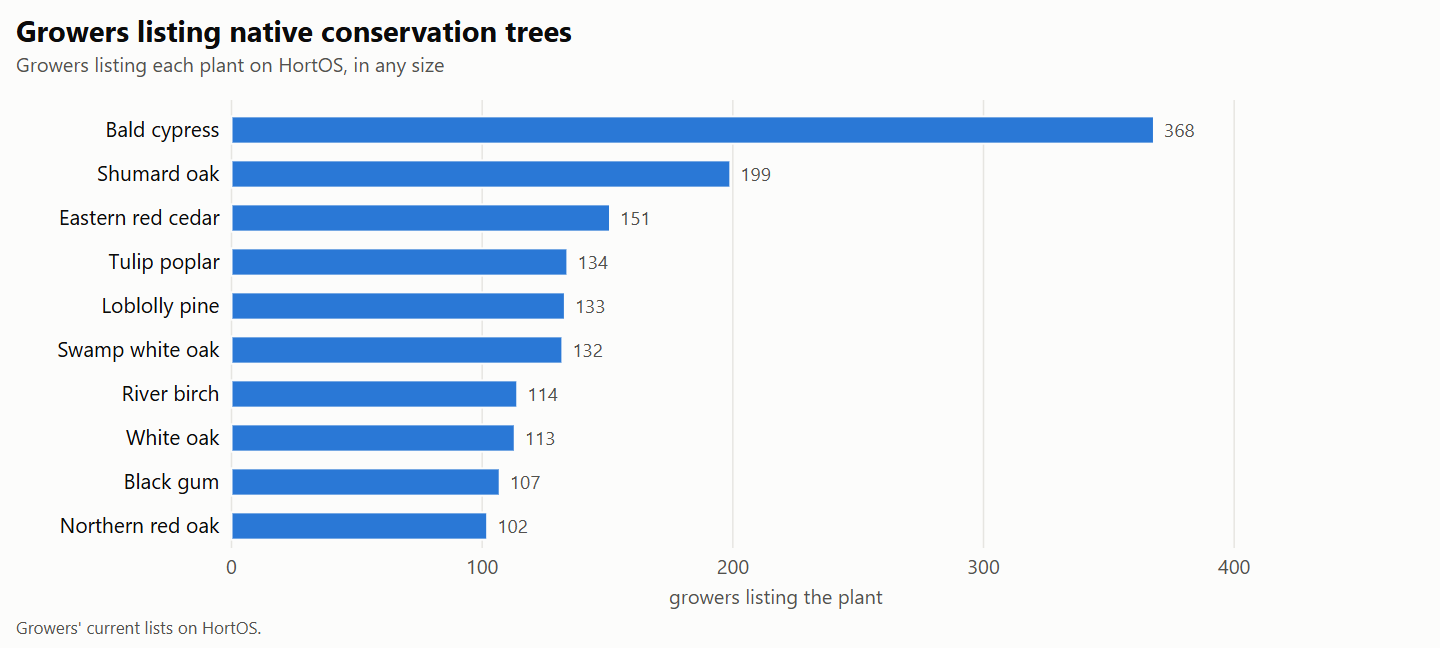
The Indiana DNR measures its seedlings in inches. The trade sells trees by container class. The rows in this table are native eastern trees and shrubs that HortOS chose as its own examples of conservation planting species. No state catalog chose them, and the table does not say that any state nursery sells a given row. The table holds 18 plants, 18 with a median, and the number of rated plants of this set left off it is 0.
Prices are medians across growers' current trade lists on HortOS: one price per grower, ex tax, freight not included, with the number of growers pricing each size in brackets.
| Plant | Growers listing it | Size most growers price | Median (growers pricing) |
|---|---|---|---|
| Longleaf pine (Pinus palustris) | 73 | #3 | $10 (23) |
| Loblolly pine (Pinus taeda) | 133 | #15 | $59 (35) |
| Slash pine (Pinus elliottii) | 101 | #15 | $60 (25) |
| Bald cypress (Taxodium distichum) | 368 | #30 | $120 (89) |
| Eastern red cedar (Juniperus virginiana) | 151 | #15 | $65 (27) |
| Buttonbush (Cephalanthus occidentalis) | 69 | #3 | $10.18 (24) |
| Silky dogwood (Cornus amomum) | 38 | #3 | $16 (11) |
| Swamp white oak (Quercus bicolor) | 132 | #7 | $37.75 (10) |
| White oak (Quercus alba) | 113 | #15 | $60 (14) |
| Northern red oak (Quercus rubra) | 102 | #3 | $12.50 (7) |
| Shumard oak (Quercus shumardii) | 199 | #30 | $125 (40) |
| Water oak (Quercus nigra) | 35 | #3 | $9.75 (7) |
| Black walnut (Juglans nigra) | 24 | #3 | $17 (4) |
| Tulip poplar (Liriodendron tulipifera) | 134 | #15 | $60 (22) |
| American sycamore (Platanus occidentalis) | 91 | #15 | $60 (16) |
| River birch (Betula nigra) | 114 | #30 | $125 (20) |
| American persimmon (Diospyros virginiana) | 64 | #3 | $12 (14) |
| Black gum (Nyssa sylvatica) | 107 | #3 | $14.50 (17) |
The growers listing the plants in this table are spread across many states; the most are in Florida, Texas and North Carolina. The size shown for each plant is the container size most growers price; field grown lines are not counted.
Anyone can see the prices on HortOS, and only the trade can order. Longleaf pine is listed by 73 growers, and its #3 median is $10 across 23 growers. Bald cypress is listed by 368 growers, with a #30 median of $120 across 89. Swamp white oak is listed by 132 growers, and its #7 median rests on 10.
Black walnut needs a word of its own. It is listed by 24 growers, but its #3 median of $17 rests on only 4 growers pricing that size. A median on so few moves when one grower changes a price.
The two routes are set side by side here and not ranked. A state program's own page gives its rules and its dates, and a grower's list gives its sizes and its prices. The reader puts them together for a given site. For how a grower's list is laid out, and what its columns and codes mean, the guide to reading an availability list walks through one.
What the data does not show
The plant table leans to the Southeast. HortOS shows few growers in the Midwest and New England, the region of the Iowa and Indiana programs, so a grower count here says little about growers near those states.
A grower count says nothing about where a tree's seed came from. The Iowa DNR's 2026 program page says a tree planted farther from its seed source runs a greater risk of disease or early death. HortOS cannot show, for any grower, the seed source of a line, whether it is the straight species or a selection, or how it was grown. A buyer who needs that asks the grower in writing for the seed zone or county of origin, whether the plants are seed grown, and how long they have been in the container.
The table does not show bare-root sizes, bundle counts or seedling grades, which are how state nurseries sell. It shows no state program's price, and it says nothing about whether a program has a species this season.
What to watch for
- Reading a neighbor state's rules as the home state's: the Indiana DNR and the Kentucky Division of Forestry both sell to their own landowners, while the Iowa DNR also serves buyers in other states (2026).
- Assuming a species named in a catalog will arrive: the Indiana DNR says in 2026 that its nurseries may substitute a species unless the order form says otherwise.
- Planning a Christmas tree planting around one state's answer, when the Indiana DNR advises against state seedlings for it and the Kentucky Division of Forestry lists it as a use.
- Waiting for spring to order: Kentucky's store opened on October 1 for spring 2027, and Indiana's nurseries take orders only until supplies run out (2026).
- Reading a grower count as a count of seed-sourced or straight-species trees, which HortOS does not record.
Getting it right
- Ask the state forestry agency who may buy, what the trees may be used for, and when orders open, on its own program page for the current season.
- Ask the district or service forester for the county which species suit the site, as the Indiana DNR suggests in 2026.
- Ask the state nursery which bundle or lot size applies and whether the order may be shipped or must be collected.
- Where a container tree is being weighed, ask the grower for the seed source, the container class and the lead time; the guide to buying from a wholesale grower sets out how a first trade order works.
- Check that program's own page again before a sale date goes on a flyer, since rules and dates change each season.
A word of caution
This page reads the 2026 program pages of the Indiana DNR, the Iowa DNR, the Kentucky Division of Forestry and the Colorado State Forest Service. Each agency decides its own buyers, uses and dates. Colorado's status is as of its August 2026 update. A landowner's state forestry agency or county forester is the one to ask before an order is placed.
Sources
- Indiana Department of Natural Resources, Forestry: State Nurseries and Tree Seedling Sales: Indiana buyers, uses and ordering.
- Iowa Department of Natural Resources, State Forest Nursery Program: Iowa order window and lots.
- Kentucky Energy and Environment Cabinet, State Nurseries and Tree Seedlings: Kentucky nurseries, uses and shipping.
- Colorado State Forest Service, Seedling Tree Nursery: Colorado rebuild and reopening.
- USDA Forest Service, State and Tribal Nurseries: national output and nursery funding.
More guides

Reading a Wholesale Availability List, and Pricing the Plants in a Bid
For landscape contractors, designers, estimators and students: what each column of a wholesale availability list means, how much the same plant at the same size varies between growers and states, how the low, median and high on the price pages are built, and how to carry the plant line of a bid from the list to the client.

Buying From a Wholesale Grower When You Are Not in the Trade
Native plant societies, watershed districts, land trusts, schools and church committees can buy from wholesale growers when they order like the trade: in quantity, ahead of the season, on the grower's terms. This page explains who sells to whom, resale certificates and exemptions, minimums and pooling, the sizes to buy, straight species and ecotype, lead times and shipping.
Florida's HOA landscaping law and the plants the state program lists
What two sections of the Florida Statutes say about homeowners' association covenants and Florida-friendly landscaping, what they leave with the association, and who decides a dispute. Two tables follow: groundcovers, grasses and shrubs from the UF/IFAS program's plant list, the Florida growers listing each, and a trade median for each at the container size most growers price.