School garden grants and the growers and trade prices for the plants
A dated record of school and youth garden grants in the United States, each read on its funder's own page. It adds the growers listing the native plants the Illinois habitat grant pays for, and trade medians for the apple and fig varieties University of Georgia Cooperative Extension names for school gardens.
Updated October 9, 2026. Figures are what the live us.hortosapp.com price and plant pages printed.
On this page
A teacher or a parent group planning a school garden asks two things: which grants take applications now, and who grows the plants a grant names. A school garden grant's status is true only of the day its funder's page was read. So each program on this page carries the date it was read and a link to the funder's own page, where the current word is.
The page draws on the funders' own pages (KidsGardening, the Whole Foods Market Foundation, Monarch Watch, the Fruit Tree Planting Foundation and others), two state departments, the U.S. Code and University of Georgia Cooperative Extension. HortOS, a free directory of American wholesale plant growers with their published availability and trade prices, adds the growers listing one state's grant plants and trade medians for named apples and figs. It is not a full register of grants, and it does not say what a grant buys.
Quick facts
| Taking applications when read | KidsGardening's page for the 2027 GroMoreGood Grassroots Grant, a United States program, said to apply when it was read in October 2026, and gave a deadline of February 5, 2027. |
|---|---|
| Next to open | KidsGardening's 2027 Youth Garden Grant, for programs in the United States, opens on November 9, 2026 and closes on December 11, 2026, by its page as read in 2026. |
| A state habitat grant | The Illinois Department of Natural Resources pays at most $2,000 a project in a year under its Schoolyard Habitat Action Grant, as reimbursement, by its 2026 page. |
| Illinois's plant list | Under Option One of the Illinois Schoolyard Habitat Action Grant the only plants that may be bought are those of the 14 native species the State names, as plants and never as seed (Illinois Department of Natural Resources, 2026). |
| Federal law | The 2023 edition of the U.S. Code, at 42 U.S.C. 1769(g), names developing school gardens as one of seven uses of the Department of Agriculture's competitive farm to school grants. |
| Fruit for a school calendar | University of Georgia Cooperative Extension (Georgia, 2022) names strawberries, muscadine grapes, apples and figs as the fruits most likely to succeed in a school garden on a traditional calendar. |
The programs and their status on the day they were read
The table holds 9 programs. They are the programs read for this page that take applicants from across the country and whose own page dated a round or said applications are rolling. The programs of two state departments, Illinois and California, are added. Monarch Watch's program covers most of the country, not all of it.
| Funder and program | Who may apply | Status read on 5 October 2026 | Source and year |
|---|---|---|---|
| KidsGardening, Youth Garden Grant | Any United States organization whose garden program reaches 15 or more young people | Opens 9 November 2026; closes 11 December 2026 | KidsGardening, 2027 round page, read 2026 |
| KidsGardening, GroMoreGood Grassroots Grant | Nonprofits, school districts, universities, government bodies and other tax-exempt groups reaching 15 or more youth | Open; closes 5 February 2027 | KidsGardening, 2027 round page, read 2026 |
| KidsGardening, Waterwise Garden Grant | Public and charter schools, kindergarten to grade 12, working with 15 or more youth | Closed 2 October 2026; grantees to be named in late November | KidsGardening, 2027 round page, read 2026 |
| Whole Foods Market Foundation, Garden Grant | Kindergarten to grade 12 schools in the United States or Canada that grow edible plants | Closed; the 2026 window ran 1 February to 15 March; the next is expected in February 2027 | Whole Foods Market Foundation, 2026 |
| KidsGardening, Growing the Future Intergenerational Garden Grant | Nonprofits, school districts and other tax-exempt bodies whose garden brings together 15 or more youth and seniors | Closed 15 May 2026 | KidsGardening, 2026 |
| Illinois Department of Natural Resources, Illinois Schoolyard Habitat Action Grant | Illinois teachers, nature center staff and adult youth group leaders, prekindergarten to grade 12 | Application deadline 2 December 2026 | Illinois Department of Natural Resources, 2026 |
| Monarch Watch, Free Milkweeds for Schools and Non-Profits | Schools and educational nonprofits; priority goes to sunny sites of 100 square feet or more with a maintenance plan | Applications open in early October and close in early to mid-February | Monarch Watch, 2026 |
| Fruit Tree Planting Foundation, orchard donation | Public schools, nonprofits and government bodies in the United States with room for roughly 15 to 20 trees | Rolling; no deadline | Fruit Tree Planting Foundation, 2026 |
| California Department of Food and Agriculture, California Farm to School Incubator Grant | To be set by the final request for applications; the draft counts school garden activities as hands-on food education | Not open; comment on the draft rules closed 11 September 2026 | California Department of Food and Agriculture, 2026 |
- KidsGardening says its 2027 Youth Garden Grant, a United States program, pays $750 each to between 30 and 50 school and youth garden programs, by its page read in 2026.
- KidsGardening says that in 2027 its GroMoreGood Grassroots Grant, a United States program, pays $750 each to 120 programs, and that 15 of them receive a further $750, by its page read in 2026.
- KidsGardening says its 2027 Waterwise Garden Grant gives 50 schools in the United States between $1,000 and $2,250 each, with an irrigation kit valued at $500, by its page read in 2026. Its applications closed on October 2, 2026.
- The Whole Foods Market Foundation says in 2026 that its Garden Grant is a $3,500 grant for an edible teaching garden at a kindergarten to grade 12 school in the United States or Canada. The foundation says to check back in February 2027.
- KidsGardening says that in 2026 its Growing the Future Intergenerational Garden Grant, a United States program, gave 75 programs a grant valued at $750.
- The Illinois Department of Natural Resources says in 2026 that its grant funds habitat such as a prairie plot, a butterfly garden or a rain garden, and does not fund vegetable gardens. The State's page gave an application deadline of December 2, 2026 when read.
- Monarch Watch says in 2026 that a qualifying school or educational nonprofit in the United States receives one flat of 32 milkweed plugs, shipping included, of a species native to the applicant's region.
- The Fruit Tree Planting Foundation, a United States program, says in 2026 that it gives fruit trees and shrubs in kind, with equipment, orchard design help and training. It asks for a site that takes a rough minimum of 15 to 20 trees.
- California's food and agriculture department says in 2026 that its farm to school grants for 2027 will come to as much as $38 million across the state. That is the whole program's total, not the size of one school's grant.
Three more programs were read the same day. Project Learning Tree was not taking GreenWorks grant applications when its page was read. The Missouri Prairie Foundation says in 2026 that its Prairie Garden Grants, for Missouri and the states around it, do not exceed $800 each. It expects to open the 2027 cycle in October 2026. The County of Union, New Jersey, ran Plant a Seed grants for school gardens and fruit trees in 2026, and its page said applications would be taken through April 10, 2026.
The federal program stands in statute. The 2023 edition of the U.S. Code, at 42 U.S.C. 1769(g), says the federal share "shall not exceed 75 percent of the total cost of the project". The same section of that 2023 edition makes matching support, in cash or in kind, a condition of receiving a grant.
The Illinois grant's native plants and the growers listing them
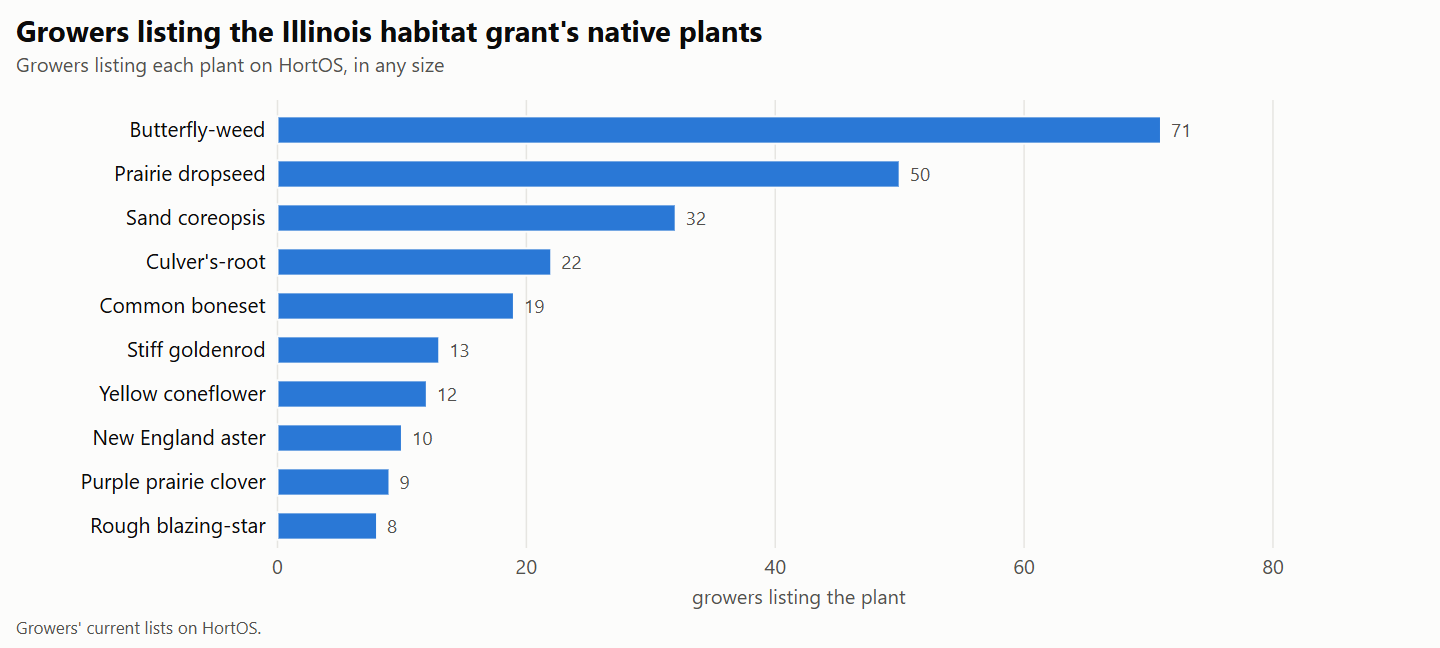
The rows below are the species the Illinois Department of Natural Resources pays for under Option One of its grant in 2026, in the State's own order, where growers list the straight species. Of the State's species, 1 is not shown. The second column is the State's bloom months and spacing. Grower counts are the growers listing each plant on HortOS, in any size.
| Plant | Bloom months and spacing (Illinois DNR, 2026) | Growers listing it | States with most growers |
|---|---|---|---|
| Leadplant (Amorpha canescens) | May to August; 2 feet | 6 | 6 states with 1 each |
| Butterfly-weed (Asclepias tuberosa) | May to September; 1.5 feet | 71 | Florida 15, Pennsylvania 8 |
| Sand coreopsis (Coreopsis lanceolata) | May to August; 1 foot | 32 | Florida 12, Maryland 4, New Jersey 3 |
| Purple prairie clover (Dalea purpurea) | June to September; 1 foot | 9 | Pennsylvania 2 |
| Common boneset (Eupatorium perfoliatum) | August to October; 1 foot | 19 | Maryland 5 |
| Western sunflower (Helianthus occidentalis) | July to October; 1 foot | 1 | Pennsylvania 1 |
| Rough blazing-star (Liatris aspera) | July to November; 1 foot | 8 | New Jersey 2, Maryland 2 |
| Stiff goldenrod (Solidago rigida) | July to October; 1 foot | 13 | Maryland 3, New York 2, Pennsylvania 2 |
| Common mountain mint (Pycnanthemum virginianum) | July to September; 1 foot | 8 | Pennsylvania 2, Maryland 2, New Jersey 2 |
| Yellow coneflower (Ratibida pinnata) | July to October; 1.5 feet | 12 | 4 states with 2 each |
| Prairie dropseed (Sporobolus heterolepis) | August to September; 2 feet | 50 | North Carolina 6, New Jersey 6 |
| New England aster (Symphyotrichum novae-angliae) | July to October; 1.5 feet | 10 | Maryland 4, Pennsylvania 2 |
| Culver's-root (Veronicastrum virginicum) | June to September; 1.5 feet | 22 | New Jersey 5, Maryland 3, Pennsylvania 3 |
The last column names the states with the most growers listing each plant, three at most, and stops where states tie for the next place.
This table prints counts and no prices. A median needs three growers pricing a size. The counts are national, not Illinois figures; the Illinois growers' hub lists the growers in that state. Butterfly-weed is listed by 71 growers and prairie dropseed by 50.
The list is Illinois's alone. Another state's grant, or another region, would name other plants, and Monarch Watch (United States, 2026) sends a milkweed native to the applicant's region. The Illinois Department of Natural Resources asks in 2026 that the plants be bought as plugs or as seedlings grown in containers. The department adds that a garden with every species on its list should flower from May until October or later.
Georgia's school garden apples and figs at trade medians
University of Georgia Cooperative Extension gives a second list, written for Georgia. The apple rows are the varieties from Red Delicious onward in the ripening order of its apple circular (Georgia, 2022). The fig rows are the varieties its fig circular (Georgia, 2023) names where it says which figs suit the mountains, the Piedmont and the country south of the Fall Line. Each is shown where growers list that named variety, and 6 are not shown. Prices are medians across growers' current trade lists on HortOS: one price per grower, ex tax, freight not included, with the number of growers pricing each size in brackets. Anyone can see the prices on HortOS, and only the trade can order.
| Plant | UGA Extension note for Georgia (2022, 2023) | Growers listing it | Size most growers price | Median (growers pricing) |
|---|---|---|---|---|
| Red Delicious apple (Malus x domestica 'Red Delicious') | Ripens late August to early September | 23 | #5 | $19.50 (7) |
| Jonagold apple (Malus x domestica 'Jonagold') | Ripens early September | 2 | Fewer than three growers | |
| Golden Delicious apple (Malus x domestica 'Golden Delicious') | Ripens a week or two after Red Delicious | 19 | #5 | $17.50 (4) |
| Fuji apple (Malus x domestica 'Fuji') | Ripens early October | 21 | #5 | $19.75 (4) |
| Granny Smith apple (Malus x domestica 'Granny Smith') | Matures late October to early November | 24 | #5 | $19.75 (6) |
| Celeste fig (Ficus carica 'Celeste') | Named among the best figs south of the Fall Line | 27 | #3 | $16 (7) |
| Hardy Chicago fig (Ficus carica 'Chicago Hardy') | Fairly well adapted in the Piedmont | 24 | #3 | $17.45 (8) |
| Brown Turkey fig (Ficus carica 'Brown Turkey') | Can fruit on new growth after a freeze cuts it to the ground | 49 | #3 | $16.70 (16) |
The growers listing the plants in this table are spread across many states; the most are in North Carolina, Florida and Texas. The size shown for each plant is the container size most growers price; field grown lines are not counted, and palms and other plants sold by height are not priced above #15.
The table has 8 varieties and 7 carry a median. The medians are national figures, not Georgia prices; the Georgia growers' hub lists the growers in that state. The Brown Turkey fig has the fullest reading: a median of $16.70 at #3 across 16 growers. The Fuji apple median rests on 4 growers, and so does Golden Delicious, which is a thin reading. Fewer than three growers price Jonagold. Apples and figs print at different container sizes, so the two groups are not ranked against each other. The fig that growers list as Chicago Hardy is the variety the university writes as Hardy Chicago.
The university records limits as well as uses. Its school garden circular (Georgia, 2022) says even its four likeliest fruits are not sure to bear during the school season, and that most fruit plants take several years to start bearing. The same circular says apples are the hardest of the four to grow without some form of pest control. Its apple circular (Georgia, 2022) says most apple varieties set fruit only with a second variety's pollen. The ripening dates it gives for the table's varieties are averages from Athens, Georgia, so another state or climate changes them. Its fig circular (Georgia, 2023) says a fig often takes three or four years to mature a crop.
What the tables do not show
The first table is not every American grant, and a status in it can change the day after it was read. Nothing on this page shows what a grant buys, and whether a purchase qualifies is the funder's decision. The Illinois Department of Natural Resources, for one, says in 2026 that its grant requires native plants.
The two plant tables show what growers list and the median of their published trade prices. They do not show what a school would pay delivered. A school buying from a grower pays the grower's trade price plus freight and any sales tax, and the guide to buying from a wholesale grower sets out how growers decide whom they sell to. The Georgia Department of Revenue's page (Georgia, 2026) says that in general the state taxes the sale price of goods, and also a seller's charges needed to complete a taxable sale, with delivery as its example. Whether a school's purchase is taxed is for that department to say.
The directory does not show whether a grower sells to a school or in small quantities, a minimum order, or the freight. It does not show whether a line is a plug or a container; the guide to reading an availability list explains the size codes a grower prints. For native plants and monarch habitat it cannot show provenance, local ecotype or seed origin, whether a line is the straight species, or how a plant was grown. A school asks the grower for each of these in writing before it orders.
What to watch for
- Reading a status as current. Each one is dated, and the funder's page is the only place the present round is stated.
- Buying before the award. The Illinois Department of Natural Resources says in 2026 that purchases made before winners are notified do not qualify.
- Matching the wrong garden to a grant. Illinois's 2026 habitat grant excludes vegetable gardens, while the Whole Foods Market Foundation's 2026 Garden Grant, for the United States and Canada, requires that a school grow edible plants.
- Taking a national median for a local delivered price. The median leaves out freight and tax, and the growers behind it may be far from the school.
Getting it right
- The funder decides who may apply and when. Open its page from the Sources list and ask the funder whether the round shown here is still the current one.
- The funder decides what the money may buy. Ask it which plants and sizes qualify, and from what date a purchase counts.
- The grower decides whom it sells to. Ask whether it takes a school's order, its minimum, its freight, and whether the line is a plug or a container.
- The state revenue department decides whether a school's purchase is taxed. The school's business office is the one to ask it.
A word of caution
Grant rounds move faster than any page about them. KidsGardening, the Whole Foods Market Foundation, the Illinois Department of Natural Resources, Monarch Watch and the other funders named here each set their own dates and rules, and only their own pages state them. Fruit timing and variety choice belong to the county extension office for the school's own state.
Sources
- KidsGardening, Youth Garden Grant (2027 round): amount, dates, eligibility, allowed purchases.
- KidsGardening, GroMoreGood Grassroots Grant (2027 round): amount, deadline and eligibility.
- KidsGardening, Waterwise Garden Grant (2027 round): amount, deadline, eligible schools.
- KidsGardening, 2026 Growing the Future Intergenerational Garden Grant: award value, deadline, eligibility.
- Whole Foods Market Foundation, School Garden Grants: amount, window and eligibility.
- Illinois Department of Natural Resources, Illinois Schoolyard Habitat Action Grant: state grant rules and deadline.
- Illinois Department of Natural Resources, Option One: Standard Pollinator Garden: the grant's native plant list.
- Illinois Department of Natural Resources, Schoolyard Habitat Action Grant: General Information and Frequently Asked Questions: grant questions and answers.
- Monarch Watch (University of Kansas), Free Milkweeds for Schools and Non-Profits: free milkweed plugs for schools.
- Fruit Tree Planting Foundation, Apply for an FTPF Orchard: orchard donation terms.
- California Department of Food and Agriculture, California Farm to School Incubator Grant Program: program total and round status.
- California Department of Food and Agriculture, Cohort 4 California Farm to School Incubator Grant Program, Draft Request for Applications, Track 1: draft rules for the round.
- Project Learning Tree, GreenWorks Grants: grant status and requirements.
- Missouri Prairie Foundation, Grants (Prairie Garden Grants Program): native garden grant and cycle.
- County of Union, New Jersey, Union County Announces the 2026 Plant a Seed Program Grant Applications: county school garden grants.
- United States Code, Title 42, section 1769 (2023 edition), subsection (g), Access to local foods: farm to school program: the federal farm to school statute.
- University of Georgia Cooperative Extension, School Gardens: Planning an Edible Garden (Circular 1027-01): fruit for Georgia school gardens.
- University of Georgia Cooperative Extension, Home Garden Apples (Circular 740): apple varieties and ripening dates.
- University of Georgia Cooperative Extension, Home Garden Figs (Circular 945): fig varieties for Georgia.
- Georgia Department of Revenue, What is Subject to Sales and Use Tax?: sales tax base, delivery charges.
More guides

Buying From a Wholesale Grower When You Are Not in the Trade
Native plant societies, watershed districts, land trusts, schools and church committees can buy from wholesale growers when they order like the trade: in quantity, ahead of the season, on the grower's terms. This page explains who sells to whom, resale certificates and exemptions, minimums and pooling, the sizes to buy, straight species and ecotype, lead times and shipping.

Reading a Wholesale Availability List, and Pricing the Plants in a Bid
For landscape contractors, designers, estimators and students: what each column of a wholesale availability list means, how much the same plant at the same size varies between growers and states, how the low, median and high on the price pages are built, and how to carry the plant line of a bid from the list to the client.
Poisonous plant rules in child care and plants off the toxic lists
Three state child care rules set a duty to keep toxic plants from children, and the plants come from separate lists. This page reports the Utah, North Carolina and Pennsylvania texts, UC ANR's toxicity classes and Poison Control's cautions, then trade prices for plants neither toxic list names.