Poisonous plant rules in child care and plants off the toxic lists
Three state child care rules set a duty to keep toxic plants from children, and the plants come from separate lists. This page reports the Utah, North Carolina and Pennsylvania texts, UC ANR's toxicity classes and Poison Control's cautions, then trade prices for plants neither toxic list names.
Updated September 23, 2026. Figures are what the live us.hortosapp.com price and plant pages printed.
On this page
The director of a child care center in North Carolina is replanting the play yard and asks two things: which plants the licensing rules allow, and what could go in beside the fence instead. The three state rules read for this page set a duty about toxic plants and name no plant, so which plants count as toxic comes from a separate list.
This page reads three state child care rules, from Utah, North Carolina and Pennsylvania, in the regulation text as published by Cornell's Legal Information Institute. It reads the toxic plant list of University of California Agriculture and Natural Resources (UC ANR) and the plant cards of the National Capital Poison Center. For a yard plan, the page then sets out trade prices from HortOS, a free directory of American wholesale plant growers with their published availability and trade prices. It is not a list of cleared plants and not a licensing opinion.
Quick facts
| Utah | Utah Administrative Code R381-100-13 (2025, text as published by Cornell's Legal Information Institute) has the provider keep poisonous and harmful plants out of children's reach. |
|---|---|
| North Carolina | 10A NCAC 09 .0604 (read 2026, same publisher) puts toxic plants out of children's reach and sends centers to a toxic plant list on the division's website. |
| Pennsylvania | 55 Pa. Code 3270.66 (read 2026, same publisher) does not allow toxic plants in a child care space. |
| UC ANR classes | The UC ANR print dated 11 July 2020 sorts plants into classes 1 to 4, from major toxicity in class 1 to skin rash or irritation in class 4. |
| Poison Control | The National Capital Poison Center (2026) calls its plant lists a guide and warns that a plant which is not poisonous may still be a choking hazard. |
| Prices on HortOS | 20 plants that neither toxic list names, with the median trade price of the size most growers price, as growers list them. |
What the state rules ask of a play yard
The three rules read here are short, and none of them is a plant list. Utah Administrative Code R381-100-13, in its 2025 text as published by Cornell's Legal Information Institute, places the duty on the provider: poisonous and harmful plants are to be kept where children cannot get at them. North Carolina's rule for child care centers, 10A NCAC 09 .0604 as read in 2026, says the same of toxic plants and adds a pointer to a toxic plant list kept on the division's website. Pennsylvania's rule for child care centers, 55 Pa. Code 3270.66 as read in 2026, goes further and does not permit toxic plants in a child care space at all.
Those are different duties. The Utah and North Carolina texts speak of whether children can reach a plant, while the Pennsylvania text speaks of whether the plant is in the space. Indoor pots, a hedge along a fence and a tree over the sandbox may each be read differently by the agency that inspects them. This page reports the rules of three states only, and each other state's licensing agency has its own.
The table below sets the three rules beside the toxicity classes of UC ANR and a caution from the National Capital Poison Center's plant page. It holds every rule and class read for this page, one row each, and the document behind each row is named in the quick facts and the sources.
| Authority | What it says |
|---|---|
| Utah | Providers must keep poisonous and harmful plants out of children's reach |
| North Carolina | Toxic plants must be out of reach; the division keeps its own list |
| Pennsylvania | No toxic plants inside a child care space |
| UC ANR, class 1 | Major toxicity: serious illness or death possible |
| UC ANR, class 2 | Minor toxicity: vomiting or diarrhea possible |
| UC ANR, class 3 | Oxalate crystals in the juice or sap |
| UC ANR, class 4 | Skin rash or irritation from juice, sap or thorns |
| Poison Control | Its plant cards are a guide; every case differs |
Each state's growers are on its hub: Utah, North Carolina and Pennsylvania.
How the plant lists sort a yard
UC ANR's toxic plant list, as read for this page, is a print of its Safe and Poisonous Garden Plants pages dated 11 July 2020. It gives each plant one or more class numbers. Class 1, in UC ANR's 2020 print, means major toxicity, where serious illness or death may follow. In the same print, UC ANR's class 2 means minor toxicity, where eating the plant may bring on vomiting or diarrhea. UC ANR's 2020 class 3 marks plants whose juice or sap holds oxalate crystals. Its class 4 in that print covers plants whose sap, juice or thorns can leave the skin red, itchy or inflamed.
Several common yard plants carry those numbers in the 2020 print. In UC ANR's 2020 print, boxwood and privet are each in classes 2 and 4, and hydrangea is in classes 1 and 4. The same print puts azalea in class 1, as it does the whole Pittosporum genus and chinaberry. UC ANR's 2020 print puts oleander in classes 1 and 4, and it is also among the poisonous plant cards of the National Capital Poison Center in 2026.
The plant part matters. UC ANR's 2020 print names the part for some entries: apple seeds and English yew seeds in class 1, and holly berries in class 2. Its elderberry entry says the ripe fruit is nontoxic while keeping the genus in class 1. The National Capital Poison Center (2026) makes the same point in general terms: for some plants every part is poisonous, and for others only certain parts do harm.
The Poison Center's page in 2026 also carries a few cards for non-poisonous plants beside its poisonous ones, and it warns that its lists are only a guide. It says that a plant which is not poisonous can still cause choking, that young children at play outdoors need close watching, and that expert help depends on knowing the plants by name.
Plants neither toxic list names, at trade prices
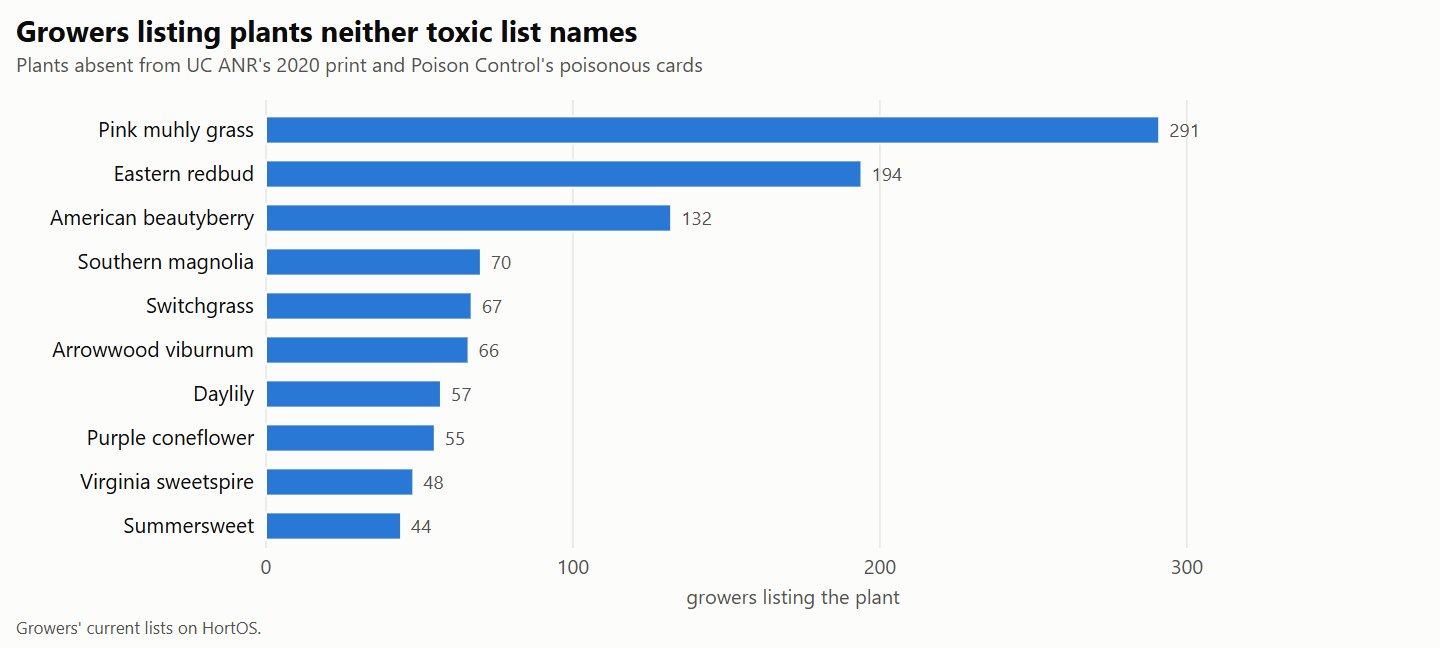
The table sets out 20 shrubs, trees, perennials and grasses that American growers list. Each comes from a genus that appears neither in UC ANR's 2020 toxic plant print nor among the National Capital Poison Center's poisonous cards as read in 2026. A plant's absence from both is not a finding by either authority, and HortOS makes no claim about any of them. The table is a selection of such plants, not every one. Prices are medians across growers' current trade lists on HortOS: one price per grower, ex tax, freight not included, with the number of growers pricing each size in brackets.
| Plant | Growers listing it | Size most growers price | Median (growers pricing) |
|---|---|---|---|
| Glossy abelia (Abelia x grandiflora) | 38 | #3 | $8.25 (20) |
| Crape myrtle (Lagerstroemia indica) | 36 | #30 | $150 (7) |
| American beautyberry (Callicarpa americana) | 132 | #3 | $9.00 (63) |
| Daylily (Hemerocallis) | 57 | #1 | $3.50 (9) |
| Border forsythia (Forsythia x intermedia) | 7 | #3 | $9.00 (4) |
| Virginia sweetspire (Itea virginica) | 48 | #3 | $12.13 (14) |
| Summersweet (Clethra alnifolia) | 44 | #3 | $22 (9) |
| Dwarf fothergilla (Fothergilla gardenii) | 36 | #3 | $18 (9) |
| Japanese camellia (Camellia japonica) | 24 | #3 | $17 (9) |
| Chinese fringe flower (Loropetalum chinense) | 33 | #3 | $6.00 (17) |
| Gardenia (Gardenia jasminoides) | 10 | #3 | $11.50 (3) |
| Common lilac (Syringa vulgaris) | 43 | #5 | $25 (7) |
| Ninebark (Physocarpus opulifolius) | 35 | #3 | $16 (5) |
| Arrowwood viburnum (Viburnum dentatum) | 66 | #3 | $16 (17) |
| Southern magnolia (Magnolia grandiflora) | 70 | #15 | $80 (13) |
| Eastern redbud (Cercis canadensis) | 194 | #15 | $77.50 (28) |
| Pink muhly grass (Muhlenbergia capillaris) | 291 | #3 | $6.00 (165) |
| Switchgrass (Panicum virgatum) | 67 | #1 | $4.00 (15) |
| Purple coneflower (Echinacea purpurea) | 55 | #1 | $4.80 (13) |
| Black-eyed Susan (Rudbeckia fulgida) | 43 | #1 | $5.83 (10) |
The growers listing the plants in this table are spread across many states; the most are in Florida, North Carolina and New Jersey. The size shown for each plant is the container size most growers price; field grown lines are not counted.
A count here is growers listing the plant, not how many plants exist or how well it suits a site. Anyone can see the prices on HortOS, and only the trade can order.
Two rows rest on few prices. Border forsythia is priced by 4 growers at #3, and gardenia by 3 at #3. A median on so few moves when one grower changes a price. At the other end, pink muhly grass is listed by 291 growers and eastern redbud by 194, so their medians stand on many lists. A shrub such as American beautyberry, listed by 132 growers, is priced at #3 by 63 of them.
Sizes on a grower's list follow the container classes, and the guide to reading an availability list explains how those classes and a grower's notes are laid out, which helps when comparing two quotes for the same shrub.
What the figures and the lists leave out
The table answers what growers list and what a size costs at trade on one date. It does not say how a plant behaves in a yard where children play. A shrub with berries, a thorny stem or a sap that stains will not show up in a median, and neither list read here was written for a particular yard, age group or climate.
The lists themselves have limits. UC ANR's print dates from 2020 and was compiled in California, so plants grown mostly in other regions may be absent from it for that reason alone. The Poison Center's cards are a short set of selected plants and, in its own words, only a guide. A plant missing from both is simply a plant neither authority wrote about on the pages read in this run.
North Carolina's rule points centers to a toxic plant list kept by the division, and a list of that kind may name a plant in the table above. The licensing agency in each state decides which list its rule refers to.
What to watch for
- Reading a state rule as a plant list. The Utah, North Carolina and Pennsylvania texts set a duty; the plants come from a list the agency or a poison center keeps.
- Treating out of reach and not present as the same thing. Pennsylvania's 2026 text speaks of a plant in the space, and the Utah and North Carolina texts of reach.
- Checking the genus but not the part. UC ANR rates seeds, berries and ripe fruit separately for some entries, so a tree overhanging the yard can matter for its fruit alone.
- Planting under a common name only. The Poison Center says expert help depends on knowing the plant, so a label with the botanical name is worth keeping.
- Taking a missing entry to mean a plant is cleared. A plant left off a list is a gap in that dated list, and nothing more.
Getting it right
- Ask the state licensing agency which toxic plant list it inspects against, and get the date of that list in writing.
- Walk the yard with the list, writing down each plant's botanical name, including trees whose branches or fruit reach into the play area.
- Ask the licensing consultant whether a plant kept behind a barrier meets the rule, or whether it must go from the space.
- Before ordering, send the planting list to the licensing agency or the center's own health consultant, and ask the grower to confirm the botanical name on each line.
- Keep the regional poison center's details with the yard plan; the National Capital Poison Center (2026) says expert help depends on knowing which plant is involved.
For a center that has never ordered from a wholesale nursery, the guide to buying from a wholesale grower covers how growers set their terms, which matters when a yard needs a few dozen shrubs at once.
A word of caution
This page reports three state rules as published by Cornell's Legal Information Institute, UC ANR's 2020 toxic plant print and the National Capital Poison Center's plant page as read in 2026. The licensing agency in each state decides what its rule requires of a yard, and the center's director decides what is planted. If a child eats or touches a plant, a poison center or a doctor is the one to ask.
Sources
- Utah Administrative Code R381-100-13 (Legal Information Institute): Utah child care plant rule.
- 10A NCAC 09 .0604 (Legal Information Institute): North Carolina center safety requirements.
- 55 Pa. Code 3270.66 (Legal Information Institute): Pennsylvania rule on toxics.
- UC ANR, Toxic Plants (by common name): toxicity classes by plant.
- National Capital Poison Center, Poisonous and non-poisonous plants: illustrated plant cards and cautions.
More guides

Reading a Wholesale Availability List, and Pricing the Plants in a Bid
For landscape contractors, designers, estimators and students: what each column of a wholesale availability list means, how much the same plant at the same size varies between growers and states, how the low, median and high on the price pages are built, and how to carry the plant line of a bid from the list to the client.

Buying From a Wholesale Grower When You Are Not in the Trade
Native plant societies, watershed districts, land trusts, schools and church committees can buy from wholesale growers when they order like the trade: in quantity, ahead of the season, on the grower's terms. This page explains who sells to whom, resale certificates and exemptions, minimums and pooling, the sizes to buy, straight species and ecotype, lead times and shipping.
School garden grants and the growers and trade prices for the plants
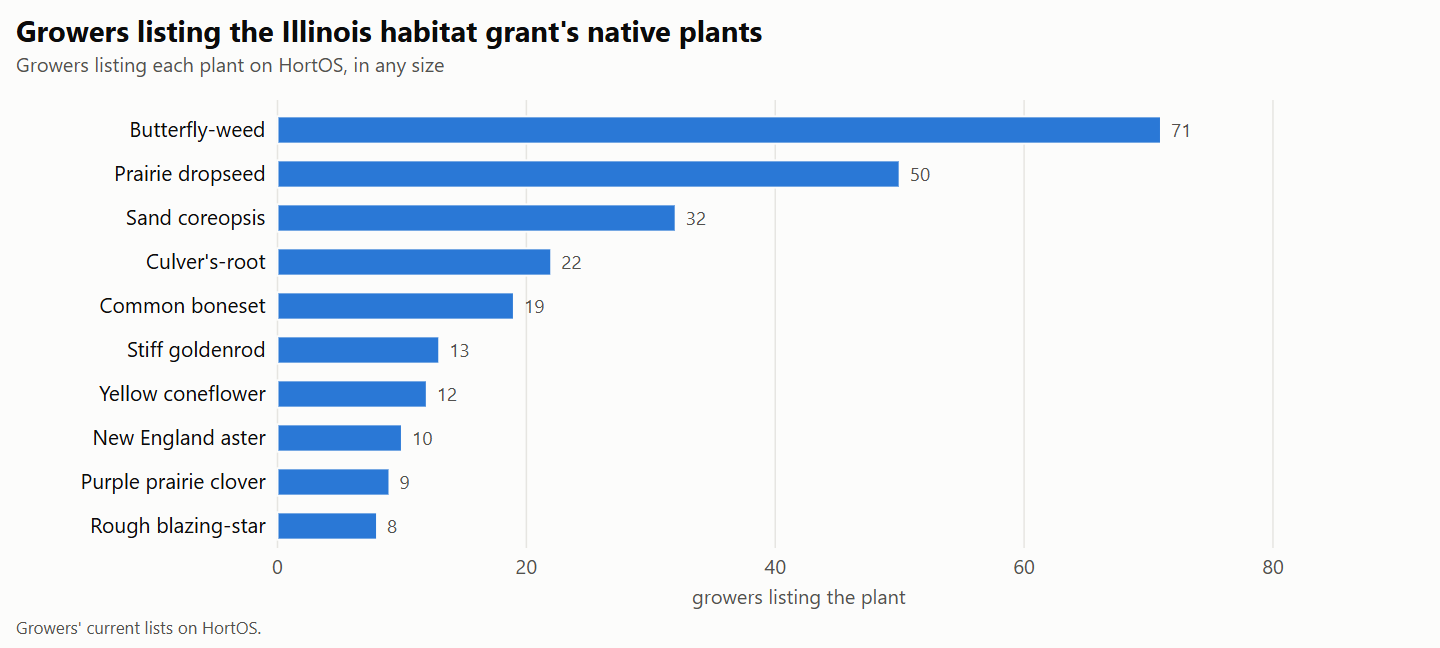
A dated record of school and youth garden grants in the United States, each read on its funder's own page. It adds the growers listing the native plants the Illinois habitat grant pays for, and trade medians for the apple and fig varieties University of Georgia Cooperative Extension names for school gardens.