Native milkweeds for monarchs and the states where growers list them
The Monarch Joint Venture's handout for nurseries sorts native milkweed species under six United States regions. This page sets the species that have a plant page on HortOS beside how many growers list each and the states those growers are based in, with the monarch's federal status as filed and what a grower count cannot show.
Updated October 21, 2026. Figures are what the live us.hortosapp.com price and plant pages printed.
On this page
A conservation district planning its spring plant sale, or a volunteer laying out a monarch waystation, starts with one question: which native milkweed belongs in this region, and who grows it. The native milkweed that suits a planting depends on its region, and the growers who list each species are not spread evenly across the states. A species named for the Southeast may be on many growers' lists, and one named for the Southwest on very few.
This page draws on the Monarch Joint Venture's two milkweed handouts, Monarch Watch, the U.S. Forest Service, two services of the U.S. Department of Agriculture, the Federal Register, and extension and state agency pages for Florida, Maryland, Ohio and Indiana. It adds what is printed on HortOS, a free directory of American wholesale plant growers with their published availability and trade prices: the growers listing each species and the states they are based in. It reports what those authorities say and is not planting advice.
Quick facts
| Native species | The Monarch Joint Venture's milkweed questions page, read in October 2026, counts more than 73 milkweed species as United States natives, with about 30 in regular use by monarchs. |
|---|---|
| Regional lists | The Monarch Joint Venture's handout for nurseries, read in October 2026, sorts 22 native milkweed species under six United States regions. |
| Federal status | The U.S. Fish and Wildlife Service proposed on December 12, 2024 that the monarch butterfly be listed as threatened under the Endangered Species Act (89 FR 100662). It is a proposed rule. |
| Next federal date | A settlement agreement filed in a United States district court on September 30, 2026 would have the U.S. Fish and Wildlife Service send its final decision on listing to the Federal Register on or before June 6, 2030. The agreement takes effect only when the court approves it. |
| Milkweed lost | The U.S. Fish and Wildlife Service's proposed rule of 2024 says the Midwest lost more than 860 million milkweed stems between 1999 and 2014, and calls that loss a fall of almost 40 percent. |
| Livestock | The USDA Agricultural Research Service's poisonous plant page, 2018, says milkweed's leaves and other parts above ground are poisonous. |
What the regional lists name
The Monarch Joint Venture's handout for nurseries, Why Grow and Sell Native Milkweed, was read in October 2026. It sorts 22 native milkweed species under six United States regions: California, West, Southwest, South Central, Southeast and Northeast. The handout gives states for one region only, the Southwest, which it marks as Arizona and New Mexico, and it does not say which states the Northeast or its other regions take in. A second sheet, Plant Milkweed for Monarchs, read in October 2026, maps six milkweed regions of the United States and says monarchs are known to use the species it picks out. The Monarch Joint Venture, in a fact sheet read in October 2026, advises planting milkweed native to the region and cutting tropical milkweed back before the fall migration where it grows through winter.
The U.S. Forest Service, on pages read in October 2026, says butterfly milkweed grows in dry open habitats from Maine to South Dakota, the desert Southwest and Florida. It says swamp milkweed grows in average garden soil so long as the soil never dries right out. Monarch Watch, on a page read in October 2026, calls common milkweed the main monarch host plant of the Midwest and Northeast.
For the West, the USDA Natural Resources Conservation Service's plant guide of 2000 places showy milkweed in sunny, dry habitats from California to British Columbia and central Canada, south to Texas. Its guide of 2001 places narrow-leaf milkweed on dry ground in valleys and foothills, and gives its range as California, Washington, Utah and Baja California.
UF/IFAS Extension, on a page read in October 2026, says six native milkweed species are sold commercially in Florida. Maryland's Department of Natural Resources said in 2024 that the state is home to 14 kinds of milkweed. Ohio State University Extension reported in September 2018 that the Ohio Pollinator Habitat Initiative was asking Ohioans who grew common milkweed that season to bring its seed pods to a conservation district office taking part. The title of that 2018 notice calls the pod collection annual.
Monarch Watch, read in October 2026, says milkweeds native to the region matter most where large areas of the United States are being restored, and matter less in a home or school garden.
Where the growers listing each species are based
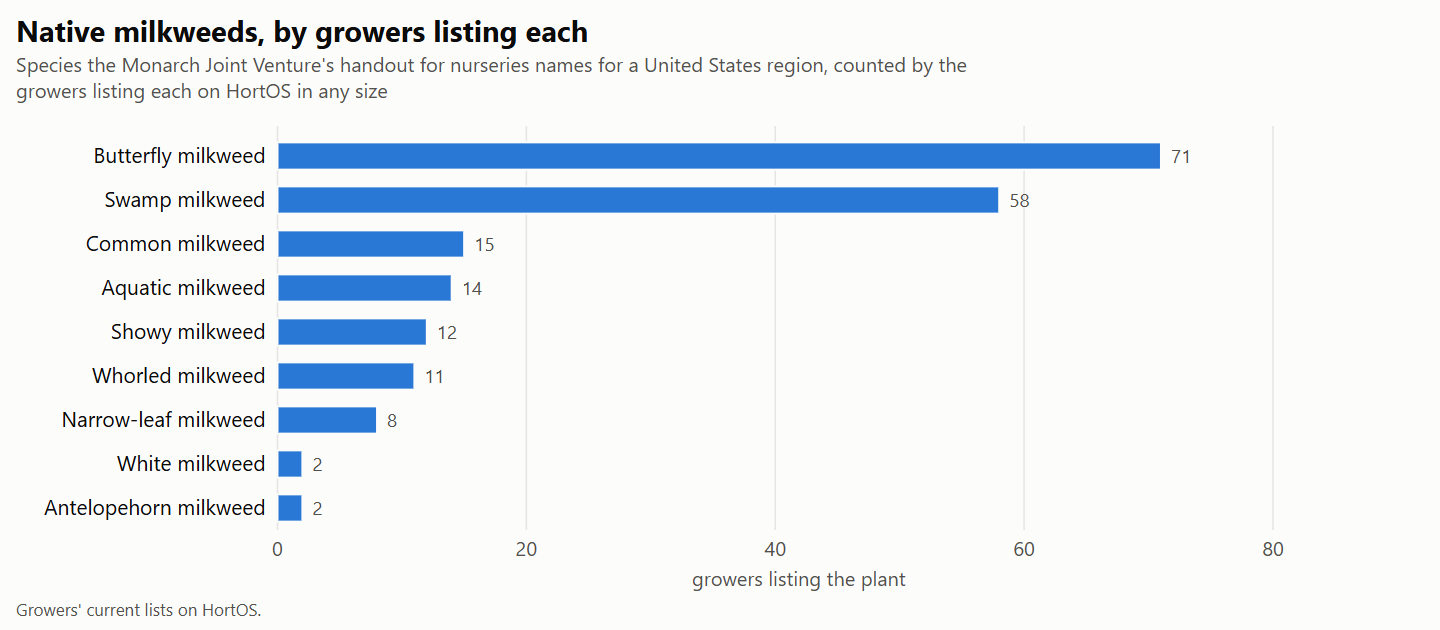
The table holds 9 milkweed species. Each is a species that the Monarch Joint Venture's handout for nurseries names for a United States region and that has a plant page on HortOS. The region names are the handout's own. The handout's other 13 species are not shown, poke milkweed and sandhill milkweed among them. Grower counts are the growers listing each plant on HortOS, in any size. A count here is growers listing the plant, not how many plants exist or how well it suits a site.
A state in the table's last column is the home state of a grower who lists the species. It is not the species' native range, not where the seed was collected and not where the grower delivers. So a row can show a state outside the regions the handout names for that species. A listing shows that a plant is on a grower's list on that date, and it does not show that plants are ready to ship.
| Plant | Regions named in the MJV handout (read 2026) | Growers listing it | States with most growers |
|---|---|---|---|
| Butterfly milkweed (Asclepias tuberosa) | Northeast, Southeast | 71 | Florida 15, Pennsylvania 8 |
| Swamp milkweed (Asclepias incarnata) | Northeast, Southeast | 58 | Florida 16, New Jersey 6 |
| Common milkweed (Asclepias syriaca) | Northeast | 15 | Pennsylvania 3 |
| Aquatic milkweed (Asclepias perennis) | Southeast | 14 | Florida 13, South Carolina 1 |
| Showy milkweed (Asclepias speciosa) | California, West, Southwest | 12 | California 4, Oregon 3 |
| Whorled milkweed (Asclepias verticillata) | Northeast, Southeast | 11 | Florida 3, Pennsylvania 2, New Jersey 2 |
| Narrow-leaf milkweed (Asclepias fascicularis) | California, West | 8 | California 6, Oregon 1, Mississippi 1 |
| White milkweed (Asclepias variegata) | Southeast | 2 | Florida 1, Texas 1 |
| Antelopehorn milkweed (Asclepias asperula) | Southwest, South Central | 2 | Colorado 1, Florida 1 |
The last column names the states with the most growers listing each plant, three at most, and stops where states tie for the next place.
Some of these counts are small. White milkweed is listed by 2 growers, antelopehorn milkweed by 2 and whorled milkweed by 11. A count this size can move when one grower changes a list, and this page draws no trend from it. The growers of each state are on that state's hub page, for example Florida, Pennsylvania, California, Ohio and Indiana.
The handout names white milkweed for the Southeast. The U.S. Forest Service, on a page read in October 2026, does not count that species as an important food for monarch caterpillars, though it says they are sometimes found on it. Purple milkweed is not in the handout. Monarch Watch, read in October 2026, names it among the species it prioritizes for the Northeast, and it is listed by 3 growers on HortOS.
The table prints no prices. Prices are medians across growers' current trade lists on HortOS: one price per grower, ex tax, freight not included, with the number of growers pricing each size in brackets. Butterfly milkweed's median at #1 is $4.50 (21). Swamp milkweed's at #1 is $4.75 (18), and aquatic milkweed's at #1 is $4.00 (9). A median needs three growers pricing a size. The other species in the table have a count and no median. Anyone can see the prices on HortOS, and only the trade can order.
Growers also list named selections. The Monarch Joint Venture's milkweed questions page, read in October 2026, says cultivars of native milkweeds can draw and support monarchs and native bees, above all in city gardens, and tells readers to keep cultivars out of natural areas. The second table holds every named selection or subspecies of swamp milkweed and butterfly milkweed that has its own plant page on HortOS, 7 rows, and none is left out. This second table prints grower counts and no prices.
| Plant | Growers listing it | States with most growers |
|---|---|---|
| Swamp Milkweed (Asclepias incarnata 'Cinderella') | 19 | Oregon 4, New Jersey 3 |
| Swamp Milkweed (Asclepias incarnata 'Ice Ballet') | 15 | New Jersey 3 |
| Swamp Milkweed (Asclepias incarnata 'Soulmate') | 6 | New Jersey 3 |
| Butterfly Weed (Asclepias tuberosa 'Hello Yellow') | 5 | 5 states with 1 each |
| Butterfly Weed (Asclepias tuberosa 'Hello Orange') | 2 | Florida 1, New Jersey 1 |
| Gay Butterflies Butterfly Weed (Asclepias tuberosa 'Gay Butterflies') | 2 | Maryland 1, Tennessee 1 |
| Woodson Swamp Milkweed (Asclepias incarnata pulchra) | 1 | North Carolina 1 |
The last column names the states with the most growers listing each plant, three at most, and stops where states tie for the next place.
What the directory does not show for a grower
A grower count answers who lists a species. It leaves open three things the monarch authorities raise, and each is a question for the grower.
- Where the seed came from. The Monarch Joint Venture's Plant Milkweed for Monarchs sheet, read in October 2026, asks buyers in the United States to look for plants raised near the planting site from the nearest seed source they can find. HortOS shows where a grower is based and nothing about seed origin.
- Whether the plant is the straight species. The second table separates only the selections that have a plant page of their own. A line under a species name on a grower's list does not say how the plant was propagated.
- Whether systemic insecticides were used. Purdue's Landscape Report told Indiana buyers in 2022 to make sure milkweed plants have not been treated with insecticides that kill caterpillars. The Monarch Joint Venture's handout for nurseries, read in October 2026, calls it crucial to keep pesticides off milkweed plants, systemic insecticides above all. HortOS shows no growing practice.
The page also covers only species that have a plant page on HortOS, on one date. The guide to reading an availability list explains the sizes and price columns a buyer meets on a grower's list. The guide to buying from a wholesale grower covers how trade growers take orders, which matters to a district sale buying a few flats.
The monarch's federal status and the livestock caution
On December 12, 2024 the U.S. Fish and Wildlife Service published a proposed rule in the Federal Register (89 FR 100662). In it the Service proposes "to list the monarch butterfly" as "a threatened species" under the Endangered Species Act. A stipulated settlement agreement with a proposed order was filed in the U.S. District Court for the Northern District of California on September 30, 2026. Under that 2026 filing, the Service would send "a final listing determination" to the Federal Register on or before June 6, 2030. The agreement of September 30, 2026 says its terms take effect only when that court enters an order approving it. This is the position as filed, and it can change.
The USDA Agricultural Research Service's poisonous plant page, 2018, says the leaves and other parts above ground are poisonous and contain toxic cardenolides. The Agricultural Research Service's 2018 page names four milkweeds in order of toxicity to range animals, and narrow-leaf milkweed, which it calls Mexican whorled milkweed, is the last of the four. The same 2018 page of the Agricultural Research Service says animals mostly leave milkweed alone while good forage lasts, and that hay with milkweed in it should not go to sheep or cattle.
What to watch for
- Reading the states column as a native range. It shows where growers are based. The regions column is the handout's, and the two can differ in one row.
- Treating a listing as plants on hand. A count is of growers with the species on a list on one date. Quantity, size and ship date are the grower's to confirm.
- Taking a species name as proof of seed origin. A grower in one state may raise plants from seed collected in another. Only the grower can say.
- Reading a small count as a trend. Several species here rest on very few growers, and one changed list moves the figure.
- Treating the proposed rule as a final one. The U.S. Fish and Wildlife Service's rule of December 12, 2024 is a proposal, not a final rule.
Getting it right
- Start from a monarch authority's list for the planting's own region, and from the state's extension service or natural resources agency where one publishes a list.
- Ask the program that will register or fund the planting which species and plant forms it accepts. The program decides.
- Open each species' plant page and the home state's hub page to see which growers list it.
- Ask each grower where the seed was collected, whether the plant is the straight species, and whether systemic insecticides were used in propagation.
- Where the site borders pasture or hay ground, put the question to the livestock owner and a veterinarian before planting.
A word of caution
The regional lists are the Monarch Joint Venture's and Monarch Watch's as read in October 2026, and a state's extension service or natural resources agency is the one to ask about a particular county. The monarch's federal status is the U.S. Fish and Wildlife Service's to decide, and the dates above are those of the proposed rule and the court filing. The grower counts and medians are HortOS figures, not a quote from any grower.
Sources
- Monarch Joint Venture, Why Grow and Sell Native Milkweed? (handout): native milkweeds by region.
- Monarch Joint Venture, Plant Milkweed for Monarchs (information sheet): milkweed regions and site notes.
- Monarch Joint Venture, Frequently Asked Questions: Milkweed: species numbers, cultivars, buying.
- Monarch Joint Venture, Tropical Milkweed and OE: Potential Risks for Monarchs (fact sheet): the Joint Venture's planting advice.
- Monarch Watch, Bring Back the Monarchs: Milkweed Regions and Seed Needs: host species by region.
- Monarch Watch, Monarch Waystation Program: priority species and garden scale.
- U.S. Fish and Wildlife Service, Threatened Species Status With Section 4(d) Rule for Monarch Butterfly and Designation of Critical Habitat, proposed rule, 89 FR 100662: the proposed listing of 2024.
- U.S. District Court, Northern District of California, Center for Biological Diversity v. U.S. Fish and Wildlife Service, No. 3:26-cv-01281-TSH, Stipulated Settlement Agreement and [Proposed] Order, filed September 30, 2026: the filing as published by the Monarch Joint Venture.
- USDA Agricultural Research Service, Poisonous Plant Research: Milkweed (Asclepias spp.): milkweed poisoning of range animals.
- U.S. Forest Service, Plant of the Week: Butterfly Milkweed: range, habitat and taproot.
- U.S. Forest Service, Plant of the Week: Swamp Milkweed: soil moisture it needs.
- U.S. Forest Service, Plant of the Week: Redring Milkweed: white milkweed and monarch caterpillars.
- USDA Natural Resources Conservation Service, Plant Guide: Showy Milkweed: range and habitat.
- USDA Natural Resources Conservation Service, Plant Guide: Narrow-leaved Milkweed: range and habitat.
- UF/IFAS Extension, Gardening Solutions: Native Milkweeds: native milkweeds sold in Florida.
- Maryland Department of Natural Resources, Monarchs in Motion: Maryland's milkweeds, 2024.
- Ohio State University Extension, Ohio Pollinator Habitat Initiative, Annual Milkweed Pod Collection: Ohio's 2018 pod collection.
- Purdue Landscape Report, Where Have All the Monarch Butterflies Gone?: buying untreated milkweed in Indiana.
More guides

Reading a Wholesale Availability List, and Pricing the Plants in a Bid
For landscape contractors, designers, estimators and students: what each column of a wholesale availability list means, how much the same plant at the same size varies between growers and states, how the low, median and high on the price pages are built, and how to carry the plant line of a bid from the list to the client.

Buying From a Wholesale Grower When You Are Not in the Trade
Native plant societies, watershed districts, land trusts, schools and church committees can buy from wholesale growers when they order like the trade: in quantity, ahead of the season, on the grower's terms. This page explains who sells to whom, resale certificates and exemptions, minimums and pooling, the sizes to buy, straight species and ecotype, lead times and shipping.
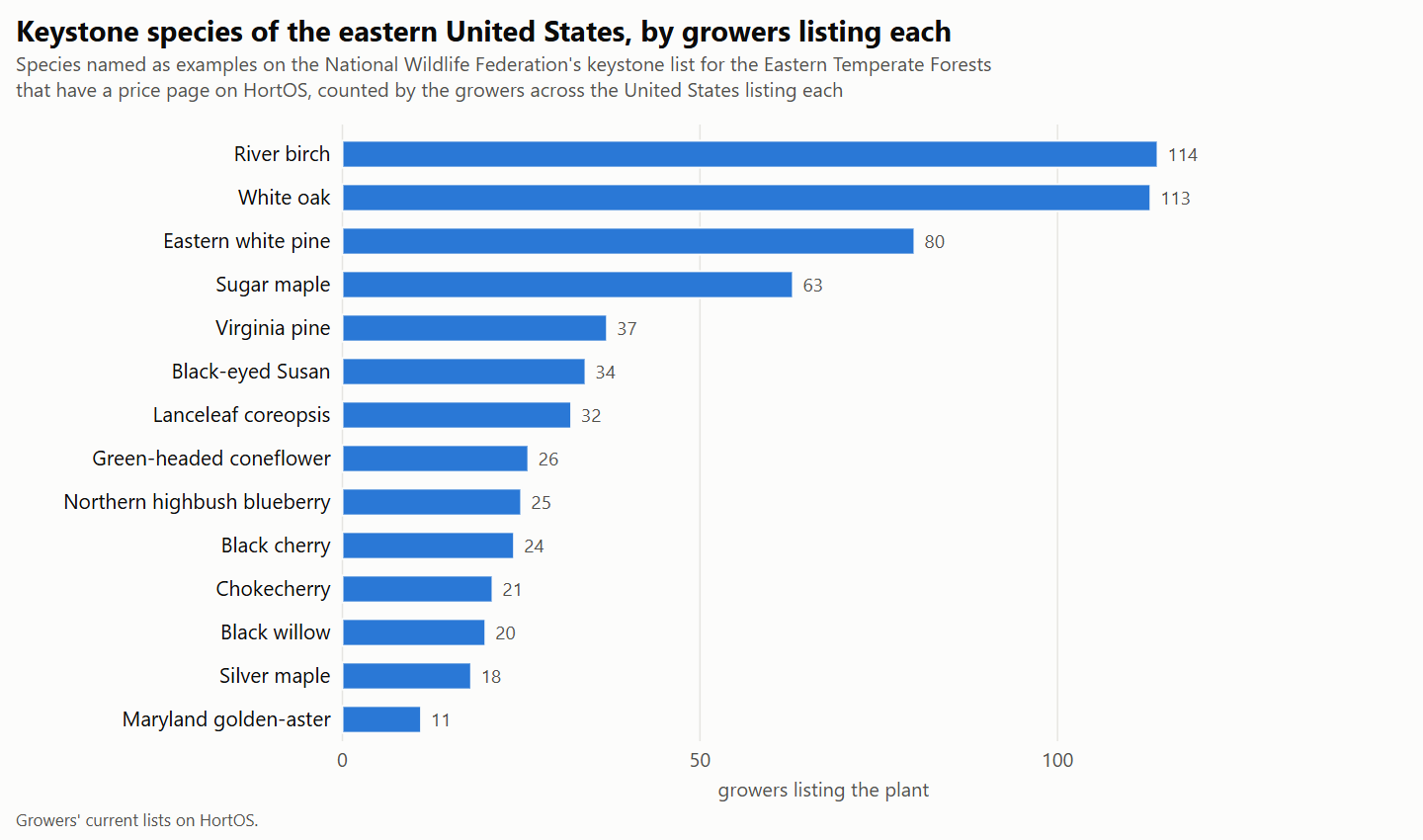
Keystone Plants of the Eastern United States by Growers Listing Each
The National Wildlife Federation's keystone list for the Eastern Temperate Forests is organized by genus and names sample species. This page sets out what the keystone figures count. It then shows how many growers list most of those species on HortOS, a median trade price where at least three price a size, and what a grower count cannot show.