Budgeting plant replacement for HOAs and condominiums
How the Community Associations Institute's reserve test, a reserve study firm and the 2026 Florida Statutes treat plants in an association budget, with a table of the trade prices growers list on HortOS for the hedge, foundation and shade plants common in Southeastern common areas, by the size most growers price.
Updated September 14, 2026. Figures are what the live us.hortosapp.com price and plant pages printed.
On this page
The treasurer of a Florida condominium association, drafting next year's budget, wants to know what to set aside for the shrubs and trees that die along entrances and shared lawns each year. The idea that matters most: one reserve study firm wrote in 2025 that landscaping is in most cases an operating expense, and the trade price of each replacement plant is the part of that cost anyone can check.
The page draws on the Community Associations Institute's 2025 explanation of its reserve study standards, a 2025 article by the reserve study firm Reserve Advisors, and three sections of the 2026 Florida Statutes. Beside those rules it sets the trade prices of common hedge, foundation and shade plants from HortOS, a free directory of American wholesale plant growers with their published availability and trade prices. It is not a reserve study, a legal opinion or a contractor's quote.
Quick facts
| The reserve test | An expense must meet all three criteria in the Community Associations Institute's 2025 explanation of its standards to count as a reserve expense: an obligation, a foreseeable need and timing, and a material cost that can be estimated. |
|---|---|
| What material means | More than the association's yearly operating budget can readily absorb, a test of scale with no dollar figure (Community Associations Institute explanation, 2025). |
| Where landscaping sits | In most cases an operating expense and not a reserve component, according to Reserve Advisors (2025). |
| Florida condominiums | Reserve accounts must be in the budget for a new roof, repainting and repaving, and for any other item over $25,000 to replace, or a higher figure adjusted for inflation (Florida Statutes s. 718.112, 2026). |
| Florida homeowners' associations | Reserves for capital spending and put-off upkeep are optional in the budget (Florida Statutes s. 720.303, 2026). |
| Plants priced on this page | 20 of the 20 shrubs and trees in the price table carry a trade median from HortOS growers' lists. |
How reserve studies treat plants
The Community Associations Institute's 2025 explanation of its reserve study standards sets out a test with three parts, and an expense has to pass all of them to be funded from reserves. First, the association must be responsible for maintaining or replacing the component today. Second, the need for the work and its timing must be something the board can reasonably foresee. Third, the total cost must be material to the association and capable of a reasonable estimate.
The same 2025 explanation defines material by scale rather than by a dollar figure: the cost must be more than the yearly operating budget can readily take in. A cost that cannot be pinned down after careful research fails that third part. CAI's explanation says a project failing any part should not come out of the reserve side of the budget. It adds that a component's useful life can end because of how it looks, and that like-for-like replacement is not always the prudent choice. Some states, it notes, set their own rules on what a reserve list must include.
Reserve Advisors, a reserve study firm, wrote in 2025 that CAI's standards set no minimum cost for an item to count as reserve or operating. Where providers draw that line differs, the firm said, and is settled case by case. In its view landscaping is in most cases an operating expense, and most providers leave it out by default because a living landscape's useful life is almost impossible to predict. The firm also gave the cases that move the line. It classed a full landscape redesign, which some master associations carry out every 10 to 15 years, as a capital improvement because it upgrades rather than replaces like with like. Clearing many mature trees, it wrote in 2025, can run to $10,000 to $15,000 and beyond, which makes it a reserve expense. Its 2025 article added that pruning on a known cost and cycle, such as $50,000 every three to five years, could go into a reserve study.
The table below puts each budgeting rule this page relies on in one line, with the authority behind it and the year of the text read.
| Authority | What it says about the budget | Source and year |
|---|---|---|
| Community Associations Institute | A reserve expense has to pass every part of a three-part test | CAI explanation, 2025 |
| Community Associations Institute | The project must cost more than the yearly operating budget can easily take in | CAI explanation, 2025 |
| Community Associations Institute | Timing and need must be foreseeable, and appearance can end a useful life | CAI explanation, 2025 |
| Reserve Advisors | Landscaping usually sits in the operating budget | Firm article, 2025 |
| Reserve Advisors | Removing many full-grown trees can become a reserve item | Firm article, 2025 |
| Florida, condominiums | Reserves are required for three named items and any other item over $25,000 or the adjusted amount | Fla. Stat. 718.112, 2026 |
| Florida, homeowners' associations | The budget may include reserve accounts, and ones set up under the statute follow its rules | Fla. Stat. 720.303, 2026 |
| Florida, covenants | A covenant cannot bar an owner from Florida-friendly landscaping | Fla. Stat. 373.185, 2026 |
What Florida's statutes ask of an association budget
The 2026 Florida Statutes set different budget duties for condominiums and for homeowners' associations. Under s. 718.112 of the 2026 Florida Statutes, a condominium budget must set money aside for capital spending and put-off upkeep as well as its yearly running costs. That section names a new roof, repainting and repaving at any cost. It then adds any other item costing over $25,000 to replace or catch up on, or a higher figure set each year for inflation. The same 2026 section computes the amount to reserve from each item's estimated remaining useful life and its estimated replacement cost. Landscaping is not among the items s. 718.112 (2026) names for a condominium's structural integrity reserve study.
For a homeowners' association, s. 720.303 of the 2026 Florida Statutes uses "may" where the condominium section uses "must": reserves for the association's capital spending and put-off upkeep are optional in the budget. Under s. 720.303 (2026), the budget must still show the year's estimated revenues and expenses and the expected surplus or deficit at year end. An association without statutory reserve accounts that is responsible for capital improvements must print a notice in its financial report, under the same 2026 section, warning that special assessments may result.
One more 2026 Florida section bears on what a board replants. Section 373.185 of the 2026 Florida Statutes bars any covenant or deed restriction from stopping an owner putting in Florida-friendly landscaping. It defines that as quality landscapes that save water, suit local conditions and tolerate drought. In the same 2026 section the Florida Legislature found that the part homeowners' associations play is essential to the state's water conservation work. Other states write their own rules for association budgets, and this page covers Florida's alone.
Trade prices for common replacement shrubs and trees
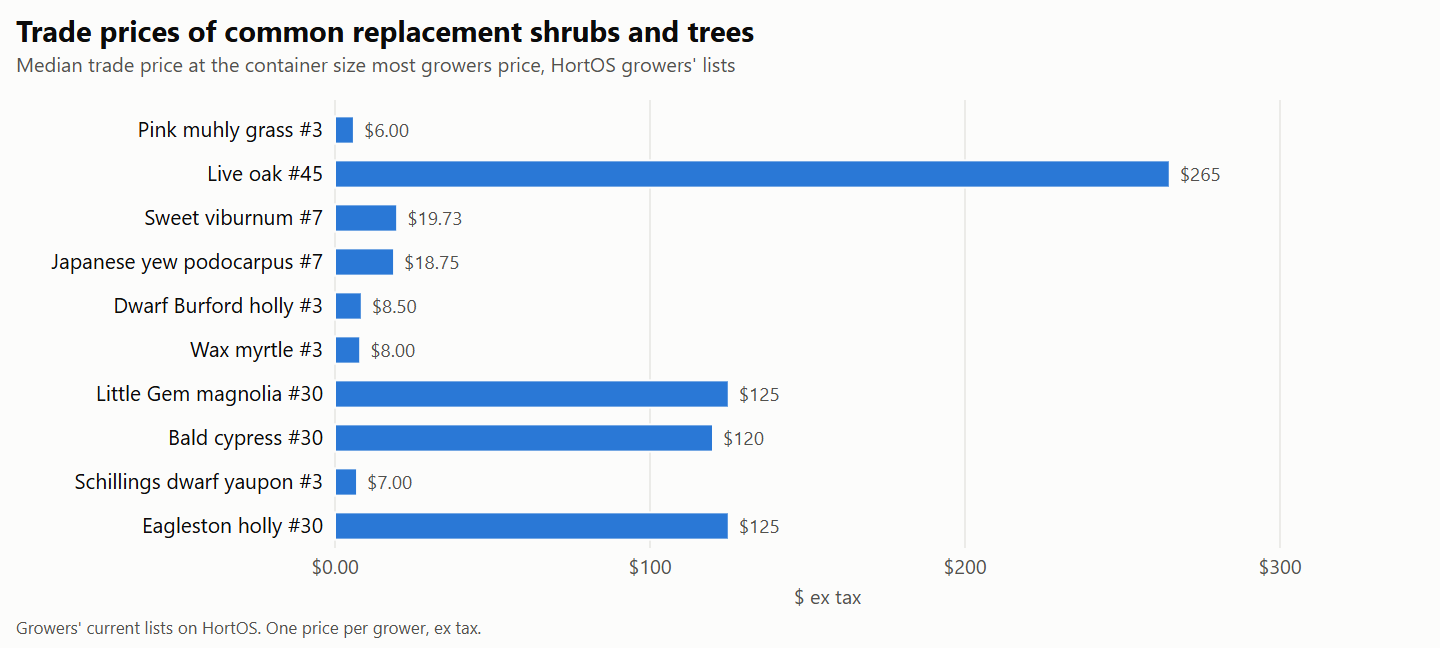
The table lists the foundation shrubs, hedge plants and shade trees common in Southeastern common-area plantings that have a price page on HortOS, shrubs and grasses first and trees after. It shows 20 of them. Each row gives the growers listing the plant, the container size most growers price, and the median at that size. Prices are medians across growers' current trade lists on HortOS: one price per grower, ex tax, freight not included, with the number of growers pricing each size in brackets. Anyone can see the prices on HortOS, and only the trade can order.
| Plant | Growers listing it | Size most growers price | Median (growers pricing) |
|---|---|---|---|
| Japanese yew podocarpus (Podocarpus macrophyllus) | 194 | #7 | $18.75 (96) |
| Sweet viburnum (Viburnum odoratissimum) | 195 | #7 | $19.73 (98) |
| Walter's viburnum (Viburnum obovatum) | 56 | #3 | $6.25 (24) |
| Wax myrtle (Myrica cerifera) | 225 | #3 | $8.00 (91) |
| Schillings dwarf yaupon holly (Ilex vomitoria 'Schillings') | 151 | #3 | $7.00 (88) |
| Dwarf Burford holly (Ilex cornuta 'Burfordii Nana') | 147 | #3 | $8.50 (92) |
| Inkberry (Ilex glabra) | 46 | #3 | $12 (13) |
| Indian hawthorn (Rhaphiolepis indica) | 99 | #3 | $5.50 (62) |
| Loropetalum (Loropetalum chinense) | 33 | #3 | $6.00 (17) |
| Yellow anise (Illicium parviflorum) | 69 | #3 | $7.25 (38) |
| Pink muhly grass (Muhlenbergia capillaris) | 291 | #3 | $6.00 (165) |
| Eagleston holly (Ilex x attenuata 'Eagleston') | 184 | #30 | $125 (76) |
| American holly (Ilex opaca) | 34 | #3 | $29.75 (6) |
| Little Gem magnolia (Magnolia grandiflora 'Little Gem') | 307 | #30 | $125 (90) |
| Southern magnolia (Magnolia grandiflora) | 70 | #15 | $80 (13) |
| Crape myrtle (Lagerstroemia indica) | 36 | #30 | $150 (7) |
| Live oak (Quercus virginiana) | 327 | #45 | $265 (107) |
| Shumard oak (Quercus shumardii) | 199 | #30 | $125 (40) |
| Red maple (Acer rubrum) | 152 | #15 | $60 (20) |
| Bald cypress (Taxodium distichum) | 368 | #30 | $120 (89) |
Most of the growers listing the plants in this table are in Florida. The size shown for each plant is the container size most growers price; field grown lines are not counted.
Two of the hedge plants are priced mostly at #7. Sweet viburnum has a median of $19.73 at #7 across 98 growers, and Japanese yew podocarpus has $18.75 at #7 across 96 growers. Lower foundation plants are priced mostly at #3: Indian hawthorn has a median of $5.50 from 62 growers, and Schillings dwarf yaupon holly has $7.00 from 88.
Trees are priced in larger containers. Live oak is listed by 327 growers, and its median at #45 is $265 from 107 growers. Little Gem magnolia has a median of $125 at #30, and bald cypress has $120 at #30. A count here is growers listing the plant, not how many plants exist or how well it suits a site.
A median is the grower's price for the plant alone. A contract to replace a dead shrub or tree also pays for the labor to plant it and any warranty the contractor gives, so a contract price and a trade median measure different things. The guide to what plants cost in 2026 gives trade prices across more plants and sizes, which helps where a board's plant list goes beyond these rows.
What the price table does not show
The table gives no yearly replacement rate and no lifespan for any plant. Reserve Advisors wrote in 2025 that a living landscape's useful life is almost impossible to predict. The table cannot say how many plants an association will replace in a year.
Each row shows one container size, the one most growers price. A board that replaces hedge plants at a larger size than the row shows will see a different price, and a size not in the table may carry no median at all. A median needs three growers pricing a size. American holly is priced by 6 growers at #3 and crape myrtle by 7 at #30. A median on so few moves when one grower changes a price.
The table says nothing about grade, root condition or how a given grower's plants look on the day. Whether a plant suits a site, fits an association's plant list or passes architectural review is for the board and its committee. For a board or manager thinking of ordering from a grower, the guide to buying from a wholesale grower sets out how orders, minimums and collection usually work.
What to watch for
- Moving a whole replanting into the reserve line without testing it against CAI's three criteria; Reserve Advisors (2025) classes a full redesign as a capital improvement, not a like-kind replacement.
- Reading a contractor's price per plant and a trade median as the same figure; only one covers labor and warranty.
- Budgeting at one container size and contracting at another; a #3 shrub and a #7 shrub are different lines with different prices.
- Writing a Florida replacement plant list without regard to s. 373.185 of the 2026 Florida Statutes on Florida-friendly landscaping; the association's attorney says what it means for the association's own rules.
- Treating a median from a handful of growers as a firm figure for a large order.
Getting it right
- Ask the reserve study provider whether landscaping, large tree removal or cyclical pruning is in the study, and which items it lists under its threshold.
- Ask the community association manager or property manager for the shrubs and trees replaced in each recent year, by plant and container size.
- Ask the landscape contractor to quote each replacement plant by name and container size, with labor and any warranty stated as separate lines.
- For a Florida condominium or homeowners' association, ask the association's attorney and accountant how s. 718.112 or s. 720.303 applies to the coming budget.
- The board then decides the operating line for plant replacement and records the basis it used.
A word of caution
This page reports what CAI's 2025 explanation, Reserve Advisors' 2025 article and the 2026 Florida Statutes say. It does not decide whether any planting belongs in a reserve study. The reserve study provider, the association's attorney and its accountant answer those questions, and the board adopts the budget. Outside Florida, association budget law is set by each state's own statutes, and an attorney in that state is the one to ask.
Sources
- Community Associations Institute, An Explanation of CAI's Reserve Study Standards: the three-part reserve test.
- Reserve Advisors, Trees and Landscaping: Operating or Reserve Expense?: landscaping as operating or reserve.
- Florida Legislature, The 2026 Florida Statutes, s. 718.112: condominium budgets and reserve accounts.
- Florida Legislature, The 2026 Florida Statutes, s. 720.303: homeowners' association budgets and reserves.
- Florida Legislature, The 2026 Florida Statutes, s. 373.185: Florida-friendly landscaping and covenants.
More guides

What Plants Cost at the Nursery in 2026
The general reference behind every article on what a landscape costs: the median trade price ex tax of the line most growers price at each container class from #1 to #100, the spread across growers, the difference between states, what a nursery-gate price leaves out, and worked figures for a planting, a street tree order and a giveaway.

Buying From a Wholesale Grower When You Are Not in the Trade
Native plant societies, watershed districts, land trusts, schools and church committees can buy from wholesale growers when they order like the trade: in quantity, ahead of the season, on the grower's terms. This page explains who sells to whom, resale certificates and exemptions, minimums and pooling, the sizes to buy, straight species and ecotype, lead times and shipping.
What the research says trees and landscaping add to a home's value
A study by study account of what American research found trees and landscaping add to a home's value: the seven-state perceived value survey, the Portland and Minnesota sale price models and eight more, each with its method and what it leaves out. A separate section shows what growers list for yard trees and shrubs.