What the plants for a community garden cost at trade
For community garden groups writing a start-up budget. It reports what Gardening Matters, University of Delaware Cooperative Extension and NC State Extension say about plants and cost, and sets out trade medians by container size for fruit trees, berry bushes, herbs and pollinator border plants, with the growers pricing each.
Updated October 8, 2026. Figures are what the live us.hortosapp.com price and plant pages printed.
On this page
A volunteer treasurer for a new neighborhood garden sits down with a blank budget worksheet and one question: what will the fruit trees, berry bushes, herbs and border flowers cost? The plant line of a community garden budget can be priced from growers' published trade lists before anyone picks up a phone. This page sets out those trade prices by container size for perennials of the kinds an extension handbook names for shared plantings, with culinary herbs added, and keeps them apart from the whole-garden totals the guides give.
Its sources are the start-up guide from Gardening Matters, a Minnesota garden group (2009), and the Northern Delaware Community Garden Toolkit from University of Delaware Cooperative Extension (2021). It also draws on NC State Extension's handbook Collard Greens and Common Ground (revised 2023). For the plant line, a treasurer gets medians from HortOS, a free directory of American wholesale plant growers with their published availability and trade prices. This is not a full garden budget, a quote from any grower, or advice on what to plant.
Quick facts
| A start-up range | Roughly $1,000 to $5,000 to start a simple shared food garden of a quarter acre in North Carolina, not counting paid staff (NC State Extension, AG-806, revised 2023). |
|---|---|
| The biggest start-up costs | Fencing and the water hookup tend to cost the most, according to NC State Extension's 2023 handbook for North Carolina gardens. |
| Yearly upkeep | Often well under $1,000 a year, salaries aside, according to NC State Extension's North Carolina handbook (2023). |
| One sample total | A grand total of $9,712 in a sample start-up budget built around 15 raised beds, offered as a guide only (University of Delaware Cooperative Extension, Northern Delaware toolkit, 2021). |
| Where the budget falls | Setting a budget and finding a sponsor is step six of ten in the University of Delaware Cooperative Extension toolkit (2021). |
| The plant line | Trade medians for 20 perennials at the container size most growers price, from growers' lists on HortOS. |
What the start-up guides say about plants and money
The Gardening Matters guide (Minnesota, 2009) tells a group to turn its garden design into a materials list and then cost the whole project. For fencing and other items, it expects the group to call suppliers one by one for prices. Its sample budget worksheet puts plant materials, meaning seeds and seedlings, among the basic elements, while hedges and trees appear only on a wish list of nice additions. The guide is plain that the dollar amounts on that worksheet are illustrations, not estimates.
The same guide's planning worksheet asks two questions that bear on the plant line. Will the garden set aside room for perennial plants or fruit trees? And would members like to buy their seeds or plants in one shared order? Once a total is known, the guide suggests that a group may scale back and hold some design ideas over for a second phase.
The University of Delaware Cooperative Extension toolkit (2021) defines a community garden as land worked by a group, which may grow fruit, vegetables or ornamentals. It says a budget helps when a group applies for a grant, because many funders ask for a detailed one. Its sample start-up budget, built around 15 raised beds, reaches a grand total of $9,712. The toolkit treats that sample as a guide only, since every garden has its own needs and material prices change over time.
NC State Extension's handbook for North Carolina (2023) gives the widest view. It puts a basic quarter-acre start-up at roughly $1,000 to $5,000, staff pay aside, with fencing and the water hookup usually the biggest items, and annual upkeep often well under $1,000. It says gardens raise money through a mix of fundraising, dues, donations and grants.
The table below gives each guide's own words on plants and cost in short form, with its publisher and year.
| Start-up guide | What it says on plants and cost | Publisher and year |
|---|---|---|
| Twin Cities start-up guide | Group phones around for prices itself | Gardening Matters, 2009 |
| Twin Cities sample worksheet | Plant line left with no amount | Gardening Matters, 2009 |
| Twin Cities sample worksheet | Hedges and trees are wish-list items | Gardening Matters, 2009 |
| Twin Cities planning worksheet | Asks about room for perennials and fruit trees | Gardening Matters, 2009 |
| Northern Delaware toolkit | Sample start-up total $9,712; no plant line read | University of Delaware, 2021 |
| North Carolina handbook | Quarter acre: $1,000 to $5,000 | NC State Extension, 2023 |
| North Carolina handbook | Yearly upkeep often under $1,000 | NC State Extension, 2023 |
| North Carolina handbook | Shared berry, rose or fruit tree plantings | NC State Extension, 2023 |
The perennial plants at trade prices
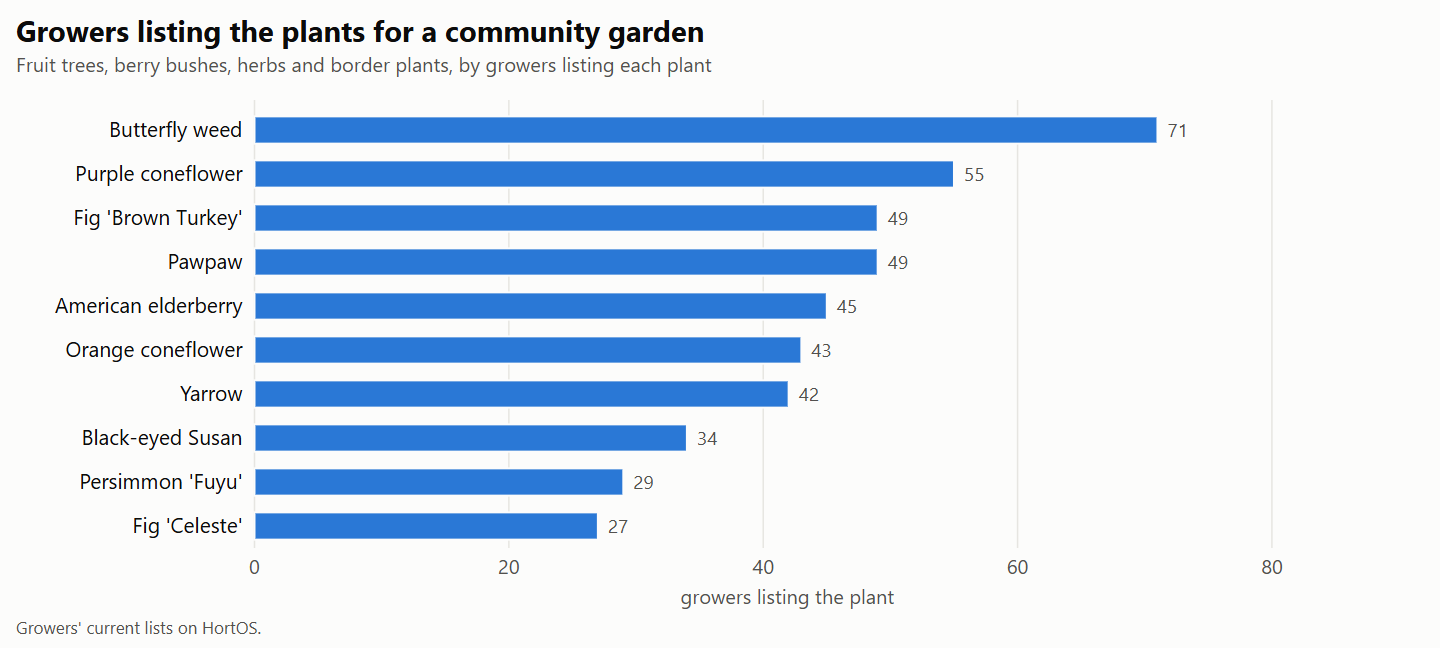
NC State Extension's 2023 handbook names berry bushes, roses and fruit trees as plantings a garden may share, and it describes flower beds along fence lines and around signs, which invite the neighborhood in and draw pollinators. The table takes perennials of those kinds, adding culinary herbs, wherever the exact species or cultivar has a price page on HortOS. It holds 20 plants, all with a median. Prices are medians across growers' current trade lists on HortOS: one price per grower, ex tax, freight not included, with the number of growers pricing each size in brackets.
| Plant | Growers listing it | Size most growers price | Median (growers pricing) |
|---|---|---|---|
| Fig 'Brown Turkey' (Ficus carica 'Brown Turkey') | 49 | #3 | $16.70 (16) |
| Fig 'Celeste' (Ficus carica 'Celeste') | 27 | #3 | $16 (7) |
| Peach (Prunus persica) | 20 | #3 | $21 (3) |
| Pomegranate (Punica granatum) | 11 | #3 | $17.50 (3) |
| Pawpaw (Asimina triloba) | 49 | #3 | $16 (15) |
| Persimmon 'Fuyu' (Diospyros kaki 'Fuyu') | 29 | #7 | $40.50 (4) |
| Rabbiteye blueberry (Vaccinium ashei) | 6 | #3 | $11.50 (6) |
| Highbush blueberry (Vaccinium corymbosum) | 25 | #3 | $18 (7) |
| Blackberry 'Apache' (Rubus 'Apache') | 8 | #3 | $13.47 (4) |
| Blackberry 'Navaho' (Rubus 'Navaho') | 12 | #3 | $12 (5) |
| Raspberry 'Heritage' (Rubus idaeus 'Heritage') | 13 | #2 | $20 (3) |
| American elderberry (Sambucus canadensis) | 45 | #3 | $15 (11) |
| Rosemary (Rosmarinus officinalis) | 22 | #1 | $4.13 (8) |
| English lavender 'Hidcote' (Lavandula angustifolia 'Hidcote') | 15 | #1 | $5.50 (5) |
| English lavender 'Munstead' (Lavandula angustifolia 'Munstead') | 16 | #1 | $7.50 (6) |
| Purple coneflower (Echinacea purpurea) | 55 | #1 | $4.80 (13) |
| Orange coneflower (Rudbeckia fulgida) | 43 | #1 | $5.83 (10) |
| Black-eyed Susan (Rudbeckia hirta) | 34 | #1 | $3.25 (15) |
| Butterfly weed (Asclepias tuberosa) | 71 | #1 | $4.50 (21) |
| Yarrow (Achillea millefolium) | 42 | #1 | $4.25 (3) |
The growers listing the plants in this table are spread across many states; the most are in Florida, North Carolina and Pennsylvania. The size shown for each plant is the container size most growers price; field grown lines are not counted, and palms and other plants sold by height are not priced above #15.
Anyone can see the prices on HortOS, and only the trade can order.
Reading the plant table by group
The fruit trees are the costliest line per plant. Fig 'Brown Turkey' is listed by 49 growers, and its median at #3 is $16.70 across 16 growers pricing that size. Pawpaw is listed by 49 growers, with a median of $16 at #3. Persimmon 'Fuyu' is the one fruit tree in the table whose most-priced container is #7, so its median of $40.50 is for a larger plant than its neighbors.
Six medians rest on thin pricing: peach, pomegranate, persimmon 'Fuyu', blackberry 'Apache', raspberry 'Heritage' and yarrow are each priced by fewer than five growers at the size shown. A median on so few moves when one grower changes a price. A firm figure for any of those rows is the grower's to give.
The berry bushes sit in the middle. Highbush blueberry has a median of $18 at #3 from 7 growers pricing, and rabbiteye blueberry has one of $11.50. American elderberry is listed by 45 growers. Raspberry 'Heritage' is priced most often at #2, a smaller container than the blackberries beside it.
The herbs and border plants are the cheapest line and are priced most often at #1. Butterfly weed is listed by 71 growers, the widest listing in the table, with a median of $4.50 from 21 growers pricing. Purple coneflower has a median of $4.80, and rosemary one of $4.13. The guide to reading an availability list sets out what container classes such as #1 and #3 mean on a grower's list.
What the figures leave out
A median is the middle of growers' published trade prices for one container size on one day. It is not a quote, and it carries no sales tax, freight, minimum order or delivery charge. Whether a grower sells to a community group is that grower's decision; the guide to buying from a wholesale grower covers that question.
The table does not show which plants suit a given site, which fruit trees need a partner for pollination, how hardy each one is in a cold winter, or which rootstock a grower uses. It says nothing of soil, mulch, irrigation, fencing or tools, which are the lines the extension guides above treat as the big costs. A plant's place in the table is not a recommendation to plant it.
Donated plants are not in the figures either. The Gardening Matters guide (2009) says local businesses may give anything from fencing to plants, and it suggests annual flower seed as a quick filler that can be replaced later when no donated plants are in hand. NC State Extension (2023) adds that donated seeds and seedlings may or may not be of a quality suited to success.
What to watch for
- Reading a whole-garden total as a plant budget. The NC State range and the Delaware sample total each cover a full garden, and the Delaware figure is offered as a guide only.
- Pricing a plant at the wrong size. Each median belongs to the container shown beside it, and persimmon 'Fuyu' is priced at a larger size than the other fruit trees.
- Leaving freight and tax off the plant line. The medians are ex tax with freight not included, and a grower's minimum order can change the sum.
- Trusting a thin median as firm. Where only a handful of growers price a size, one changed price moves the figure.
- Planting trees before the water is on. The Gardening Matters guide places shade and fruit trees after the site has water, and names drip and soaker hoses as suited to deep-rooted fruit trees.
Getting it right
- The garden's steering group decides which shared plantings go in the first phase and which wait. The Gardening Matters worksheet puts to members whether they want to order plants together.
- The landowner decides what the site can take. The Delaware toolkit notes that most community gardens sit on borrowed land, which limits what can be added to a site.
- The grower sets its own terms: its minimum order, the container sizes it prices, the delivery charge, and whether it sells to a community group.
- The sponsor or grant maker decides what budget detail it needs, and the Delaware toolkit notes that many funders ask for a detailed budget.
- The gardeners decide who looks after shared plantings. NC State Extension says these succeed only when the gardeners know who waters and weeds each week.
A word of caution
The budget figures on this page are NC State Extension's range for a North Carolina quarter-acre food garden (2023) and the University of Delaware Cooperative Extension sample total (2021); Gardening Matters calls its own worksheet amounts illustrative. None of them is a price for any one garden. For what grows well in a county and when to plant it, the local Cooperative Extension office is the one to ask, and for a firm price, the grower.
Sources
- Gardening Matters, Community Garden Start-Up Guide: budget step and sample worksheet.
- University of Delaware Cooperative Extension, Northern Delaware Community Garden Toolkit: sample budget, sponsors, borrowed land.
- NC State Extension, Collard Greens and Common Ground: Funding and Resources: start-up and yearly budget ranges.
- NC State Extension, Collard Greens and Common Ground: Food Garden Design: shared plantings and flower beds.
- NC State Extension, Collard Greens and Common Ground (AG-806): handbook scope and revision date.
More guides

Reading a Wholesale Availability List, and Pricing the Plants in a Bid
For landscape contractors, designers, estimators and students: what each column of a wholesale availability list means, how much the same plant at the same size varies between growers and states, how the low, median and high on the price pages are built, and how to carry the plant line of a bid from the list to the client.

Buying From a Wholesale Grower When You Are Not in the Trade
Native plant societies, watershed districts, land trusts, schools and church committees can buy from wholesale growers when they order like the trade: in quantity, ahead of the season, on the grower's terms. This page explains who sells to whom, resale certificates and exemptions, minimums and pooling, the sizes to buy, straight species and ecotype, lead times and shipping.
School garden grants and the growers and trade prices for the plants
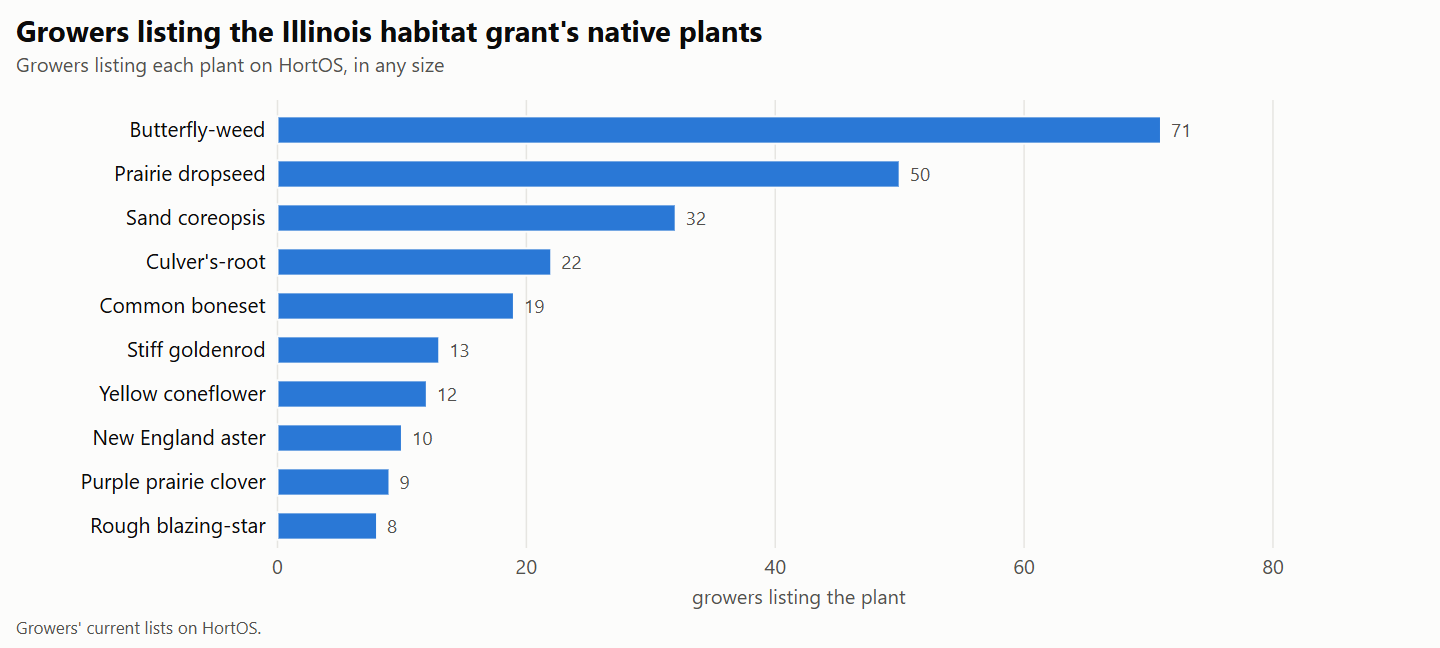
A dated record of school and youth garden grants in the United States, each read on its funder's own page. It adds the growers listing the native plants the Illinois habitat grant pays for, and trade medians for the apple and fig varieties University of Georgia Cooperative Extension names for school gardens.