Maryland's 5 Million Trees goal and trade prices for recommended trees
Sets out Maryland's 5 Million Trees goal as the 2021 statute words it and the counting tests the Department of Natural Resources published in March 2026. Two tables set the trees on the Department's recommended list beside the growers listing each on HortOS and a median trade price. Two more count them for Maryland and compile the tree programs.
Updated October 9, 2026. Figures are what the live us.hortosapp.com price and plant pages printed.
On this page
A watershed group, a school or a county forestry office planning a planting in Maryland asks two things. Will the trees be counted toward the state's 5 Million Trees goal, and what do growers list those trees for? The first answer comes from two places. Section 2-1212 of Maryland's Environment Article (enacted 2021) sets a goal of 5,000,000 sustainable native trees, due by the end of 2031, and the Department of Natural Resources' release of March 31, 2026 says which plantings count.
This page reads the statute, the Department's program pages and tree list, the Department of the Environment's 2025 annual report, and the pages of the Alliance for the Chesapeake Bay and the Chesapeake Bay Trust. It adds figures from HortOS, a free directory of American wholesale plant growers with their published availability and trade prices: the growers listing each tree on the Department's recommended list, and a median trade price. It is not a ruling on whether a planting counts, and it prints no Maryland price.
Quick facts
| The goal in law | Section 2-1212 of Maryland's Environment Article (enacted 2021, in effect 2026) sets a goal of "planting and helping to maintain in the State 5,000,000 sustainable trees of species native to the State" by the end of 2031. |
|---|---|
| The urban share | Section 2-1212 of Maryland's Environment Article (2021) records the General Assembly's intent that 500,000 or more of those trees "should be planted" in an underserved area, a term that section 8-1911 of Maryland's Natural Resources Article defines. |
| What the Department counts | The Maryland Department of Natural Resources' release of March 31, 2026 gives three tests for a planting: it went in after July 1, 2021, it supports afforestation, and its trees are native to Maryland. |
| How many species | More than 60 species count, most of them on the recommended tree list, the Maryland Department of Natural Resources said on March 31, 2026. That list had 43 entries when it was read on October 5, 2026. |
| Progress recorded | The Maryland Department of the Environment's annual report of December 2025 counts 1,537,131 plantings recorded since July 1, 2021, which it puts at 30 percent of the goal. |
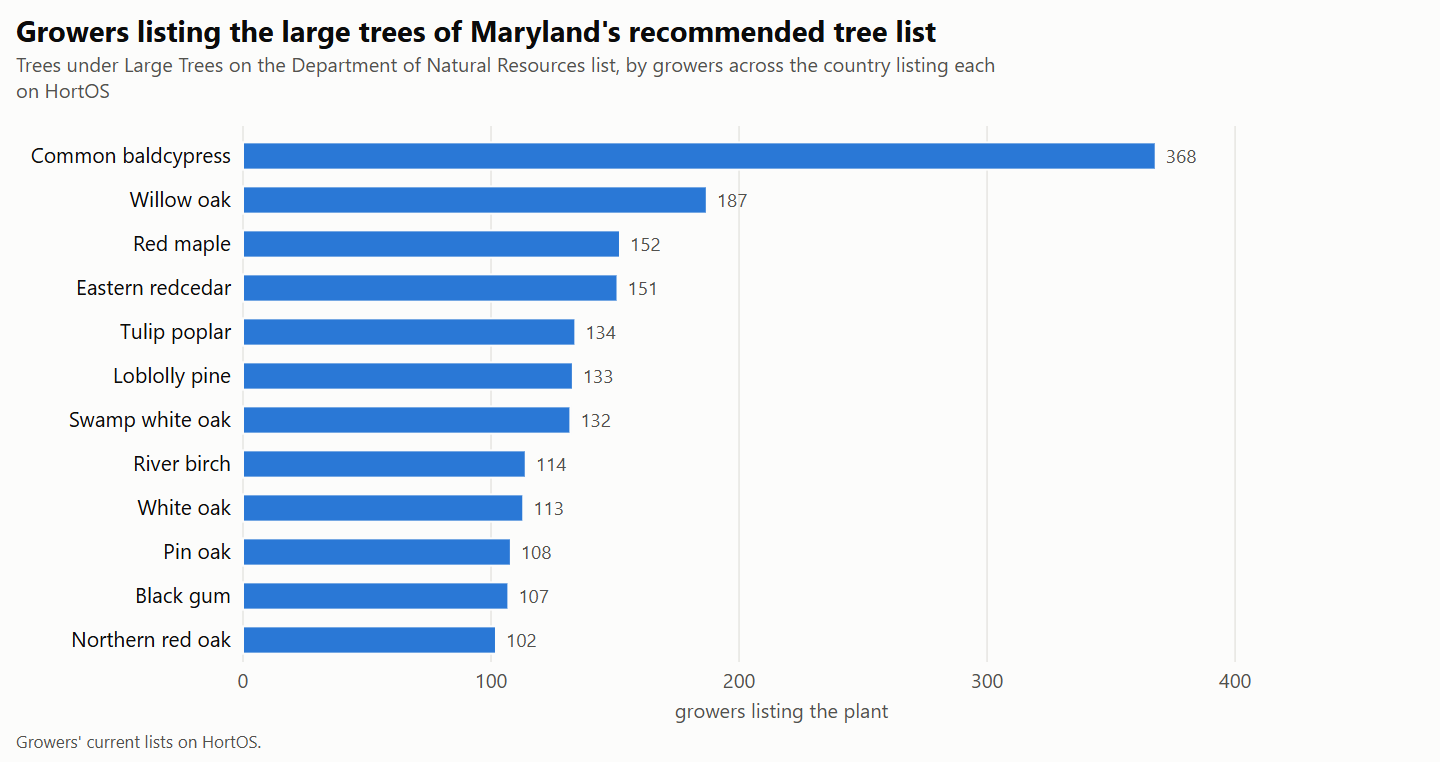
| Willow oak at trade | Willow oak is listed by 187 growers across the country on HortOS. Its median trade price in a #15 container, the size most growers price, is $60, read from 35 growers at one price each, ex tax. |
What the statute sets and what the Department adds
The goal sits in section 2-1212 of Maryland's Environment Article. On October 5, 2026 the General Assembly's statute pages showed that section as in effect, and as effective until June 30, 2031 under Chapter 645 of 2021. That chapter is the Tree Solutions Now Act of 2021, House Bill 991, to which the General Assembly's bill page gives an effective date of June 1, 2021.
The section (Maryland, 2021) makes it State policy to back public and private planting, with a goal of "5,000,000 sustainable trees of species native to the State" by the end of 2031. It sets that goal on top of the trees projected under the programs of the State's 2019 draft greenhouse gas plan, and it takes in plantings by State programs, nonprofits and private organizations (Maryland, 2021). It records the General Assembly's intent that 500,000 or more of the trees "should be planted" in an underserved area, and it has the Department of the Environment track progress (Maryland, 2021).
Section 8-1911 of Maryland's Natural Resources Article (2021, in effect 2026) defines an underserved area as land in a Census Bureau urban area that also meets one of four tests. They are a neighborhood once redlined or graded "hazardous" by the Home Owners' Loan Corporation, a census tract that meets the section's unemployment test or its income test, and a housing project (Maryland, 2021).
The Department of Natural Resources words the goal in its own way. Its program page (Maryland, 2026) speaks of five million "additional" native trees, 500,000 or more of them in underserved urban communities. Its release of March 31, 2026 then sets out what a planting must be to count:
- It went into the ground after July 1, 2021, and a planting made since then may still be registered.
- It supports afforestation, which the release explains as planting on land long without tree cover.
- Its trees are native to Maryland: more than 60 species, most of them on the Department's recommended tree list.
The release adds that at least 10 percent of the trees must go into urban underserved areas as the 2021 Act defines them (Maryland Department of Natural Resources, 2026). These tests are reported here from the release, not from the text of section 2-1212.
The Department of the Environment's annual report of December 2025 (Maryland) records 1,537,131 plantings since July 1, 2021, which it puts at 30 percent of the goal. It counts 86,500 of the trees in urban, underserved areas, and it says work is under way on gaps between the trees reported and the trees planted. The Department of Natural Resources' release of March 31, 2026 put the total at more than 1.5 million, with 3.5 million more to plant by 2031.
The Department's tree list beside growers' lists
The Department of Natural Resources keeps a recommended tree list for its Marylanders Plant Trees program and says the list may be updated (Maryland, 2026). Its release of March 31, 2026 names that list as holding most of the species that count. Read on October 5, 2026, the list had 43 entries in two groups: 14 under Small Trees and 29 under Large Trees.
The two tables below keep those groups and the list's order. Each shows the entries that the list names to species and that had a price page on HortOS: 11 of the small trees and 27 of the large. Not shown are 3 entries of the first group and 2 of the second: the crabapple entry, which is a genus, and trees with no price page that day. Among those, green hawthorn (Crataegus viridis) is listed by 4 growers and downy serviceberry (Amelanchier arborea) by 14.
The groups are the Department's, not a HortOS judgment of size. The height column is the figure in each entry of the Department's web page (Maryland, 2026), and the entries for sweetbay magnolia and pawpaw give none. Chestnut oak appears under the botanical name the Department uses.
Prices are medians across growers' current trade lists on HortOS: one price per grower, ex tax, freight not included, with the number of growers pricing each size in brackets. Grower counts are the growers listing each plant on HortOS, in any size. Anyone can see the prices on HortOS, and only the trade can order.
| Plant | Height on the Maryland DNR list (2026) | Growers listing it | Size most growers price | Median (growers pricing) |
|---|---|---|---|---|
| Pagoda dogwood (Cornus alternifolia) | 12 to 15 ft | 23 | #3 | $28 (3) |
| American flowering dogwood (Cornus florida) | 20 ft | 52 | #5 | $40 (4) |
| White fringetree (Chionanthus virginicus) | 12 to 20 ft | 69 | #3 | $20 (12) |
| Washington hawthorn (Crataegus phaenopyrum) | 25 to 30 ft | 18 | Field grown only | |
| American holly (Ilex opaca) | 15 to 30 ft | 34 | #3 | $29.75 (6) |
| Hophornbeam (Ostrya virginiana) | 30 to 50 ft | 34 | #15 | $75 (3) |
| Sweetbay magnolia (Magnolia virginiana) | Not stated | 152 | #15 | $62.50 (32) |
| Pawpaw (Asimina triloba) | Not stated | 49 | #3 | $16 (15) |
| Eastern redbud (Cercis canadensis) | 20 to 30 ft | 194 | #15 | $77.50 (28) |
| Serviceberry or shadblow (Amelanchier canadensis) | 6 to 20 ft | 35 | #3 | $21.98 (4) |
| Allegheny serviceberry (Amelanchier laevis) | 30 to 40 ft | 36 | #1 | $10.50 (3) |
The growers listing the plants in this table are spread across many states; the most are in Florida, North Carolina and Tennessee. The size shown for each plant is the container size most growers price; field grown lines are not counted. Where a row says Field grown only, its growers price that plant as field grown stock and no container median is shown.
The growers listing the plants in this table are spread across many states; the most are in Florida, North Carolina and Tennessee. The size shown for each plant is the container size most growers price; field grown lines are not counted.
The size column changes from row to row, so the medians are not a ranking of the trees by price. The guide to nursery pot sizes explains the container classes, and the tree cost guide prices a set of trees at three container sizes.
Some medians rest on few growers. Pagoda dogwood (3 growers pricing a #3), hophornbeam (3 pricing a #15), chestnut oak (3 pricing a #3) and black walnut (4 pricing a #3) each have fewer than five, and so do several other rows. A median on so few is a thin reading that one grower's list can move, so the count in brackets is read before the dollar figure.
Both tables are national, as the line under each one says. They are not Maryland prices, and no Maryland median is printed on this page. They are trade prices at the grower, so freight, planting and aftercare are outside them.
The same trees counted in Maryland alone
The third table counts the same trees for one state. It shows each tree from the first two tables that one or more growers in Maryland list, in order of that count, read on the same date. No price is printed for Maryland. A count here is growers listing the plant, not how many plants exist or how well it suits a site.
| Plant | Growers listing it in Maryland |
|---|---|
| Eastern redcedar (Juniperus virginiana) | 11 |
| Eastern redbud (Cercis canadensis) | 9 |
| Pin oak (Quercus palustris) | 9 |
| Willow oak (Quercus phellos) | 9 |
| Northern red oak (Quercus rubra) | 8 |
| Black gum (Nyssa sylvatica) | 8 |
| Sweetbay magnolia (Magnolia virginiana) | 7 |
| Swamp white oak (Quercus bicolor) | 7 |
| American sweetgum (Liquidambar styraciflua) | 7 |
| Common baldcypress (Taxodium distichum) | 6 |
| American beech (Fagus grandifolia) | 6 |
| White oak (Quercus alba) | 6 |
| Loblolly pine (Pinus taeda) | 6 |
| Tulip poplar (Liriodendron tulipifera) | 6 |
| American flowering dogwood (Cornus florida) | 5 |
| River birch (Betula nigra) | 5 |
| Hackberry (Celtis occidentalis) | 5 |
| Sycamore (Platanus occidentalis) | 5 |
| Red maple (Acer rubrum) | 4 |
| Sugar maple (Acer saccharum) | 4 |
| Persimmon (Diospyros virginiana) | 4 |
| Eastern white pine (Pinus strobus) | 4 |
| White fringetree (Chionanthus virginicus) | 3 |
| Washington hawthorn (Crataegus phaenopyrum) | 3 |
| American holly (Ilex opaca) | 3 |
| Hophornbeam (Ostrya virginiana) | 3 |
| Serviceberry or shadblow (Amelanchier canadensis) | 3 |
| American elm (Ulmus americana) | 3 |
| American linden (Tilia americana) | 3 |
| Virginia pine (Pinus virginiana) | 3 |
| Pagoda dogwood (Cornus alternifolia) | 2 |
| Allegheny serviceberry (Amelanchier laevis) | 2 |
| Southern magnolia (Magnolia grandiflora) | 2 |
| Chestnut oak (Quercus prinus) | 2 |
| Pawpaw (Asimina triloba) | 1 |
| Sourwood (Oxydendrum arboreum) | 1 |
| Black walnut (Juglans nigra) | 1 |
A small count can change when one grower updates a list. A count does not give the size, the quantity or the origin of the seed. Those are questions for the grower, and the guide to buying from a wholesale grower sets out how the trade asks them.
Where seedlings, trees and planting money come from
The fourth table gathers nine of the programs that the Department's release of March 31, 2026 or the 2025 annual report names as a way to get trees, seedlings or planting money in Maryland. Each row rests on the document named in its last column, read on October 5, 2026, and no dollar amount is in the table.
| Program | What it offers | Who it is for | Authority and year |
|---|---|---|---|
| State Tree Nursery seedlings | Tree and shrub seedlings sold only for conservation uses such as reforestation, wildlife habitat and streamside buffers | Buyers planting for conservation; people who want ornamental trees are pointed to private nurseries | Maryland Forest Service, State Tree Nursery ordering site, 2026 |
| Backyard Buffers | Native tree and shrub seedlings at no charge, for planting beside water | Maryland landowners with a stream, pond, ditch or other waterway on their land | Maryland Department of Natural Resources, 2026 |
| Marylanders Plant Trees | A coupon toward one native tree, used at a participating nursery | Maryland residents planting on private residential land, one tree a household each year | Maryland Department of Natural Resources, 2026 |
| Tree-Mendous Maryland | Reduced-cost native trees, bought through a wholesale nursery partner | Local governments, schools, civic and watershed groups and nonprofits planting on public land or shared community space | Maryland Department of Natural Resources, 2026 |
| Urban Trees Program | Grants to qualified organizations for planting native trees in underserved urban areas | Nonprofits, schools, counties and municipalities, institutions of higher education, community associations, service, youth and civic groups, and forest conservancy district boards | Maryland Natural Resources Article, section 8-1911, in effect 2026 |
| Healthy Forests, Healthy Waters | A planting of one acre or larger on open land, at no charge to the landowner | Private landowners who agree to keep the new forest for ten years or more | Alliance for the Chesapeake Bay, 2026 |
| Conservation Reserve Enhancement Program signing bonus | A one-time bonus per acre, capped in statute, for land enrolled with a forested streamside buffer | Landowners who enroll in fiscal years 2023 to 2031 | Maryland Agriculture Article, section 8-706, in effect 2026 |
| Agricultural Water Quality Cost-Share (MACS) | Cost-share for establishing trees and shrubs, with an added payment for each tree planted | Farmers | Maryland Department of the Environment, annual report, 2025 |
| Maryland Urban and Community Forestry Council grants | Grants that pay for planting and for education projects in the state's urban forests | Community groups | Maryland Department of Natural Resources news release, 2026 |
Each program has limits. The State Tree Nursery's ordering site (Maryland Forest Service, 2026) bars the use of its seedlings for ornamental landscaping. The Department of Natural Resources runs the Marylanders Plant Trees coupon (Maryland, 2026). Only nurseries on its participating list, last updated in April 2026, take the coupon, and the recommended tree list is the only list it covers.
The Chesapeake Bay Trust's request for proposals for fiscal year 2027 (Maryland, 2026) says every tree planted with an Urban Trees grant must be native. It also says a tree already required as mitigation for development, or for another regulatory reason, cannot be proposed. That round closed on March 5, 2026, the Trust's page shows.
The money stands in separate instruments. Section 8-1911 of Maryland's Natural Resources Article (2021) directs the Governor to include $10,000,000 for the Urban Trees Program in the State budget for each of fiscal years 2024 through 2031. Section 8-706 of Maryland's Agriculture Article (2021) aims for wider enrollment in the Conservation Reserve Enhancement Program. It provides a one-time signing bonus of no more than $1,000 for each acre enrolled with a forested streamside buffer in fiscal years 2023 through 2031 (Maryland, 2021). The Department of the Environment's annual report (Maryland, 2025) says the Agricultural Water Quality Cost-Share Program pays up to 100% of the cost of establishing trees and shrubs, plus $2 for each tree planted.
Section 8-2A-02 of Maryland's Natural Resources Article (2021) covers Trust Fund money for tree planting. That money may go to private land only where the landowner signs a binding agreement to keep the area under tree cover for 15 years or more (Maryland, 2021).
What the list and the figures leave open
Nothing on this page decides whether a planting counts. Section 2-1212 (Maryland, 2021) gives the tracking of progress to the Department of the Environment, and the Department of Natural Resources' release (Maryland, 2026) sends doubtful projects to the local tree planting specialist. The release says more than 60 species count and that most of them are on the recommended list, so the list is not the whole of what counts. A listed tree still has to meet the Department's other tests.
Neither the release nor the tree list says whether a named cultivar of a listed species counts, and neither sets a minimum size for a counted tree. Both are questions for the Maryland Forest Service or the local tree planting specialist. The Department's list (Maryland, 2026) also says white oak is hard to get from nurseries and is sometimes sold as a seedling. A grower count does not answer that: it counts growers listing a tree in any size and says nothing of quantity.
HortOS shows that a grower lists a species. It does not show where the seed was collected, whether a line is the straight species or a named selection, or how the tree was grown. A buyer who needs local seed origin asks each grower for it in writing, with the botanical name as the grower will invoice it. This page also has no field grown price and no figure for what a garden center charges a resident.
What to watch for
- Citing the Act for the Department's tests. The date test, the afforestation test and the 10 percent share are worded in the Department of Natural Resources' release of March 31, 2026. Section 2-1212 (Maryland, 2021) words the urban share as 500,000 trees that "should be planted".
- Treating the recommended list as the whole rule. The release (Maryland, 2026) counts more than 60 species, while the Department says its coupon covers the recommended list only (Maryland, 2026).
- Reading a national median as a Maryland quote. A grower's own price, freight and minimum order are found only by asking.
- Comparing medians down a column. Each row is priced at its own container size.
- Planning State Nursery seedlings for ornamental planting. The ordering site (Maryland Forest Service, 2026) bars ornamental landscaping with them.
Getting it right
- Ask the local tree planting specialist whether the site and the project count. The Department of Natural Resources' release (Maryland, 2026) sends a doubtful project to that specialist, and it says the Maryland Forest Service assists landowners who want to plant.
- For an urban underserved area, check the site on the Department of Natural Resources' online map, which the Chesapeake Bay Trust's request for proposals (Maryland, 2026) uses to show whether a community is eligible.
- Check the species against the recommended list, which the release (Maryland, 2026) says holds most of the species that count. A native species that is not on it, a named cultivar or a very small tree is a question for the Maryland Forest Service.
- Use the Maryland counts and each tree's page to find growers listing it, then ask each for a written quote giving size, quantity, seed origin and delivery.
- Register the planting. The release asks Marylanders to register their trees, and the Trust requires its project leads to enter every tree in the Department of the Environment's tracking tool (Maryland, 2026).
A word of caution
The goal is the Maryland General Assembly's and the counting tests are the Department of Natural Resources'. Both were read on October 5, 2026, and the Department says its tree list may be updated. The statute has the Department of the Environment track progress, and the release sends a doubtful project to the local tree planting specialist. The counts and medians were read from HortOS and move as growers update their lists, so a price for a real order comes only from a grower.
Sources
- Annotated Code of Maryland, Environment Article, section 2-1212: the tree goal in law.
- Maryland General Assembly, House Bill 991 of the 2021 session: the bill's status and dates.
- Annotated Code of Maryland, Natural Resources Article, section 8-1911: Urban Trees Program, underserved area.
- Annotated Code of Maryland, Natural Resources Article, section 8-2A-02: Trust Fund money for planting.
- Annotated Code of Maryland, Agriculture Article, section 8-706: the streamside buffer signing bonus.
- Maryland Department of Natural Resources, 5 Million Trees Initiative: the goal and the partners.
- Maryland Department of Natural Resources, Planting with a Purpose, release of March 31, 2026: what counts, progress, the programs.
- Maryland Department of the Environment, Five Million Trees Initiative 2025 Annual Report: plantings counted to mid 2025.
- Maryland Department of Natural Resources, Recommended Tree List: the tree list and heights.
- Maryland Department of Natural Resources, Marylanders Plant Trees: the coupon program.
- Maryland Department of Natural Resources, Participating Nurseries: where the coupon is accepted.
- Maryland Forest Service, State Tree Nursery ordering site: what seedlings may be used for.
- Maryland Department of Natural Resources, Backyard Buffers Program: seedlings for streamside planting.
- Maryland Department of Natural Resources, Tree-Mendous Maryland: native trees for public land.
- Chesapeake Bay Trust, Urban Trees Award Program: the urban grant program.
- Chesapeake Bay Trust, Urban Trees Grant Program FY27 Request for Proposals: grant rules and dates.
- Alliance for the Chesapeake Bay, Healthy Forests, Healthy Waters: plantings on open land.
More guides

Nursery Pot Sizes Explained: Millimetres, Litres and Gallons
Australian growers name a pot by its rim diameter up to 400 mm and by its volume in litres above that, while American growers use gallon classes. This guide explains each step of the ladder, the approximate height and age behind it, how to convert between systems, and what the trade pays at every size.

What a Tree Costs at the Nursery, by Container Size and Caliper
A tree has a knowable wholesale price before freight, planting and margin are added, and the container size sets it far more than the species does. This page gives the trade prices for seven widely grown American trees at every size three or more growers publish, with the sizing rules behind them.

Buying From a Wholesale Grower When You Are Not in the Trade
Native plant societies, watershed districts, land trusts, schools and church committees can buy from wholesale growers when they order like the trade: in quantity, ahead of the season, on the grower's terms. This page explains who sells to whom, resale certificates and exemptions, minimums and pooling, the sizes to buy, straight species and ecotype, lead times and shipping.