Lilies and cats, and plants the ASPCA lists as non-toxic to cats
What the U.S. Food and Drug Administration and the ASPCA say about true lilies, daylilies and other plants called lilies around cats, set beside HortOS figures: how many wholesale growers list each daylily, its median trade price, and the same figures for plants the ASPCA listed as non-toxic to cats when read in October 2026.
Updated October 17, 2026. Figures are what the live us.hortosapp.com price and plant pages printed.
On this page
A cat owner looks at the clump of daylilies by the back steps, or at the Easter lily a relative brought, and asks whether the plant can stay. The U.S. Food and Drug Administration (FDA), on a page marked current in 2021, says true lilies and daylilies are very dangerous for cats and the entire plant is toxic, down to the pollen and the vase water. The same U.S. FDA page (2021) puts other plants called lilies into two further groups, so a common name alone settles nothing.
This page reports what the U.S. Food and Drug Administration (2021) and the ASPCA's plant list (United States, read October 2026) say, with plant profiles from NC State Extension and UF/IFAS Extension. HortOS, a free directory of American wholesale plant growers with their published availability and trade prices, adds grower counts and median trade prices. These cover daylilies and a few plants the ASPCA lists as non-toxic to cats (United States, read October 2026). The page is not veterinary advice: a veterinarian or a pet poison control center decides what a cat needs.
Quick facts
| The warning | The U.S. Food and Drug Administration (2021) calls the true lily and daylily families very dangerous for cats and says every part of the plant is toxic: stem, leaves, flowers, pollen and the water in a vase. |
|---|---|
| How little it takes | A small amount of leaf or petal, a few pollen grains licked from the fur, or a drink of vase water can cause fatal kidney failure in a cat in less than 3 days (U.S. Food and Drug Administration, 2021). |
| The clock | The U.S. Food and Drug Administration (2021) says early signs start 0 to 12 hours after a cat eats the plant and the kidneys fail within 24 to 72 hours. It says treatment delayed by 18 hours or more generally means irreversible kidney failure (U.S. Food and Drug Administration, 2021). |
| The daylily | The FDA's table of the most dangerous lilies for cats names the daylily as Hemerocallis species, the genus as a whole (United States, 2021). The ASPCA's plant list (United States, read October 2026) shows day lilies as toxic to cats and non-toxic to dogs. |
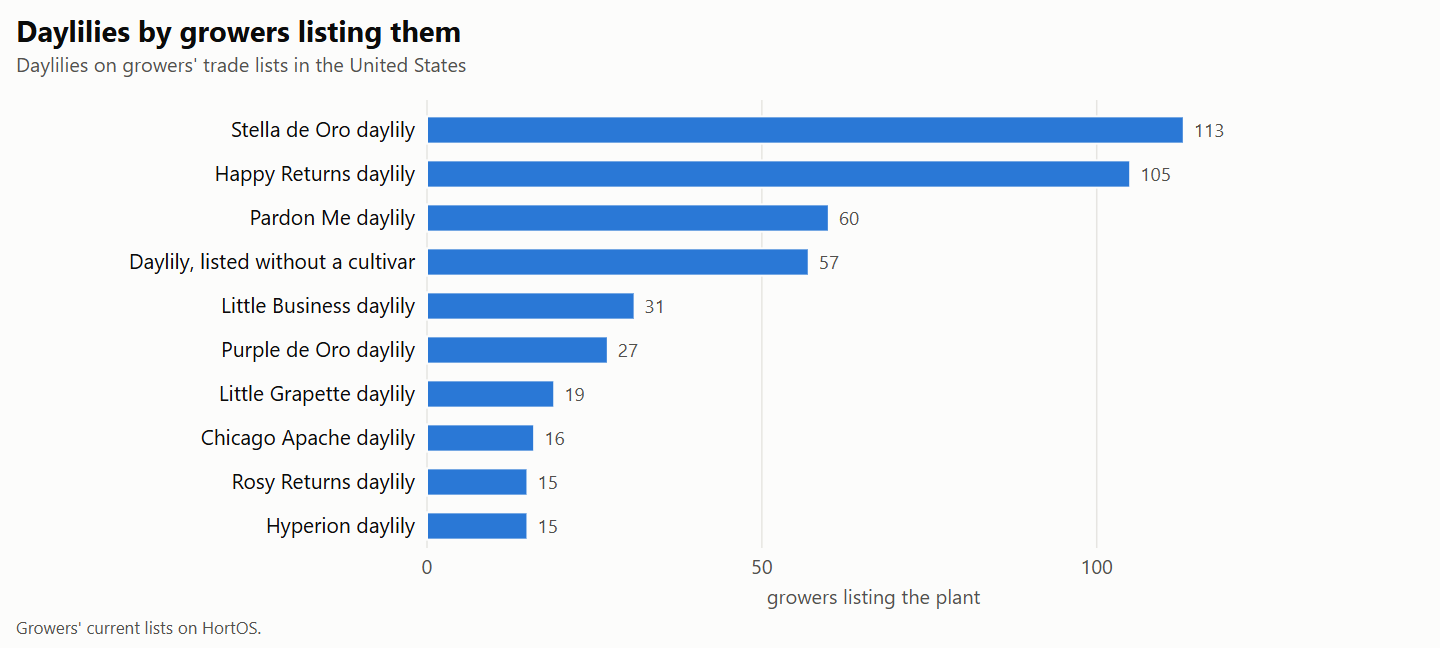
| Daylilies at growers | Stella de Oro daylily was listed by 113 growers on HortOS, and 62 growers priced the #1 container at a median trade price of $4.00, ex tax, freight not included. |
| Who decides | The U.S. Food and Drug Administration (2021) says an owner who suspects a cat has swallowed any part of a lily, its pollen or its vase water should immediately call a veterinarian or a pet poison control center. |
The three groups the FDA sorts lilies into
The U.S. Food and Drug Administration's page on lilies and cats, last marked current on September 16, 2021 and read for this guide in October 2026, sorts plants called lilies into three groups. Its table for the first group, the lilies it calls highly toxic for cats, names nine plants: eight true lilies and the daylily (U.S. FDA, 2021). The second group is lily of the valley and the gloriosa or flame lily, which the U.S. FDA (2021) calls very dangerous to cats and dogs. The third is the plants it treats as less harmful to cats and dogs: calla lily, peace lily and Peruvian lily (U.S. FDA, 2021).
The U.S. FDA (2021) ties its kidney warning to the first group alone. It says other plants with lily in their name are outside the true lily and daylily families and do not cause kidney failure in cats, though they may cause other serious problems (U.S. FDA, 2021). For the first group it says the toxin has not been identified and affects only cats, and that a dog that eats a lily may get a minor stomach upset but does not develop kidney failure (U.S. FDA, 2021).
The table sets out every plant the FDA page names, with its group and the outcome the page describes for a cat. None is left out, and three of the nine share a row. The FDA introduces the nine with the word include, and its warning is for the true lily and daylily families as a whole (U.S. FDA, 2021). The wording in the cells is this page's. The sorting is the FDA's (United States, 2021), not a finding by HortOS.
| Plant | FDA group (2021) | What the FDA says can happen to a cat (2021) |
|---|---|---|
| Asiatic lily, including hybrids | Highly toxic lilies for cats | Fatal kidney failure, developing in less than 3 days, from a small amount of leaf, petal, pollen or vase water |
| Easter lily (Lilium longiflorum) | Highly toxic lilies for cats | Fatal kidney failure, developing in less than 3 days, from a small amount of leaf, petal, pollen or vase water |
| Tiger lily | Highly toxic lilies for cats | Fatal kidney failure, developing in less than 3 days, from a small amount of leaf, petal, pollen or vase water |
| Stargazer lily | Highly toxic lilies for cats | Fatal kidney failure, developing in less than 3 days, from a small amount of leaf, petal, pollen or vase water |
| Japanese show lily, Oriental lily and Rubrum lily | Highly toxic lilies for cats | Fatal kidney failure, developing in less than 3 days, from a small amount of leaf, petal, pollen or vase water |
| Wood lily | Highly toxic lilies for cats | Fatal kidney failure, developing in less than 3 days, from a small amount of leaf, petal, pollen or vase water |
| Daylily (Hemerocallis species) | Highly toxic lilies for cats | Fatal kidney failure, developing in less than 3 days, from a small amount of leaf, petal, pollen or vase water |
| Lily of the valley | Other highly toxic plants called lilies, for cats and dogs | An abnormal heart rhythm that can be life-threatening |
| Gloriosa or flame lily | Other highly toxic plants called lilies, for cats and dogs | Serious multi-system organ failure if the roots or tubers are chewed |
| Calla lily | Less harmful plants called lilies, for cats and dogs | Mouth, tongue and throat irritation from calcium oxalate crystals; the signs usually clear up by themselves |
| Peace lily | Less harmful plants called lilies, for cats and dogs | Mouth, tongue and throat irritation from calcium oxalate crystals; the signs usually clear up by themselves |
| Peruvian lily | Less harmful plants called lilies, for cats and dogs | Mild stomach upset if a large amount is eaten; no kidney failure |
The U.S. FDA (2021) says peace lily and calla lily both contain insoluble calcium oxalate crystals, and that when a cat or dog chews the plant the crystals irritate its mouth, tongue, throat and esophagus. It says the signs usually clear up by themselves, and that breathing problems from swelling can occur but are uncommon (U.S. FDA, 2021).
Peruvian lily appears in both references. The U.S. FDA (2021) says it causes mild stomach upset if a cat or dog eats a large amount, does not cause kidney failure in cats, and can be mistaken for a small true lily. The ASPCA's plant list (United States, read October 2026) shows Peruvian lily (Alstroemeria) as non-toxic to dogs, cats and horses.
How the ASPCA plant list classes a plant
The second reference is the plant list kept by ASPCA Animal Poison Control. The ASPCA (United States, read October 2026) says the list gathers plants reported to affect an animal's whole body or to upset its gut severely. Each plant has its own entry under a common name, with a scientific name beside it, so it can be looked up by either (ASPCA, United States, read October 2026). The entry says which of dogs, cats and horses the plant is listed as toxic or non-toxic to (ASPCA, United States, read October 2026). The list for cats is one page in two parts, toxic plants first and non-toxic plants after (ASPCA, United States, read October 2026).
On that list, day lilies (Hemerocallis spp.) are shown as toxic to cats and non-toxic to dogs, and lily (Lilium species) as toxic to cats and non-toxic to dogs and horses (ASPCA, United States, read October 2026).
How many growers list each daylily
NC State Extension (North Carolina, read 2026) describes daylilies as clump-forming herbaceous perennials, native to Asia and central Europe, that are not in fact lilies. It gives the genus USDA hardiness zones 3a to 9b and says the old orange and yellow daylilies have been bred into numerous modern cultivars (NC State Extension, North Carolina, read 2026). UF/IFAS Extension (Florida, read 2026) says daylilies whose foliage goes dormant may not get enough winter chilling in central and south Florida to grow and bloom well.
That breeding shows in what growers list. The table has 20 rows: every daylily cultivar with a price page on HortOS, and one line for daylilies that growers list without a cultivar name. Daylily names that have no price page are not shown. Rows are sorted by the number of growers listing each one. Prices are medians across growers' current trade lists on HortOS: one price per grower, ex tax, freight not included, with the number of growers pricing each size in brackets. A count here is growers listing the plant, not how many plants exist or how well it suits a site. Anyone can see the prices on HortOS, and only the trade can order.
The growers listing the plants in this table are spread across many states; the most are in North Carolina, Oregon and Pennsylvania. The size shown for each plant is the container size most growers price; field grown lines are not counted.
The line with no cultivar name was listed by 57 growers, but only 9 priced the #1 container, so its median of $3.50 rests on those few. The medians for Chicago Apache, Ruby Stella, Siloam Double Classic, Cranberry Baby, Yangtze, Grape Ripples and Pandora's Box daylilies each rest on fewer than five growers, as the brackets show. One more price can move a median that thin.
These are national medians, not local prices. The # numbers in the size column are container classes, and the guide to nursery pot sizes sets out what each class means.
The FDA's table names the daylily as Hemerocallis species, the genus as a whole, and singles out no cultivar (United States, 2021). The U.S. FDA (2021) says it is best not to bring the lilies of its first group into a home with a cat, or to plant them where a household's or a neighbor's cat goes outside. That sentence is the FDA's. The table shows only how widely the daylily is listed, and HortOS rates no plant.
True lilies are listed too. Two that the FDA's table names (United States, 2021) have their own plant pages: Easter lily was listed by 2 growers on HortOS, and Stargazer lily by 5.
Plants on the non-toxic side of the ASPCA list, with grower figures
The non-toxic part of the ASPCA's list for cats runs to several hundred entries (United States, read October 2026). The table shows 7 of them, chosen for this page. Each has its own ASPCA entry, read for this page, and a price page on HortOS for the same species or genus. It is a selection, and several hundred entries are left out in all. The ASPCA's plant list (United States, read October 2026) shows every plant in the table as non-toxic to cats. Counts and medians are on the same basis as the daylily table.
| Plant | Growers listing it | Size most growers price | Median (growers pricing) |
|---|---|---|---|
| Cast iron plant (Aspidistra elatior) | 77 | #3 | $11.18 (46) |
| Coreopsis, tickseed (Coreopsis) | 66 | #1 | $3.63 (4) |
| Christmas fern (Polystichum acrostichoides) | 44 | #1 | $6.94 (12) |
| Western sword fern (Polystichum munitum) | 24 | #1 | $4.97 (4) |
| Rosemary (Rosmarinus officinalis) | 22 | #1 | $4.13 (8) |
| Scarlet sage (Salvia coccinea) | 18 | #1 | $3.38 (14) |
| Garden canna, canna lily (Canna x generalis) | 7 | #3 | $8.95 (3) |
The growers listing the plants in this table are spread across many states; the most are in Florida, Oregon and California. The size shown for each plant is the container size most growers price; field grown lines are not counted.
Some of these medians rest on few prices. Coreopsis was listed by 66 growers, but only 4 priced the #1 container. Western sword fern was priced in the #1 container by 4 growers, and garden canna in the #3 container by 3. These too are national medians, not local prices.
The names need care. The ASPCA rated coreopsis as a genus, Coreopsis spp., and the row here is the genus line, not one species (ASPCA, United States, read October 2026). Its Christmas fern entry is headed Christmas dagger, and its western sword fern entry is headed giant holly fern (ASPCA, United States, read October 2026).
NC State Extension (North Carolina, read 2026) says scarlet sage is a perennial in warm climates and an annual where winters fall below freezing, and lists it for USDA zones 8a to 10b. It lists garden canna for zones 8a to 11b, rosemary for zones 8a to 10b and cast iron plant for zones 7a to 11b (NC State Extension, North Carolina, read 2026). NC State Extension (North Carolina, read 2026) lists the two ferns for colder zones. Christmas fern, native to eastern North America, is listed for zones 3a to 9b, and western sword fern, native to western North America, for zones 5a to 9b (NC State Extension, North Carolina, read 2026).
What a grower count and a plant list leave out
A listing on HortOS says one thing: a grower lists the plant. It does not say what the plant was treated with at the nursery, or confirm that the pot holds the species or genus the ASPCA rated. Both are questions for the grower, and the guide to reading a wholesale availability list shows where the botanical name sits on a list line.
The daylily table is not a census: it holds only the daylily names that have a price page. A grower count is not a count of gardens either.
Cut flowers are outside the directory. The U.S. FDA (2021) notes that lilies are commonly seen in bouquets as well as in garden beds and borders, and names Easter and Mother's Day as the holidays it has in mind. NC State Extension (North Carolina, read 2026) says the Easter lily is mostly a potted plant, brought into flower in a greenhouse and sold as a decoration for the season. A bouquet or a potted gift lily can reach a cat without ever appearing on a wholesale grower's list.
Nothing here compares one daylily with another for a cat, and the grower figures carry no toxicity information of any kind. The ASPCA (United States, read October 2026) says its list is not all-inclusive, so a plant missing from it has not been rated there.
What to watch for
- Reading the word lily as the test. The U.S. FDA (2021) calls lily of the valley and the gloriosa lily very dangerous to cats and dogs, though neither is a true lily or a daylily. The ASPCA's plant list (United States, read October 2026) shows canna lily as non-toxic to cats.
- Leaving the daylily out because it is not a true lily. The FDA's table of the most dangerous lilies for cats names the daylily, as Hemerocallis species (United States, 2021).
- Using a dog owner's answer for a cat. The U.S. FDA (2021) says the toxin affects only cats. The ASPCA's plant list (United States, read October 2026) shows day lilies as toxic to cats and non-toxic to dogs.
- Thinking only of the leaves. The U.S. FDA (2021) says a few pollen grains licked off the fur, or a drink of the vase water, can cause fatal kidney failure in a cat.
- Reading non-toxic as harmless. The ASPCA (United States, read October 2026) says a dog or cat that eats plant matter of any kind may vomit and have an upset stomach. Of the plants it lists as non-toxic it says only that it does not expect them to threaten a pet's life (ASPCA, United States, read October 2026).
Getting it right
- List every plant in the house and yard that is called a lily or a daylily, or is labeled Lilium or Hemerocallis, the scientific names in the FDA's table (United States, 2021). Find the scientific name of each on the tag, the receipt or the grower's list line.
- Set each name against the FDA's three groups (United States, 2021) and against the ASPCA's entry for that plant (United States, read October 2026). Both pages can change, so note the date each was read.
- For a daylily or a true lily, read the FDA's own sentence on homes and gardens with cats (United States, 2021). The household decides where the plant goes, and a veterinarian can say what the warning means for a particular cat.
- For a plant that is on neither page, ask a veterinarian or a pet poison control center. The ASPCA (United States, read October 2026) says its list is not all-inclusive.
- Before ordering a plant from the last table, find the grower in the directory and ask for the botanical name on its list line. Check the hardiness zone with the state extension service. Each grower sets who it sells to, and the guide to buying from a wholesale grower covers the usual terms.
- If a cat may have eaten any part of a lily, its pollen or its vase water, the U.S. FDA (2021) says to call a veterinarian or a pet poison control center immediately. It suggests taking the plant, or a photo of it, so the veterinarian can tell whether it is one of the highly toxic lilies (U.S. FDA, 2021).
A word of caution
Every toxicity statement on this page is the U.S. Food and Drug Administration's (2021) or the ASPCA's (United States, read October 2026), and either page can change after the date it was read. HortOS rates no plant, and its grower counts and medians say nothing about what a plant does to an animal. A veterinarian or a pet poison control center decides what a cat needs. The grower answers for what is in the pot.
Sources
- U.S. Food and Drug Administration, Lovely Lilies and Curious Cats: A Dangerous Combination: the three groups, signs, timing.
- ASPCA Animal Poison Control, Toxic and Non-Toxic Plants List: what the list is.
- ASPCA Animal Poison Control, Toxic and Non-Toxic Plant List: Cats: the full list for cats.
- ASPCA, plant entry for day lilies (many varieties): the day lily listing.
- ASPCA, plant entry for lily (Lilium species): the true lily listing.
- ASPCA, plant entry for Peruvian lily: the Peruvian lily listing.
- ASPCA, plant entry for canna lily: the canna lily listing.
- ASPCA, plant entry for cast iron plant: the cast iron plant listing.
- ASPCA, plant entry for coreopsis: the coreopsis listing, by genus.
- ASPCA, plant entry for Christmas dagger: the Christmas fern listing.
- ASPCA, plant entry for giant holly fern: the western sword fern listing.
- ASPCA, plant entry for rosemary: the rosemary listing.
- ASPCA, plant entry for scarlet sage: the scarlet sage listing.
- NC State Extension Plant Toolbox, Hemerocallis: what a daylily is, zones.
- NC State Extension Plant Toolbox, Lilium longiflorum: Easter lily as a potted plant.
- NC State Extension Plant Toolbox, Salvia coccinea: scarlet sage zones and habit.
- NC State Extension Plant Toolbox, Canna x generalis: garden canna zones.
- NC State Extension Plant Toolbox, Salvia rosmarinus: rosemary habit and hardiness zones.
- NC State Extension Plant Toolbox, Aspidistra elatior: cast iron plant zones.
- NC State Extension Plant Toolbox, Polystichum acrostichoides: Christmas fern range and zones.
- NC State Extension Plant Toolbox, Polystichum munitum: western sword fern range, zones.
- University of Florida IFAS Extension, Daylilies for Florida: daylilies in Florida landscapes.
More guides

Nursery Pot Sizes Explained: Millimetres, Litres and Gallons
Australian growers name a pot by its rim diameter up to 400 mm and by its volume in litres above that, while American growers use gallon classes. This guide explains each step of the ladder, the approximate height and age behind it, how to convert between systems, and what the trade pays at every size.

Reading a Wholesale Availability List, and Pricing the Plants in a Bid
For landscape contractors, designers, estimators and students: what each column of a wholesale availability list means, how much the same plant at the same size varies between growers and states, how the low, median and high on the price pages are built, and how to carry the plant line of a bid from the list to the client.

Buying From a Wholesale Grower When You Are Not in the Trade
Native plant societies, watershed districts, land trusts, schools and church committees can buy from wholesale growers when they order like the trade: in quantity, ahead of the season, on the grower's terms. This page explains who sells to whom, resale certificates and exemptions, minimums and pooling, the sizes to buy, straight species and ecotype, lead times and shipping.