Bottomland hardwood reforestation in the South by flood tolerance
How the 2001 federal restoration guide and University of Arkansas extension rate bottomland oaks, bald cypress and other Southern floodplain trees for flooding, set beside the growers listing each tree on HortOS and trade medians for #3 and #15 containers. With a section on Louisiana swamp plantings and the federal reserve and easement rules.
Updated October 22, 2026. Figures are what the live us.hortosapp.com price and plant pages printed.
On this page
A woodland owner with a wetland easement in the Lower Mississippi valley has gaps to fill in a planted stand. The question is which trees are rated for the flooding on that ground, and which growers list them. The idea that matters most: a bottomland tree is chosen by how long it survives flooded soil in the growing season, and the federal restoration guide of 2001 sorts the trees into four classes on that measure.
This page draws on that guide, from the U.S. Geological Survey and the USDA Forest Service, and on the federal rules in 7 CFR parts 1410 and 1468. Its state sources are from Arkansas, Mississippi, Louisiana and Virginia. It adds figures from HortOS, a free directory of American wholesale plant growers with their published availability and trade prices: the growers listing each tree, and trade medians for two container sizes. It is not a planting plan and prices no bare-root seedling.
Quick facts
| The valley | Ducks Unlimited says the Mississippi Alluvial Valley once held 24.7 million acres of forested wetlands, and that about 80 percent of its forested land has been cleared (page read in October 2026). |
|---|---|
| The federal guide's four classes | A Guide to Bottomland Hardwood Restoration (2001), from the U.S. Geological Survey and the USDA Forest Service, rates trees of the Southeast tolerant, moderately tolerant, weakly tolerant or intolerant of flooding, by how long each survives saturated or flooded soil in the growing season. |
| The Arkansas scale | University of Arkansas extension calls a tree tolerant if it withstands 30 to 120 days in a row of flooding or saturated soil in the growing season, and intermediate if it survives up to 30 (Arkansas, page read in 2026). |
| Bare root and container | The 2001 federal guide says bare-root seedlings go in only while dormant, from December to the middle of March, and that container seedlings are the better choice on harsher sites or outside that season. |
| Easement cost share | Under 7 CFR 1468.36 (eCFR, current to 1 October 2026), on land under a permanent wetland reserve easement NRCS "will offer to pay at least 75 percent but not more than 100 percent" of the cost of the practices in the easement's plan of operations. |
| Nuttall oak at trade | 154 growers list Nuttall oak on HortOS. A #15 container has a median of $60 across 23 growers, one price per grower, ex tax. |
Flood tolerance on two scales
How each scale is defined
A Guide to Bottomland Hardwood Restoration, published in 2001 by the U.S. Geological Survey with the USDA Forest Service, covers the southeastern United States and, within it, the Lower Mississippi Alluvial Valley. Its Table 4.1 gives flood tolerance for 69 bottomland species. The key to that 2001 table defines four classes by flooding in the growing season:
- Tolerant. The tree lives and grows where soil stays saturated or flooded for long spells.
- Moderately tolerant. The tree survives several months of saturated or flooded soil, but many die if the flooding lasts or returns for several years running.
- Weakly tolerant. The tree survives a short spell, from a few days up to a few weeks, and many die if the water stays longer.
- Intolerant. The tree does not survive even a short spell of saturated or flooded soil.
The University of Arkansas extension page on flood impacts, undated and read in 2026, uses classes of its own for Arkansas. On that page a tolerant tree withstands 30 to 120 days in a row of flooding or saturated soil in the growing season, and an intermediate tree up to 30. The two scales are not one measure, and this page prints both without merging them.
Ducks Unlimited, on its Mississippi Alluvial Valley page read in October 2026, puts cherrybark oak and willow oak on higher ground that floods less. It puts overcup oak on low ground that floods often and long, and cypress and tupelo in sloughs that stay flooded. Mississippi State University Extension (2023) says a rise or fall of only 6 inches can alter which trees a Mississippi site suits.
The trees from the wettest ground to the driest
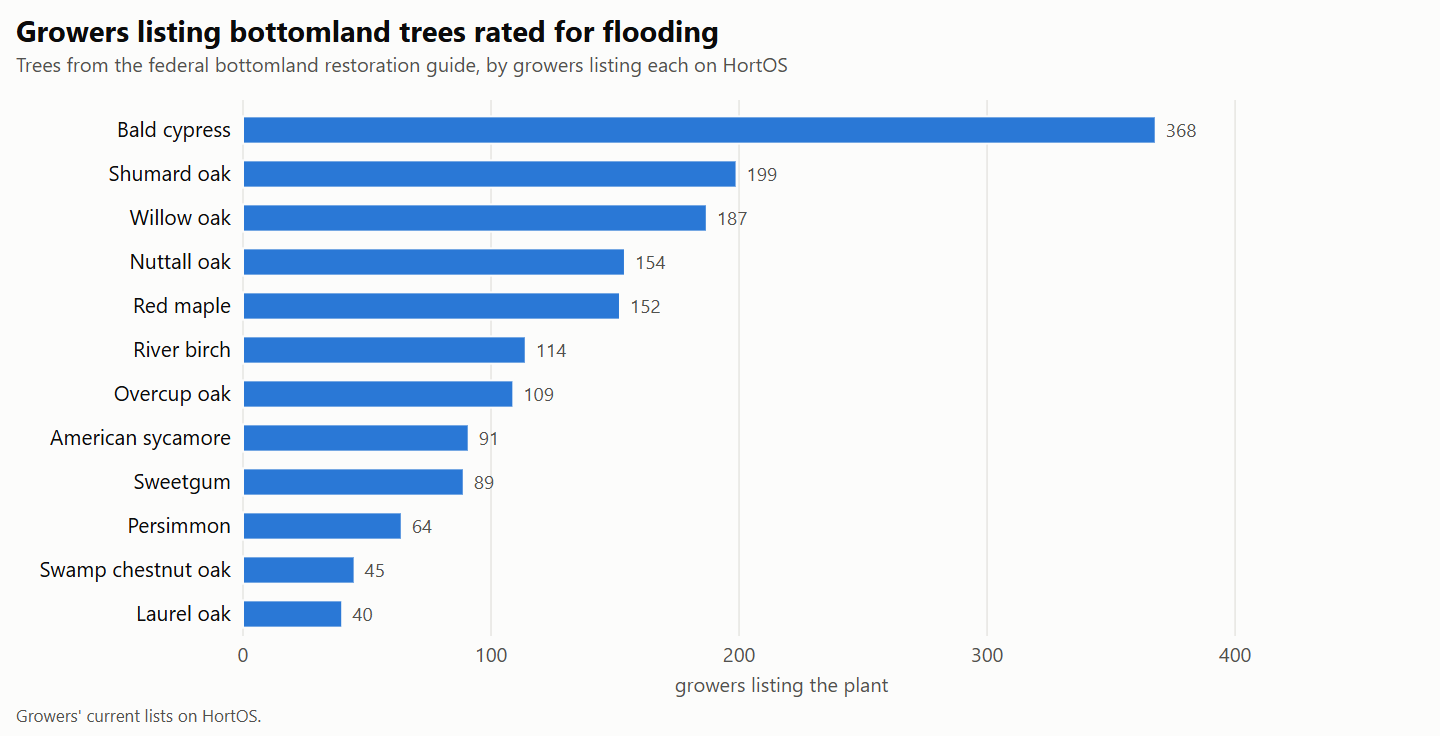
The first table sets beside both scales 19 species from the guide's Table 4.1 (2001) that growers list on HortOS. It is a selection: the guide rates 50 more species that are not shown. Rows run from the wettest ground to the driest. For bald cypress and water tupelo the first column gives what the guide's forest cover type notes say of the pair, and every other row carries the class Table 4.1 prints. "Not listed" in the Arkansas column means only that the page does not name the tree. Grower counts are the growers listing each plant on HortOS, in any size. A count here is growers listing the plant, not how many plants exist or how well it suits a site.
| Plant | Flood tolerance, USGS and Forest Service guide (2001) | Flood tolerance, University of Arkansas extension (read 2026) | Growers listing it | States with most growers |
|---|---|---|---|---|
| Bald cypress (Taxodium distichum) | Among the most tolerant of full flooding | Tolerant | 368 | Florida 163, Texas 48, Georgia 25 |
| Water tupelo (Nyssa aquatica) | Among the most tolerant of full flooding | Tolerant | 5 | North Carolina 2 |
| Black willow (Salix nigra) | Tolerant | Tolerant | 20 | Pennsylvania 5, North Carolina 3, Tennessee 3 |
| Overcup oak (Quercus lyrata) | Moderately tolerant | Tolerant | 109 | Georgia 19, Tennessee 18, North Carolina 17 |
| Water hickory (Carya aquatica) | Moderately tolerant | Not listed | 10 | Florida 6, Georgia 2 |
| Nuttall oak (Quercus texana) | Moderately tolerant | Tolerant | 154 | Florida 34, Georgia 24, North Carolina 18 |
| Persimmon (Diospyros virginiana) | Moderately tolerant | Tolerant | 64 | North Carolina 11, Florida 10, Tennessee 8 |
| Sugarberry (Celtis laevigata) | Moderately tolerant | Not listed | 17 | Florida 7, North Carolina 4, Pennsylvania 2 |
| Red maple (Acer rubrum) | Moderately tolerant | Tolerant | 152 | Florida 70, Tennessee 9 |
| Sweetgum (Liquidambar styraciflua) | Moderately tolerant | Tolerant | 89 | Florida 35, Tennessee 9, Texas 9 |
| American sycamore (Platanus occidentalis) | Moderately tolerant | Tolerant | 91 | Florida 33, North Carolina 11 |
| River birch (Betula nigra) | Moderately tolerant | Intermediate | 114 | Florida 25, North Carolina 12 |
| Willow oak (Quercus phellos) | Weakly to moderately tolerant | Tolerant | 187 | North Carolina 31, Florida 26, Georgia 22 |
| Water oak (Quercus nigra) | Weakly to moderately tolerant | Tolerant | 35 | Texas 12, Florida 7 |
| Laurel oak (Quercus laurifolia) | Weakly to moderately tolerant | Not listed | 40 | Florida 24, Texas 6, South Carolina 5 |
| Pecan (Carya illinoinensis) | Weakly tolerant | Tolerant | 28 | Texas 12, Florida 4, Tennessee 4 |
| Swamp chestnut oak (Quercus michauxii) | Weakly tolerant | Intermediate | 45 | Florida 8, Georgia 7, North Carolina 7 |
| Shumard oak (Quercus shumardii) | Weakly tolerant | Intermediate | 199 | Texas 48, Florida 35, Georgia 21 |
| Cherrybark oak (Quercus pagoda) | Weakly tolerant to intolerant | Intermediate | 14 | North Carolina 3, Georgia 3 |
The last column names the states with the most growers listing each plant, three at most, and stops where states tie for the next place.
Where the two columns differ
The two columns do not always agree: the 2001 guide rates pecan weakly tolerant, for one, and the Arkansas page, read in 2026, calls it tolerant. The 2001 guide also gives overcup oak and Nuttall oak one class, so other sources are what separate them. The NRCS plant guide for overcup oak (2000, edited 2003 and 2006) says the tree may dominate low flats in backwater and other ground commonly under water for 30 to 40 percent of the growing season. That federal plant guide also says Nuttall oak is often planted in overcup oak's place where flooding or stream flow has been reduced.
The 2001 guide also separates the trees to plant from the trees that arrive unaided. It says species likely to seed in from nearby do not need planting, or not in great numbers, and names sweetgum, sycamore and the common maples and elms. Most oaks and hickories, whose fruit is heavy, are the trees the 2001 guide says to plant.
Bare-root seedlings at scale and where containers fit
The 2001 guide names two main kinds of seedling: bare-root and container grown. It says bare-root seedlings cost less, weigh less and are easier to move and to plant, and that they go in only while dormant, from December to the middle of March. With a planting machine, the 2001 guide says, an experienced team of two or three may plant between 4,000 and 10,000 seedlings in a day.
The same 2001 guide prefers container seedlings on harsher sites and for planting outside the dormant season. It adds two cautions: a seedling grown in too small a pot is often root bound, and far fewer container seedlings are planted in a day.
A 2004 paper in Ecological Restoration reports a survey of Wetlands Reserve Program plantings in west-central Mississippi, made with one-year bare-root oak seedlings or sown acorns. More than 90 percent of the surveyed sites fell short of 100 woody stems per acre three years on. Seedlings did better than acorns, yet the land planted with seedlings reached the count on only 23 percent of its area. The program plantings in that 2004 survey were bare-root seedlings or sown acorns. This page prices container trees only.
Trade medians for two container sizes
The second table prices the same 19 trees, in the same order, at #3 and #15, two of the container classes explained in the guide to nursery pot sizes. Prices are medians across growers' current trade lists on HortOS: one price per grower, ex tax, freight not included, with the number of growers pricing each size in brackets. Anyone can see the prices on HortOS, and only the trade can order. A median needs three growers pricing a size, and a cell says so where there are fewer.
| Plant | Growers listing it | #3 median (growers pricing) | #15 median (growers pricing) |
|---|---|---|---|
| Bald cypress (Taxodium distichum) | 368 | $10.25 (46) | $59.25 (68) |
| Water tupelo (Nyssa aquatica) | 5 | Fewer than three growers | Fewer than three growers |
| Black willow (Salix nigra) | 20 | $20 (3) | Fewer than three growers |
| Overcup oak (Quercus lyrata) | 109 | $10 (8) | $62.50 (14) |
| Water hickory (Carya aquatica) | 10 | Fewer than three growers | Fewer than three growers |
| Nuttall oak (Quercus texana) | 154 | $12 (16) | $60 (23) |
| Persimmon (Diospyros virginiana) | 64 | $12 (14) | $66.38 (4) |
| Sugarberry (Celtis laevigata) | 17 | $8.07 (6) | Fewer than three growers |
| Red maple (Acer rubrum) | 152 | $10.50 (16) | $60 (20) |
| Sweetgum (Liquidambar styraciflua) | 89 | $11 (10) | $50 (10) |
| American sycamore (Platanus occidentalis) | 91 | $12 (14) | $60 (16) |
| River birch (Betula nigra) | 114 | $12.50 (9) | $65 (14) |
| Willow oak (Quercus phellos) | 187 | $11 (19) | $60 (35) |
| Water oak (Quercus nigra) | 35 | $9.75 (7) | $50 (3) |
| Laurel oak (Quercus laurifolia) | 40 | $8.00 (6) | Fewer than three growers |
| Pecan (Carya illinoinensis) | 28 | $10.97 (4) | $65 (3) |
| Swamp chestnut oak (Quercus michauxii) | 45 | $15 (11) | $60 (5) |
| Shumard oak (Quercus shumardii) | 199 | $12 (21) | $60 (30) |
| Cherrybark oak (Quercus pagoda) | 14 | Fewer than three growers | Fewer than three growers |
Most of the growers listing the plants in this table are in Florida, Texas and North Carolina.
Some of these medians rest on few growers. The #3 median for black willow, $20, rests on 3 growers and is the highest #3 figure in the table. The #15 median for persimmon, $66.38, rests on 4 growers. The #15 medians for water oak and pecan rest on 3 and 3 growers, and the #3 median for pecan on 4. Water tupelo, water hickory and cherrybark oak have no median at either size: 5, 10 and 14 growers list them, in that order.
These are whole-country medians, not prices in the Lower Mississippi valley. In the last column of the first table, no row names Arkansas, Louisiana or Mississippi among the states with the most growers. The hubs for Arkansas, Louisiana and Mississippi show who lists in each state. The guide to what trees cost at trade follows trees up the size ladder, past the two sizes priced here.
Swamp and coastal plantings in Louisiana
The forest cover type notes in the 2001 guide name bald cypress and water tupelo as the two trees that best withstand being fully under water. Growers' lists split the pair: 368 growers list bald cypress on HortOS and 5 list water tupelo, in any size.
Salt sets the seaward limit in these sources. The same cover type notes (2001) say bald cypress reaches the estuaries near the coast but seems unable to stand salinity above 0.89 percent salt, and that water tupelo does not survive brackish surface water. A 2024 paper in Ecological Restoration says mean soil salinity under 2.5 parts per thousand generally marks ground that may suit wetland trees, though such ground in coastal Louisiana can see spikes of 8 to 10.
That 2024 paper reports that a conservancy planted about 80,000 saplings in the Pontchartrain Estuary of Louisiana from 2011 to 2021, more than 80 percent of them bald cypress. Of the saplings assessed, 63 percent survived near the Caernarvon freshwater diversion and 82 percent on the Maurepas Landbridge. Each sapling was set in a tree protector against browsing animals.
Reserve contracts and wetland easements
The Wetlands Reserve Program named in the 2004 paper is now the Wetland Reserve Easement, part of the NRCS Agricultural Conservation Easement Program, the Lower Mississippi Valley Joint Venture says. The Farm Service Agency's practices library, read in October 2026, lists a second route, Conservation Reserve Program practice CP-31, under the title "Bottomland Timber Establishment on Wetlands". The third table gives the length and cost share the federal rules set. Its first row is from 7 CFR 1410.7 and 1410.21 and its easement rows from 7 CFR 1468.30 and 1468.36, as the eCFR showed them current to 1 October 2026. As current to 1 October 2026, the same two sections of 7 CFR part 1468 give a 30-year contract, on the 30-year easement's cost share, for land that Indian Tribes own.
| Program and option | Length | Share of practice cost the agency pays |
|---|---|---|
| Conservation Reserve Program, practice CP31 (bottomland timber on wetlands) | Contract of 10 to 15 years | Up to 50 percent |
| Wetland reserve easement, permanent | Perpetual | At least 75 and up to 100 percent |
| Wetland reserve easement, 30-year | 30 years | At least 50 and up to 75 percent |
The Farm Service Agency's CP31 fact sheet, as read in October 2026, says participants receive annual rental payments for 10 to 15 years and cost-share assistance of 50 percent toward establishment costs. It says the Farm Service Agency makes the final decision on who and what land is eligible.
NRCS in Louisiana, in its landowner guide of July 2019, said USDA pays 100 percent of the cost of restoring the wetland on a permanent easement. That 2019 Louisiana guide lists tree planting among the practices that may be used to restore the wetland. NRCS makes the offer on an easement, and its field office is where to ask what an offer covers.
What the directory and the sources leave open
A grower count says who lists a tree. It does not show a grower's seed source, whether a tree is the straight species or a selection, whether bare-root seedlings are also offered, how the tree was grown, the freight or the minimum order. Those are questions for the grower. The 2001 guide says it is best to get planting material as locally as possible, from a supplier whose seed came from a local source judged acceptable. A 2007 draft of the Virginia Department of Forestry's hardwood planting guidelines says to choose seedlings raised from seed gathered at, or close to, the latitude where they will be planted. The guide to buying from a wholesale grower covers how a buyer outside the trade asks about straight species and local ecotype.
The page rests on federal sources for the Southeast and its largest floodplain, and on state sources from Arkansas, Mississippi, Louisiana and Virginia only. Practice in other states is outside what they cover. The 2004 survey covers plantings in west-central Mississippi up to that year and nothing later. The page carries no bare-root seedling price, no field grown price and no price by state.
What to watch for
- Reading the two columns as one scale. "Tolerant" in the 2001 guide means long spells of flooding in the growing season; on the Arkansas page, read in 2026, it means 30 to 120 days in a row.
- Treating overcup oak and Nuttall oak as one choice. The 2001 guide gives them one class, but Ducks Unlimited and two NRCS documents put overcup oak at the wet end of the oaks.
- Planting what would arrive unaided. The 2001 guide says sweetgum, sycamore and the common maples are likely to seed in where a seed source is near, and that most oaks and hickories are the trees to plant.
- Taking a whole-country median for a local price. No median on this page is a Lower Mississippi valley price, and several rest on very few growers.
- Taking brackish ground for cypress ground. The 2001 guide's cover type notes put the limit for bald cypress at 0.89 percent salt.
Getting it right
- Find out how long the ground floods in the growing season, and map its low and high spots. Mississippi State University Extension (2023) says a 6-inch difference in height can alter which trees suit a site.
- Read each tree against both columns of the first table, and note where the 2001 guide and the Arkansas page differ.
- Ask the program office before choosing trees. NRCS decides what it will offer to pay toward on an easement, and the Farm Service Agency decides eligibility for practice CP31.
- Choose bare-root or container by season and site. The 2001 guide gives December to mid-March for bare-root seedlings, and prefers containers on harsher sites and outside that season.
- Ask each grower where the seed was collected, whether the tree is the straight species, what the minimum order is and what freight will cost.
A word of caution
The flood classes on this page are those of the 2001 U.S. Geological Survey and Forest Service guide and of the University of Arkansas extension page read in 2026. Neither places a tree on a particular site, and a consulting forester or the NRCS field office is who to ask about one. Program terms are from 7 CFR parts 1410 and 1468 as current to 1 October 2026, and the Farm Service Agency and NRCS decide what applies to a tract. Grower counts and medians are what HortOS showed, and they move as growers update their lists.
Sources
- U.S. Geological Survey and USDA Forest Service, A Guide to Bottomland Hardwood Restoration (2001): flood classes, seedlings, planting methods.
- University of Arkansas Division of Agriculture Cooperative Extension Service, Arkansas Flood Impacts: flood tolerance classes of trees.
- Ducks Unlimited, Mississippi Alluvial Valley: the valley, clearing, oaks by flooding.
- Mississippi State University Extension, Bottomland Hardwood Management Species/Site Relationships (2023): trees by floodplain position.
- USDA NRCS, Plant Guide, Overcup Oak (Quercus lyrata): overcup oak sites and flooding.
- Clemson OPEN record, Recognizing and Overcoming Difficult Site Conditions for Afforestation of Bottomland Hardwoods, Ecological Restoration (2004): how program plantings performed.
- Swamp Reforestation in Coastal Louisiana, USA Exposes Landscape Scale Differences in Survival and Growth Across Two Hydrologically Restored Regions, Ecological Restoration (2024): cypress and tupelo plantings.
- USDA Farm Service Agency, Practices Library for the Conservation Reserve Program: the practice named CP-31.
- USDA Farm Service Agency, Conservation Reserve Program fact sheet CP31: payments, eligibility, obligations.
- 7 CFR part 1410, Conservation Reserve Program (eCFR): contract length and cost share.
- 7 CFR part 1468, Agricultural Conservation Easement Program (eCFR): wetland reserve easement terms.
- USDA NRCS, Louisiana, Understanding NRCS Wetland Reserve Easements (2019): how an easement works.
- Lower Mississippi Valley Joint Venture, Wetland Reserve Easements: the program and its former name.
- Virginia Department of Forestry, Hardwood Tree Planting Guidelines, draft of July 6, 2007: seed source for seedlings.
More guides

Nursery Pot Sizes Explained: Millimetres, Litres and Gallons
Australian growers name a pot by its rim diameter up to 400 mm and by its volume in litres above that, while American growers use gallon classes. This guide explains each step of the ladder, the approximate height and age behind it, how to convert between systems, and what the trade pays at every size.

What a Tree Costs at the Nursery, by Container Size and Caliper
A tree has a knowable wholesale price before freight, planting and margin are added, and the container size sets it far more than the species does. This page gives the trade prices for seven widely grown American trees at every size three or more growers publish, with the sizing rules behind them.

Buying From a Wholesale Grower When You Are Not in the Trade
Native plant societies, watershed districts, land trusts, schools and church committees can buy from wholesale growers when they order like the trade: in quantity, ahead of the season, on the grower's terms. This page explains who sells to whom, resale certificates and exemptions, minimums and pooling, the sizes to buy, straight species and ecotype, lead times and shipping.